If your second graders freeze when they see 47 + 28 or make wild guesses on subtraction problems, you’re not alone. Building fluency with two-digit addition and subtraction is one of the biggest challenges in second grade math. The good news? With the right strategies and systematic practice, your students can master these skills and build the number sense they’ll need for years to come.
Key Takeaway
Second grade addition and subtraction fluency develops through place value understanding, multiple strategies, and scaffolded practice that moves from concrete to abstract thinking.
Why Number & Operations in Base Ten Matters in Second Grade
The CCSS.Math.Content.2.NBT.B.5 standard requires students to fluently add and subtract within 100 using strategies based on place value, properties of operations, and the relationship between addition and subtraction. This isn’t just about memorizing algorithms — it’s about developing deep number sense that will support all future math learning.
Research from the National Council of Teachers of Mathematics shows that students who understand multiple strategies for addition and subtraction perform significantly better on standardized assessments and show greater mathematical reasoning skills. By second grade, students should move beyond counting by ones to use place value strategies like decomposing numbers, making tens, and using the relationship between addition and subtraction.
This standard typically appears in the second quarter of second grade, after students have mastered place value concepts through 100. It builds directly on first grade addition and subtraction within 20 and prepares students for multi-digit arithmetic in third grade.
Looking for a ready-to-go resource? I put together a differentiated 2nd grade addition and subtraction pack that covers everything below — but first, the teaching strategies that make it work.
Common Addition & Subtraction Misconceptions in 2nd Grade
Common Misconception: Students subtract the smaller digit from the larger digit in each place value position (e.g., 52 – 27 = 35 because 7 – 2 = 5).
Why it happens: They apply the “always subtract smaller from larger” rule without understanding place value or borrowing.
Quick fix: Use base-ten blocks to model regrouping and emphasize that we’re working with tens and ones, not just individual digits.
Common Misconception: Students add or subtract from left to right like reading (e.g., 34 + 28 becomes 30 + 20 = 50, then 4 + 8 = 12, final answer 5012).
Why it happens: They transfer reading patterns to math without understanding place value alignment.
Quick fix: Always model problems vertically with clear place value columns and use place value language consistently.
Common Misconception: Students think addition and subtraction are completely separate operations with no relationship.
Why it happens: They memorize procedures without understanding the inverse relationship.
Quick fix: Teach fact families together and use number lines to show how addition and subtraction move in opposite directions.
Common Misconception: Students believe they must regroup in every subtraction problem, even when it’s not necessary.
Why it happens: Over-application of the regrouping procedure they’ve recently learned.
Quick fix: Present mixed problems and have students predict whether regrouping is needed before solving.
5 Research-Backed Strategies for Teaching Addition & Subtraction
Strategy 1: Base-Ten Block Modeling for Concrete Understanding
Start with concrete manipulatives to build place value understanding before moving to abstract algorithms. Base-ten blocks make regrouping visible and logical for students who struggle with the concept.
What you need:
- Base-ten blocks (units, rods, flats)
- Place value mats
- Recording sheets
Steps:
- Model the first number using base-ten blocks on a place value mat
- For addition: add the second number’s blocks, trading 10 units for 1 rod when needed
- For subtraction: remove blocks from the first number, trading 1 rod for 10 units when necessary
- Record each step numerically as you manipulate the blocks
- Have students explain their thinking using place value language
Strategy 2: Number Line Jumps for Visual Strategy Building
Open number lines help students visualize addition and subtraction as movement and develop flexible thinking about numbers. This strategy particularly supports students who think spatially.
What you need:
- Large number line (0-100) or open number lines
- Different colored markers
- Individual student number lines
Steps:
- Start at the first number on the number line
- For addition: make jumps forward by tens, then by ones
- For subtraction: make jumps backward by tens, then by ones
- Record each jump with an arc and label it
- Discuss efficient jumping strategies (jumping by 10 vs. jumping by 1)
Strategy 3: Expanded Form Decomposition
Teaching students to break numbers into tens and ones before operating builds place value understanding and creates a bridge to standard algorithms.
What you need:
- Expanded form recording sheets
- Place value charts
- Colored pencils for tens and ones
Steps:
- Write both numbers in expanded form (47 = 40 + 7)
- Add or subtract the tens separately from the ones
- Combine the results (40 + 20 = 60, 7 + 8 = 15, so 60 + 15 = 75)
- Check the answer using a different strategy
- Gradually move toward more efficient notation
Strategy 4: Making Ten Strategy for Mental Math
This strategy builds on students’ fluency with combinations that make 10 and helps them develop mental math skills that transfer to larger numbers.
What you need:
- Ten frames
- Two-color counters
- Making ten recording sheets
Steps:
- Identify which addend is closer to a multiple of 10
- Determine how much is needed to reach the next ten
- “Borrow” that amount from the other addend
- Add the remaining amount to the new multiple of 10
- Practice with multiple examples to build automaticity
Strategy 5: Fact Family Triangles for Addition-Subtraction Connections
Help students see the relationship between addition and subtraction by working with fact families systematically. This builds algebraic thinking and provides a checking strategy.
What you need:
- Fact family triangle cards
- Dry erase boards
- Fact family recording sheets
Steps:
- Present a fact family triangle with three related numbers
- Generate all four related equations (two addition, two subtraction)
- Practice covering different numbers to create missing addend problems
- Use fact families to check addition with subtraction and vice versa
- Connect to word problems that use the same number relationships
How to Differentiate Addition & Subtraction for All Learners
For Students Who Need Extra Support
Begin with numbers within 50 and ensure mastery of basic addition facts within 20. Provide base-ten blocks for every problem initially, and use consistent place value language. Focus on one strategy at a time and provide plenty of guided practice. Consider using number lines with benchmarks marked (multiples of 10) and allow extra time for manipulative exploration. Review prerequisite skills like counting by tens and place value identification regularly.
For On-Level Students
Work with the full range of numbers within 100 as specified in CCSS.Math.Content.2.NBT.B.5. Introduce multiple strategies and encourage students to choose the most efficient method for each problem. Provide a mix of horizontal and vertical problems, and include word problems that require students to determine the operation needed. Practice should include both computation and explaining mathematical reasoning.
For Students Ready for a Challenge
Extend to three-digit numbers or problems with multiple steps. Introduce algebraic thinking with missing addend problems (__ + 37 = 85). Have students create their own word problems and explain why they chose specific strategies. Explore patterns in addition and subtraction, such as what happens when you add 9 vs. 10, or investigate the commutative property with concrete examples.
A Ready-to-Use Addition & Subtraction Resource for Your Classroom
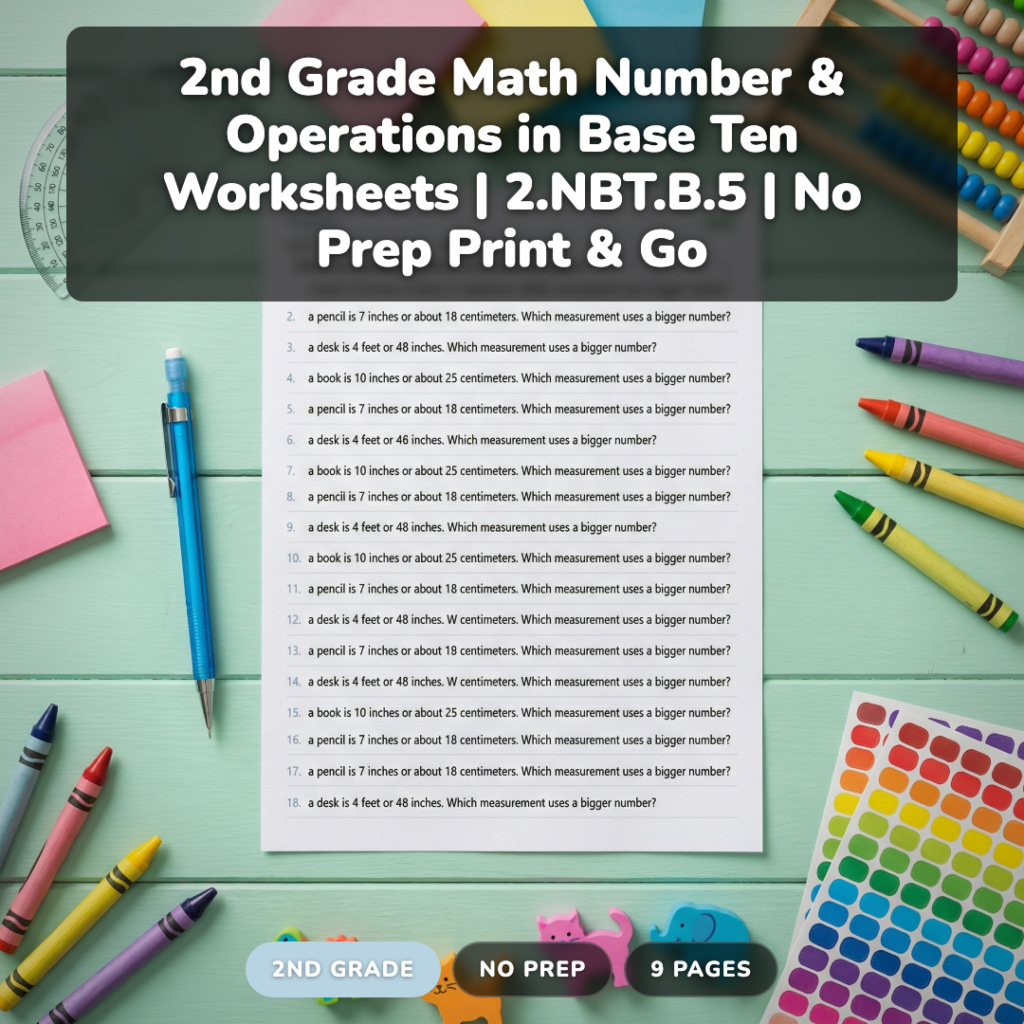
After teaching these strategies for years, I created a comprehensive resource that takes the guesswork out of differentiated practice. This 2nd Grade Number & Operations in Base Ten pack includes 106 carefully crafted problems across three difficulty levels, so every student gets appropriately challenging practice.
The resource includes 30 practice problems for students who need extra support, 40 on-level problems that align perfectly with grade-level expectations, and 36 challenge problems for advanced learners. Each level focuses on different aspects of the standard — from basic two-digit addition with regrouping to complex subtraction and missing addend problems. Answer keys are included for quick checking, and the problems are designed to spiral through all the strategies covered above.
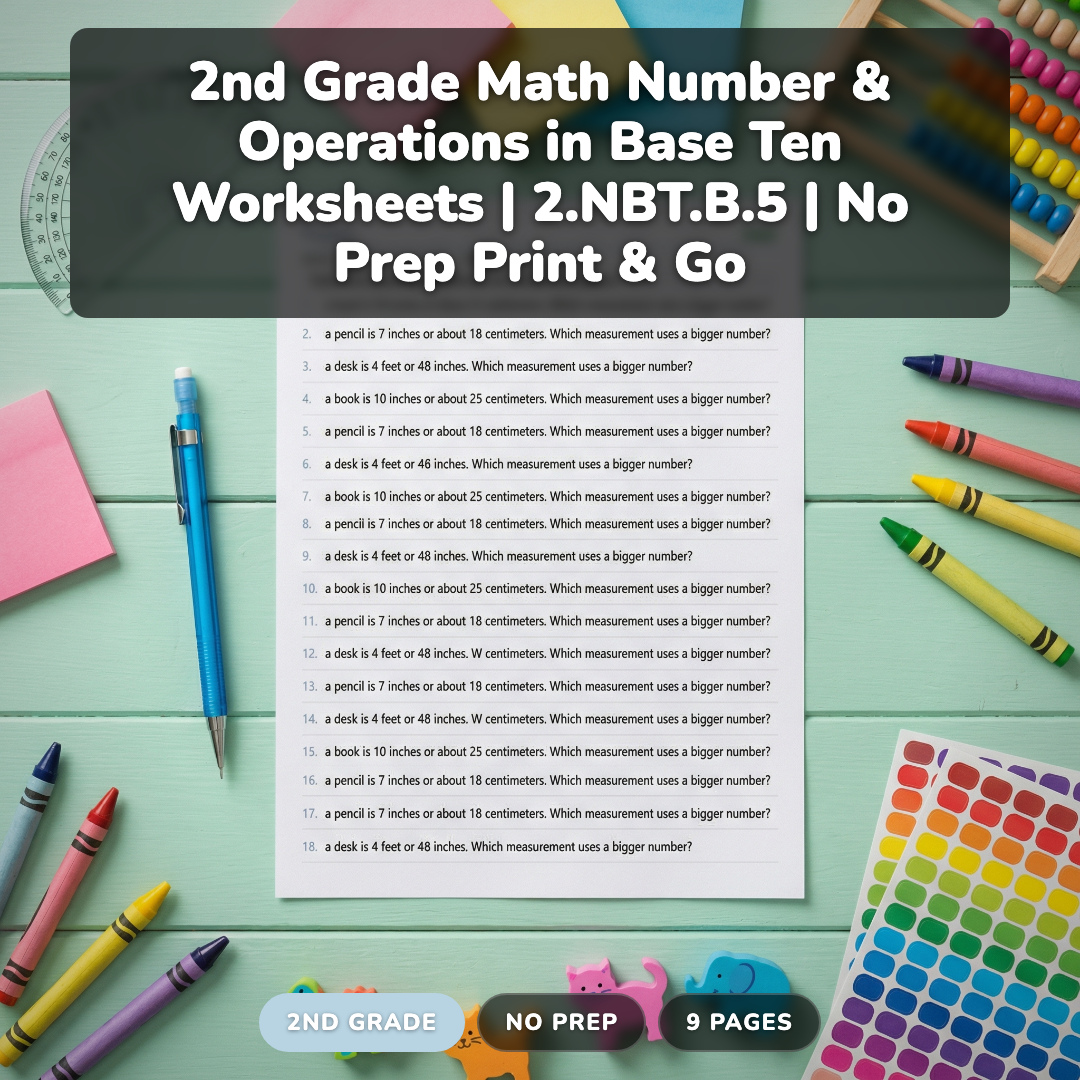
What makes this different from other worksheets is the intentional progression and variety. Students aren’t just practicing the same type of problem repeatedly — they’re building fluency across multiple strategies and problem types, which is exactly what the research shows leads to lasting understanding.
Grab a Free Addition & Subtraction Sample to Try
Want to see how these strategies work in practice? I’ve created a free sample pack with one page from each difficulty level, plus a strategy reference sheet you can use with your students. Drop your email below and I’ll send it right over.
Frequently Asked Questions About Teaching 2nd Grade Addition & Subtraction
When should students stop using manipulatives for addition and subtraction?
Students should transition away from manipulatives gradually as they develop number sense, typically by mid-second grade. However, some students may need concrete support longer, and manipulatives should always be available for complex problems or when introducing new concepts.
How do I know if my students are ready for the standard algorithm?
Students are ready for the standard algorithm when they understand place value, can explain regrouping with manipulatives, and have fluency with basic addition facts. Rushing to the algorithm without conceptual understanding often leads to procedural errors and math anxiety.
What’s the difference between fluency and speed in math?
Fluency includes accuracy, efficiency, and flexibility — not just speed. A fluent student can solve 47 + 28 accurately using an efficient strategy and explain their thinking. Speed without understanding isn’t fluency and can actually hinder mathematical development.
How much practice do students need to develop fluency with two-digit operations?
Research suggests students need distributed practice over several months rather than intensive drill sessions. Daily practice with 5-10 problems using varied strategies is more effective than worksheet packets completed quickly. Quality practice with feedback trumps quantity every time.
Should I teach multiple strategies or focus on one method?
Teaching multiple strategies builds deeper number sense and gives students options when one method doesn’t work. CCSS.Math.Content.2.NBT.B.5 specifically mentions using strategies based on place value, properties of operations, and addition-subtraction relationships, indicating students should know several approaches.
Building fluency with addition and subtraction within 100 sets the foundation for all future math learning. When students understand place value deeply and can use multiple strategies flexibly, they’re prepared for the multi-digit operations and algebraic thinking that comes next. Remember to celebrate progress, provide plenty of practice opportunities, and keep the focus on understanding rather than just getting right answers.
What’s your go-to strategy for helping students who struggle with regrouping? I’d love to hear what works in your classroom! And don’t forget to grab that free sample pack above — it’s a great way to try these strategies with your students.