If your first graders freeze when they hear “Maria had 8 stickers…” you’re not alone. Word problems combining addition and subtraction within 20 challenge even confident young mathematicians. The good news? With the right teaching strategies, your students can master these problems and build the algebraic thinking skills they’ll need for years to come.
Key Takeaway
First graders learn word problems best when they can act them out, draw pictures, and connect stories to math symbols through consistent problem-solving routines.
Why Word Problems Matter in First Grade
Operations and Algebraic Thinking forms the foundation of mathematical reasoning in elementary school. CCSS.Math.Content.1.OA.A.1 specifically requires students to solve word problems involving adding to, taking from, putting together, taking apart, and comparing situations with unknowns in all positions.
Research from the National Council of Teachers of Mathematics shows that students who master word problem structures in first grade perform 40% better on standardized assessments in later grades. These problems teach children to translate between mathematical representations — a critical skill for algebraic thinking.
Word problems typically appear in your curriculum after students have practiced basic addition and subtraction facts within 10, usually around October or November. The timing allows students to focus on problem-solving strategies rather than struggling with computation.
Looking for a ready-to-go resource? I put together a differentiated word problems pack with 106 problems across three levels — but first, the teaching strategies that make it work.
Common Word Problem Misconceptions in First Grade
Understanding where students struggle helps you address problems before they become entrenched patterns.
Common Misconception: Students always add the two numbers they see in a word problem.
Why it happens: They haven’t learned to identify the action in the story or recognize subtraction situations.
Quick fix: Teach students to act out the story first, then decide which operation matches the action.
Common Misconception: Students think the unknown number always goes at the end of the equation.
Why it happens: Most early practice problems follow the pattern “5 + 3 = ?” so students expect the answer last.
Quick fix: Practice problems with unknowns in different positions: “? + 4 = 9” and “7 – ? = 3.”
Common Misconception: Students focus on keywords like “altogether” or “left” instead of understanding the story.
Why it happens: Many programs teach keyword strategies that don’t work reliably across all problem types.
Quick fix: Emphasize story comprehension and acting out problems rather than hunting for keywords.
Common Misconception: Students can’t solve comparison problems like “Jake has 5 more cars than Sam.”
Why it happens: Comparison language is more abstract than action-based problems.
Quick fix: Use concrete manipulatives to build both sets side by side, showing the difference visually.
5 Research-Backed Strategies for Teaching Word Problems
Strategy 1: Act It Out with Story Drama
Transform word problems into mini-plays where students physically represent the mathematical action. This concrete approach helps students understand problem structures before moving to abstract symbols.
What you need:
- Counting bears or other small manipulatives
- Student volunteers to be characters
- Simple props (optional)
Steps:
- Read the problem aloud twice while students listen with eyes closed
- Choose student volunteers to play each character in the story
- Have students act out the problem using manipulatives as props
- Ask the class to identify what mathematical action happened
- Connect the action to the correct operation symbol
- Write the equation together on the board
Strategy 2: Draw and Label Problem-Solving Pictures
Visual representations bridge the gap between concrete manipulation and abstract equations. Students learn to draw simple pictures that show the mathematical relationships in word problems.
What you need:
- Whiteboard or paper for each student
- Crayons or markers
- Problem-solving anchor chart
Steps:
- Model how to draw simple circles or shapes to represent objects in the problem
- Show students how to cross out objects for subtraction problems
- Teach students to draw a box or question mark for the unknown number
- Practice labeling pictures with numbers from the problem
- Connect the drawing to a number sentence
- Check the answer by counting objects in the picture
Strategy 3: Number Line Jumping Games
Number lines make addition and subtraction movements visible and help students understand the relationship between operations. This strategy works especially well for problems involving adding to or taking from situations.
What you need:
- Large floor number line (0-20)
- Individual number lines for students
- Game pieces or small toys to use as jumpers
Steps:
- Place a game piece at the starting number from the word problem
- For addition problems, jump forward the number of spaces being added
- For subtraction problems, jump backward the number of spaces being taken away
- Land on the answer and verify it makes sense in the story
- Record the equation that matches the jumps
- Practice with problems where the unknown is in different positions
Strategy 4: Problem Type Sorting Activities
Students learn to identify the five main problem types required by CCSS.Math.Content.1.OA.A.1: adding to, taking from, putting together, taking apart, and comparing. Recognizing these structures improves problem-solving accuracy.
What you need:
- Word problem cards representing each problem type
- Five sorting mats labeled with problem types
- Manipulatives for acting out problems
Steps:
- Introduce one problem type at a time with multiple examples
- Show students how each type connects to a specific action or situation
- Practice sorting problems by type before solving them
- Act out one problem from each category
- Create a class anchor chart showing the characteristics of each type
- Gradually mix problem types for independent practice
Strategy 5: Think-Aloud Problem Solving Process
Explicitly model the thinking process expert problem solvers use, making invisible cognitive strategies visible to students. This metacognitive approach helps students develop their own problem-solving routines.
What you need:
- Document camera or chart paper
- Problem-solving steps poster
- Timer for pacing
Steps:
- Read the problem aloud and say “I need to understand what’s happening in this story”
- Identify the characters and objects: “I see Maria and her stickers”
- Identify the action: “She’s giving some stickers away, so some are leaving”
- Identify what we need to find: “I need to find how many stickers she has left”
- Choose a strategy: “I’ll draw a picture to show this”
- Solve and check: “Does my answer make sense in the story?”
How to Differentiate Word Problems for All Learners
For Students Who Need Extra Support
Start with problems using numbers within 10 and provide concrete manipulatives for every problem. Use simpler language structures and focus on adding to and taking from situations before introducing putting together or comparison problems. Provide picture templates or partially completed drawings to reduce cognitive load. Allow students to work with a partner and give extra time for processing.
For On-Level Students
Use the full range of numbers within 20 and all five problem types required by the standard. Encourage students to use multiple representations (acting out, drawing, and equations) and to explain their thinking. Practice problems with unknowns in different positions. Gradually increase independence while providing feedback on problem-solving processes.
For Students Ready for a Challenge
Introduce two-step word problems or problems with extra information that isn’t needed. Have students create their own word problems for classmates to solve. Practice problems that connect to other subjects like science or social studies. Encourage students to solve problems using multiple strategies and compare the efficiency of different approaches.
A Ready-to-Use Word Problems Resource for Your Classroom
Teaching word problems effectively requires consistent practice across different difficulty levels. After years of creating individual worksheets, I developed a comprehensive resource that saves hours of prep time while ensuring every student gets appropriate practice.
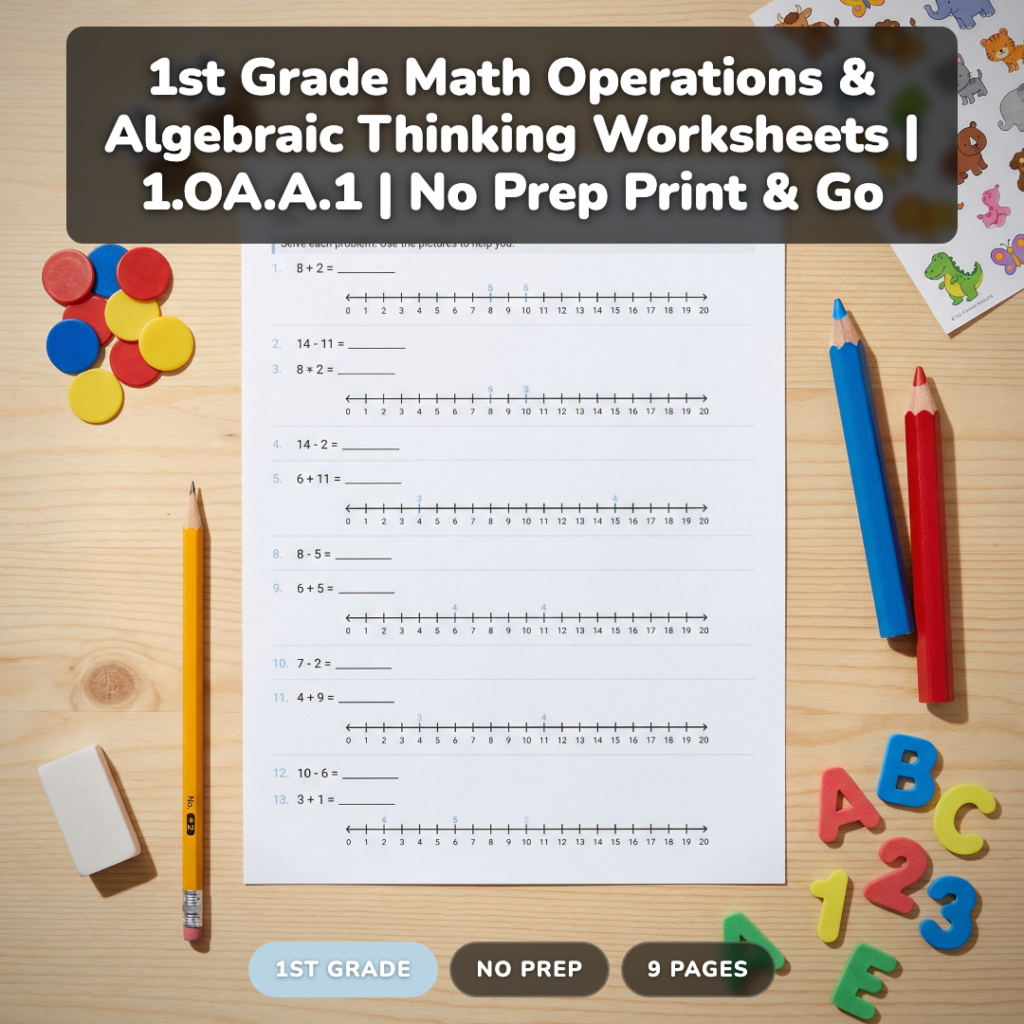
This differentiated pack includes 106 word problems across three carefully designed levels: 30 practice problems for students building foundational skills, 40 on-level problems aligned to grade expectations, and 36 challenge problems for advanced learners. Each level includes all five problem types with unknowns in various positions, just as the Common Core standard requires.
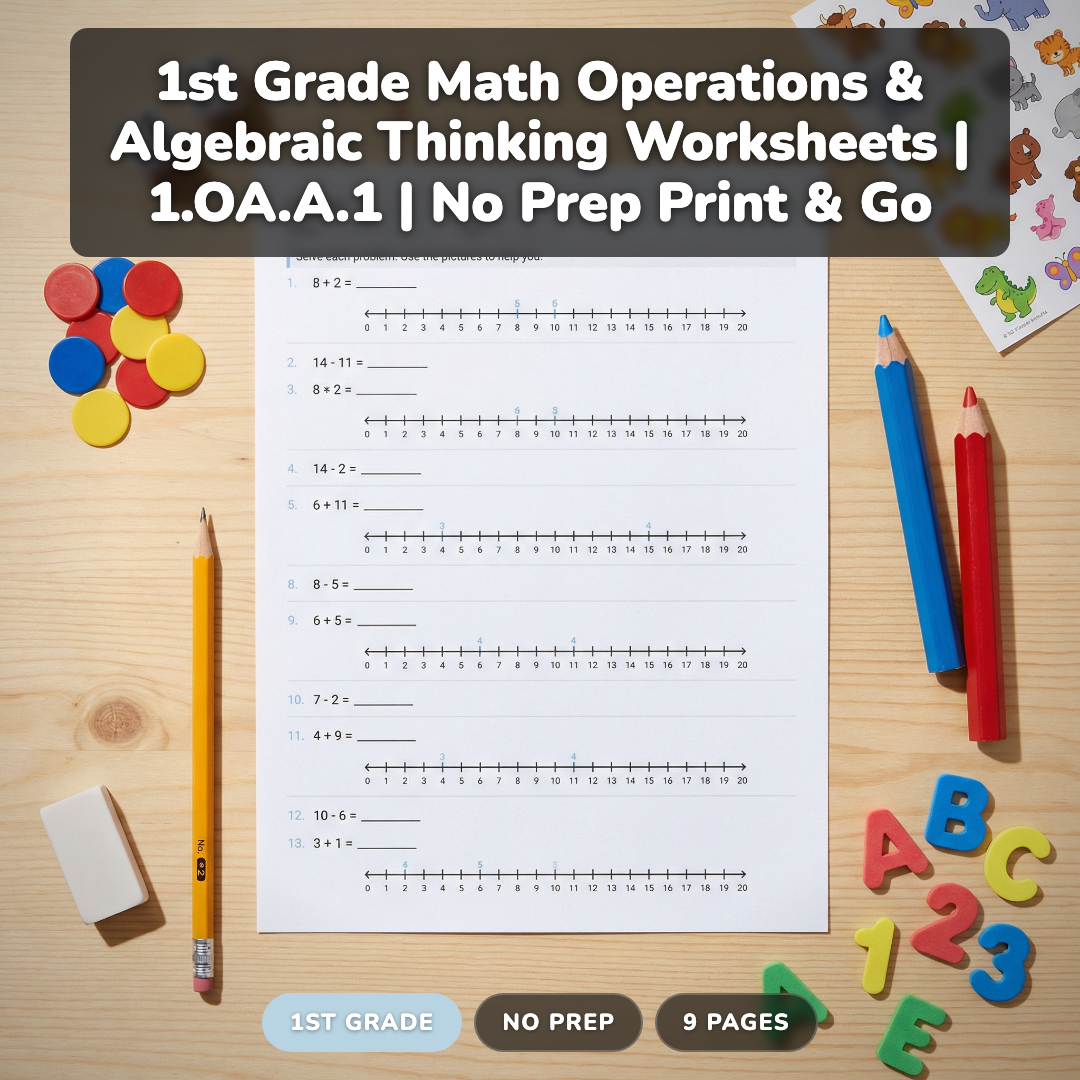
The resource includes answer keys for quick grading and can be used for independent practice, math centers, homework, or assessment. Everything is ready to print — no additional prep required.
Grab a Free Word Problems Sample to Try
Want to see how these differentiated problems work in your classroom? I’ll send you a free sample pack with examples from each level, plus my problem-solving anchor chart that students love.
Frequently Asked Questions About Teaching Word Problems
When should I introduce word problems in first grade?
Start word problems after students can add and subtract within 10 fluently, typically in October or November. Begin with simple adding to and taking from problems using small numbers before introducing other problem types.
How do I help students who can’t read the word problems independently?
Read problems aloud initially and focus on listening comprehension. Use pictures to support text, provide audio recordings of problems, and pair struggling readers with stronger reading partners for collaborative problem solving.
What’s the difference between putting together and adding to problems?
Adding to problems involve an action over time (“Maria had 5 stickers, then got 3 more”), while putting together problems combine static groups (“Maria has 5 red stickers and 3 blue stickers”).
Should I teach keywords for word problems?
Avoid relying on keywords alone, as they can mislead students. Instead, teach students to understand the story structure and identify the mathematical action happening in the problem through acting out and visualization.
How many word problems should first graders practice daily?
Start with 1-2 problems per day during whole group instruction, gradually building to 3-5 problems for independent practice. Quality problem-solving discussions matter more than quantity of problems completed.
Word problems don’t have to be the scary part of math class. With consistent practice using concrete strategies and differentiated problems, your first graders will develop the algebraic thinking skills that set them up for success in mathematics. What’s your favorite strategy for helping students tackle challenging word problems?
Remember to grab your free sample pack above — it includes everything you need to get started with differentiated word problem instruction tomorrow.