If your first graders freeze when they see a word problem, you’re not alone. Many students can add numbers just fine, but throw in a story context and suddenly they’re lost. The good news? With the right strategies, you can help your students become confident word problem solvers who actually enjoy the challenge.
Key Takeaway
First grade word problems require explicit instruction in both problem-solving strategies and mathematical language — students need to learn how to find the math hiding in the words.
Why Word Problems Matter in First Grade
Word problems aren’t just math practice — they’re critical thinking exercises that help students see math in their everyday world. Standard CCSS.Math.Content.1.OA.A.2 specifically asks students to solve addition word problems with three whole numbers whose sum is 20 or less, using objects, drawings, and equations with unknown symbols.
This standard bridges concrete and abstract thinking. Research from the National Council of Teachers of Mathematics shows that students who master word problems early develop stronger number sense and algebraic reasoning skills. They learn to translate between different mathematical representations — a skill that becomes crucial in higher grades.
The timing matters too. First grade is when students transition from counting-based strategies to more efficient addition strategies. Word problems provide the perfect context for this growth, giving meaning to mathematical operations and helping students understand when and why to add.
Looking for a ready-to-go resource? I put together a differentiated word problems pack that covers everything below — but first, the teaching strategies that make it work.
Common Word Problem Misconceptions in First Grade
Common Misconception: Students add all numbers they see without reading the problem.
Why it happens: They’ve learned that word problems usually mean “do math” but haven’t learned to analyze what the problem is actually asking.
Quick fix: Teach them to circle the question and underline key information before solving.
Common Misconception: Students think they need to add numbers in the order they appear in the problem.
Why it happens: They’re reading left to right and processing numbers sequentially rather than understanding the problem structure.
Quick fix: Use manipulatives to act out problems so they see that order doesn’t matter in addition.
Common Misconception: Students struggle when the unknown is in the beginning or middle of an equation.
Why it happens: They’re used to problems where the unknown comes at the end (3 + 4 = ?).
Quick fix: Practice with missing addend problems using balance scales or ten frames to show equivalence.
Common Misconception: Students can’t connect their manipulative work to written equations.
Why it happens: They see concrete and symbolic representations as completely separate activities.
Quick fix: Always have students write the equation while using manipulatives, narrating each step aloud.
5 Research-Backed Strategies for Teaching Word Problems
Strategy 1: The Act It Out Method
This concrete approach helps students physically experience the problem before moving to abstract thinking. Students use manipulatives or their bodies to represent the problem situation, making the mathematics visible and tangible.
What you need:
- Counting bears, cubes, or other small manipulatives
- Problem scenarios written on chart paper
- Recording sheets for equations
Steps:
- Read the problem aloud together, having students visualize the scenario
- Identify what’s happening in the story (combining groups, finding totals)
- Use manipulatives to act out each part of the problem
- Count the final result and connect it to a written equation
- Check the answer against the original question
Strategy 2: Picture Drawing and Number Bonds
Visual representations help students organize information and see relationships between numbers. This strategy builds the foundation for algebraic thinking by showing how parts combine to make wholes.
What you need:
- Whiteboard or paper for each student
- Crayons or colored pencils
- Number bond templates
- Word problems with clear visual elements
Steps:
- Read the problem and identify the three groups being combined
- Draw simple pictures or symbols to represent each group
- Create a number bond showing the three addends and their sum
- Write the corresponding equation using a symbol for the unknown
- Verify the answer makes sense in the context
Strategy 3: The CUBES Problem-Solving Method
This systematic approach gives students a consistent framework for tackling any word problem. CUBES stands for Circle numbers, Underline question, Box key words, Eliminate extra information, and Solve and check.
What you need:
- CUBES anchor chart
- Colored pencils for marking text
- Word problems printed with space for work
- CUBES checklist for student reference
Steps:
- Circle all the numbers in the problem
- Underline the question being asked
- Box key words that tell you what operation to use
- Eliminate any information you don’t need
- Solve the problem and check your answer
Strategy 4: Ten Frame Addition Stories
Ten frames provide a powerful visual model for addition within 20, helping students see number relationships and develop mental math strategies. This approach is particularly effective for three-addend problems.
What you need:
- Large ten frames (laminated for reuse)
- Two-color counters or beans
- Ten frame worksheets
- Word problems involving quantities up to 20
Steps:
- Read the word problem and identify the three quantities
- Use different colored counters for each addend on the ten frame
- Fill the ten frame systematically, making groups of 10 when possible
- Count the total and record the equation
- Discuss any patterns or efficient strategies noticed
Strategy 5: Story Problem Creation and Peer Solving
When students create their own word problems, they deepen their understanding of problem structure and mathematical language. This strategy also builds communication skills and mathematical confidence.
What you need:
- Story problem templates with blanks
- Number cards (1-10)
- Scenario cards (playground, classroom, home)
- Recording sheets for solutions
Steps:
- Provide a story template: “There are ___ [objects] in the [location]. Then ___ more [objects] come. Finally, ___ more [objects] arrive. How many [objects] are there altogether?”
- Students draw number cards to fill in the blanks
- They solve their own problem first to check it works
- Partners exchange problems and solve using manipulatives or drawings
- Discuss different solution strategies as a class
How to Differentiate Word Problems for All Learners
For Students Who Need Extra Support
Start with concrete manipulatives and very simple contexts. Use problems with smaller numbers (sums to 10) and familiar scenarios like classroom objects or snacks. Provide sentence frames like “First there were ___. Then ___ more came. Now there are ___ altogether.” Focus on one-step thinking before moving to three-addend problems. Use picture supports and allow students to draw their thinking before writing equations.
For On-Level Students
These students can handle the full CCSS.Math.Content.1.OA.A.2 expectations with three addends totaling up to 20. They should practice with varied contexts (toys, animals, food) and different question formats. Encourage them to use multiple strategies and compare efficiency. They can begin using symbols for unknowns and writing complete equations independently.
For Students Ready for a Challenge
Extend these learners with problems involving larger numbers, multi-step thinking, or real-world applications. They can create problems for classmates, explore different ways to group three addends, or investigate patterns in three-number addition. Introduce them to problems where the unknown appears in different positions (? + 5 + 3 = 12) to build algebraic reasoning.
A Ready-to-Use Word Problems Resource for Your Classroom
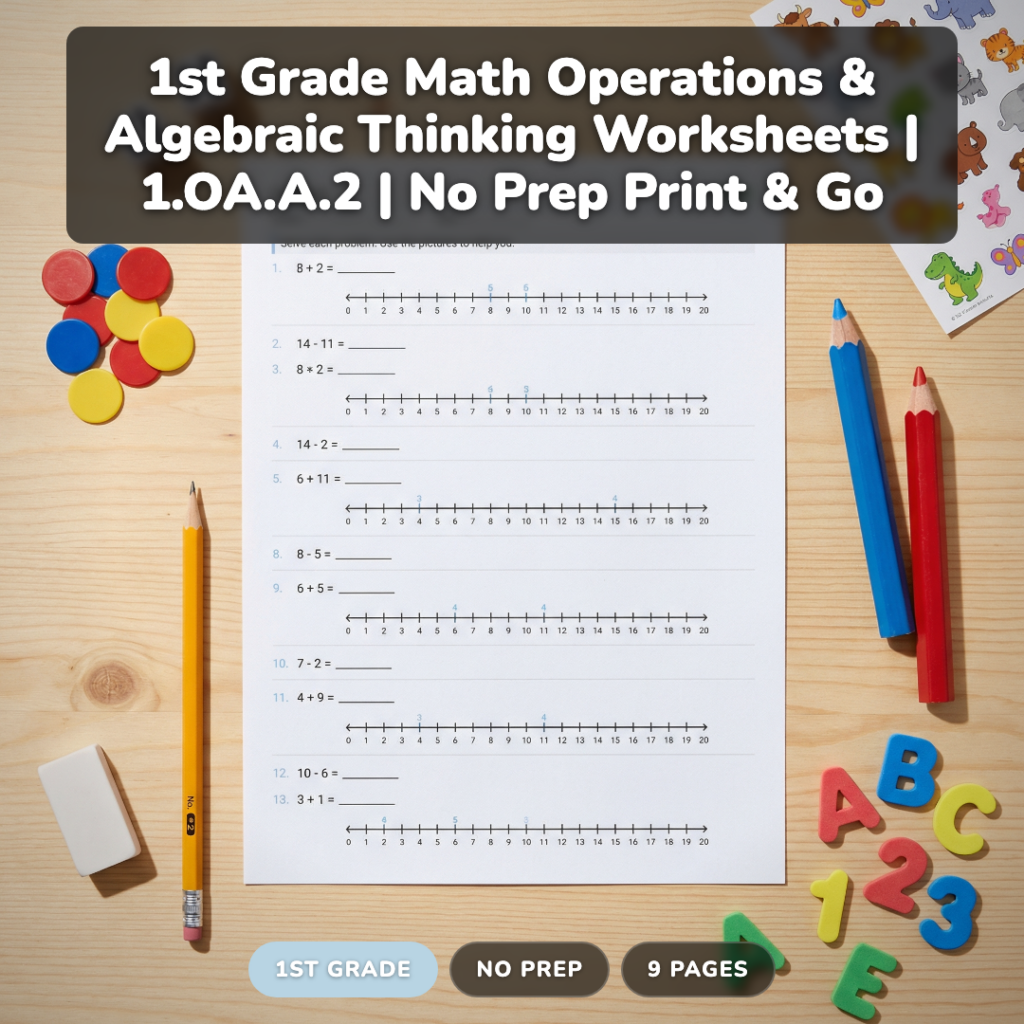
Teaching three-addend word problems takes time and intentional practice. That’s why I created a comprehensive worksheet pack that provides 106 differentiated problems across three levels. The practice level focuses on building foundational skills with simpler contexts and smaller numbers. The on-level section provides grade-appropriate challenges aligned to the standard. The challenge level pushes students to think more deeply about problem-solving strategies.
Each worksheet includes clear directions, varied problem types, and space for students to show their thinking through drawings or manipulatives. The problems use engaging contexts that first graders connect with — classroom pets, playground equipment, art supplies, and snack time scenarios. Answer keys are included for quick checking, and the no-prep format means you can print and use them immediately.
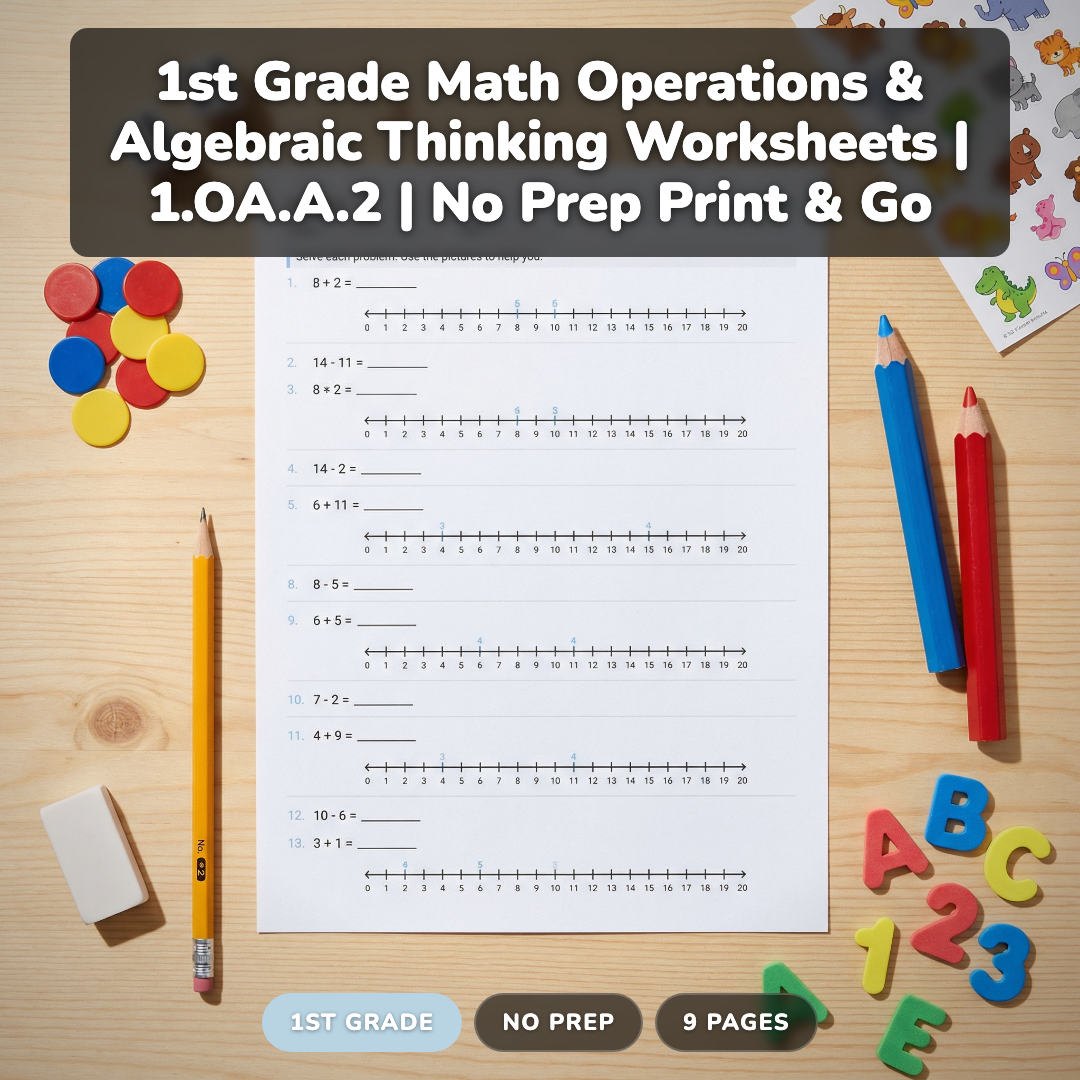
What makes this resource different is the careful scaffolding across difficulty levels and the variety of problem structures. Students practice with unknowns in different positions, varied contexts, and multiple solution pathways.
Grab a Free Word Problem Sample to Try
Want to see how these strategies work in practice? I’ll send you a free sample worksheet with problems at all three levels, plus a strategy reference card you can use with your students.
Frequently Asked Questions About Teaching Word Problems
How many word problems should first graders solve per day?
Start with 2-3 problems daily, focusing on quality discussion over quantity. As students build confidence, you can increase to 4-5 problems. Always prioritize deep understanding of problem-solving strategies over speed or volume of practice.
What if students can add but struggle with word problems?
This is common and indicates students need explicit instruction in problem comprehension. Use the CUBES method, practice identifying key information, and connect word problems to familiar situations. Start with very simple contexts before adding complexity.
Should first graders use calculators for word problems?
No, first graders should focus on developing number sense and mental math strategies. The goal of CCSS.Math.Content.1.OA.A.2 is building conceptual understanding, which requires hands-on manipulation and visual representation, not calculator computation.
How do I help students who add all numbers without reading?
Teach them to identify the question first by underlining it. Use problems with extra information they don’t need, forcing them to read carefully. Practice with manipulatives so they understand what the problem is asking before computing.
When should students move from manipulatives to abstract equations?
Students should use manipulatives as long as they need them, typically 4-6 weeks of consistent practice. The transition happens gradually — first they manipulate while writing equations, then they visualize the manipulatives mentally before writing equations independently.
Word problems don’t have to be the scary part of math class. With consistent practice using these research-backed strategies, your first graders will develop both the skills and confidence to tackle any addition challenge. Remember to grab that free sample to see these strategies in action, and feel free to share your own favorite word problem teaching tips in the comments!