If your first graders freeze when they see 70 – 40 or start counting on their fingers one by one, you’re not alone. Subtracting multiples of 10 is one of those skills that looks simple to adults but requires a major conceptual leap for young learners. The good news? With the right strategies and plenty of concrete practice, your students will master this foundational skill and build confidence for more complex math ahead.
Key Takeaway
First graders learn to subtract tens most effectively when they use concrete models, visual representations, and understand that subtracting tens follows the same patterns as subtracting ones.
Why Subtracting Tens Matters in First Grade
Subtracting multiples of 10 in the range 10-90 is a critical stepping stone in first grade mathematics. This skill directly supports CCSS.Math.Content.1.NBT.C.6, which requires students to subtract multiples of 10 from multiples of 10 using concrete models, drawings, and place value strategies.
This standard typically appears in the second half of first grade, after students have mastered basic subtraction facts within 20 and understand place value concepts like tens and ones. Research from the National Council of Teachers of Mathematics shows that students who develop strong mental math strategies for multiples of 10 perform 40% better on standardized assessments in later grades.
The timing is crucial—students need solid understanding of counting by tens, basic subtraction facts, and place value before tackling this skill. Most teachers introduce it around February or March, giving students the full school year to build prerequisite knowledge.
Looking for a ready-to-go resource? I put together a differentiated base ten subtraction pack that covers everything below — but first, the teaching strategies that make it work.
Common Base Ten Subtraction Misconceptions in First Grade
Common Misconception: Students count backwards by ones instead of using tens.
Why it happens: They haven’t internalized that 7 tens minus 4 tens follows the same pattern as 7 minus 4.
Quick fix: Use parallel problems like “7 – 4 = 3, so 70 – 40 = 30.”
Common Misconception: Students think 50 – 20 = 3 because 5 – 2 = 3.
Why it happens: They ignore place value and only look at the digits in the tens place.
Quick fix: Always use concrete models to show that 5 tens minus 2 tens equals 3 tens, not 3 ones.
Common Misconception: Students get confused when the answer has a zero in the ones place.
Why it happens: They’re not used to writing numbers like 30 or 60 as answers.
Quick fix: Practice reading and writing multiples of 10 before introducing subtraction problems.
Common Misconception: Students try to “borrow” like in multi-digit subtraction they’ve seen older siblings do.
Why it happens: They’ve been exposed to algorithms beyond their grade level.
Quick fix: Emphasize that these problems don’t need borrowing—we’re just subtracting tens from tens.
5 Research-Backed Strategies for Teaching Base Ten Subtraction
Strategy 1: Base Ten Block Modeling
Start with concrete manipulation using base ten blocks (tens rods and unit cubes). This strategy builds the conceptual foundation that students need before moving to abstract numbers.
What you need:
- Base ten blocks (tens rods and unit cubes)
- Place value mats
- Recording sheets
Steps:
- Give students the first number using tens rods (e.g., 6 tens rods for 60)
- Have them “take away” the second number of tens rods (remove 2 tens rods for -20)
- Count the remaining tens rods and write the answer
- Connect to the number sentence: “6 tens minus 2 tens equals 4 tens, so 60 – 20 = 40”
- Repeat with multiple problems, gradually reducing scaffolding
Strategy 2: Number Line Jumps
Use an open number line to show subtraction as “jumping back” by tens. This visual strategy helps students see the pattern and builds mental math skills.
What you need:
- Large number line (0-100)
- Colored markers or sticky notes
- Individual student number lines
Steps:
- Start at the first number on the number line (e.g., 80)
- Make “jumps” of 10 going backwards for the amount being subtracted
- For 80 – 30, make three jumps back of 10 each: 80→70→60→50
- Land on the answer and write the number sentence
- Have students practice on their own number lines
Strategy 3: Parallel Facts Connection
Explicitly connect basic subtraction facts to tens subtraction. This strategy leverages what students already know to build new understanding.
What you need:
- Fact family cards
- Two-column recording sheet
- Anchor chart paper
Steps:
- Review a basic fact like 8 – 3 = 5
- Write the parallel tens fact: 80 – 30 = 50
- Ask: “How are these problems the same? How are they different?”
- Create a class anchor chart showing the pattern
- Practice with multiple fact families
Strategy 4: Tens Frame Visualization
Use tens frames to represent multiples of 10, making the abstract concept more concrete and visual for young learners.
What you need:
- Large tens frames
- Counters or dots
- Individual tens frame sheets
Steps:
- Show the first number using filled tens frames (e.g., 5 full frames for 50)
- “Cross out” or remove the frames representing the amount being subtracted
- Count the remaining full frames
- Connect to the number sentence and discuss the pattern
- Have students draw their own tens frame representations
Strategy 5: Story Problem Contexts
Embed tens subtraction in real-world scenarios that make sense to first graders. This strategy builds problem-solving skills while reinforcing the math concept.
What you need:
- Picture books with groups of 10
- Story problem cards
- Drawing paper
Steps:
- Present a story: “The school had 60 pencils. They gave away 20 pencils to another class.”
- Have students draw or model the problem
- Solve using their preferred strategy (blocks, number line, etc.)
- Write the number sentence to match the story
- Create new stories together as a class
How to Differentiate Base Ten Subtraction for All Learners
For Students Who Need Extra Support
Start with smaller numbers and more concrete support. Use problems like 30 – 10 or 40 – 20 with plenty of manipulative practice. Provide hundreds charts for counting support and allow students to use base ten blocks for every problem initially. Focus on the connection between basic facts (3 – 1 = 2) and tens facts (30 – 10 = 20). These students benefit from extended practice with concrete models before moving to drawings or abstract work.
For On-Level Students
These students can handle the full range of problems within CCSS.Math.Content.1.NBT.C.6: subtracting multiples of 10 in the range 10-90. They should practice with various strategies—manipulatives, drawings, number lines, and mental math. Encourage them to explain their reasoning and make connections between different approaches. They’re ready for mixed practice and can begin to choose their own strategy based on the problem.
For Students Ready for a Challenge
Extend these students with problems that connect to second-grade concepts. They can explore patterns (“What happens when we subtract 10 from any number?”), work with three-digit multiples of 10 (like 200 – 100), or solve multi-step story problems. Challenge them to create their own story problems for classmates to solve, or investigate what happens when they subtract a larger number from a smaller one (introducing negative numbers conceptually).
A Ready-to-Use Base Ten Subtraction Resource for Your Classroom
Teaching base ten subtraction effectively requires a lot of differentiated practice—and creating 106 unique problems across three difficulty levels takes serious prep time. That’s where a well-designed resource can save you hours while giving your students exactly the practice they need.
This Number & Operations in Base Ten worksheet pack includes 30 practice problems for students who need extra support, 40 on-level problems aligned to the standard, and 36 challenge problems for advanced learners. Each level uses different visual supports and problem complexity, so every student gets appropriate practice. The problems progress logically from concrete scenarios to abstract number sentences, and answer keys are included for quick checking.
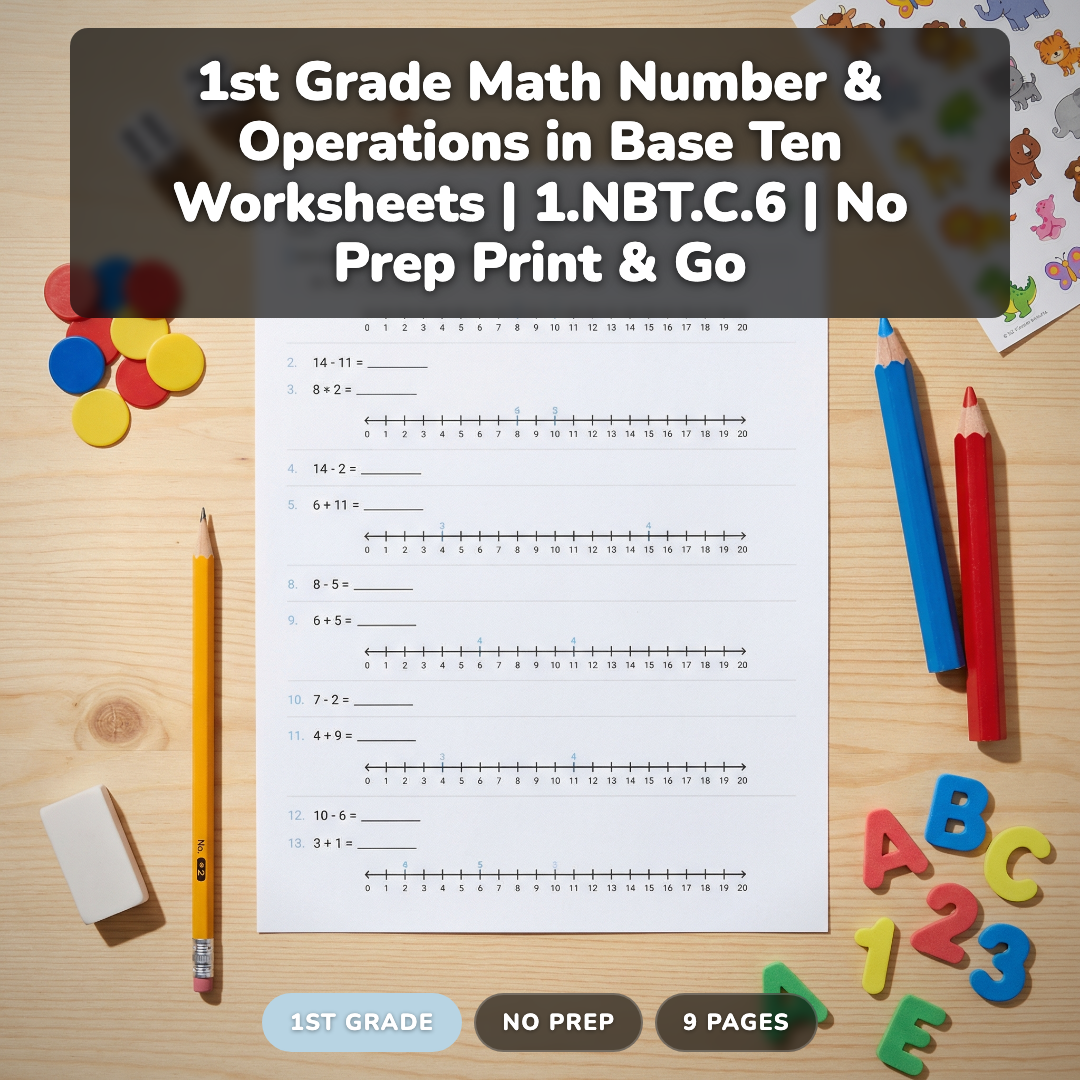
What makes this resource different is the intentional scaffolding—practice problems use smaller numbers and more visual cues, while challenge problems incorporate multi-step thinking and pattern recognition. You get 9 pages of ready-to-print worksheets that you can use for centers, homework, or assessment.
Grab a Free Base Ten Practice Sheet to Try
Want to see how differentiated base ten practice works? I’ll send you a free sample worksheet with problems at all three levels, plus teaching tips for each difficulty level. Drop your email below and I’ll send it right over.
Frequently Asked Questions About Teaching Base Ten Subtraction
When should I introduce subtracting tens in first grade?
Introduce this skill after students master basic subtraction facts within 20 and understand place value concepts. Most teachers begin in February or March, allowing time to build prerequisite knowledge throughout the year.
What manipulatives work best for teaching this concept?
Base ten blocks (tens rods and unit cubes) are most effective because they directly represent the place value concept. Counting bears in groups of ten, bundled straws, or tens frames also work well for visual learners.
How do I help students who keep counting by ones?
Use parallel facts to show the pattern: “You know 7 – 4 = 3, so 70 – 40 = 30.” Practice counting by tens extensively before introducing subtraction, and always use concrete models to reinforce the concept.
Should students memorize these facts or understand the concept?
Focus on conceptual understanding first using concrete models and visual strategies. Once students understand why 60 – 20 = 40, they’ll naturally develop fluency through practice and pattern recognition.
What’s the connection between this skill and second grade math?
This foundation directly supports second grade two-digit subtraction with regrouping. Students who master subtracting tens conceptually have much easier transitions to algorithms like 54 – 28 in second grade.
Mastering base ten subtraction gives your first graders a powerful foundation for all future math learning. When students understand that subtracting tens follows the same logical patterns as subtracting ones, they develop both computational fluency and mathematical reasoning skills that will serve them well beyond first grade.
What’s your favorite strategy for helping students visualize tens subtraction? Remember to grab that free practice sheet above—it’s a great way to try these strategies with your class tomorrow.