If your first graders look confused when you mention “tens” and “ones,” you’re not alone. Teaching place value is one of the trickiest concepts in first grade math — but it’s also one of the most important foundations for everything that comes next.
Key Takeaway
First graders understand place value best through hands-on manipulation with concrete objects before moving to abstract numbers.
Why Place Value Matters in First Grade
Place value understanding forms the foundation for all future math learning. When students grasp that the digit 2 in “23” represents 2 tens (not just “2”), they’re ready for addition with regrouping, subtraction across zeros, and eventually multiplication and division.
According to research by Van de Walle, students who master place value concepts in first grade show significantly higher achievement in second and third grade math. The timing matters too — first grade is when students transition from counting individual objects to understanding our base-ten number system.
CCSS.Math.Content.1.NBT.B.2 specifically requires students to understand that two-digit numbers represent amounts of tens and ones. This standard builds directly on kindergarten counting skills and prepares students for CCSS.Math.Content.2.NBT.A.1 in second grade.
Looking for a ready-to-go resource? I put together a differentiated place value practice pack that covers everything below — but first, the teaching strategies that make it work.
Common Place Value Misconceptions in 1st Grade
Common Misconception: Students think the “2” in “23” just means “two” — the same as the “2” in “2.”
Why it happens: They haven’t connected digit position to value. To them, all 2s are equal.
Quick fix: Use base-ten blocks to show 2 individual cubes versus 2 ten-rods side by side.
Common Misconception: When counting objects in groups of ten, students recount the same objects multiple times.
Why it happens: They don’t understand that grouped objects are still the same total — just organized differently.
Quick fix: Use physical barriers (cups, circles drawn on paper) to clearly separate tens groups from loose ones.
Common Misconception: Students write “twenty-three” as “203” instead of “23.”
Why it happens: They’re writing what they hear in the number name rather than understanding place value.
Quick fix: Practice with place value charts where students physically place digits in tens and ones columns.
5 Research-Backed Strategies for Teaching Place Value
Strategy 1: Bundle Sticks for Concrete Understanding
Start with individual popsicle sticks or straws that students can physically handle. This concrete approach helps students see that ten individual items become one group of ten — the foundation of our number system.
What you need:
- Popsicle sticks or straws (200+ per class)
- Rubber bands for bundling
- Small cups or containers
Steps:
- Give each student 15-20 individual sticks
- Count together: “1, 2, 3… 10”
- Bundle the 10 sticks with a rubber band
- Place the bundle in one cup, loose sticks in another
- Practice with different amounts: “Show me 14” (1 bundle + 4 loose)
Strategy 2: Base-Ten Block Building
Base-ten blocks provide the perfect visual representation of place value. The ten-rod clearly shows ten unit cubes stuck together, making the connection between individual ones and groups of ten obvious.
What you need:
- Base-ten blocks (unit cubes and ten-rods)
- Place value mats or drawn charts
- Number cards 10-99
Steps:
- Show a number card (example: 26)
- Students use ten-rods to show the tens (2 ten-rods)
- Add unit cubes for the ones (6 unit cubes)
- Count to verify: “10, 20, 21, 22, 23, 24, 25, 26”
- Write the number in a place value chart
Strategy 3: The “Quick Draw” Method
Students draw simple lines for tens and dots for ones. This strategy bridges concrete manipulatives and abstract numbers while being quick enough for daily practice.
What you need:
- Whiteboards and markers
- Place value charts (drawn or printed)
- Number cards or dice
Steps:
- Call out a number (“Draw 34”)
- Students draw 3 lines in the tens column (each line = 10)
- Draw 4 dots in the ones column
- Count together: “10, 20, 30, 31, 32, 33, 34”
- Write the standard numeral below their drawing
Strategy 4: Number Detective Game
Turn place value into a mystery-solving game where students use clues about tens and ones to identify secret numbers. This strategy builds logical thinking while reinforcing place value concepts.
What you need:
- Pre-written clue cards
- Number charts 1-100
- Small prizes or stickers
Steps:
- Read clues aloud: “My number has 4 tens and 7 ones”
- Students use base-ten blocks or drawings to build the number
- Reveal the answer (47) and let students check their work
- Increase difficulty: “My number has one more ten than 23”
- Students explain their thinking to a partner
Strategy 5: Real-World Counting Collections
Use everyday objects that naturally group into tens — like egg cartons, ten-frames with beans, or boxes of crayons. This connects place value to students’ real experiences outside school.
What you need:
- Empty egg cartons (cut to show 10 spaces)
- Small countable objects (beans, buttons, pennies)
- Recording sheets
Steps:
- Give students 27 beans and 3 egg carton “ten-frames”
- Fill complete ten-frames first
- Count leftover beans
- Record: “2 full ten-frames + 7 extra beans = 27”
- Practice with different amounts throughout the week
How to Differentiate Place Value for All Learners
For Students Who Need Extra Support
Start with numbers 10-19 where the pattern is most obvious. Use only concrete materials for the first few weeks — no abstract worksheets yet. Focus on the language: “1 ten and 4 ones makes 14.” Provide pre-drawn place value charts and encourage finger counting within each group. Review counting by tens daily using a hundreds chart.
For On-Level Students
Work with two-digit numbers 10-50, then extend to 99. Mix concrete manipulatives with simple drawings and written work. Introduce expanded form (20 + 6 = 26) once students are solid with tens and ones language. Practice comparing numbers using place value understanding: “34 is greater than 29 because 3 tens is more than 2 tens.”
For Students Ready for a Challenge
Explore three-digit numbers conceptually (“What would 100 look like with our blocks?”). Work with number patterns: “What happens when we add 10 to any number?” Connect to money: “How many dimes and pennies make 47 cents?” Introduce early addition strategies using place value: “20 + 30 = 50 because 2 tens + 3 tens = 5 tens.”
A Ready-to-Use Place Value Resource for Your Classroom
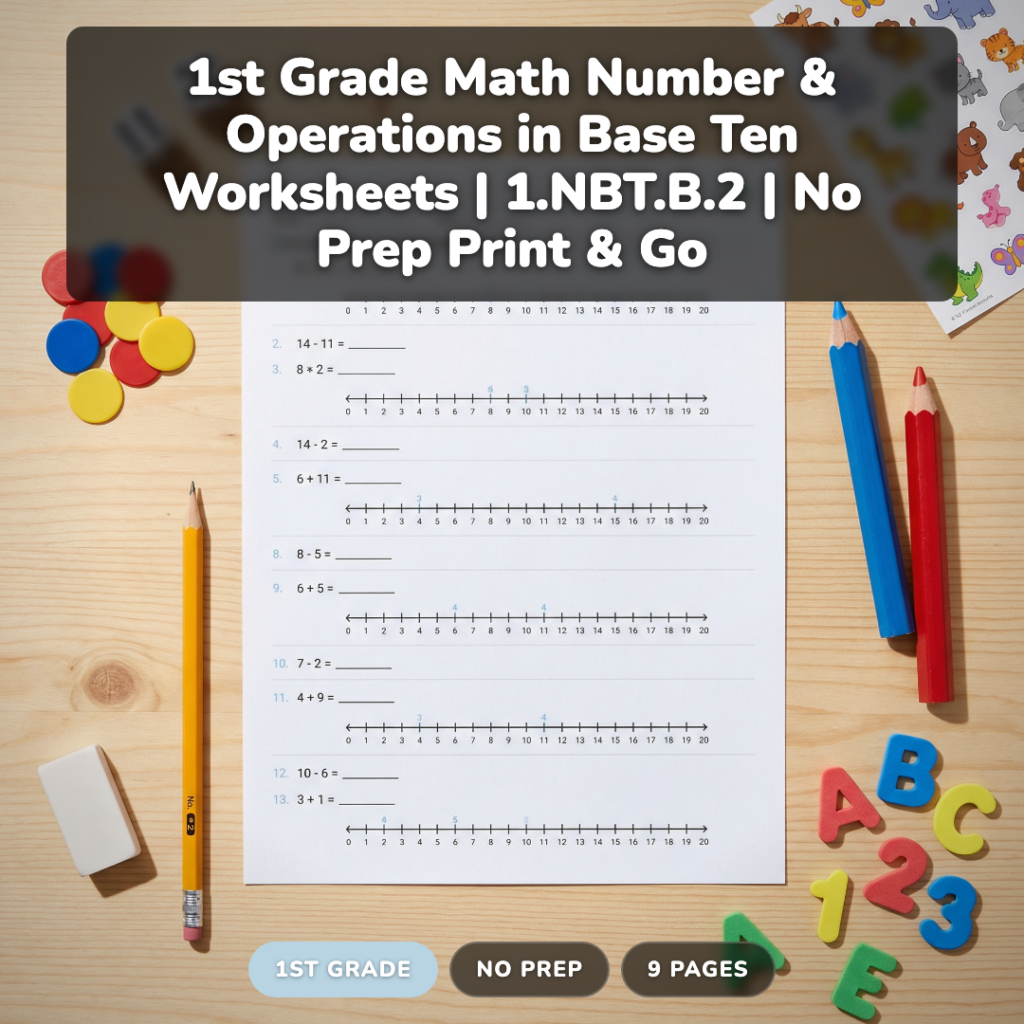
After years of creating place value activities from scratch, I put together a comprehensive practice pack that covers all the strategies above. The 1st Grade Number & Operations in Base Ten Worksheets includes 106 problems across three differentiation levels — perfect for meeting CCSS.Math.Content.1.NBT.B.2 requirements.
What makes this resource different is the careful progression: Practice level focuses on numbers 10-20 with visual supports, On-Level covers 10-50 with mixed representations, and Challenge extends to 99 with comparison problems. Each page includes answer keys and can be used for independent practice, math centers, or homework.
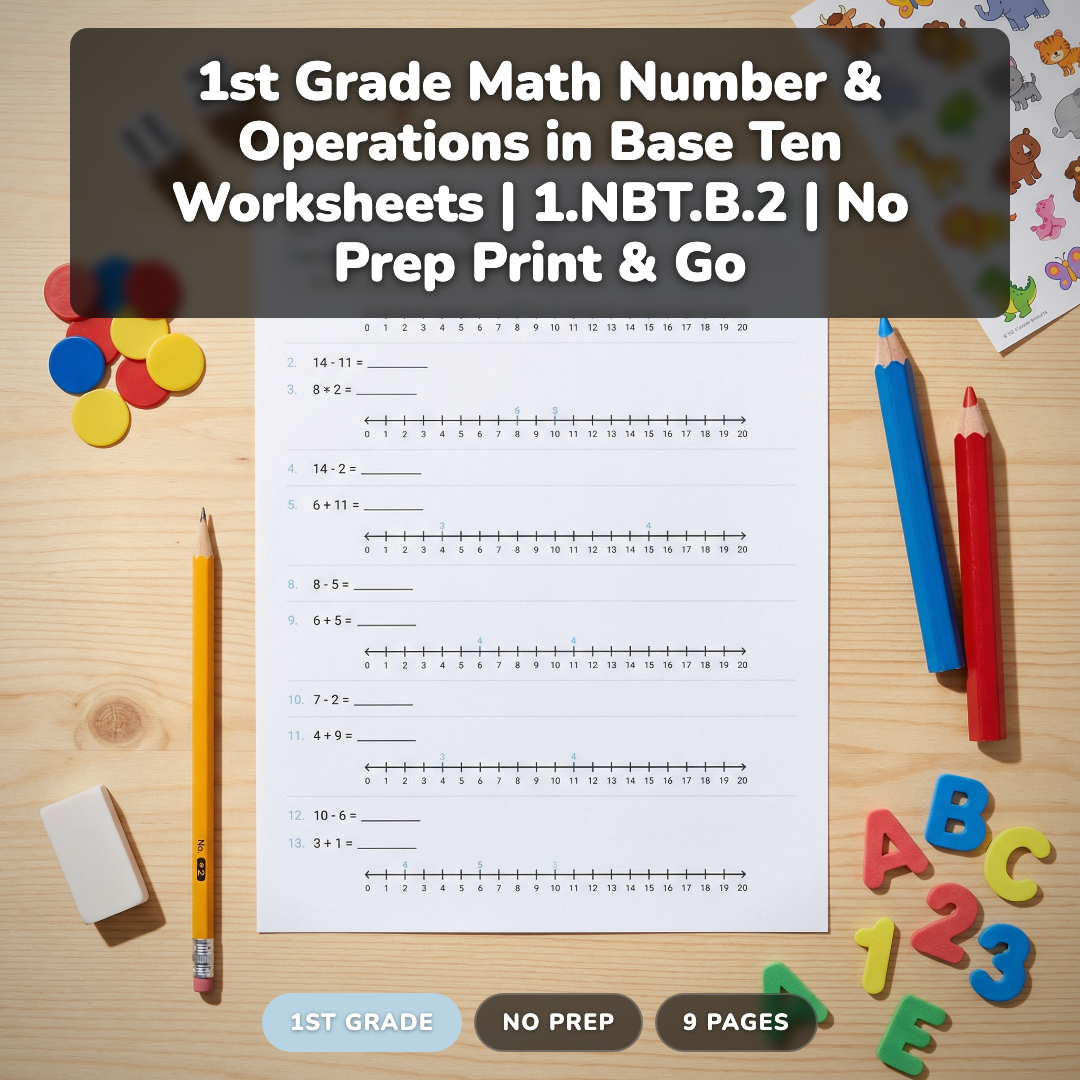
The pack includes 9 ready-to-print pages that save you hours of prep time while ensuring your students get the systematic practice they need.
Grab a Free Place Value Practice Sheet to Try
Want to see the quality before you buy? I’ll send you a free sample worksheet that includes problems from all three differentiation levels, plus a quick reference guide for teaching place value concepts.
Frequently Asked Questions About Teaching Place Value
When should I start teaching place value in first grade?
Begin place value instruction after students can count to 100 and recognize teen numbers, typically October or November. Students need solid counting skills before understanding that digit position affects value in our base-ten system.
Should I teach place value with or without manipulatives?
Always start with concrete manipulatives like base-ten blocks or bundled sticks. Research shows students need 4-6 weeks of hands-on experience before transitioning to drawings and abstract number work for lasting understanding.
How do I help students who write numbers backwards?
Use place value mats with clearly labeled “tens” and “ones” columns. Have students say the number aloud while pointing to each digit position. Practice with magnetic numbers on a place value chart daily.
What’s the difference between place value and number sense?
Place value is understanding that digit position determines value (the 2 in 23 means 20). Number sense includes place value plus comparing, estimating, and flexible thinking about numbers in multiple ways.
How long does it take students to master place value?
Most first graders need 8-12 weeks of consistent instruction and practice to solidly understand two-digit place value. Struggling learners may need additional support through second grade to fully grasp these concepts.
Building Strong Number Foundations
Teaching place value well in first grade sets your students up for years of math success. The key is moving slowly from concrete to abstract, giving students plenty of time to manipulate, discuss, and truly understand what those digits represent.
What’s your go-to strategy for helping students understand tens and ones? I’d love to hear what works in your classroom — and don’t forget to grab that free practice sheet to try these strategies with your students tomorrow.