If your first graders look confused when you ask them to compare the lengths of two pencils, you’re not alone. Teaching measurement concepts to 6 and 7-year-olds requires hands-on strategies that make abstract concepts concrete. You’ll discover five research-backed approaches that help students master ordering and comparing objects by length — plus differentiation tips for every learner in your classroom.
Key Takeaway
First graders learn measurement best through direct comparison activities using real objects before moving to indirect comparison with a third object.
Why Length Measurement Matters in First Grade
Length measurement forms the foundation for all future geometry and measurement learning. According to research by the National Council of Teachers of Mathematics, students who master direct and indirect comparison in first grade show 40% better performance on standardized measurement assessments in later grades.
The CCSS.Math.Content.1.MD.A.1 standard specifically requires students to order three objects by length and compare lengths indirectly using a third object. This skill typically appears in the spring semester after students have developed number sense and counting skills.
Brain research shows that first graders need concrete experiences with measurement before they can understand abstract units like inches or centimeters. Students must physically manipulate objects, make direct comparisons, and use transitivity reasoning (if A > B and B > C, then A > C) to build measurement sense.
Looking for a ready-to-go resource? I put together a differentiated measurement pack that covers everything below — but first, the teaching strategies that make it work.
Common Length Measurement Misconceptions in First Grade
Common Misconception: Students think wider objects are automatically longer.
Why it happens: Young children confuse size with length and focus on overall bulk rather than linear measurement.
Quick fix: Use thin and thick objects of different lengths to separate width from length concepts.
Common Misconception: Students don’t align objects at a common starting point when comparing.
Why it happens: They lack understanding that measurement requires a consistent reference point.
Quick fix: Always use a “starting line” (tape on the floor or table edge) for all comparisons.
Common Misconception: Students think curved or bent objects can’t be measured.
Why it happens: They associate length only with straight lines.
Quick fix: Demonstrate straightening yarn or string to show that curved objects have measurable length.
Common Misconception: Students struggle with transitivity (if A > B and B > C, then A > C).
Why it happens: This abstract reasoning skill is still developing in first grade.
Quick fix: Use physical demonstrations with three clearly different lengths before introducing close comparisons.
5 Research-Backed Strategies for Teaching Length Measurement
Strategy 1: Direct Comparison with Classroom Objects
Students physically place objects side-by-side to compare lengths directly. This concrete approach builds the foundation for all measurement understanding and addresses the CCSS.Math.Content.1.MD.A.1 requirement for length comparison.
What you need:
- Various classroom objects (pencils, crayons, books, scissors)
- Masking tape for starting line
- Recording sheet with comparison symbols
Steps:
- Place masking tape on tables as a “starting line”
- Give each pair of students two different objects
- Model aligning both objects at the starting line
- Students determine which object extends further from the line
- Record findings using longer than, shorter than, or equal symbols
- Rotate objects so each pair compares 4-5 different combinations
Strategy 2: Three-Object Ordering Challenge
Students arrange three objects from shortest to longest, developing the ordering skills required by the first grade standard. This activity builds logical thinking and introduces transitivity concepts.
What you need:
- Sets of three objects with clear length differences
- Recording sheets with three boxes labeled “shortest,” “middle,” “longest”
- Timer for rotation activities
Steps:
- Present three objects in random order
- Students predict the order from shortest to longest
- Use direct comparison to check predictions
- Place objects in order on the recording sheet
- Discuss which comparisons were easy or challenging
- Introduce new sets with closer length differences
Strategy 3: Indirect Comparison Using a Third Object
Students use a third object as a measuring tool to compare two objects that can’t be placed side-by-side. This strategy directly addresses the indirect comparison requirement in CCSS.Math.Content.1.MD.A.1.
What you need:
- Objects that can’t be moved easily (desk height, door width)
- Various measuring tools (string, paper strips, linking cubes)
- Recording sheets for indirect comparisons
Steps:
- Identify two objects that can’t be placed together (like desk height vs. bookshelf height)
- Choose a third object as a measuring tool (string or paper strip)
- Measure the first object by marking the string
- Use the same marked string to measure the second object
- Compare where the second object ends relative to the mark
- Record which object is longer using mathematical language
Strategy 4: Human Measurement Games
Students use their bodies as measuring tools and comparison objects, making measurement personal and memorable. This kinesthetic approach helps students who learn best through movement and physical activity.
What you need:
- Open floor space
- Yarn or rope for body tracings
- Clipboards for recording
- Partner recording sheets
Steps:
- Students work in pairs to measure each other’s arm span using yarn
- Cut yarn pieces to match each student’s measurement
- Compare yarn lengths to determine who has the longer arm span
- Use the same yarn pieces to measure classroom objects
- Find objects longer than, shorter than, and equal to their arm spans
- Create a class chart showing measurement discoveries
Strategy 5: Length Estimation and Check
Students develop measurement sense by estimating lengths before measuring, building the foundation for using standard units in second grade. This strategy combines prediction skills with measurement practice.
What you need:
- Estimation recording sheets
- Various objects for measuring
- Linking cubes or paper clips as non-standard units
- “Estimation Station” signs
Steps:
- Set up stations with different objects to measure
- Students estimate how many linking cubes long each object will be
- Record estimates before measuring
- Measure objects using linking cubes end-to-end
- Compare estimates to actual measurements
- Discuss which estimates were close and why
How to Differentiate Length Measurement for All Learners
For Students Who Need Extra Support
Begin with very obvious length differences — compare a pencil to a crayon rather than two similar pencils. Use physical guidance to help students align objects at starting points. Provide sentence frames like “The _____ is longer than the _____” to support mathematical language development. Focus on direct comparison for several weeks before introducing indirect comparison. Use consistent vocabulary and repeat key terms frequently during activities.
For On-Level Students
Students work with moderate length differences and begin combining direct and indirect comparison strategies. They should master ordering three objects and explain their reasoning using mathematical language. Introduce measurement vocabulary like “longest,” “shortest,” and “equal length.” Students begin using non-standard units like paper clips or linking cubes to quantify length differences. They can handle 4-5 different comparison tasks in one session.
For Students Ready for a Challenge
Advanced students work with very similar lengths that require careful comparison. They order 4-5 objects instead of three and explain the complete reasoning process. Challenge them to find objects that are exactly equal in length or to use multiple measurement tools for the same object. Introduce early standard unit concepts by showing how many paper clips equal one linking cube. Connect measurement to real-world scenarios like comparing plant heights in science.
A Ready-to-Use Measurement Resource for Your Classroom
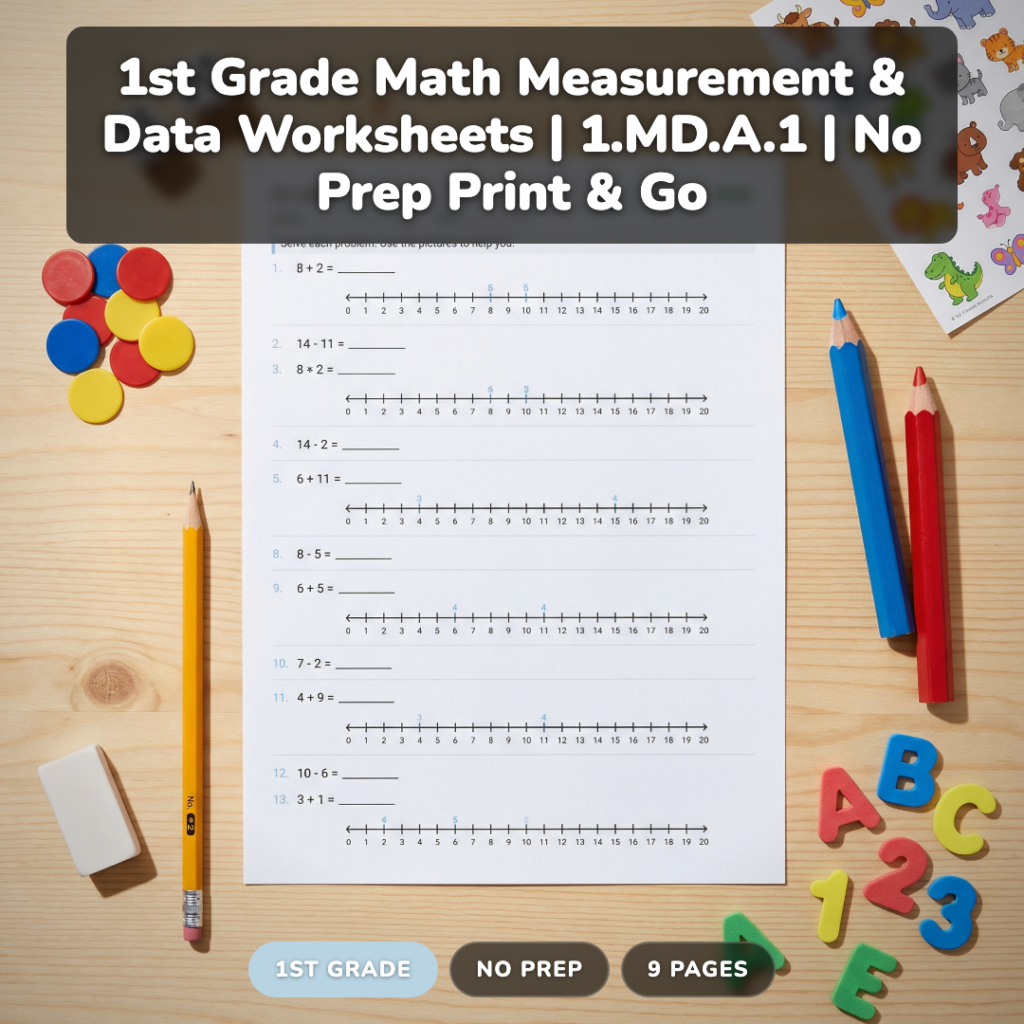
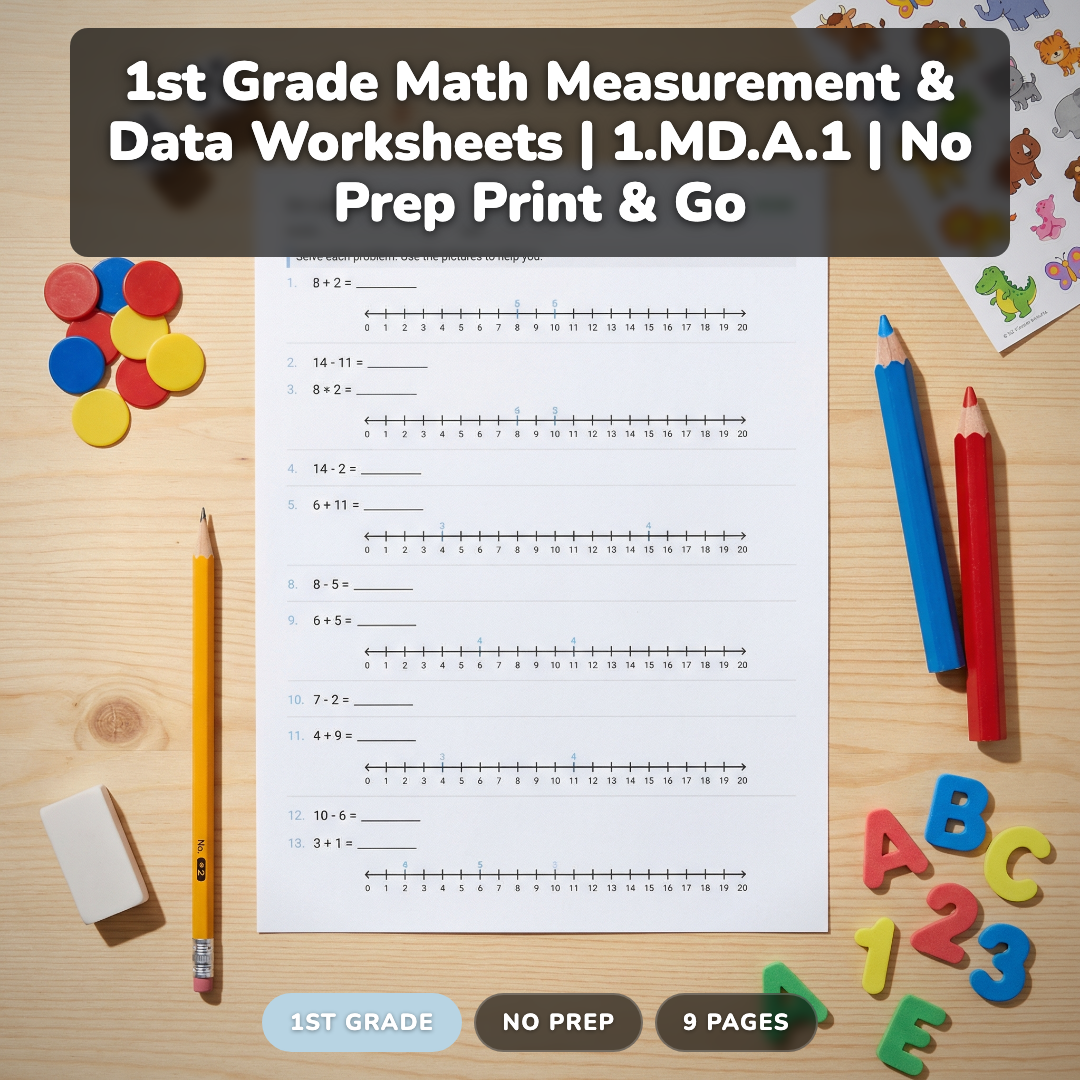
Teaching measurement effectively requires lots of varied practice at different difficulty levels. My 1st Grade Measurement & Data pack includes 106 problems across three differentiation levels — exactly what you need to meet every student where they are.
The Practice level (30 problems) focuses on direct comparison with obvious length differences. The On-Level section (40 problems) combines direct and indirect comparison with moderate difficulty. The Challenge level (36 problems) includes complex ordering tasks and reasoning questions that push advanced learners.
Each level includes answer keys and covers all aspects of CCSS.Math.Content.1.MD.A.1. The worksheets are print-and-go ready — no prep time required. Students get immediate practice with the concepts you’ve taught, and you get reliable assessment data to guide your instruction.
The resource includes visual supports, clear directions, and graduated difficulty that matches how students actually learn measurement concepts.
Grab a Free Measurement Sample to Try
Want to see how the differentiated approach works? I’ll send you a free sample with problems from each level plus teaching tips for making measurement stick with your first graders.
Frequently Asked Questions About Teaching First Grade Measurement
When should I introduce indirect comparison in first grade?
Introduce indirect comparison after students master direct comparison, typically in late winter or spring. Students need several weeks of direct comparison practice before they can understand using a third object as a measuring tool. Start with very obvious examples where the indirect method gives clear results.
What’s the difference between ordering and comparing objects by length?
Comparing involves determining which of two objects is longer, shorter, or equal. Ordering requires arranging three or more objects from shortest to longest (or vice versa). CCSS.Math.Content.1.MD.A.1 requires both skills, with ordering being the more complex task that builds on comparison abilities.
Should first graders use standard units like inches?
No, first grade focuses on non-standard units and comparison without formal measurement. Students use objects like paper clips, linking cubes, or their own hands as measuring tools. Standard units are introduced in second grade after students develop strong measurement sense through comparison activities.
How do I help students who confuse length with width or height?
Use objects where length is clearly the longest dimension and explicitly point out the difference. Have students trace the length of objects with their finger while saying “length” aloud. Use consistent language and always measure the same dimension when comparing similar objects like books or pencils.
What are good non-standard units for first grade measurement?
Linking cubes, paper clips, new crayons, and large paper clips work well because they’re consistent in size. Avoid objects like beans or blocks that vary in size. The key is using identical units that can be placed end-to-end without gaps or overlaps.
Teaching measurement in first grade builds the foundation for all future math learning. When students master direct and indirect comparison through hands-on activities, they develop the reasoning skills needed for more complex mathematical concepts. Remember to keep activities concrete, use consistent vocabulary, and celebrate the “aha” moments when students discover that objects can be compared even when they can’t be placed side-by-side.
What’s your favorite hands-on strategy for teaching length comparison? Drop your email above to grab the free measurement sample and share your classroom successes!