If your first graders can identify a circle but freeze when asked to make a new shape using two triangles, you’re seeing a common geometry gap. Many students can name shapes but struggle with the spatial reasoning needed to combine and create them.
This post shares five research-backed strategies that help first graders master shape composition — the foundation skill that bridges basic shape recognition to complex geometric thinking. You’ll get step-by-step activities, differentiation tips, and solutions to the most common misconceptions.
Key Takeaway
First grade geometry success comes from hands-on manipulation before abstract thinking — students need to physically move shapes before they can mentally visualize combinations.
Why Shape Composition Matters in First Grade
Shape composition sits at the heart of CCSS.Math.Content.1.G.A.2, which asks students to combine 2D and 3D shapes to create new composite shapes. This standard typically appears in the spring semester, after students have mastered basic shape identification and attributes.
Research from the National Council of Teachers of Mathematics shows that students who develop strong spatial reasoning in early elementary perform 43% better on later geometry assessments. Shape composition builds three critical skills: spatial visualization, part-whole relationships, and geometric flexibility.
The timing matters too. By first grade, students have the fine motor skills needed for precise shape manipulation and the cognitive development to understand that shapes can be combined and separated. This makes it the perfect window for building geometric reasoning that will support fraction concepts, area understanding, and algebraic thinking in later grades.
Looking for a ready-to-go resource? I put together a differentiated geometry pack that covers everything below — but first, the teaching strategies that make it work.
Common Geometry Misconceptions in First Grade
Understanding where students typically struggle helps you address problems before they become ingrained habits.
Common Misconception: Students think a rotated square becomes a diamond.
Why it happens: They rely on visual orientation rather than geometric properties like equal sides and right angles.
Quick fix: Rotate shapes together while counting sides and corners, emphasizing that properties don’t change with position.
Common Misconception: Students believe you can only make one new shape from two given shapes.
Why it happens: Limited exposure to multiple arrangements and rigid thinking about ‘correct’ answers.
Quick fix: Show multiple solutions using the same shapes and celebrate different arrangements.
Common Misconception: Students think composite shapes are completely new shapes with no connection to the original pieces.
Why it happens: They focus on the final product without understanding the building process.
Quick fix: Use transparent shapes or trace around pieces before removing them to show the connection.
Common Misconception: Students assume 3D shapes can’t be combined because they’re ‘too hard.’
Why it happens: Limited hands-on experience with 3D manipulatives and fear of complex-looking objects.
Quick fix: Start with familiar 3D objects like blocks and boxes before introducing geometric vocabulary.
5 Research-Backed Strategies for Teaching Shape Composition
Strategy 1: Pattern Block Exploration with Guided Discovery
Pattern blocks provide the perfect introduction to shape composition because they’re designed to fit together in predictable ways. Students discover relationships naturally while building spatial reasoning skills.
What you need:
- Pattern blocks (physical or virtual)
- Pattern block paper or whiteboards
- Shape composition recording sheets
Steps:
- Give each student 6 triangles and challenge them to make a hexagon
- Once successful, ask them to make the same hexagon using different shapes
- Have students trace their solutions and compare with partners
- Introduce vocabulary: ‘I made a hexagon using three rhombuses’
- Challenge students to find a third way using trapezoids
Strategy 2: Shape Building with Everyday Objects
Using familiar 3D objects helps students understand that geometry exists everywhere, not just in math class. This strategy builds confidence with three-dimensional shape composition.
What you need:
- Empty boxes, cans, paper towel tubes
- Building blocks or wooden cubes
- Modeling clay or playdough
- Digital camera or tablets for documentation
Steps:
- Start with two identical boxes and ask students to create something new
- Demonstrate stacking, placing side-by-side, and connecting end-to-end
- Have students build a ‘robot’ using at least 3 different shaped objects
- Take photos of creations and discuss which shapes were used
- Challenge students to rebuild someone else’s creation from a photo
Strategy 3: Digital Shape Composition with Immediate Feedback
Technology tools provide unlimited shapes and instant reset capabilities, letting students experiment freely without material constraints. This strategy particularly helps visual learners see transformations clearly.
What you need:
- Tablets or computers with geometry apps
- Interactive whiteboard for whole-class demonstrations
- Student recording sheets for offline documentation
Steps:
- Use apps like Tangrams or Shape Builder to demonstrate combining two triangles into a square
- Have students recreate your example, then find two more ways to arrange the same triangles
- Challenge them to build a house using exactly 5 shapes
- Students screenshot their solutions and explain their thinking to a partner
- Create a class gallery of different solutions to the same challenge
Strategy 4: Shape Dissection and Reconstruction
This strategy helps students understand that composite shapes can be broken apart and rebuilt differently, developing flexibility in geometric thinking and supporting the reversible nature of composition.
What you need:
- Pre-cut paper shapes in multiple colors
- Scissors for teacher demonstrations
- Glue sticks for permanent arrangements
- Shape composition journals
Steps:
- Show students a paper rectangle and cut it diagonally to create two triangles
- Challenge them to make a different shape using those same two triangles
- Provide pre-cut shapes and let students experiment with arrangements
- Have them glue down their favorite creation and label the component shapes
- Partner students to recreate each other’s designs using different colored shapes
Strategy 5: Real-World Shape Scavenger Hunt
Connecting geometry to students’ environment helps them see math as relevant and builds observation skills. This strategy reinforces that composite shapes exist everywhere around us.
What you need:
- Clipboards and pencils for outdoor exploration
- Shape identification cards
- Digital cameras or drawing materials
- Classroom objects for indoor alternative
Steps:
- Take students on a walk to find objects made from multiple shapes
- Have them identify a swing set as rectangles and triangles combined
- Challenge them to find something made from circles and rectangles (like a bicycle)
- Back in class, students draw or photograph their discoveries
- Create a class book of ‘Shapes in Our World’ with student explanations
How to Differentiate Geometry for All Learners
For Students Who Need Extra Support
Start with concrete manipulatives before moving to abstract representations. Provide shapes that fit together easily, like puzzle pieces or magnetic tiles. Use consistent vocabulary and give students extra time to manipulate materials. Focus on one shape combination at a time rather than multiple possibilities. Consider providing templates or outlines for students to fill with shapes.
For On-Level Students
Students working at grade level should practice CCSS.Math.Content.1.G.A.2 with all required 2D shapes (rectangles, squares, trapezoids, triangles, half-circles, quarter-circles) and 3D shapes (cubes, rectangular prisms, cones, cylinders). They should find multiple solutions to composition challenges and explain their thinking using geometric vocabulary. Expect them to work independently with minimal teacher support.
For Students Ready for a Challenge
Advanced students can explore creating specific objects (like houses or animals) using geometric constraints. Challenge them to use all six 2D shapes in one composite creation, or to build 3D structures that serve a purpose (like a tower that holds weight). Introduce early symmetry concepts by having them create symmetric composite shapes.
A Ready-to-Use Geometry Resource for Your Classroom
After years of creating geometry activities from scratch, I developed a comprehensive worksheet pack that saves hours of prep time while providing exactly the right level of challenge for every student.
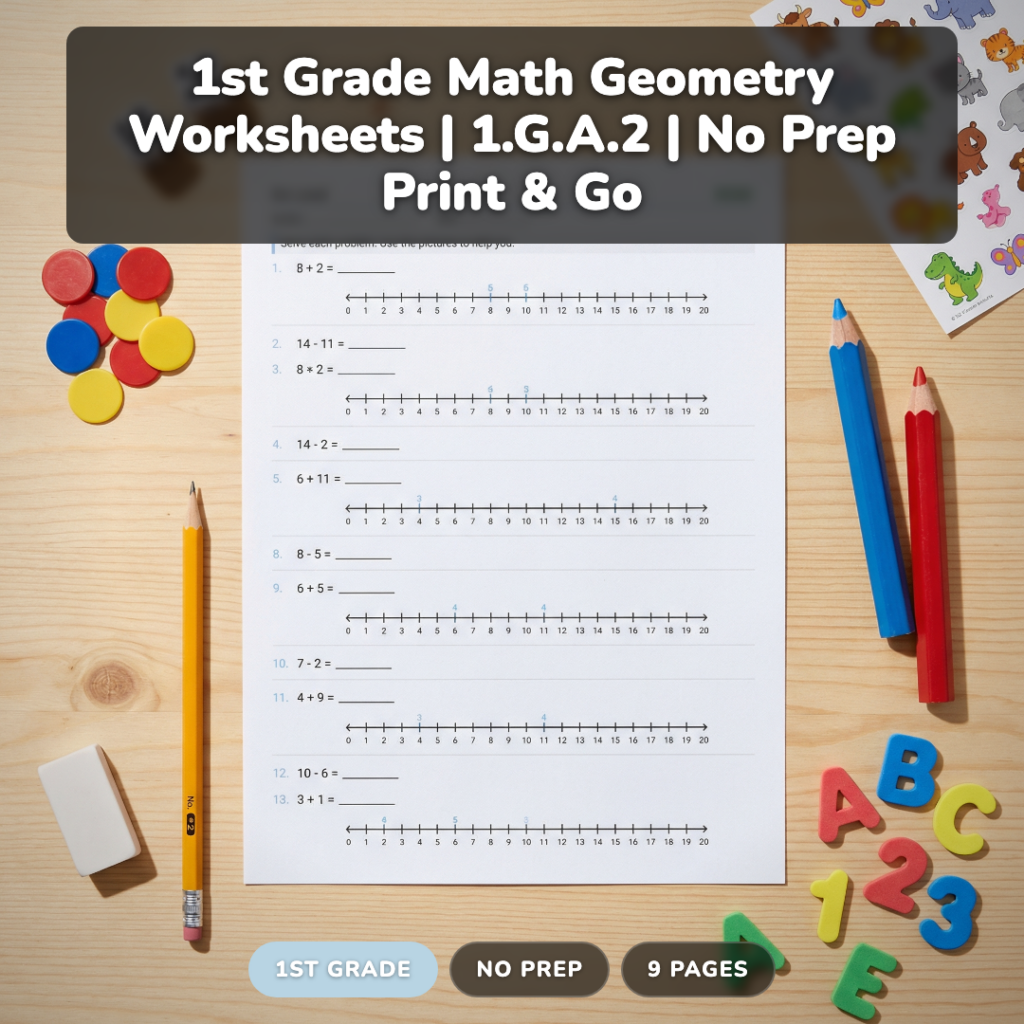
This differentiated geometry pack includes 106 problems across three difficulty levels: 30 practice problems for students building foundational skills, 40 on-level problems that align perfectly with grade expectations, and 36 challenge problems for students ready to extend their thinking. Each level focuses on the shape composition skills required by CCSS.Math.Content.1.G.A.2.
What makes this resource different is the careful progression from simple combinations to complex creations. Students start by combining two shapes, then move to multi-shape compositions, and finally create their own designs with specific constraints. Answer keys and teaching notes are included for every page.
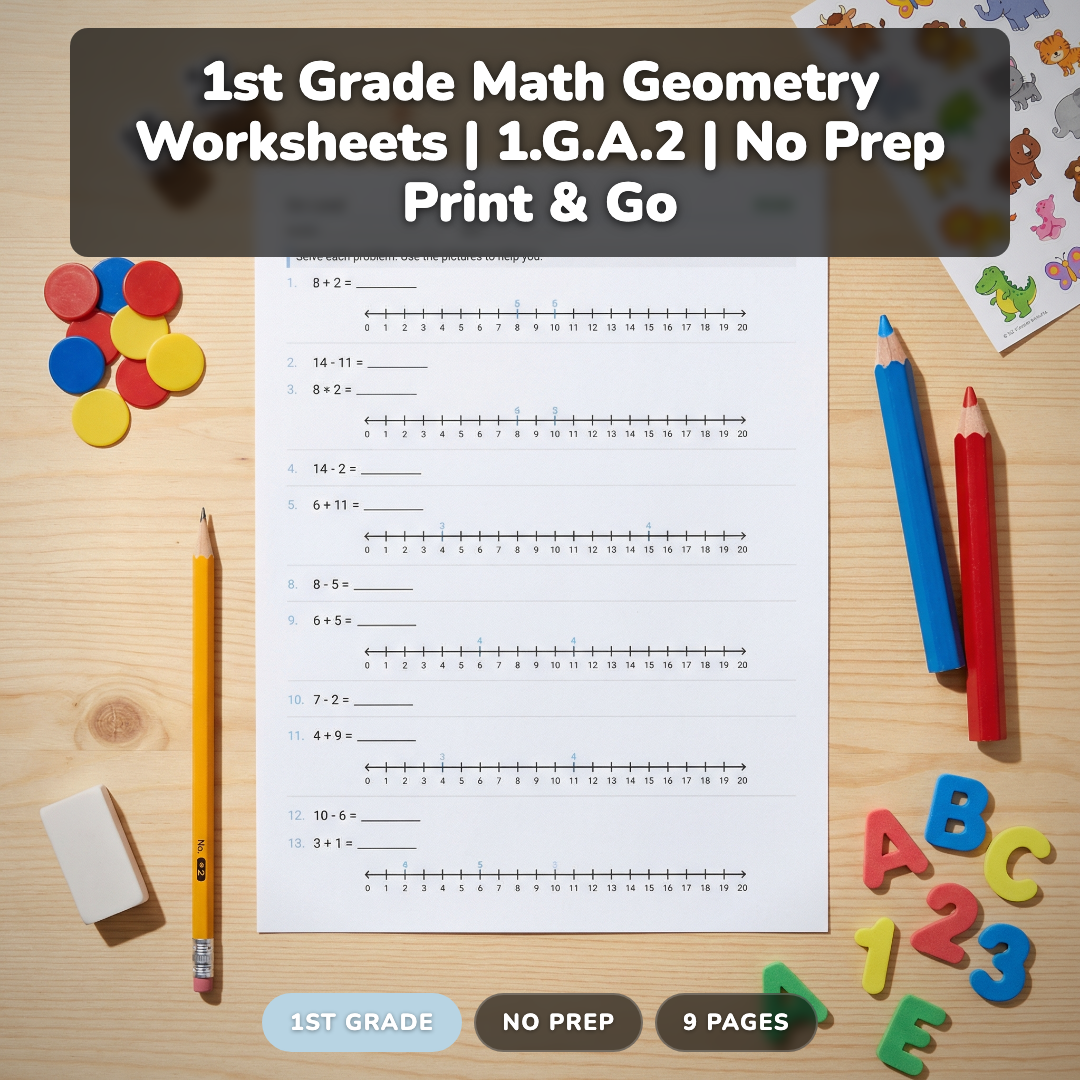
The pack covers both 2D and 3D shape composition with clear visuals and age-appropriate challenges. No prep required — just print and go.
Grab a Free Geometry Sample to Try
Want to see how these strategies work in practice? I’ll send you a free sample worksheet that includes one problem from each difficulty level, plus a quick-start teaching guide with setup instructions.
Frequently Asked Questions About Teaching First Grade Geometry
When should I introduce 3D shape composition in first grade?
Introduce 3D shape composition after students master 2D combinations, typically in late winter or spring. Start with familiar objects like blocks and boxes before using geometric vocabulary. Most students need 3-4 weeks of 2D practice before attempting 3D compositions successfully.
How do I assess shape composition skills effectively?
Use performance tasks where students build specific shapes using given pieces, then explain their process. Look for accurate construction, multiple solutions, and geometric vocabulary use. Avoid paper-only assessments since CCSS.Math.Content.1.G.A.2 emphasizes hands-on manipulation and spatial reasoning.
What if students can identify shapes but struggle with composition?
This indicates weak spatial reasoning skills. Increase hands-on manipulation time, use larger manipulatives for easier handling, and start with shapes that fit together obviously. Practice mental rotation by having students predict how shapes will look when turned or flipped.
How many different shape combinations should first graders master?
Focus on quality over quantity. Students should confidently combine 2-3 shapes in multiple ways rather than attempting every possible combination. The standard emphasizes creating composite shapes, not memorizing all possible arrangements. Mastery means flexible thinking, not exhaustive practice.
Can I teach geometry composition without expensive manipulatives?
Absolutely. Use cut paper shapes, everyday objects, or free digital tools. Empty boxes, cans, and containers work perfectly for 3D exploration. The key is providing enough materials for hands-on exploration, regardless of cost. Student-made shapes from construction paper work as well as commercial manipulatives.
Teaching geometry composition successfully comes down to giving students plenty of time to explore, experiment, and discover relationships between shapes. Start with concrete materials, celebrate multiple solutions, and connect learning to the world around them.
What’s your favorite way to help students visualize shape combinations? Try the free sample above and let me know how these strategies work in your classroom!