If your first graders look confused when you mention “halves” and “fourths,” you’re not alone. Teaching geometry concepts like equal shares can feel abstract to six-year-olds who are still mastering basic counting. You need concrete strategies that make these concepts click — and that’s exactly what you’ll find here.
Key Takeaway
First grade geometry success comes from hands-on experiences with real objects before moving to abstract worksheets and vocabulary.
Why Geometry Matters in First Grade
Geometry in first grade builds the foundation for all future fraction work. When students understand that a circle can be split into two equal parts called “halves,” they’re developing spatial reasoning and part-whole relationships that will support them through middle school algebra.
CCSS.Math.Content.1.G.A.3 specifically asks students to partition circles and rectangles into equal shares and describe them using precise mathematical language. This standard bridges concrete manipulation with abstract thinking — a crucial developmental step for six-year-olds.
Research from the National Council of Teachers of Mathematics shows that students who master basic geometry concepts in primary grades score 23% higher on standardized math assessments in later years. The key is starting with concrete, hands-on experiences before introducing vocabulary.
Timing matters too. Most teachers introduce this unit in late winter or early spring, after students have solid number sense to 20. This allows you to connect equal shares to addition facts (two halves make one whole, four fourths make one whole).
Looking for a ready-to-go resource? I put together a differentiated geometry pack that covers everything below — but first, the teaching strategies that make it work.
Common Geometry Misconceptions in First Grade
Common Misconception: Students think any two pieces make “halves,” even if they’re unequal.
Why it happens: They focus on quantity (two pieces) rather than equality.
Quick fix: Use the “fair share” language and have them check if pieces match exactly.
Common Misconception: Students confuse “fourths” and “quarters” as different concepts.
Why it happens: Multiple vocabulary words for the same concept overwhelm young learners.
Quick fix: Teach “fourths” first, then explain “quarters” means the same thing, like how “mom” and “mama” mean the same person.
Common Misconception: Students think a rectangle divided diagonally creates equal shares.
Why it happens: They see two pieces and assume equality without checking size.
Quick fix: Use folding paper to show equal shares must match when overlapped.
Common Misconception: Students believe bigger shapes have bigger halves.
Why it happens: They don’t understand that “half” is relative to the whole.
Quick fix: Compare pizza slices from different sized pizzas to show half depends on the original size.
5 Research-Backed Strategies for Teaching First Grade Geometry
Strategy 1: Paper Plate Fair Shares
Start with concrete objects students can manipulate and see. Paper plates work perfectly because they’re circles, easy to fold, and connect to real-life experiences like sharing food.
What you need:
- Paper plates (2 per student)
- Crayons or markers
- Play food or counters
- Scissors
Steps:
- Give each student two paper plates and ask them to “share fairly” between two people
- Let them fold the plate in half and draw a line
- Cut along the line and check that pieces match by overlapping
- Introduce the word “halves” — each person gets one half
- Repeat with four people sharing one plate to create fourths
- Practice vocabulary: “This whole plate has four fourths”
Strategy 2: Rectangle Folding Exploration
Rectangles are trickier than circles because there are multiple ways to create equal shares. This strategy helps students discover different partitioning methods while maintaining equal areas.
What you need:
- Construction paper rectangles (same size)
- Different colored crayons
- Rulers (optional)
Steps:
- Start with one rectangle and ask: “How can we split this fairly for two people?”
- Demonstrate folding horizontally, then vertically — both create halves
- Color each half a different color to emphasize equal parts
- Try folding into fourths: fold in half, then half again
- Show that rectangles can be divided into fourths two different ways
- Practice language: “One fourth of this rectangle is blue”
Strategy 3: Shape Pattern Block Fractions
Pattern blocks provide a hands-on way to explore equal shares with precise geometric shapes. The hexagon-triangle relationship is particularly powerful for building fraction understanding.
What you need:
- Pattern blocks (hexagons, triangles, rhombuses)
- Pattern block worksheets or paper
- Document camera (if available)
Steps:
- Start with yellow hexagons as the “whole”
- Ask students to cover the hexagon with green triangles
- Count together: “Six triangles cover one hexagon”
- Remove triangles and cover with blue rhombuses (three fit exactly)
- Connect to vocabulary: “Each triangle is one-sixth, each rhombus is one-third”
- Focus on halves: use three triangles to cover exactly half the hexagon
Strategy 4: Fraction Circle Games
Turn equal shares practice into engaging partner games. Competition motivates students to use precise vocabulary while reinforcing concepts through repetition.
What you need:
- Fraction circles or circles drawn on paper
- Spinner or dice
- Game boards
- Small counters or stickers
Steps:
- Create game boards with circles divided into halves and fourths
- Players take turns spinning: “halves,” “fourths,” or “whole”
- Students must correctly identify and point to the fraction shown
- If correct, they place a counter on that section
- First to fill their board wins
- Require players to use complete sentences: “I need one fourth”
Strategy 5: Real-World Share Scenarios
Connect geometry learning to authentic situations students encounter daily. This builds meaningful connections between math concepts and practical applications.
What you need:
- Real objects: crackers, sandwiches, pizza pictures
- Plastic knives for cutting
- Story problem cards
- Chart paper for recording
Steps:
- Present real scenarios: “Four friends want to share this granola bar fairly”
- Let students physically divide the object or draw division lines
- Practice mathematical language: “Each friend gets one fourth of the granola bar”
- Create a class chart of “fair sharing” examples from their own lives
- Challenge them to find rectangles and circles at home to share
- Share discoveries the next day using proper vocabulary
How to Differentiate Geometry for All Learners
For Students Who Need Extra Support
Begin with physical objects before any paper-and-pencil work. Use food items like crackers or fruit that students can actually eat after dividing — this makes the concept memorable and meaningful. Focus exclusively on halves for several weeks before introducing fourths. Provide sentence frames like “This is one _____ of the whole circle.” Review prerequisite skills like identifying shapes and understanding “equal” versus “different.”
For On-Level Students
Students working at grade level should master CCSS.Math.Content.1.G.A.3 by using both circles and rectangles in multiple contexts. They should confidently use the vocabulary “halves,” “fourths,” “quarters,” and phrases like “half of” and “quarter of.” Provide varied practice with different sized shapes to reinforce that fractions are relative to the whole. Include word problems that require them to apply their understanding to new situations.
For Students Ready for a Challenge
Advanced students can explore thirds and sixths using pattern blocks or by dividing circles into more complex equal shares. Challenge them to find multiple ways to create the same fraction (like showing fourths by folding horizontally vs. vertically). Introduce early decimal connections: “One half can also be written as 0.5.” Have them create their own fair sharing word problems for classmates to solve.
A Ready-to-Use Geometry Resource for Your Classroom
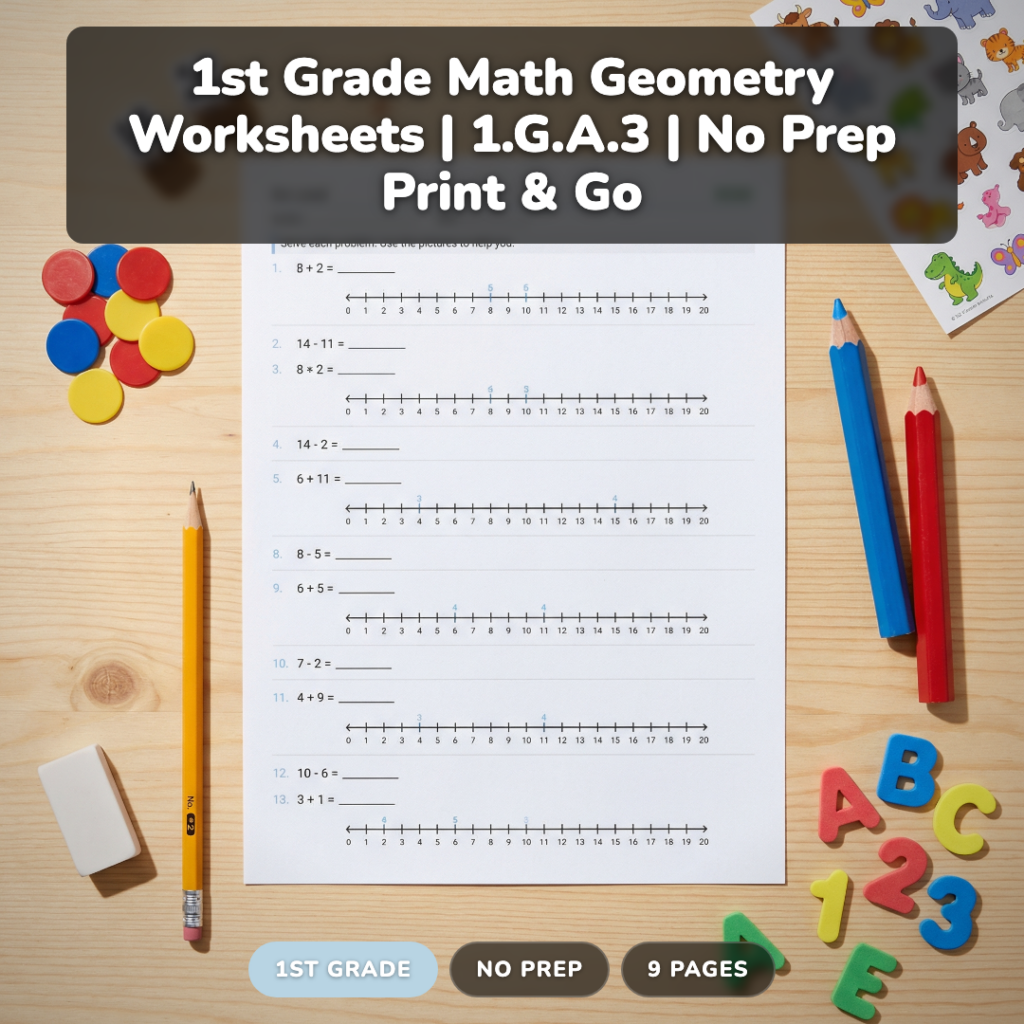
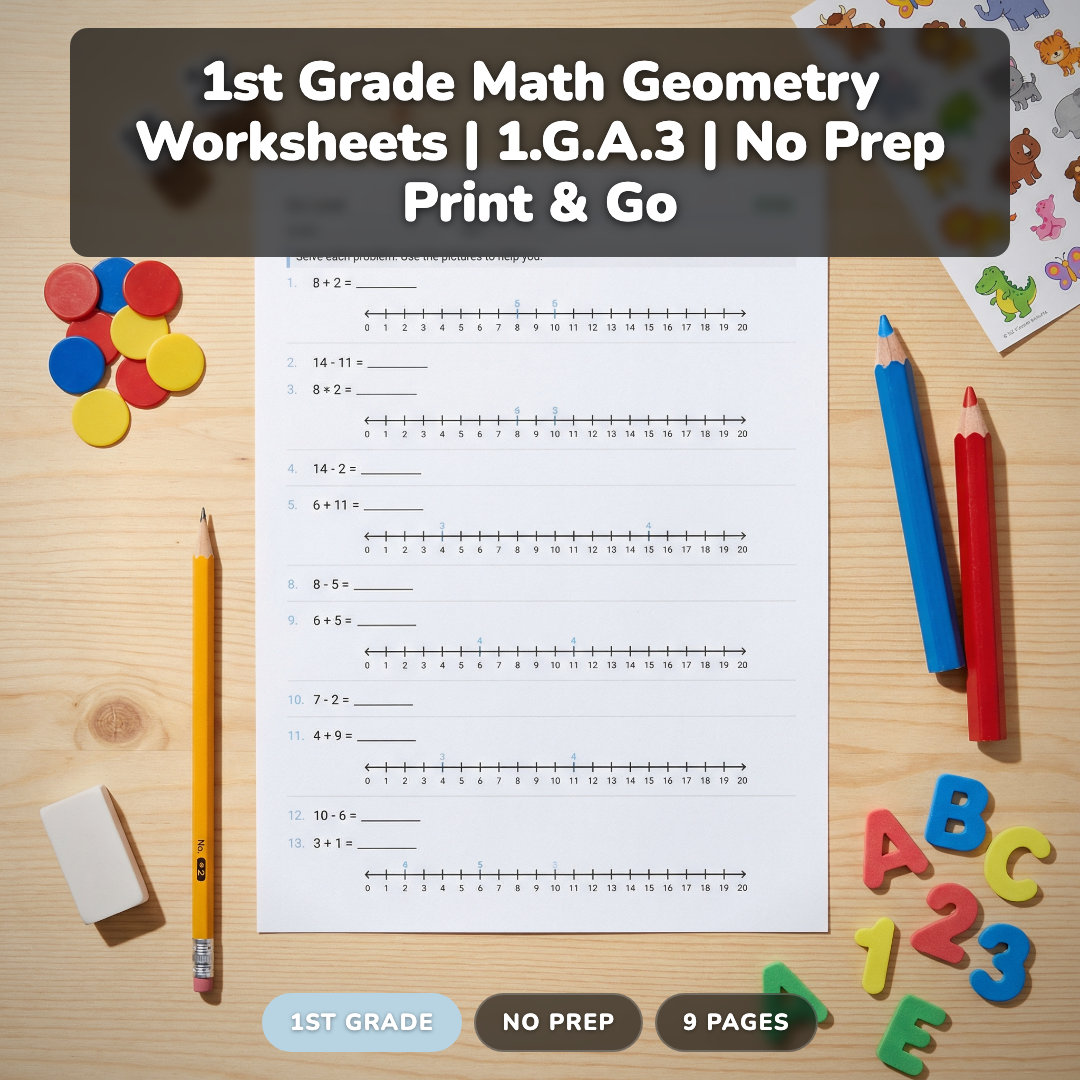
After years of creating geometry materials from scratch, I developed a comprehensive resource that saves you hours of prep time while ensuring every student gets appropriate practice. This 1st Grade Geometry pack includes 106 differentiated problems across 9 pages, specifically designed to address CCSS.Math.Content.1.G.A.3.
What makes this resource different is the three-level approach: Practice level (30 problems) focuses on basic identification of halves and fourths with visual supports. On-Level (40 problems) includes word problems and vocabulary practice. Challenge level (36 problems) extends learning with complex scenarios and multiple solution paths.
Each worksheet includes clear directions, answer keys, and can be used for independent practice, math centers, or homework. The problems progress logically from concrete to abstract, matching how students naturally develop geometric understanding.
The pack covers everything from basic shape partitioning to real-world applications, giving you flexibility to meet every student’s needs without creating multiple resources.
Grab a Free Geometry Sample to Try
Want to see how these strategies work in practice? I’ll send you a free sample worksheet that includes problems from each differentiation level, plus a quick reference guide for teaching vocabulary. Drop your email below and I’ll send it right over.
Frequently Asked Questions About Teaching First Grade Geometry
When should I introduce halves versus fourths in first grade?
Start with halves in January after students master counting to 20. Introduce fourths 2-3 weeks later once halves are solid. Students need time to understand that equal shares must be exactly the same size before adding more complex vocabulary.
How do I help students remember the difference between fourths and quarters?
Explain that fourths and quarters mean exactly the same thing, like how “happy” and “glad” mean the same thing. Use quarters (coins) as a concrete connection — four quarters make one dollar, just like four fourths make one whole.
What’s the biggest mistake teachers make when teaching CCSS.Math.Content.1.G.A.3?
Rushing to worksheets before students have enough hands-on experience. Students need at least 2-3 weeks of manipulating real objects and folding paper before they can successfully complete abstract fraction problems on paper.
How can I assess if students truly understand equal shares?
Ask them to explain why two pieces are or aren’t equal shares. Students who understand will mention that pieces must be “the same size” or “match exactly.” Those who don’t understand will just count pieces without considering equality.
Should first graders learn about thirds or just halves and fourths?
Focus on halves and fourths as required by CCSS.Math.Content.1.G.A.3. Thirds are more abstract and typically introduced in second grade. Mastering halves and fourths thoroughly provides a stronger foundation than surface-level exposure to many fractions.
Teaching geometry in first grade sets the stage for all future fraction learning. Focus on hands-on experiences, use consistent vocabulary, and give students plenty of time to explore equal shares with real objects. The concrete understanding they build now will support them through years of mathematical learning ahead.
What’s your favorite hands-on activity for teaching equal shares? I’d love to hear what works in your classroom — and don’t forget to grab that free sample worksheet above!