If your first graders look confused when you mention “ten ones make one ten,” you’re not alone. Teaching the concept that 10 can be thought of as a bundle of ten ones is one of the most crucial foundational skills in elementary math, yet it’s where many students hit their first real mathematical roadblock.
You’ll walk away from this post with five research-backed strategies that make base ten concepts click for first graders, plus differentiation tips for every learner in your classroom.
Key Takeaway
Students master base ten when they physically manipulate objects to see that ten individual items can be regrouped into one unit of ten.
Why Base Ten Matters in First Grade
The concept addressed by CCSS.Math.Content.1.NBT.B.2a — understanding that 10 can be thought of as a bundle of ten ones — forms the foundation for all future place value learning. Without this understanding, students struggle with two-digit addition, subtraction with regrouping, and even basic multiplication concepts in later grades.
Research from the National Council of Teachers of Mathematics shows that students who master grouping by tens in first grade perform 40% better on place value assessments in second and third grade. This skill typically appears in curriculum around October or November, after students have solid number recognition and counting skills to 20.
The standard specifically focuses on the conceptual understanding that ten individual objects can be bundled together and treated as one unit — a “ten.” This abstract thinking represents a significant cognitive leap for six and seven-year-olds, who are naturally concrete thinkers.
Looking for a ready-to-go resource? I put together a differentiated base ten worksheet pack that covers everything below — but first, the teaching strategies that make it work.
Common Base Ten Misconceptions in 1st Grade
Common Misconception: Students think “ten” is just the number that comes after nine.
Why it happens: They’ve memorized the counting sequence without understanding quantity.
Quick fix: Always pair counting with physical objects they can group and regroup.
Common Misconception: Students see ten individual objects and ten bundled objects as different amounts.
Why it happens: They focus on appearance rather than quantity.
Quick fix: Use the same objects in both forms — show ten loose blocks, then bundle them with a rubber band.
Common Misconception: Students think you “lose” objects when you bundle them.
Why it happens: The bundled objects look different and aren’t individually visible.
Quick fix: Count together before and after bundling to prove the quantity stays the same.
Common Misconception: Students believe that once objects are bundled, they can’t be unbundled.
Why it happens: They see bundling as a permanent change rather than regrouping.
Quick fix: Practice bundling and unbundling the same objects multiple times in one lesson.
5 Research-Backed Strategies for Teaching Base Ten
Strategy 1: Ten Frame Bundling with Counters
This concrete strategy helps students physically see and manipulate the relationship between ten ones and one ten using familiar ten frames.
What you need:
- Ten frames (laminated or drawn on paper)
- Small counters (beans, buttons, or counting bears)
- Small rubber bands or string
- Recording sheet
Steps:
- Give each student a ten frame and 15-20 counters
- Have students fill their ten frame completely with counters
- Ask: “How many counters are in your ten frame?” (Students count to verify ten)
- Show students how to carefully remove all ten counters and bundle them with a rubber band
- Place the bundle next to the empty ten frame and discuss: “This bundle has the same amount as what filled our ten frame”
- Practice unbundling and rebundling several times
- Students record: “10 ones = 1 ten”
Strategy 2: Base Ten Block Exploration
Using manipulatives designed specifically for place value helps students see the mathematical relationship clearly while building toward standard representations.
What you need:
- Base ten blocks (units and rods)
- Recording mats with “ones” and “tens” columns
- Comparison charts
Steps:
- Give students 15 unit blocks and 2 ten rods
- Have students count out exactly ten unit blocks
- Place the ten units next to one ten rod
- Guide students to trace their fingers along both sets while counting
- Ask: “What do you notice?” (Both have ten, but one is bundled)
- Students practice trading: ten units for one rod, one rod for ten units
- Record trades on their mats
Strategy 3: The Bundling Store Game
This engaging partner activity makes bundling practice feel like play while reinforcing the concept through repeated application.
What you need:
- Small objects to “sell” (pasta, blocks, counting bears)
- Rubber bands for bundling
- Play money (optional)
- “Store” signs and price lists
Steps:
- Set up classroom “stores” where items are sold in groups of ten
- Partner A is the customer, Partner B is the store clerk
- Customer asks for a specific number of items (11, 13, 16, etc.)
- Clerk counts out the items and bundles every ten
- Both partners verify the count: “13 is 1 ten and 3 ones”
- Partners switch roles and repeat
- Students record their purchases on a chart
Strategy 4: Number Line Jumping by Tens
This visual-kinesthetic approach helps students see tens as single units while connecting to number patterns they’ll use throughout elementary math.
What you need:
- Floor number line (0-30) with masking tape
- Individual number lines (paper copies)
- Jumping markers or small toys
- Recording sheets
Steps:
- Students start at zero on the floor number line
- Demonstrate one big jump that lands on 10
- Explain: “One jump of ten is the same as ten jumps of one”
- Students practice jumping by tens: 0 to 10, 10 to 20
- Compare with taking ten individual steps from 0 to 10
- Transfer to paper number lines with markers
- Students draw and record their jumps
Strategy 5: Ten Stick Construction
Students create their own manipulatives while internalizing the concept that ten individual items can become one unit.
What you need:
- Craft sticks or straws
- Rubber bands
- Counting objects (beans, buttons)
- Construction paper
- Glue sticks
Steps:
- Students count out exactly ten craft sticks
- Bundle the ten sticks together with a rubber band
- Create a “ten stick” by gluing ten objects in a line on paper
- Compare their bundled sticks to individual sticks
- Use their ten sticks to build larger numbers (2 tens = 20, 3 tens = 30)
- Students explain their creations to a partner
- Display ten sticks as classroom reference tools
How to Differentiate Base Ten for All Learners
For Students Who Need Extra Support
Begin with smaller groupings before tackling ten. Practice making groups of 5 using five frames, then gradually work up to 10. Use larger manipulatives that are easier to handle, like large counting bears or blocks. Provide extra time for physical manipulation before moving to abstract representations. Review prerequisite skills like counting to 20 and recognizing the numeral 10. Use consistent language: always say “ten ones” rather than just “ten” when referring to individual objects.
For On-Level Students
Students at grade level should master CCSS.Math.Content.1.NBT.B.2a through varied practice with different materials. They can work with numbers 10-19, understanding each as “1 ten and some ones.” Provide opportunities to explain their thinking verbally and in writing. Use standard base ten blocks alongside creative materials like bundled straws or grouped toys. Students should comfortably move between concrete manipulatives and pictorial representations by mid-year.
For Students Ready for a Challenge
Advanced students can explore what happens with larger quantities — what would 30 objects look like bundled? Can they find different ways to group the same number of objects? Introduce early concepts of hundreds by showing that ten bundles of ten make 100. Connect base ten to money concepts using dimes and pennies. Challenge them to create word problems for classmates involving bundling and unbundling scenarios.
A Ready-to-Use Base Ten Resource for Your Classroom
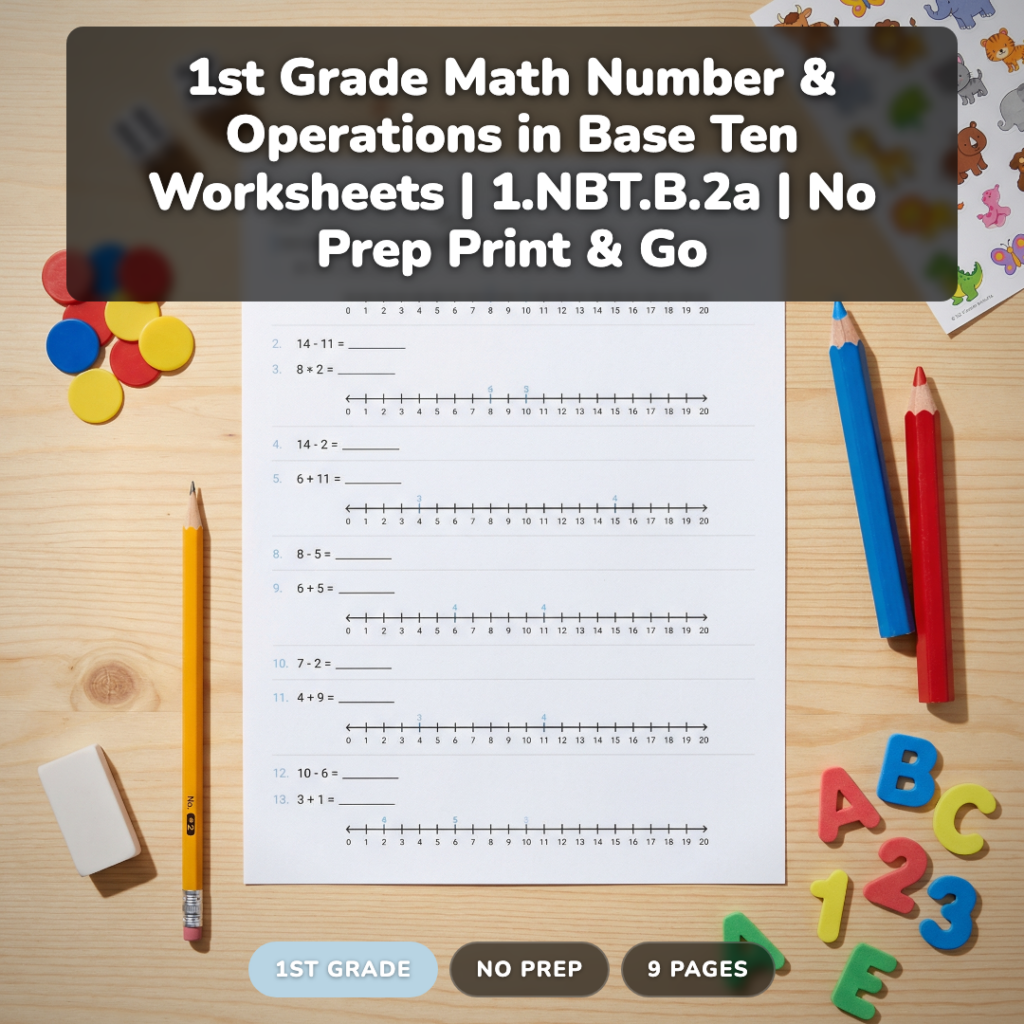
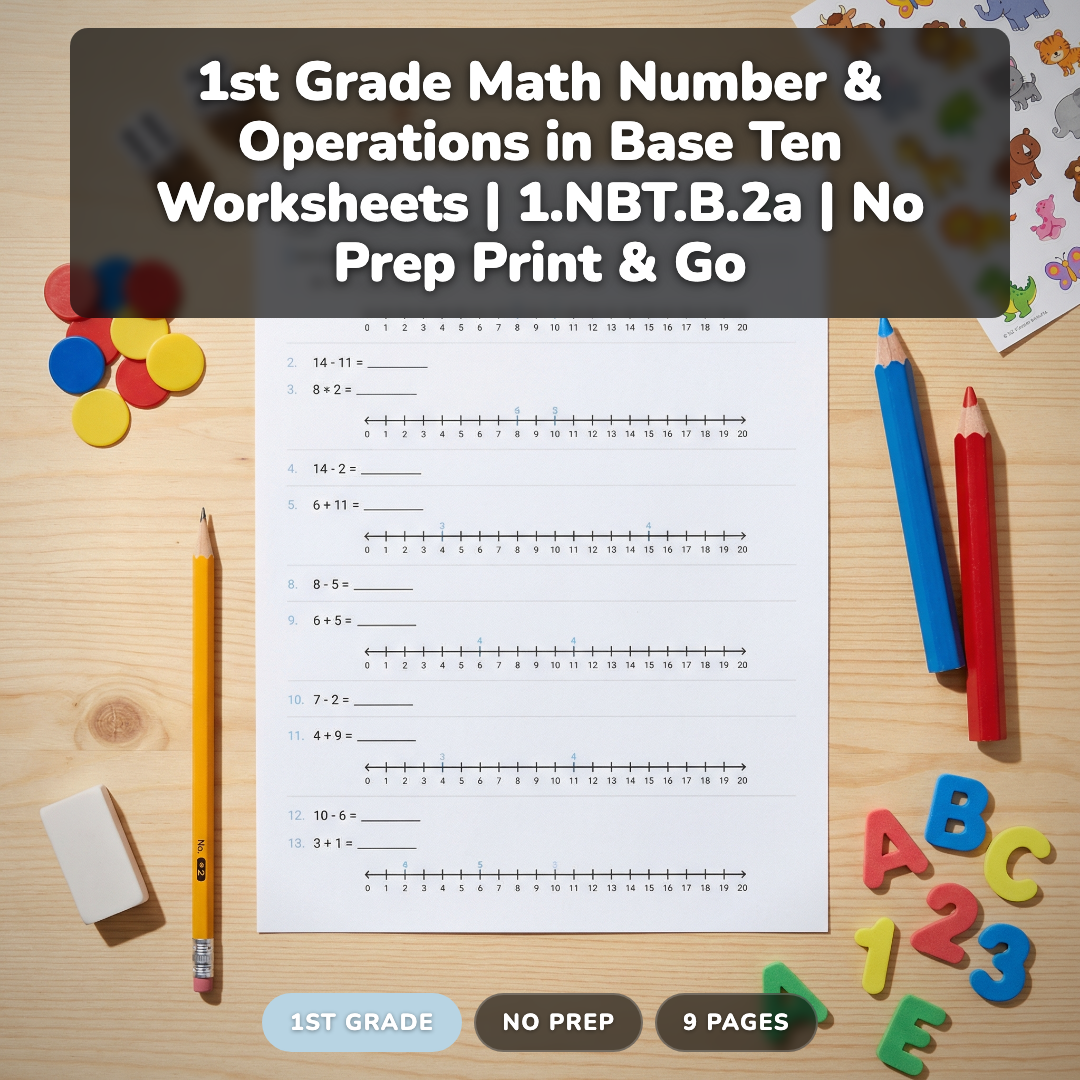
After years of creating base ten activities from scratch, I put together a comprehensive worksheet pack that covers all the differentiation levels your classroom needs. This 9-page resource includes 106 carefully designed problems across three difficulty levels: Practice (30 problems), On-Level (40 problems), and Challenge (36 problems).
What makes this resource different is the thoughtful progression within each level. Practice problems focus on visual bundling with clear illustrations. On-Level problems mix concrete and abstract representations. Challenge problems push students to apply base ten concepts in problem-solving contexts. Each level includes answer keys, and the problems align perfectly with CCSS.Math.Content.1.NBT.B.2a.
The worksheets save you hours of prep time while ensuring every student gets appropriate practice. Students can work independently once you’ve taught the concepts using the strategies above.
Grab a Free Base Ten Sample to Try
Want to see how the differentiated practice works? I’ll send you a free sample page from each difficulty level, plus a quick reference guide for teaching base ten concepts. Perfect for trying out the format with your students before diving into the full resource.
Frequently Asked Questions About Teaching Base Ten
When should I introduce base ten concepts in first grade?
Most first graders are ready for base ten concepts in October or November, after they can reliably count to 20 and recognize numbers 1-10. Students need solid one-to-one correspondence and basic addition facts to 10 before tackling bundling concepts successfully.
What if students understand ten frames but struggle with base ten blocks?
This is common because ten frames show individual spaces while base ten blocks show connected units. Bridge the gap by using loose objects first, then connecting cubes, then standard base ten blocks. The progression helps students see the relationship between separate and connected representations.
How long does it take students to master the “ten ones = one ten” concept?
Most first graders need 3-4 weeks of consistent practice with concrete manipulatives before the concept becomes automatic. Struggling students may need 6-8 weeks. The key is daily practice with physical objects before moving to worksheets or abstract problems.
Should I teach base ten before or after addition and subtraction?
Teach basic addition and subtraction facts to 10 first, then introduce base ten concepts. Students need to understand that 10 is a quantity before they can understand it as a unit. However, base ten understanding will strengthen their addition and subtraction skills significantly.
What’s the difference between CCSS.Math.Content.1.NBT.B.2a and 1.NBT.B.2b?
Standard 1.NBT.B.2a focuses on understanding that 10 can be thought of as a bundle of ten ones. Standard 1.NBT.B.2b extends this to numbers 11-19, understanding them as ten ones and some more ones. Teach 2a thoroughly before moving to 2b.
Teaching base ten concepts successfully sets your first graders up for place value success throughout elementary school. The key is providing plenty of concrete experiences before moving to abstract representations.
What’s your go-to strategy for helping students understand that ten ones make one ten? I’d love to hear what works in your classroom! And don’t forget to grab your free base ten sample above — it’s a great way to test these concepts with your students.