If your 5th graders freeze when they see a word problem about multiplying fractions, you’re not alone. This skill — solving real-world problems with fraction multiplication — trips up even strong math students because it combines computational fluency with problem-solving reasoning.
You need strategies that help students visualize what’s happening when they multiply fractions, not just memorize algorithms. Here’s how to make fraction multiplication click for every learner in your classroom.
Key Takeaway
Students master fraction multiplication when they understand it as “finding a part of a part” through visual models before moving to abstract computation.
Why Fraction Multiplication Matters in 5th Grade
Fraction multiplication sits at a crucial intersection in 5th grade mathematics. Students need this skill to tackle real-world scenarios like cooking (“I need 2/3 of a recipe that calls for 3/4 cup flour”) and measurement problems (“What’s the area of a garden that’s 2 1/2 feet by 1 3/4 feet?”).
The CCSS.Math.Content.5.NF.B.6 standard specifically requires students to solve real-world problems involving multiplication of fractions and mixed numbers using visual models or equations. This isn’t just about computation — it’s about mathematical reasoning and representation.
Research from the National Council of Teachers of Mathematics shows that students who learn fraction operations through visual models perform 23% better on problem-solving assessments than those who learn algorithms first. The key is helping students see that multiplying fractions means “taking a fractional part of another fractional part.”
Timing matters too. Most curricula introduce this concept in January or February, after students have solid foundations in equivalent fractions and fraction addition/subtraction. Students need to understand what fractions represent before they can multiply them meaningfully.
Looking for a ready-to-go resource? I put together a differentiated fraction multiplication pack with 132 problems across three levels — but first, the teaching strategies that make it work.
Common Fraction Multiplication Misconceptions in 5th Grade
Common Misconception: “When you multiply fractions, the answer gets bigger.”
Why it happens: Students apply whole number multiplication rules to fractions.
Quick fix: Use the phrase “part of a part” and show 1/2 × 1/4 with visual models.
Common Misconception: “You multiply the denominators and add the numerators.”
Why it happens: Students mix up addition and multiplication algorithms.
Quick fix: Emphasize “multiply across” with consistent language and visual arrays.
Common Misconception: “Mixed numbers can’t be multiplied.”
Why it happens: Students don’t see the connection between mixed numbers and improper fractions.
Quick fix: Convert to improper fractions first, then show the same problem with area models.
Common Misconception: “Word problems with fractions are impossible.”
Why it happens: Students can’t visualize fractional parts in real contexts.
Quick fix: Start with simple contexts like pizza or chocolate bars before moving to abstract scenarios.
5 Research-Backed Strategies for Teaching Fraction Multiplication
Strategy 1: Area Models with Grid Paper
Area models help students visualize multiplication as finding the overlap between two fractional parts. This concrete representation makes the abstract algorithm meaningful and supports students who need to see math concepts spatially.
What you need:
- Grid paper or fraction tiles
- Colored pencils or crayons
- Document camera for modeling
Steps:
- Draw a rectangle and divide it to show the first fraction (e.g., shade 2/3 horizontally)
- Divide the same rectangle to show the second fraction (e.g., divide into fourths vertically)
- Count the overlapping shaded squares to find the product
- Write the equation: 2/3 × 1/4 = 2/12 = 1/6
- Connect to the algorithm: multiply numerators, multiply denominators
Strategy 2: Real-World Recipe Problems
Cooking contexts make fraction multiplication concrete and relevant. Students can physically measure ingredients when possible, connecting mathematical operations to practical applications they’ll use outside school.
What you need:
- Simple recipe cards
- Measuring cups and spoons (if available)
- Calculator for checking work
Steps:
- Present a recipe problem: “This recipe serves 8, but we need to serve 6. How much flour do we need if the recipe calls for 3/4 cup?”
- Help students identify the multiplication: 3/4 × 3/4 (since 6 is 3/4 of 8)
- Solve using visual models first, then the algorithm
- Check the answer with measuring cups if possible
- Extend to mixed number recipes for challenge
Strategy 3: Fraction Multiplication Stories
Story problems help students understand when to multiply fractions in real contexts. This strategy builds the problem-solving component required by CCSS.Math.Content.5.NF.B.6 while developing mathematical communication skills.
What you need:
- Story problem templates
- Manipulatives for modeling
- Anchor chart for problem-solving steps
Steps:
- Read the problem aloud: “Maya ate 1/3 of a pizza. The pizza was 3/4 pepperoni. What fraction of the whole pizza was pepperoni that Maya ate?”
- Identify key information and what we’re finding
- Draw or model the situation (circle for pizza, shade parts)
- Write the equation: 1/3 × 3/4
- Solve and check if the answer makes sense in context
Strategy 4: Pattern Recognition with Unit Fractions
Starting with unit fractions (fractions with 1 in the numerator) helps students discover patterns in fraction multiplication before tackling more complex problems. This builds number sense and computational fluency simultaneously.
What you need:
- Fraction strips or circles
- Pattern recording sheet
- Colored markers
Steps:
- Start with 1/2 × 1/2, 1/2 × 1/3, 1/2 × 1/4 using manipulatives
- Record results in a table to spot patterns
- Notice that 1/a × 1/b = 1/(a×b)
- Extend to non-unit fractions: 2/3 × 1/4 = 2/12
- Connect patterns to the standard algorithm
Strategy 5: Estimation and Reasonableness Checks
Teaching students to estimate fraction products builds number sense and helps them catch computational errors. This strategy emphasizes the problem-solving and reasoning components of the standard.
What you need:
- Number line displays
- Estimation recording sheets
- Calculators for verification
Steps:
- Before solving, estimate: “Is 3/4 × 2/5 closer to 0, 1/2, or 1?”
- Use benchmark reasoning: 3/4 is close to 1, 2/5 is less than 1/2
- Predict: “The answer should be less than 3/4 but more than 0”
- Solve the problem using chosen method
- Check if the answer (6/20 = 3/10) matches the estimate
How to Differentiate Fraction Multiplication for All Learners
For Students Who Need Extra Support
Start with concrete manipulatives and unit fractions. Use fraction strips, circles, or tiles to make the “part of a part” concept visible. Focus on problems where one factor is a unit fraction (1/2, 1/3, 1/4) before introducing larger numerators. Provide multiplication charts and encourage drawing pictures for every problem. Review equivalent fractions and simplifying before introducing multiplication algorithms.
For On-Level Students
Balance visual models with algorithmic practice. Students should be comfortable with area models and can begin working with mixed numbers by converting to improper fractions first. Introduce real-world contexts like recipes, measurement, and simple geometry problems. Focus on explaining their reasoning and checking answers for reasonableness using estimation strategies.
For Students Ready for a Challenge
Extend to complex word problems involving multiple steps and mixed numbers. Introduce connections to area and volume calculations. Have students create their own fraction multiplication story problems and solve them using multiple methods. Connect to decimal multiplication and explore patterns between fraction and decimal representations of the same problems.
A Ready-to-Use Fraction Multiplication Resource for Your Classroom
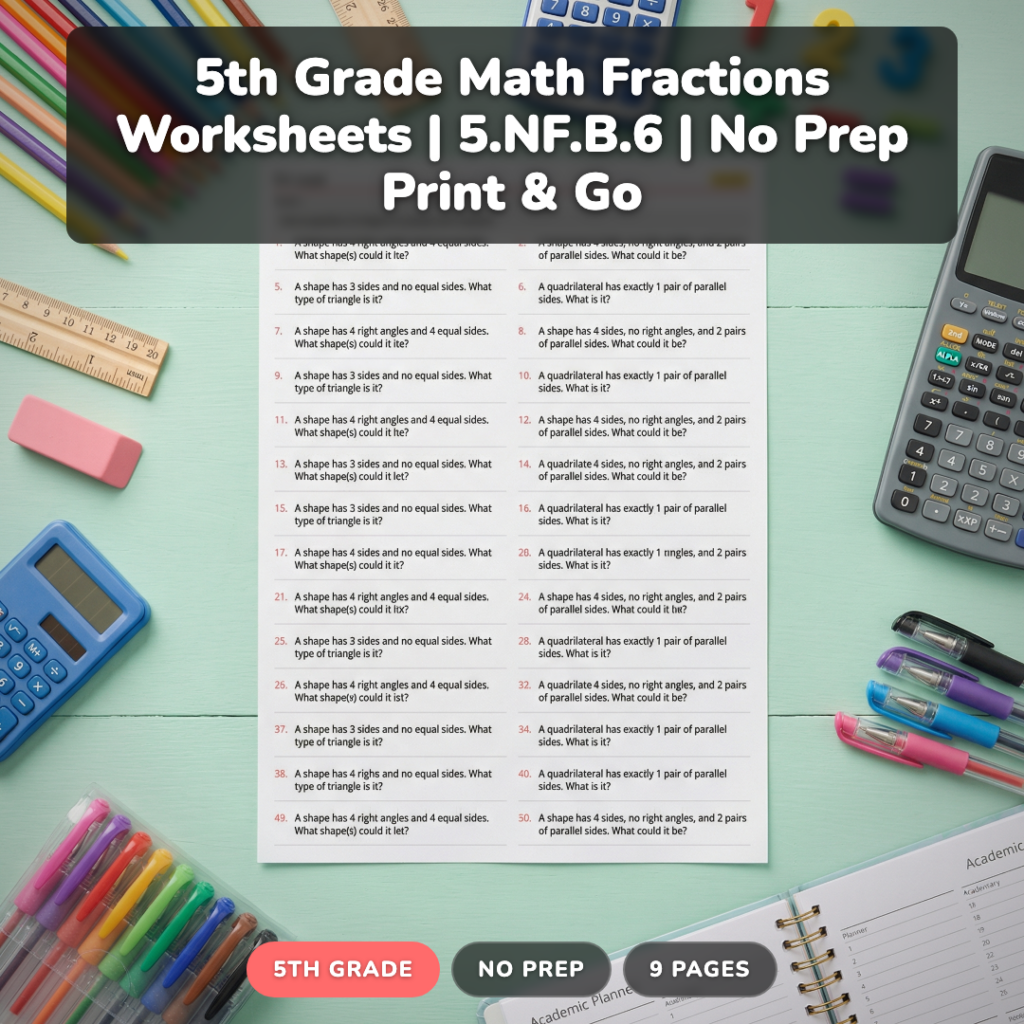
Teaching fraction multiplication effectively requires a lot of differentiated practice problems — more than most textbooks provide. That’s why I created a comprehensive fraction multiplication worksheet pack specifically aligned to CCSS.Math.Content.5.NF.B.6.
This resource includes 132 carefully crafted problems across three difficulty levels: 37 practice problems for students building foundational understanding, 50 on-level problems for grade-level expectations, and 45 challenge problems for students ready to extend their learning. Each level includes real-world contexts, visual model prompts, and mixed number applications.
What makes this different from generic fraction worksheets? Every problem is designed to build conceptual understanding alongside computational fluency. The practice level focuses on unit fractions and simple contexts, the on-level problems mirror standardized test formats, and the challenge level connects to measurement and geometry applications.
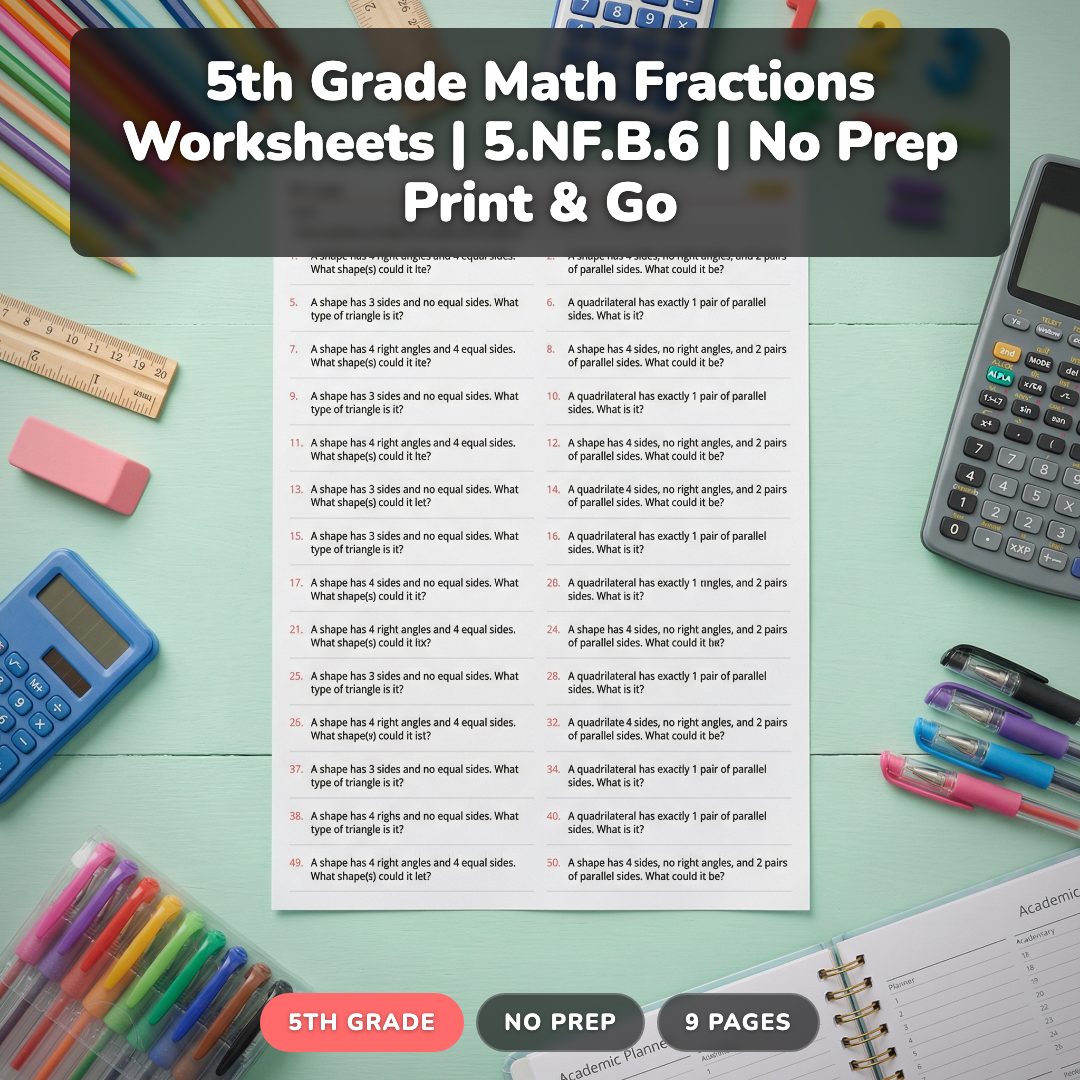
The pack includes answer keys for all levels plus teaching notes for common misconceptions. It’s completely no-prep — just print and go.
Grab a Free Fraction Multiplication Sample to Try
Want to see how these strategies work in practice? I’ll send you a free sample worksheet with problems from each difficulty level, plus a visual model template you can use with any fraction multiplication problem.
Frequently Asked Questions About Teaching Fraction Multiplication
When should I introduce the standard algorithm for multiplying fractions?
Introduce the algorithm after students understand multiplication as “part of a part” through visual models. Most students are ready for the algorithm after 3-4 weeks of concrete and visual work, typically in late February or early March.
How do I help students who confuse fraction addition and multiplication rules?
Use consistent language: “add across the top, keep the bottom the same” for addition versus “multiply across” for multiplication. Color-code operations differently and provide visual anchors showing the difference between combining parts and finding parts of parts.
Should students simplify fractions before or after multiplying?
Both approaches work, but simplifying before multiplying often creates smaller, more manageable numbers. Teach cross-canceling as an efficiency strategy for students comfortable with the basic algorithm, typically in late 5th grade or 6th grade.
What’s the best way to connect fraction multiplication to real-world contexts?
Start with familiar contexts like food (pizza, chocolate bars) and recipes, then expand to measurement, crafts, and simple geometry. Ensure problems have realistic numbers and contexts students can visualize or experience directly.
How do I assess student understanding beyond computational accuracy?
Use problems that require explanation, estimation, or multiple solution methods. Ask students to draw models, explain their reasoning, or create their own word problems. Look for understanding of when the product is larger or smaller than the factors.
Fraction multiplication becomes manageable when students understand the underlying concept before memorizing procedures. Focus on visual models, real-world connections, and building number sense — the computational fluency will follow naturally.
What’s your biggest challenge when teaching fraction multiplication? The visual strategies above have transformed how my students approach these problems.