If your fourth graders freeze when they see angle problems or think every corner is a “90-degree angle,” you’re not alone. Teaching angle measurement can feel abstract to students who are just beginning to understand that angles have precise measurements beyond “big” or “small.” You need concrete strategies that help students visualize, measure, and understand what it really means when we say an angle measures a specific number of degrees.
Key Takeaway
Students master angle measurement when they connect the abstract concept of degrees to concrete experiences with turning and rotation.
Why Angle Measurement Matters in Fourth Grade
Fourth grade marks a critical transition in mathematical thinking. Students move from informal geometry (“this looks like a square”) to formal measurement and classification. CCSS.Math.Content.4.MD.C.5b specifically requires students to understand that “an angle that turns through n one-degree angles is said to have an angle measure of n degrees.”
This standard builds the foundation for protractor use in fifth grade and connects directly to fraction concepts students are learning simultaneously. Research from the National Council of Teachers of Mathematics shows that students who develop strong spatial reasoning skills in elementary grades perform 23% better on geometry assessments in middle school.
The timing is crucial: introduce angle measurement in late fall after students have solidified their understanding of fractions and before diving into more complex geometric concepts in spring. This skill directly supports standards 4.MD.C.6 (measuring angles with protractors) and prepares students for 5.G.A.1 (classifying geometric figures by properties).
Looking for a ready-to-go resource? I put together a differentiated angle measurement pack that covers everything below — but first, the teaching strategies that make it work.
Common Angle Misconceptions in Fourth Grade
Common Misconception: Students think angle size depends on the length of the rays.
Why it happens: They focus on what they can see (the drawn lines) rather than the invisible rotation between rays.
Quick fix: Use paper plates with moveable rays to show that angle size stays the same regardless of ray length.
Common Misconception: All corners are “right angles” or “90 degrees.”
Why it happens: Most classroom objects have right angles, so students overgeneralize from their environment.
Quick fix: Create an “angle hunt” around school to find acute and obtuse angles in unexpected places.
Common Misconception: Degrees are just numbers without meaning.
Why it happens: Students memorize angle measurements without connecting them to actual rotation or turning.
Quick fix: Start every angle lesson with physical turning — have students rotate their bodies through different degree measurements.
Common Misconception: Angles can only open to the right.
Why it happens: Most textbook examples show angles in standard position with the vertex at the bottom left.
Quick fix: Present angles in multiple orientations from day one, including upside-down and sideways examples.
5 Research-Backed Strategies for Teaching Angle Measurement
Strategy 1: Human Protractor Method
Transform your students into living angle measurers by using their bodies as reference points. This kinesthetic approach helps students internalize what different degree measurements actually feel like before they encounter abstract numbers.
What you need:
- Masking tape for floor markings
- Large circle template (hula hoop works perfectly)
- Degree reference cards (30°, 45°, 60°, 90°, 120°, 150°)
- Clipboard for recording observations
Steps:
- Create a large circle on the floor using masking tape, marking 0°, 90°, 180°, 270° positions clearly
- Have one student stand at the center as the “vertex” with arms extended as rays
- Start with both arms pointing to 0° (straight ahead), then slowly rotate one arm to create different angles
- Call out degree measurements and have students predict where the arm should point
- Check predictions by having the “vertex student” actually turn to that position
- Switch roles so every student experiences being the angle vertex
Strategy 2: Paper Plate Angle Builders
Give students concrete tools to construct and measure angles using everyday materials. This hands-on approach makes the abstract concept of degree measurement tangible and manipulatable.
What you need:
- Paper plates (2 per student)
- Brass fasteners
- Colored pencils or markers
- Pre-marked degree templates
- Angle measurement recording sheets
Steps:
- Pre-mark one paper plate with degree measurements around the edge (every 10 degrees)
- Cut a small slit from the center to the edge on the second plate
- Attach plates with a brass fastener so the top plate can rotate
- Students use the slit as one ray and align it with degree markings to create specific angles
- Practice building angles from verbal descriptions (“Show me 45 degrees”)
- Progress to estimating unknown angles, then checking with their plate protractor
Strategy 3: Clock Connection Method
Bridge students’ existing knowledge of analog clocks to angle measurement. Since students already understand that clock hands move in predictable patterns, this connection makes degree measurement more intuitive and relatable.
What you need:
- Large demonstration clock with moveable hands
- Individual student clocks or clock worksheets
- “Clock angle” reference chart
- Timer for time-based activities
Steps:
- Review that a full clock rotation equals 360°, making each hour mark worth 30°
- Start with simple times: 3:00 (90°), 6:00 (180°), 9:00 (270°)
- Show students how to calculate angles for any time by counting hour marks
- Practice with half-hour times (1:30, 4:30) to introduce 15° increments
- Challenge students to create specific angles by setting clock times
- Connect back to standard angle notation by drawing the same angles without clock numbers
Strategy 4: Angle Estimation Games
Develop students’ number sense for angles through structured estimation activities. This approach builds intuitive understanding before formal measurement and helps students develop benchmarks for common angle sizes.
What you need:
- Angle cards with various measurements
- “Estimation vs. Actual” recording sheets
- Small prizes or stickers for close estimates
- Timer for quick-fire rounds
Steps:
- Show an angle without the degree measurement visible
- Students write their estimation on individual whiteboards
- Reveal the actual measurement and discuss whose estimates were closest
- Keep a class chart of “benchmark angles” students can reference (45° = half of a right angle)
- Progress from static pictures to angles students create with manipulatives
- End each session by having students explain their estimation strategies
Strategy 5: Real-World Angle Hunt
Connect angle measurement to students’ everyday environment by identifying and measuring angles in familiar objects. This strategy helps students see geometry as relevant and applicable beyond the classroom.
What you need:
- Digital cameras or smartphones
- Angle measurement apps or simple protractors
- “Angle Hunt” recording sheets
- Clipboards for outdoor exploration
Steps:
- Start indoors with obvious examples: door hinges, book covers, scissors
- Students photograph or sketch angles they find, estimating the measurement
- Use simple tools to verify estimates and discuss why certain angles are common in construction
- Expand to outdoor exploration: playground equipment, building corners, tree branches
- Create a class collection of “interesting angles” with photos and measurements
- Discuss why certain angle measurements appear frequently in human-made vs. natural objects
How to Differentiate Angle Measurement for All Learners
For Students Who Need Extra Support
Begin with concrete experiences before introducing degree measurements. Use large motor movements—have students physically turn their bodies through different angles while counting. Provide reference charts showing common angles (30°, 45°, 60°, 90°) with visual examples. Focus on benchmark angles first: right angles (90°), straight lines (180°), and full rotations (360°). Use manipulatives like paper plates and brass fasteners for hands-on angle construction. Scaffold with guided practice using angles that are multiples of 30° before introducing more complex measurements.
For On-Level Students
Students work with the full range of CCSS.Math.Content.4.MD.C.5b expectations, understanding that angles measure the amount of rotation between two rays. They should estimate angles to the nearest 10°, identify acute, right, and obtuse angles, and explain their reasoning using mathematical vocabulary. Provide opportunities to measure angles in multiple orientations and connect angle measurement to fraction concepts (a 90° angle is 1/4 of a full rotation). Use real-world applications like clock problems and simple geometric figures to reinforce learning.
For Students Ready for a Challenge
Introduce reflex angles (greater than 180°) and help students understand that angles can measure up to 360°. Challenge them to find angle measurements in complex geometric figures and explore how angles relate to polygon properties. Have them create their own angle measurement problems for classmates to solve. Connect angle concepts to coordinate geometry by exploring angles in different quadrants. Introduce the concept that multiple angles can share the same vertex and discuss angle relationships like complementary and supplementary pairs.
A Ready-to-Use Angle Measurement Resource for Your Classroom
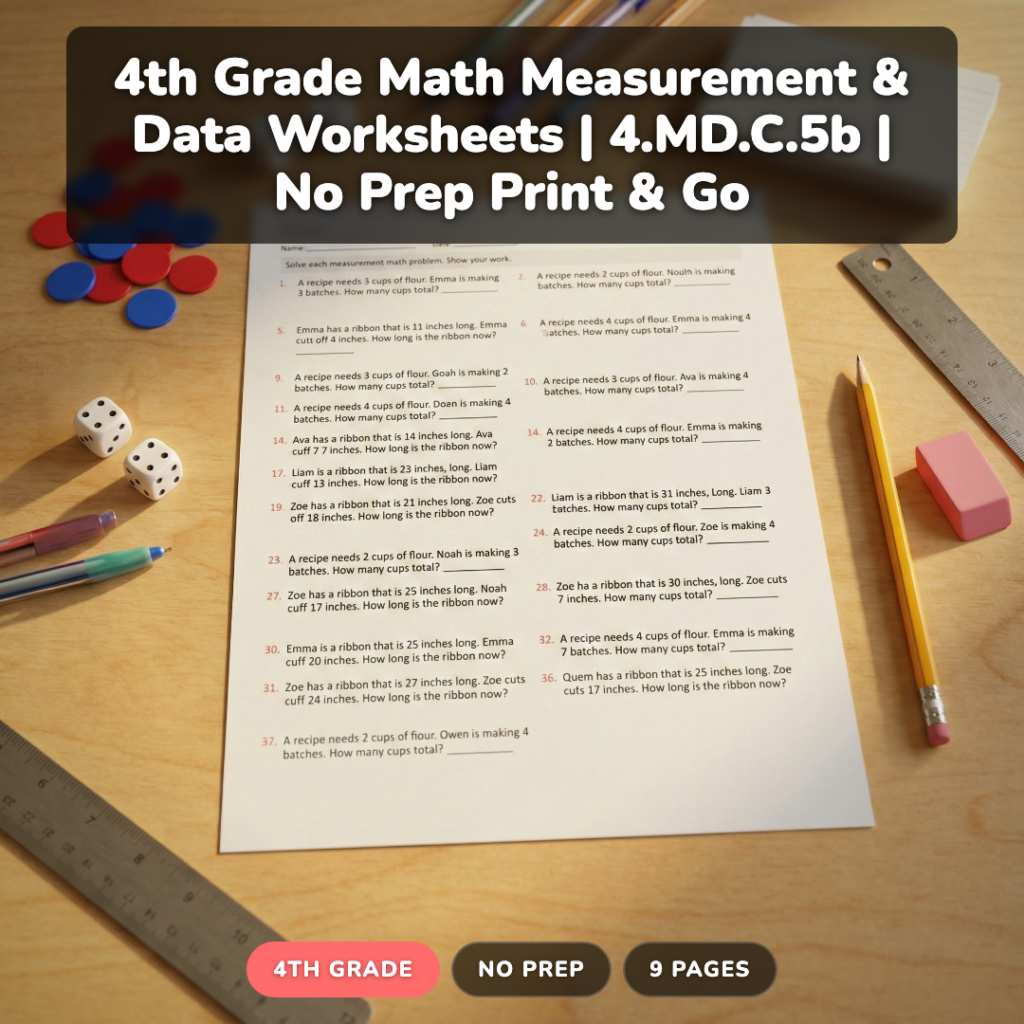
After teaching angle measurement for several years, I created a comprehensive resource that saves you hours of prep time while providing exactly the differentiated practice your students need. This 9-page angle measurement pack includes 132 carefully crafted problems across three difficulty levels.
The Practice level (37 problems) focuses on benchmark angles and basic angle identification, perfect for students who need extra support with foundational concepts. The On-Level section (50 problems) covers the full scope of CCSS.Math.Content.4.MD.C.5b with varied angle orientations and real-world applications. The Challenge level (45 problems) extends learning with reflex angles, angle relationships, and complex problem-solving scenarios.
What makes this resource different is the intentional progression within each level—problems start simple and gradually increase in complexity, building student confidence while maintaining appropriate challenge. Each section includes answer keys with common student errors highlighted, so you can address misconceptions quickly during instruction.
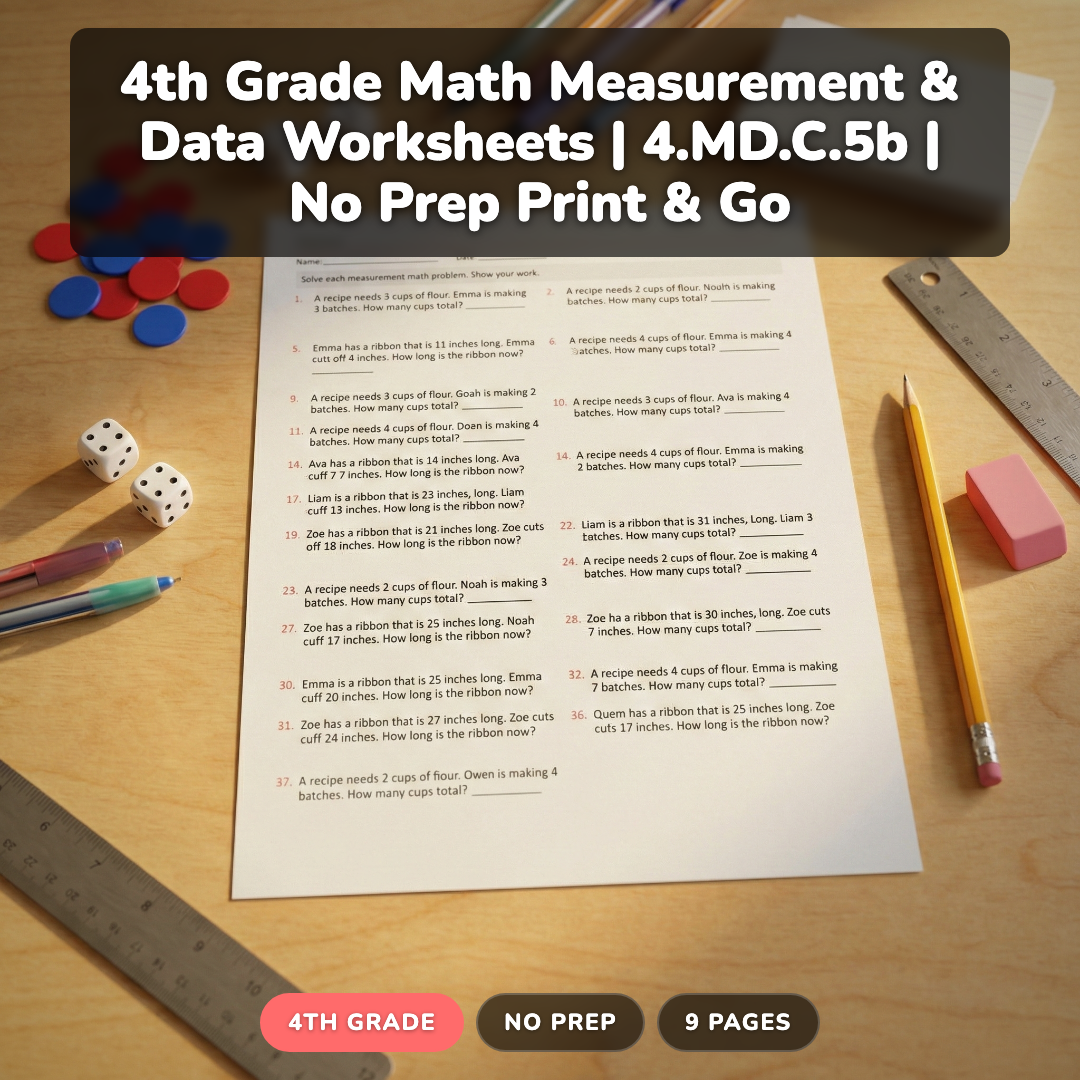
The resource is completely no-prep—just print and go. Perfect for math centers, homework, assessment prep, or substitute teacher plans.
Grab a Free Angle Measurement Sample to Try
Want to see how these strategies work in practice? I’ll send you a free sample from the angle measurement pack, including one problem from each difficulty level plus a quick reference guide for teaching angle vocabulary. Perfect for trying out the format with your students before committing to the full resource.
Frequently Asked Questions About Teaching Angle Measurement
When should I introduce protractors in fourth grade?
Wait until students understand that angles measure rotation, not ray length. Typically introduce protractors in spring after students master angle estimation and understand degree measurement conceptually. CCSS.Math.Content.4.MD.C.5b focuses on understanding degrees, while protractor use appears in 4.MD.C.6.
How do I help students who confuse acute and obtuse angles?
Use memory devices: “acute” sounds like “a cute” little angle (less than 90°), while “obtuse” sounds like “obvious” because obtuse angles are obviously bigger than right angles. Practice with benchmark comparisons rather than memorizing definitions.
What’s the biggest mistake teachers make when teaching angles?
Starting with protractors before students understand what degrees represent. Students need concrete experiences with rotation and turning before abstract measurement tools make sense. Build conceptual understanding first, then introduce measurement tools.
How can I connect angle measurement to other fourth grade math topics?
Link angles to fractions (90° is 1/4 of 360°), multiplication (6 × 30° = 180°), and time (clock angles). These connections help students see mathematics as interconnected rather than isolated skills and strengthen number sense.
Should fourth graders learn about angles greater than 180 degrees?
The standard focuses on basic angle measurement, but advanced students benefit from exploring reflex angles. Introduce them as extensions for students who master standard content, connecting to full rotations and multiple turns.
Building Strong Angle Foundations
Remember that angle measurement success comes from connecting abstract degree concepts to concrete experiences students can feel and see. Start with movement, build understanding through manipulation, then progress to formal measurement and problem-solving.
What’s your favorite strategy for helping students visualize angle measurement? I’d love to hear how these approaches work in your classroom. Don’t forget to grab your free angle measurement sample above—it’s a great way to test these strategies with your students.