If your fourth graders look confused when you mention angles and degrees, you’re not alone. Teaching the concept that angles are fractions of a circle — and that we measure them in 360 tiny pieces called degrees — requires concrete experiences before abstract understanding clicks.
You’ll discover five research-backed strategies that help students visualize angles as parts of circles, understand why we use 360 degrees, and confidently measure angles using this foundational concept.
Key Takeaway
Students master angle measurement when they see angles as fractions of a circle’s rotation, starting with concrete experiences before moving to abstract degree measurements.
Why 4th Grade Angle Understanding Matters
The CCSS.Math.Content.4.MD.C.5a standard establishes the foundation for all future geometry work by defining angles as fractions of circular arcs. This conceptual understanding directly impacts students’ success with protractor use, geometric reasoning, and even trigonometry in high school.
Research from the National Council of Teachers of Mathematics shows that students who develop strong angle sense in elementary grades perform 34% better on high school geometry assessments. The key insight: angles aren’t just corner shapes — they’re rotational measurements based on circular motion.
This standard typically appears in late fall or early spring, after students have mastered fraction concepts in CCSS.Math.Content.4.NF standards. Students need solid understanding of fractions like 1/4, 1/2, and 1/360 before tackling angle measurement.
Looking for a ready-to-go resource? I put together a differentiated angles practice pack that covers everything below — but first, the teaching strategies that make it work.
Common Angle Misconceptions in 4th Grade
Common Misconception: Students think bigger-looking angles are always larger in measurement.
Why it happens: They focus on ray length instead of the amount of rotation between rays.
Quick fix: Use paper plates to show that rotation amount stays the same regardless of ray length.
Common Misconception: Students believe angles are measured by the space inside them.
Why it happens: They confuse area concepts with rotational measurement.
Quick fix: Demonstrate with a door opening — the angle is the turn, not the space.
Common Misconception: Students think 360 degrees is arbitrary and meaningless.
Why it happens: They haven’t connected degrees to circular fractions.
Quick fix: Show that 360 comes from dividing a circle into 360 equal pieces, like slicing a pizza into tiny wedges.
Common Misconception: Students assume all corners are 90-degree angles.
Why it happens: Most classroom objects have right angles, limiting their angle exposure.
Quick fix: Collect objects with various angles and compare them to quarter-circle rotations.
5 Research-Backed Strategies for Teaching Angles
Strategy 1: Paper Plate Circle Fractions
Students create physical angle models using paper plates to see the direct connection between fractions and degrees. This concrete approach helps students visualize why angles are measured as parts of a complete 360-degree rotation.
What you need:
- Paper plates (2 per student)
- Brass fasteners
- Scissors
- Markers in different colors
- Fraction reference chart
Steps:
- Cut a wedge from one plate, starting small (like 1/12 of the circle)
- Attach the cut plate over a whole plate with a brass fastener at center
- Rotate the top plate to show different angle sizes
- Mark common fractions: 1/4 (90°), 1/2 (180°), 1/8 (45°)
- Connect each fraction to its degree measurement
- Have students predict degree measures for new positions
Strategy 2: Body Rotation Angle Theater
Students use their bodies to act out different angle measurements, physically experiencing the rotational nature of angles. This kinesthetic approach reinforces that angles measure turns, not shapes or spaces.
What you need:
- Masking tape for floor markers
- Angle reference cards (90°, 180°, 270°, 360°)
- Timer
- Recording sheet for observations
Steps:
- Create a large circle on the floor with tape
- Student stands at center, facing 12 o’clock position
- Call out fraction rotations: “Turn 1/4 of the way around”
- Student rotates and freezes, class identifies the degree measure
- Progress from simple fractions (1/2, 1/4) to complex ones (1/8, 3/4)
- Students take turns being the “angle maker” and “degree guesser”
Strategy 3: Clock Face Angle Connections
Students leverage familiar clock knowledge to understand angle measurements, connecting hour hand positions to degree measures. This builds on prior knowledge while establishing the 360-degree circle concept.
What you need:
- Large demonstration clock
- Individual student clocks or clock worksheets
- Angle measurement recording sheets
- Colored pencils
Steps:
- Show that 12 hours = 360 degrees (30 degrees per hour)
- Set clock to 3:00, identify the 90-degree angle
- Move to 6:00 for 180 degrees, 9:00 for 270 degrees
- Practice with half-hours: 1:30 shows 45 degrees
- Students predict angles for given times, then verify
- Create “angle time” problems: “What time shows a 120-degree angle?”
Strategy 4: Angle Scavenger Hunt with Estimation
Students find real-world angles around the classroom and school, estimating their measurements using benchmark angles. This connects abstract degree concepts to concrete, observable examples in their environment.
What you need:
- Clipboards and recording sheets
- Benchmark angle reference cards (30°, 45°, 90°, 120°, 180°)
- Digital camera or tablets (optional)
- Measuring tools for verification
Steps:
- Review benchmark angles using reference cards
- Students hunt for angles in classroom objects (scissors, door hinges, book corners)
- Estimate each angle using benchmark comparisons
- Record findings with drawings and degree estimates
- Return to classroom to verify estimates with measuring tools
- Discuss which estimates were closest and why
Strategy 5: Pizza Slice Degree Building
Students create “pizza slices” of different degree measures to build a complete 360-degree circle. This hands-on activity reinforces that all angles in a complete rotation must sum to 360 degrees.
What you need:
- Cardstock circles (8-inch diameter)
- Protractors
- Colored paper
- Glue sticks
- Degree measurement worksheets
Steps:
- Give each group a “pizza order” with specific angle slices (90°, 45°, 30°, etc.)
- Students measure and cut colored paper slices for each angle
- Arrange slices on circle base, checking that they total 360°
- Glue completed “pizzas” and label each slice with its degree measure
- Compare different pizza combinations that all equal 360°
- Challenge: Create pizzas with 6 equal slices, 8 equal slices, etc.
How to Differentiate Angles for All Learners
For Students Who Need Extra Support
Start with concrete fraction connections using familiar benchmarks. Focus on quarter-turns (90°), half-turns (180°), and full turns (360°) before introducing other measurements. Use physical manipulatives like the paper plate models for every lesson, and provide angle reference cards showing common degree measures. Review fraction concepts like 1/4 and 1/2 before connecting them to degrees.
For On-Level Students
Students should master the CCSS.Math.Content.4.MD.C.5a standard by understanding that angles measure circular rotation in 360 equal parts. They can identify and estimate common angles (30°, 45°, 60°, 90°, 120°, 180°) and explain why we use 360 degrees. Provide opportunities to measure angles in real-world contexts and connect degree measures to familiar fractions.
For Students Ready for a Challenge
Extend learning by exploring why ancient mathematicians chose 360 degrees (divisible by many numbers). Have students calculate angles in regular polygons, investigate complementary and supplementary angle relationships, and solve multi-step problems involving angle measures. Connect to coordinate geometry by exploring angles in different quadrants.
A Ready-to-Use Angles Resource for Your Classroom
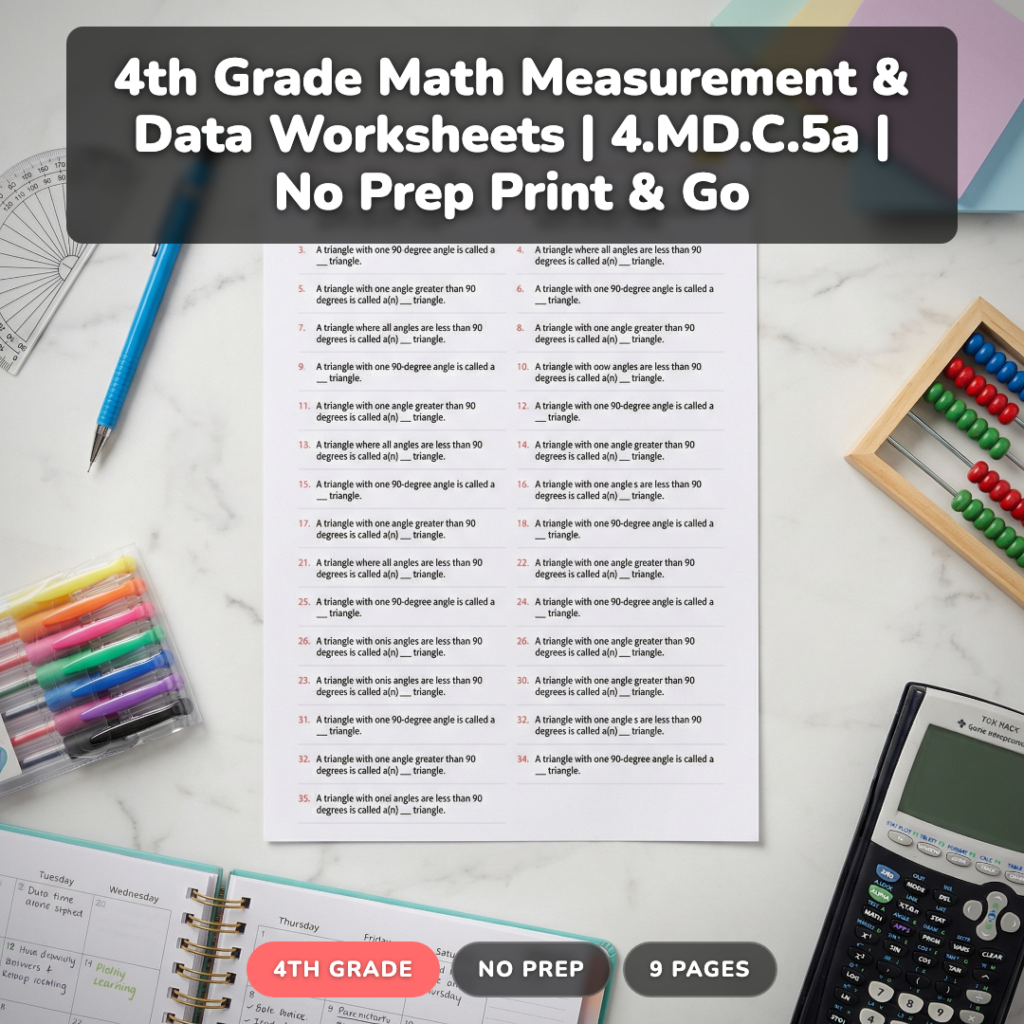
After teaching angles for several years, I created a comprehensive resource that takes the guesswork out of differentiation. This 9-page pack includes 132 carefully scaffolded problems across three difficulty levels, so every student gets appropriate practice with angle concepts.
The Practice level focuses on basic angle identification and simple degree measures. On-Level problems include estimation, benchmark comparisons, and real-world applications. Challenge problems involve multi-step reasoning, angle relationships, and connections to fraction concepts.
What makes this different from other angle worksheets is the intentional progression from concrete to abstract thinking. Students start with visual models, move to estimation tasks, and finish with precise calculations — exactly how the research says angle understanding develops.
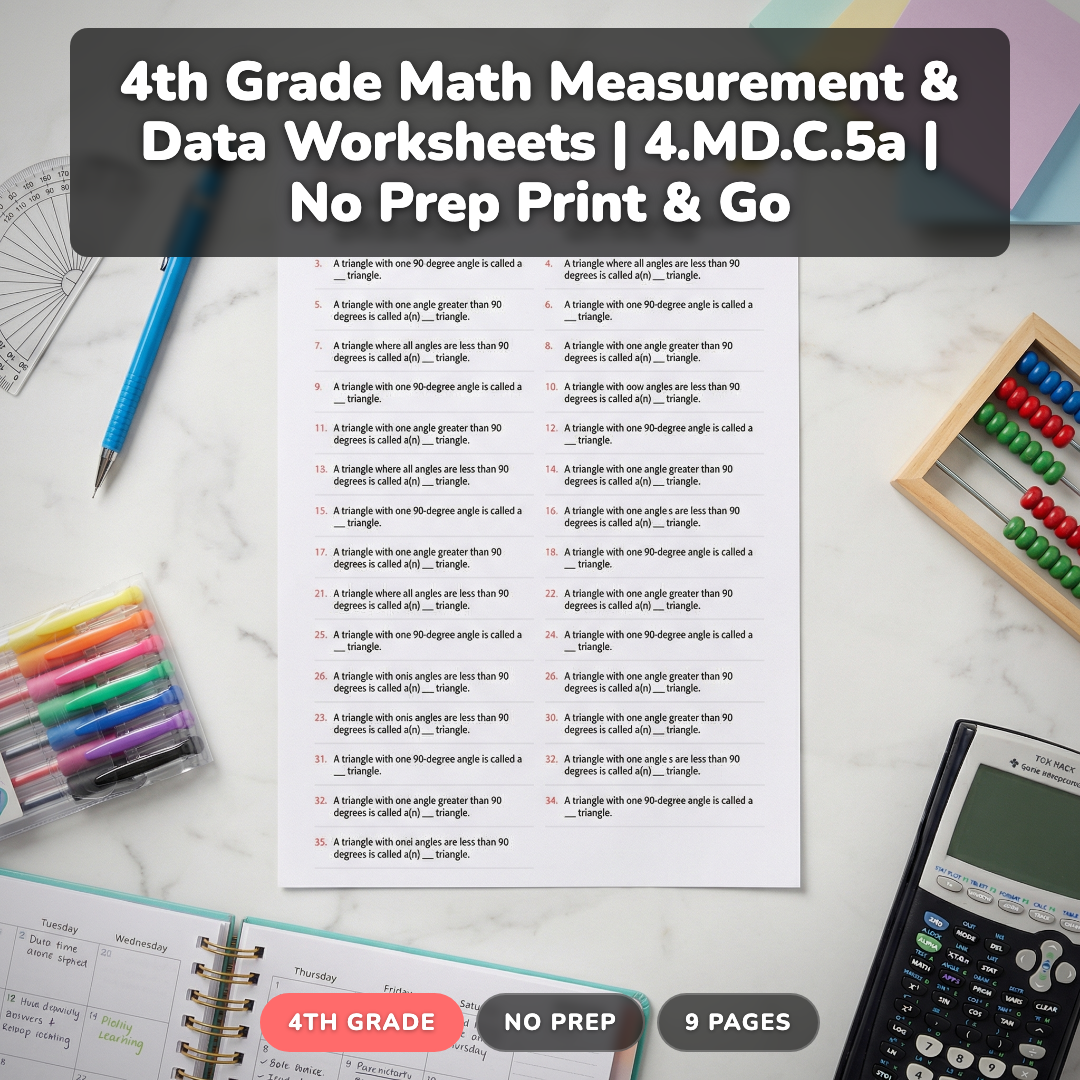
Each level includes answer keys and teaching notes, so you can focus on instruction instead of prep work. The problems align perfectly with CCSS.Math.Content.4.MD.C.5a and provide the practice students need to master angle measurement.
Grab a Free Angle Estimation Activity to Try
Want to see how these strategies work in your classroom? I’ll send you a free angle estimation activity that uses real-world photos to help students practice benchmark angle identification. Perfect for introducing the concept before diving deeper.
Frequently Asked Questions About Teaching Angles
Why do we use 360 degrees instead of 100 or another number?
Ancient Babylonians chose 360 because it divides evenly by many numbers (2, 3, 4, 5, 6, 8, 9, 10, 12, 15, 18, 20, 24, 30, 36, 40, 45, 60, 72, 90, 120, 180). This makes calculations easier and creates convenient benchmark fractions like 1/4 = 90° and 1/6 = 60°.
What’s the difference between an angle and a corner?
A corner is the physical point where two lines meet, while an angle measures the amount of rotation between two rays that share an endpoint. The angle exists in the space of rotation, not in the corner itself. Students often confuse these concepts initially.
Should 4th graders use protractors to measure angles?
The CCSS.Math.Content.4.MD.C.5a standard focuses on conceptual understanding of angles as fractions of circles, not protractor use. Protractor skills come in 4th grade standard CCSS.Math.Content.4.MD.C.6. Build the concept first, then introduce the tool.
How do I help students who think larger-looking angles are always bigger?
Use consistent ray lengths when comparing angles, or demonstrate with door hinges and paper plate models where ray length stays constant. Show that a 30° angle with long rays covers more area than a 90° angle with short rays, but the 90° angle represents more rotation.
What real-world connections help students understand angle measurement?
Clock faces, door hinges, scissors opening, steering wheel turns, and pizza slices all demonstrate rotational angles. Sports examples like skateboard turns, gymnastics rotations, and basketball shot arcs also connect to students’ experiences with rotational movement and degree measures.
Teaching angles as fractions of circular rotation gives students the conceptual foundation they need for all future geometry work. When students understand that 360 degrees represents one complete turn divided into 360 equal pieces, protractor use and angle relationships make perfect sense.
What’s your favorite strategy for helping students visualize angles as rotations? I’d love to hear what works in your classroom — and don’t forget to grab that free angle estimation activity above!