If your 4th graders stare blankly when you ask “How many centimeters in a meter?” you’re not alone. Teaching measurement unit conversions is one of those skills that seems straightforward to adults but trips up students year after year. The good news? With the right strategies, your students can master measurement equivalents and even enjoy the process.
Key Takeaway
Students master measurement conversions when they understand the relationships between units through hands-on exploration before memorizing conversion facts.
Why Measurement Units Matter in 4th Grade
Measurement unit conversions form the foundation for advanced math concepts students will encounter in middle school, including ratios, proportions, and scientific notation. CCSS.Math.Content.4.MD.A.1 requires students to know relative sizes of measurement units within metric (km, m, cm) and customary (lb, oz) systems, plus time units (hr, min, sec).
Research from the National Council of Teachers of Mathematics shows that students who develop strong measurement sense in elementary school perform 23% better on algebra assessments in 8th grade. This happens because measurement conversions teach proportional reasoning—the same thinking students need for solving equations and understanding functions.
Fourth grade is the critical year for this skill because students have developed enough number sense to work with larger numbers but haven’t yet formed rigid misconceptions about how units relate to each other. By December, students should fluently convert between units and record equivalents in two-column tables as specified in the standard.
Looking for a ready-to-go resource? I put together a differentiated measurement worksheets pack that covers everything below — but first, the teaching strategies that make it work.
Common Measurement Misconceptions in 4th Grade
Common Misconception: Students think larger units contain fewer smaller units (“A kilogram has fewer grams than a gram has kilograms”).
Why it happens: They confuse the size of the unit with the number needed for conversion.
Quick fix: Use physical objects to show that bigger containers hold more smaller items.
Common Misconception: Students multiply when they should divide and vice versa.
Why it happens: They memorize rules without understanding the underlying relationship.
Quick fix: Teach the “Does my answer make sense?” check—converting to smaller units should give a bigger number.
Common Misconception: Students think all conversions follow the same pattern (everything converts by 10s or 100s).
Why it happens: They overgeneralize from metric system patterns.
Quick fix: Create separate anchor charts for metric, customary, and time conversions.
Common Misconception: Students believe you can convert between metric and customary systems using simple multiplication.
Why it happens: They don’t understand these are completely different measurement systems.
Quick fix: Emphasize that conversions only work within the same system—metric to metric, customary to customary.
5 Research-Backed Strategies for Teaching Measurement Units
Strategy 1: Measurement Container Exploration
Students physically explore unit relationships using actual measuring tools before learning conversion formulas. This builds conceptual understanding that makes the math meaningful rather than just memorized procedures.
What you need:
- Measuring cups (1 cup, 1/2 cup, 1/4 cup)
- Liter bottles and milliliter containers
- Meter sticks and centimeter rulers
- Kitchen scale with gram and kilogram settings
- Recording sheets
Steps:
- Give partners one large measuring tool and several smaller ones (e.g., 1 liter bottle and 100ml containers)
- Have students predict how many small units fit in the large unit
- Students test their predictions by filling and counting
- Record results in a two-column table: “1 liter = ___ milliliters”
- Repeat with different unit pairs within the same system
- Students look for patterns in their data
Strategy 2: Human Number Line Conversions
Students become living measurement units on a floor number line, physically moving to show conversion relationships. This kinesthetic approach helps students visualize why converting to smaller units creates larger numbers.
What you need:
- Masking tape for floor number line
- Large index cards with unit names
- Conversion scenario cards
- Stopwatch for time conversions
Steps:
- Create a floor number line from 0 to 1000 using masking tape
- Assign students to represent different measurement units (meters, centimeters, grams, kilograms)
- Call out conversion problems: “Show me 3 meters in centimeters”
- Students holding “meter” cards stand at position 3, while “centimeter” students stand at 300
- Discuss why the centimeter number is larger than the meter number
- Practice with time conversions using actual movement (walk for 1 minute, count steps for 60 seconds)
Strategy 3: Conversion Factor Anchor Charts
Students create visual reference tools that show unit relationships within each measurement system. These charts become permanent classroom resources that students can reference during independent work and assessments.
What you need:
- Large poster paper (one per measurement system)
- Colored markers
- Real objects for size comparisons
- Sticky notes for student additions
Steps:
- Create separate charts for metric length, metric mass, customary weight, and time
- Start each chart with the base unit in the center (meter, gram, pound, minute)
- Add related units around the base, connected with arrows showing conversion factors
- Include memory devices: “1000 millimeters march in a meter”
- Post real objects next to units for size reference (paperclip ≈ 1 gram)
- Students add new conversions as they learn them
Strategy 4: Two-Column Table Practice with Real Scenarios
Students practice the exact skill required by CCSS.Math.Content.4.MD.A.1 using authentic measurement situations. This connects abstract conversions to practical applications students might encounter outside school.
What you need:
- Recipe cards with mixed units
- Sports statistics with time and distance
- Two-column table templates
- Calculators for checking work
Steps:
- Present real scenarios: “The recipe calls for 2 liters of water, but you only have a 250ml measuring cup”
- Students set up two-column tables with headers: “Liters” and “Milliliters”
- Fill in known information: “2 liters = ? milliliters”
- Students solve using conversion knowledge and record multiple equivalent measurements
- Check answers using calculators and discuss reasonableness
- Create class collection of useful conversion tables
Strategy 5: Measurement Scavenger Hunt
Students apply conversion skills while finding and measuring objects around the classroom and school. This game-like activity reinforces learning while showing students that measurement is everywhere in their environment.
What you need:
- Clipboards with recording sheets
- Various measuring tools
- List of objects to find and measure
- Conversion challenge cards
Steps:
- Give teams lists of items to locate: “Find something about 30 centimeters long”
- Students measure items and record in original units
- Challenge: Express each measurement in a different unit (30 cm = 0.3 m)
- Teams rotate through stations with different measurement focuses
- Conclude by comparing findings and discussing which units work best for different objects
- Students explain their conversion thinking to other teams
How to Differentiate Measurement Units for All Learners
For Students Who Need Extra Support
Start with concrete manipulatives and familiar units before introducing abstract conversions. Provide conversion charts as references and focus on one measurement system at a time. Use smaller numbers (converting 2 meters instead of 25 meters) and emphasize the “Does my answer make sense?” reasoning check. Scaffold two-column tables by providing partially completed examples and having students fill in missing information.
For On-Level Students
Students should work with standard grade-level conversions within metric, customary, and time systems as outlined in CCSS.Math.Content.4.MD.A.1. They create their own two-column tables, solve multi-step problems involving conversions, and explain their reasoning using mathematical vocabulary. Provide opportunities to choose appropriate units for different measurement situations.
For Students Ready for a Challenge
Extend learning by having students research measurement systems from other countries, create conversion problems for classmates, and work with decimal conversions. Challenge students to find patterns across different measurement systems and explain why certain conversions exist. Have them investigate the history of measurement units and create presentations about how different cultures developed measurement systems.
A Ready-to-Use Measurement & Data Resource for Your Classroom
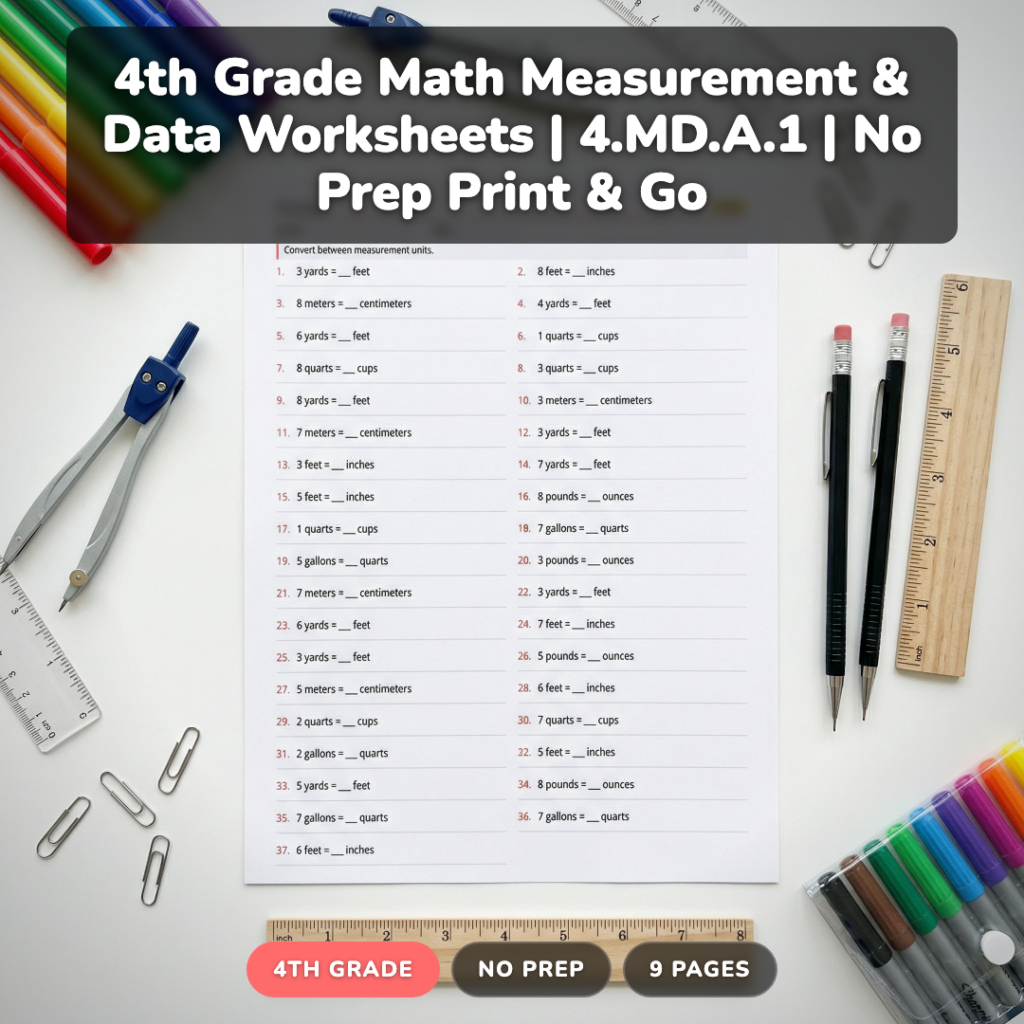
If you want to save hours of prep time while ensuring your students get differentiated practice with measurement conversions, I’ve created a comprehensive worksheet pack that covers everything we’ve discussed. This 9-page resource includes 132 problems across three difficulty levels—37 practice problems for students building foundational skills, 50 on-level problems aligned to grade expectations, and 45 challenge problems for advanced learners.
What makes this resource different is the careful scaffolding within each level. Practice problems start with visual supports and familiar units, on-level problems mirror the complexity you’ll see on state assessments, and challenge problems push students to apply conversions in multi-step scenarios. Each level includes two-column table practice as required by the standard, plus answer keys that show multiple solution strategies.
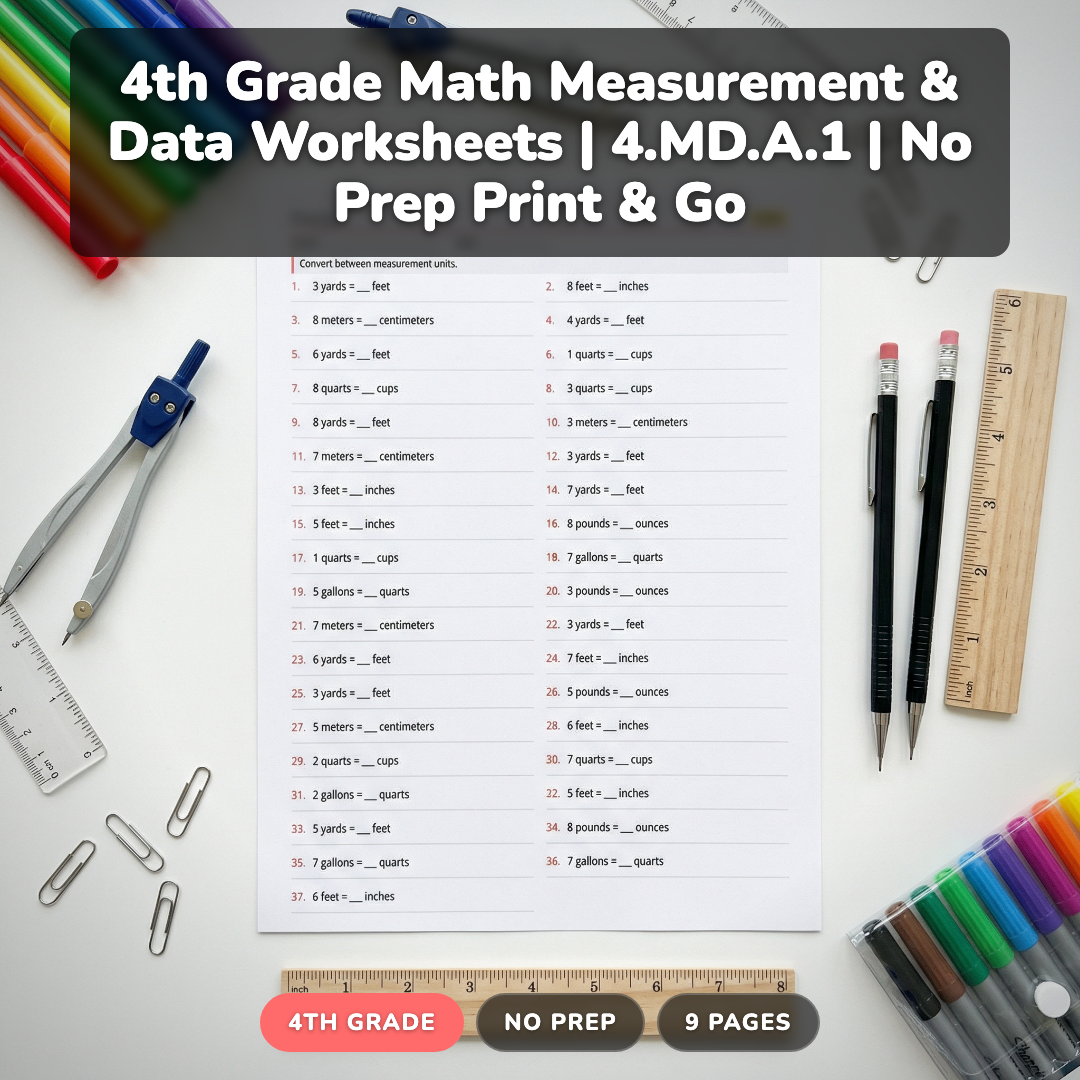
The worksheets work perfectly as independent practice after your hands-on lessons, math center rotations, or homework assignments. You’ll have everything you need to meet each student where they are while building toward grade-level mastery.
Grab a Free Measurement Conversion Chart to Try
Want to see how visual supports can help your students master unit conversions? I’ll send you a free measurement reference chart that includes metric, customary, and time conversions with memory devices. It’s perfect for posting in your classroom or sending home for homework support.
Frequently Asked Questions About Teaching Measurement Units
What order should I teach measurement conversions in 4th grade?
Start with metric length (easiest pattern recognition), then metric mass, time units, and finally customary weight. This sequence builds from most logical to most complex conversion patterns, helping students develop confidence before tackling irregular ratios.
How can I help students remember which direction to multiply or divide?
Teach the reasoning check: “Am I converting to bigger or smaller units?” Converting to smaller units should give a bigger number (multiply). Converting to bigger units should give a smaller number (divide). This prevents memorizing rules without understanding.
What’s the most important skill students need before learning conversions?
Students must understand place value and be fluent with multiplication and division by 10, 100, and 1000. They also need to recognize that measurement units have size relationships—a meter is longer than a centimeter.
Should I teach metric and customary conversions at the same time?
No, teach them separately to avoid confusion. Metric conversions follow predictable base-10 patterns, while customary conversions use irregular ratios (12 inches = 1 foot, 16 ounces = 1 pound). Master one system before introducing the other.
How do I assess whether students truly understand conversions?
Ask students to explain their thinking, not just give answers. Can they tell you why 3 meters equals 300 centimeters? Do they recognize when an answer doesn’t make sense? Understanding shows through reasoning, not just correct calculations.
Teaching measurement conversions doesn’t have to be a struggle when you build understanding through hands-on exploration before moving to abstract practice. Remember to grab your free conversion chart above, and let me know—what’s your go-to strategy for helping students master measurement units?