If your 4th graders look confused when you mention lines of symmetry, you’re not alone. Many students struggle to visualize how a figure can be folded to create matching parts. The good news? With the right teaching strategies, your students can master this essential geometry skill and even start seeing symmetry everywhere around them.
Key Takeaway
Students learn symmetry best through hands-on folding, drawing, and real-world exploration rather than abstract explanations.
Why Symmetry Matters in 4th Grade Math
Symmetry instruction in 4th grade builds critical spatial reasoning skills that students will use throughout their mathematical journey. According to the National Council of Teachers of Mathematics, students who develop strong spatial skills in elementary grades perform better in algebra and geometry later on.
The CCSS.Math.Content.4.G.A.3 standard requires students to recognize lines of symmetry and identify line-symmetric figures. This skill typically appears in the second half of the school year, after students have mastered basic geometric shapes and properties. Research from the University of Chicago shows that 73% of students who struggle with symmetry lack sufficient experience with physical manipulation of shapes.
Symmetry connects to real-world applications students see daily — from butterfly wings to building architecture. When students understand symmetry, they develop better pattern recognition skills and strengthen their ability to visualize geometric transformations.
Looking for a ready-to-go resource? I put together a differentiated 4th grade symmetry pack that covers everything below — but first, the teaching strategies that make it work.
Common Symmetry Misconceptions in 4th Grade
Understanding where students typically struggle helps you address these misconceptions before they become entrenched. Here are the most common symmetry misunderstandings I’ve seen in 4th grade classrooms:
Common Misconception: Students think diagonal lines are always lines of symmetry.
Why it happens: They confuse diagonal lines with symmetry lines because both “split” a shape.
Quick fix: Have them physically fold along the diagonal to see if parts match perfectly.
Common Misconception: Students believe all shapes have symmetry.
Why it happens: Early examples often focus on symmetric shapes like squares and circles.
Quick fix: Show irregular shapes and scalene triangles early in your instruction.
Common Misconception: Students think symmetry only works horizontally or vertically.
Why it happens: Initial practice often emphasizes these orientations.
Quick fix: Introduce diagonal and rotational examples from day one.
Common Misconception: Students confuse lines of symmetry with shape outlines.
Why it happens: They focus on drawing around the shape rather than through it.
Quick fix: Emphasize that symmetry lines always pass through the interior of the figure.
5 Research-Backed Strategies for Teaching Symmetry
Strategy 1: The Paper Folding Foundation
Start with physical folding before introducing abstract concepts. This concrete approach helps students literally see how symmetry works by creating matching parts through folding.
What you need:
- Cut-out paper shapes (squares, rectangles, triangles, circles)
- Irregular shapes traced on paper
- Scissors
- Colored pencils
Steps:
- Give each student a paper square and ask them to fold it so both sides match exactly
- Have them unfold and trace the fold line with a colored pencil
- Repeat with different fold orientations (horizontal, vertical, diagonal)
- Try the same process with rectangles, then circles
- Challenge them with irregular shapes that have no lines of symmetry
- Create a class chart showing which shapes have symmetry and which don’t
Strategy 2: Mirror Magic Exploration
Using mirrors helps students visualize the reflection property of symmetry lines. This strategy bridges the gap between concrete folding and abstract understanding.
What you need:
- Small handheld mirrors (one per student pair)
- Worksheets with half-shapes drawn
- Various symmetric objects (leaves, photos, geometric shapes)
- Dry erase markers
Steps:
- Place a mirror along a potential line of symmetry on a shape
- Ask students to predict what they’ll see in the mirror
- Have them check their prediction by looking in the mirror
- If the reflection completes the shape perfectly, they’ve found a line of symmetry
- Practice with multiple orientations and different shapes
- Challenge students to use mirrors to complete half-shapes on worksheets
Strategy 3: Symmetry Scavenger Hunt
Connecting classroom learning to real-world examples helps students recognize symmetry in their environment. This strategy builds lasting understanding through authentic discovery.
What you need:
- Clipboards and recording sheets
- Digital cameras or tablets
- Symmetry hunt checklist
- Colored pencils for sketching
Steps:
- Create a checklist of items to find: faces, leaves, buildings, logos, etc.
- Take students around the school or use classroom objects
- Have them sketch or photograph symmetric objects
- For each item, students must identify and draw the line(s) of symmetry
- Back in class, create a symmetry gallery with their discoveries
- Discuss which items have multiple lines of symmetry
Strategy 4: Dot Paper Design Creation
Having students create their own symmetric designs on dot paper reinforces understanding while developing spatial reasoning skills. This strategy moves students from recognition to creation.
What you need:
- Dot paper (or graph paper)
- Colored pencils or markers
- Rulers
- Examples of symmetric patterns
Steps:
- Show students how to draw a line of symmetry first
- Demonstrate creating a simple design on one side
- Model how to reflect each point across the symmetry line
- Have students create their own designs, starting simple
- Encourage them to try multiple lines of symmetry
- Display completed designs and have classmates identify symmetry lines
Strategy 5: Interactive Symmetry Sorts
Sorting activities help students practice identifying symmetric versus non-symmetric figures while developing classification skills. This strategy works well for centers or partner work.
What you need:
- Shape cards (mix of symmetric and non-symmetric)
- Sorting mats labeled “Symmetric” and “Not Symmetric”
- Answer key for self-checking
- Small mirrors for verification
Steps:
- Students work in pairs to sort shape cards
- For each “symmetric” choice, they must identify where the line of symmetry would be
- Partners can use mirrors to verify their decisions
- Have them record their thinking on a recording sheet
- Rotate through different sets of cards with varying difficulty
- End with a class discussion about challenging examples
How to Differentiate Symmetry for All Learners
For Students Who Need Extra Support
Begin with highly symmetric, familiar shapes like hearts, butterflies, and simple geometric figures. Provide physical manipulatives for every activity and allow extra time for folding and mirror work. Use shapes with thick, clear lines of symmetry marked with dotted lines as guides. Focus on vertical lines of symmetry first, as these are typically easiest to visualize. Pair struggling students with patient partners during sorting activities.
For On-Level Students
These students should work with the standard CCSS.Math.Content.4.G.A.3 expectations, recognizing lines of symmetry in various orientations and drawing them accurately. Provide a mix of geometric shapes and real-world objects. Include shapes with multiple lines of symmetry and some with no symmetry at all. Students should be able to explain their reasoning when identifying symmetric figures.
For Students Ready for a Challenge
Introduce rotational symmetry concepts and shapes with multiple lines of symmetry. Have them create complex symmetric designs and explore symmetry in letters and numbers. Challenge them to find examples of symmetry in art, architecture, and nature. These students can also help teach struggling peers and create their own symmetry problems for classmates to solve.
A Ready-to-Use 4th Grade Symmetry Resource for Your Classroom
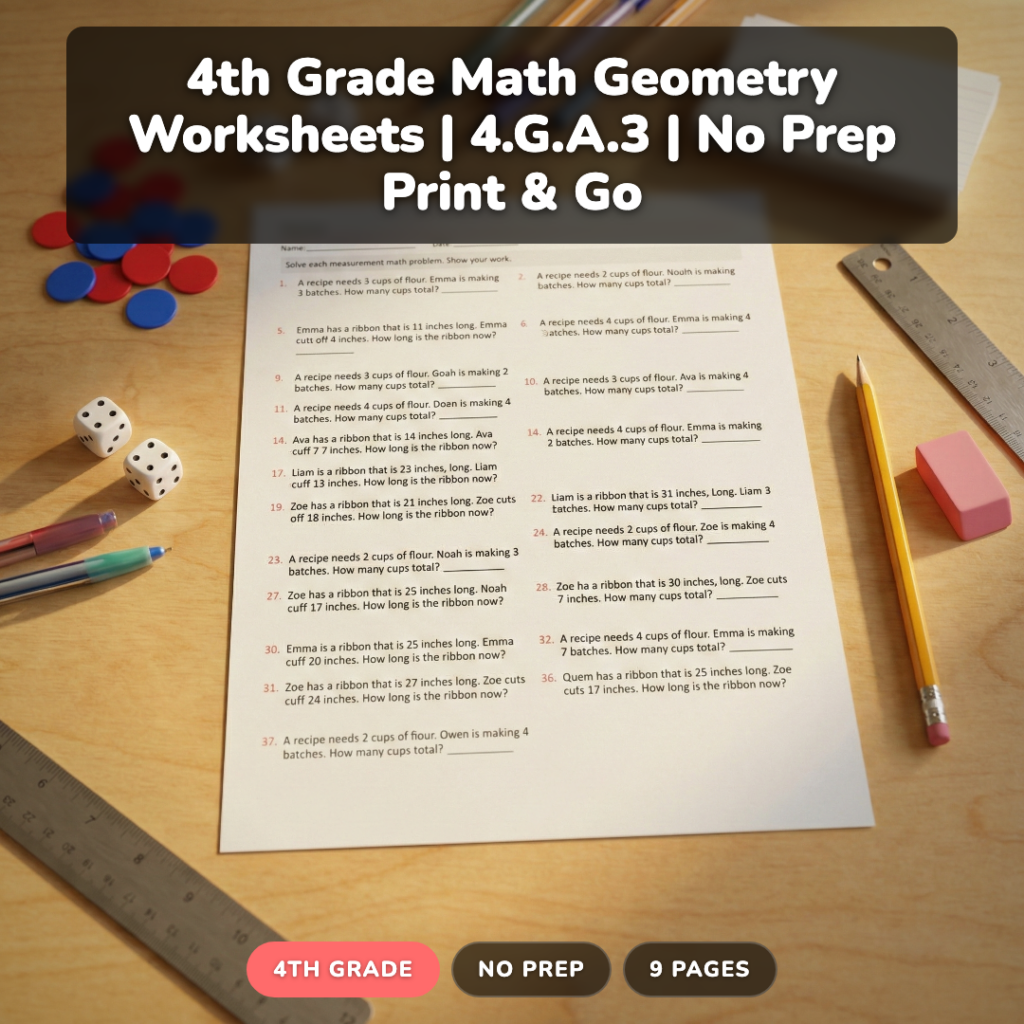
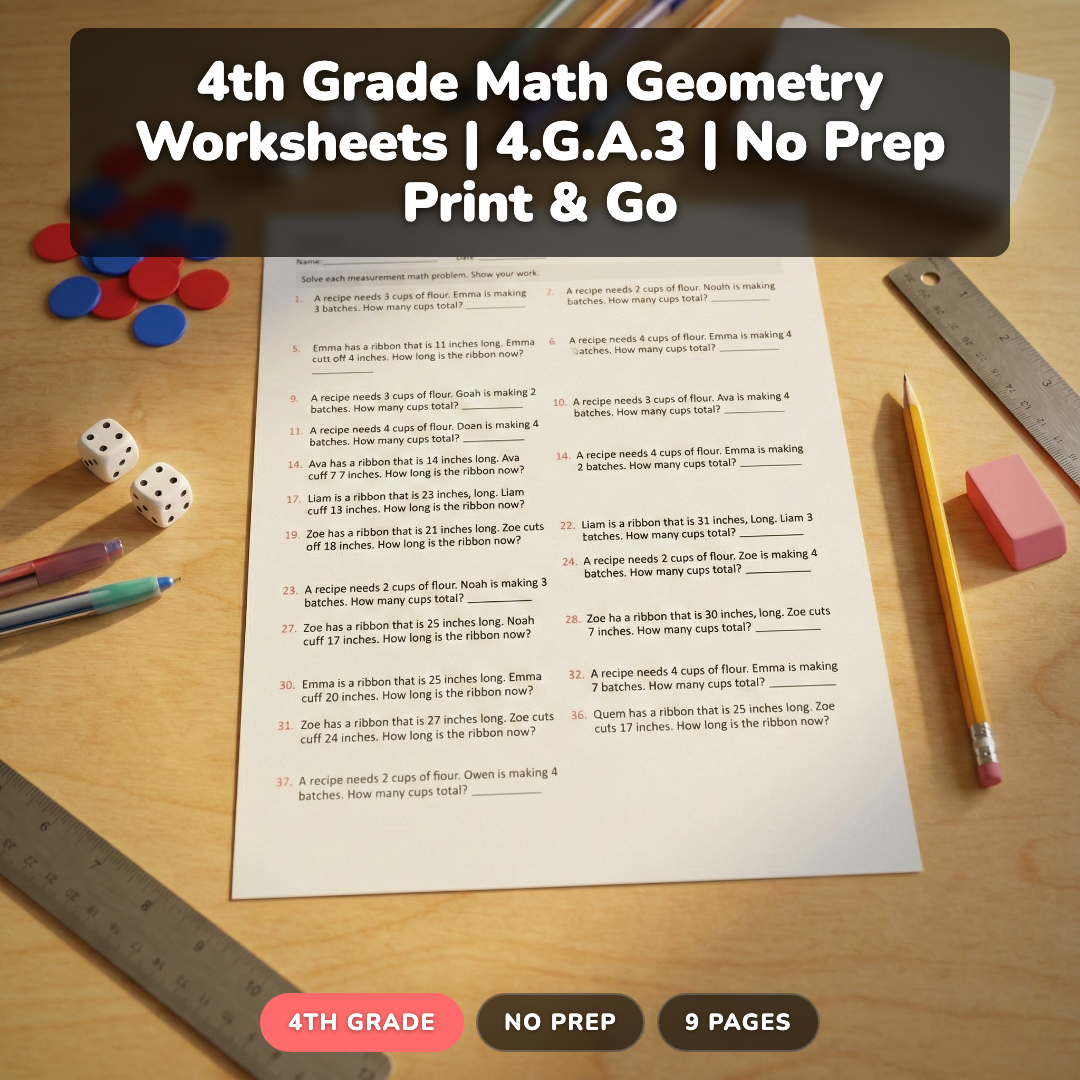
After years of teaching symmetry and seeing what works best, I created a comprehensive resource that takes the guesswork out of planning. This 4th grade symmetry worksheet pack includes 132 carefully crafted problems across three difficulty levels, perfect for meeting every student’s needs in your classroom.
The pack includes 37 practice problems for students who need extra support, 50 on-level problems that align perfectly with CCSS.Math.Content.4.G.A.3, and 45 challenge problems for advanced learners. Each level includes answer keys and clear instructions, so you can focus on teaching rather than prep work. The problems progress from simple recognition tasks to complex design challenges, giving students multiple ways to demonstrate their understanding.
What makes this resource different is the careful scaffolding and real-world connections throughout. Students work with everything from geometric shapes to everyday objects, building the spatial reasoning skills they need for future math success.
Grab a Free Symmetry Activity to Try
Want to see how these strategies work in action? I’ve created a free symmetry exploration activity that includes folding templates and a real-world symmetry hunt. It’s perfect for introducing the concept or reviewing with your class.
Frequently Asked Questions About Teaching 4th Grade Symmetry
When should I introduce symmetry in 4th grade?
Most teachers introduce symmetry in the second half of the year, after students have solid understanding of geometric shapes and properties. This timing aligns with the CCSS.Math.Content.4.G.A.3 standard placement and allows students to build on their shape knowledge.
How many lines of symmetry should 4th graders identify?
Fourth graders should recognize that squares have 4 lines of symmetry, rectangles have 2, and circles have infinite lines. They should also identify shapes with no symmetry, like scalene triangles, and understand that most real-world objects have 1-2 lines of symmetry.
What’s the difference between line symmetry and rotational symmetry?
Line symmetry means a figure can be folded along a line to create matching parts. Rotational symmetry means a figure looks the same when rotated around a center point. Fourth grade focuses primarily on line symmetry, though advanced students may explore basic rotational concepts.
How do I help students who confuse symmetry with congruence?
Emphasize that symmetry is about one figure having matching parts when folded, while congruence compares two separate figures. Use physical folding activities and avoid showing two identical shapes side-by-side when teaching symmetry. Focus on the fold line within a single shape.
Should 4th graders draw lines of symmetry freehand or use rulers?
Students should use rulers to ensure accuracy when drawing lines of symmetry. Precise lines help them better understand the concept and avoid misconceptions about approximate symmetry. Freehand drawing can come later once understanding is solid.
Teaching symmetry successfully comes down to giving students plenty of hands-on experience before moving to abstract concepts. When students can physically fold, reflect, and create symmetric figures, they develop the spatial reasoning skills that will serve them well in future geometry learning.
What’s your favorite way to help students visualize lines of symmetry? Try the free activity above and see how your students respond to exploring symmetry in their world.