If your third graders freeze when they see 7 × 8 or struggle to remember that 56 ÷ 7 = 8, you’re not alone. Building fluency with multiplication and division facts is one of the most challenging—and crucial—skills in third grade math. You need strategies that help students see the connections between operations while building automatic recall.
Key Takeaway
Effective multiplication and division fluency comes from understanding the relationship between operations, not just memorizing isolated facts.
Why Multiplication and Division Fluency Matters in Third Grade
Standard CCSS.Math.Content.3.OA.C.7 requires students to fluently multiply and divide within 100 using the relationship between operations and properties of multiplication. This isn’t just about speed—it’s about flexible thinking with numbers that becomes the foundation for multi-digit operations in fourth grade.
Research from the National Mathematics Advisory Panel shows that students who achieve automaticity with basic facts by the end of third grade are significantly more successful in later mathematics. The key timing: students need these skills solid before tackling two-digit multiplication in fourth grade.
This standard builds directly on third grade’s earlier work with equal groups and arrays (3.OA.A.1-3) and connects to division as an unknown-factor problem (3.OA.A.4). Students should understand that multiplication and division are inverse operations before working toward fluency.
Looking for a ready-to-go resource? I put together a differentiated operations and algebraic thinking pack that covers everything below—but first, the teaching strategies that make it work.
Common Multiplication and Division Misconceptions in Third Grade
Common Misconception: Students think division always makes numbers smaller and multiplication always makes them bigger.
Why it happens: They overgeneralize from whole number experiences with addition and subtraction.
Quick fix: Show examples like 12 ÷ 1 = 12 and 1 × 15 = 15 early and often.
Common Misconception: Students memorize facts in isolation without seeing operation relationships.
Why it happens: Traditional drill-and-kill approaches focus on speed over understanding.
Quick fix: Always teach fact families together (6 × 4, 4 × 6, 24 ÷ 6, 24 ÷ 4).
Common Misconception: Students think they need to recount or recalculate known facts to solve related problems.
Why it happens: They don’t recognize patterns or use derived facts strategically.
Quick fix: Explicitly model thinking: ‘If I know 5 × 6 = 30, then 6 × 6 is just 5 × 6 + 6 more.’
5 Research-Backed Strategies for Teaching Operations & Algebraic Thinking
Strategy 1: Fact Family Triangles with Inverse Thinking
Help students see the deep connection between multiplication and division by working with complete fact families from the start. This visual tool makes the relationship between operations concrete and memorable.
What you need:
- Triangle fact family cards (product at top, factors at bottom corners)
- Index cards or triangle templates
- Counters or small manipulatives
Steps:
- Show a triangle with 24 at the top, 6 and 4 at the bottom corners
- Cover the 24: ‘What’s 6 × 4?’ Students build arrays to verify
- Cover the 6: ‘What’s 24 ÷ 4?’ Use the same array, group by 4s
- Cover the 4: ‘What’s 24 ÷ 6?’ Regroup the same array by 6s
- Students create their own triangles for assigned fact families
- Practice daily with quick triangle flashes, covering different numbers
Strategy 2: Skip Counting Bridges to Multiplication
Connect students’ existing skip counting skills to multiplication facts through rhythmic patterns and visual number lines. This strategy builds on what students already know while developing fluency.
What you need:
- Large number line (0-100) displayed in classroom
- Colored markers or sticky dots
- Rhythm instruments (optional)
Steps:
- Start with 5s: chant ‘5, 10, 15, 20…’ while marking jumps on number line
- Connect to multiplication: ‘4 jumps of 5 lands on 20, so 4 × 5 = 20’
- Show division connection: ‘Start at 20, how many jumps back to 0? 20 ÷ 5 = 4’
- Practice with different starting points: ‘3 jumps of 5 from 0 is 15’
- Students create their own skip counting patterns for 3s, 4s, 6s
- Use rhythm or clapping to reinforce patterns
Strategy 3: Array Building and Breaking Apart
Arrays make multiplication and division visual and concrete while teaching students to use known facts to figure out unknown ones. This strategy develops both conceptual understanding and strategic thinking.
What you need:
- Square tiles or counters
- Grid paper
- Array recording sheets
Steps:
- Build a 6 × 8 array with tiles: ‘I need 6 rows of 8’
- Count total: ‘That’s 48 tiles total, so 6 × 8 = 48’
- Break apart: ‘I can see this as 5 × 8 plus 1 × 8’
- Connect to division: ‘If I have 48 tiles in 6 rows, each row has 8’
- Students build arrays for assigned facts, then break them apart using known facts
- Record thinking: ‘7 × 6 = (5 × 6) + (2 × 6) = 30 + 12 = 42’
Strategy 4: Multiplication and Division War Card Game
Turn fact practice into an engaging game that reinforces the relationship between operations while building fluency. This partner activity provides repeated practice in a low-pressure format.
What you need:
- Deck of cards (remove face cards, aces = 1)
- Recording sheets
- Timer (optional)
Steps:
- Partners each flip two cards and multiply: 4 × 7 vs 3 × 8
- Highest product wins all four cards
- Winner states the related division fact: ’28 ÷ 4 = 7 and 28 ÷ 7 = 4′
- For ties, each player flips two new cards and adds to their product
- Game continues until cards are gone or time is up
- Extension: play division war using products to find quotients
Strategy 5: Real-World Problem Solving Stations
Connect multiplication and division to meaningful contexts while practicing fluency. Students rotate through stations that require both computational fluency and problem-solving reasoning.
What you need:
- Station cards with real-world scenarios
- Manipulatives for each station
- Recording sheets
- Timer for rotations
Steps:
- Set up 4-5 stations with different contexts (arrays in gardens, equal groups in sports, etc.)
- Each station has 3-4 problems requiring multiplication or division within 100
- Students work in pairs, solving problems and explaining their thinking
- Require students to write both the multiplication and division equation for each scenario
- Rotate every 10-12 minutes, ensuring all students experience variety
- Close with whole-group sharing of strategies used
How to Differentiate Operations & Algebraic Thinking for All Learners
For Students Who Need Extra Support
Start with concrete manipulatives and focus on smaller fact families (2s, 5s, 10s) before introducing more challenging facts. Use hundreds charts to support skip counting patterns. Provide multiplication charts during problem-solving until basic facts become automatic. Break larger arrays into smaller, more manageable pieces.
For On-Level Students
Focus on building fluency with all single-digit multiplication and division facts as required by CCSS.Math.Content.3.OA.C.7. Emphasize strategy use and the relationship between operations. Practice with timed activities once understanding is solid, aiming for recall within 3-5 seconds per fact.
For Students Ready for a Challenge
Extend to patterns in multiplication (like 9s finger tricks), introduce early concepts of square numbers, and explore multiplication and division with multiples of 10. Challenge them to find multiple strategies for the same problem and explain which is most efficient.
A Ready-to-Use Operations & Algebraic Thinking Resource for Your Classroom
Teaching multiplication and division fluency requires consistent, differentiated practice that goes beyond worksheets. You need problems that build understanding while developing speed and accuracy.
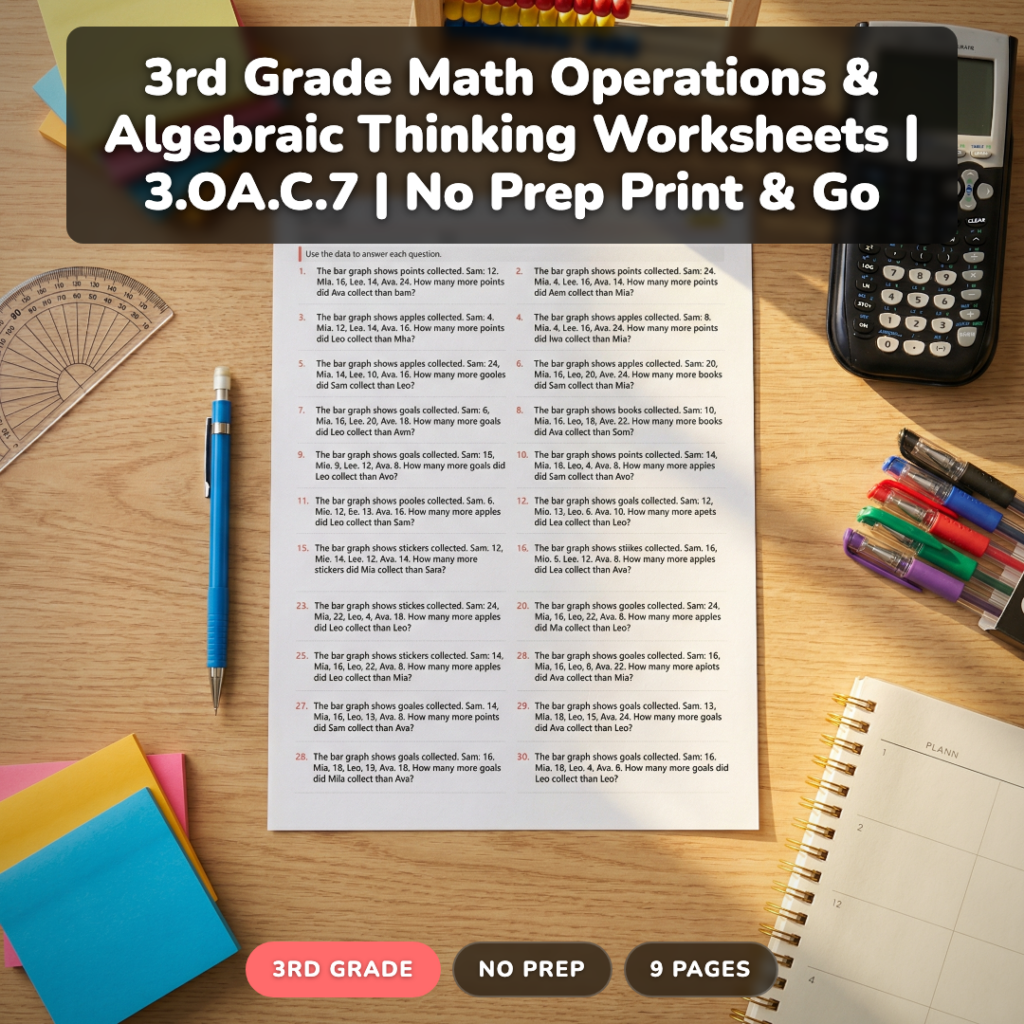
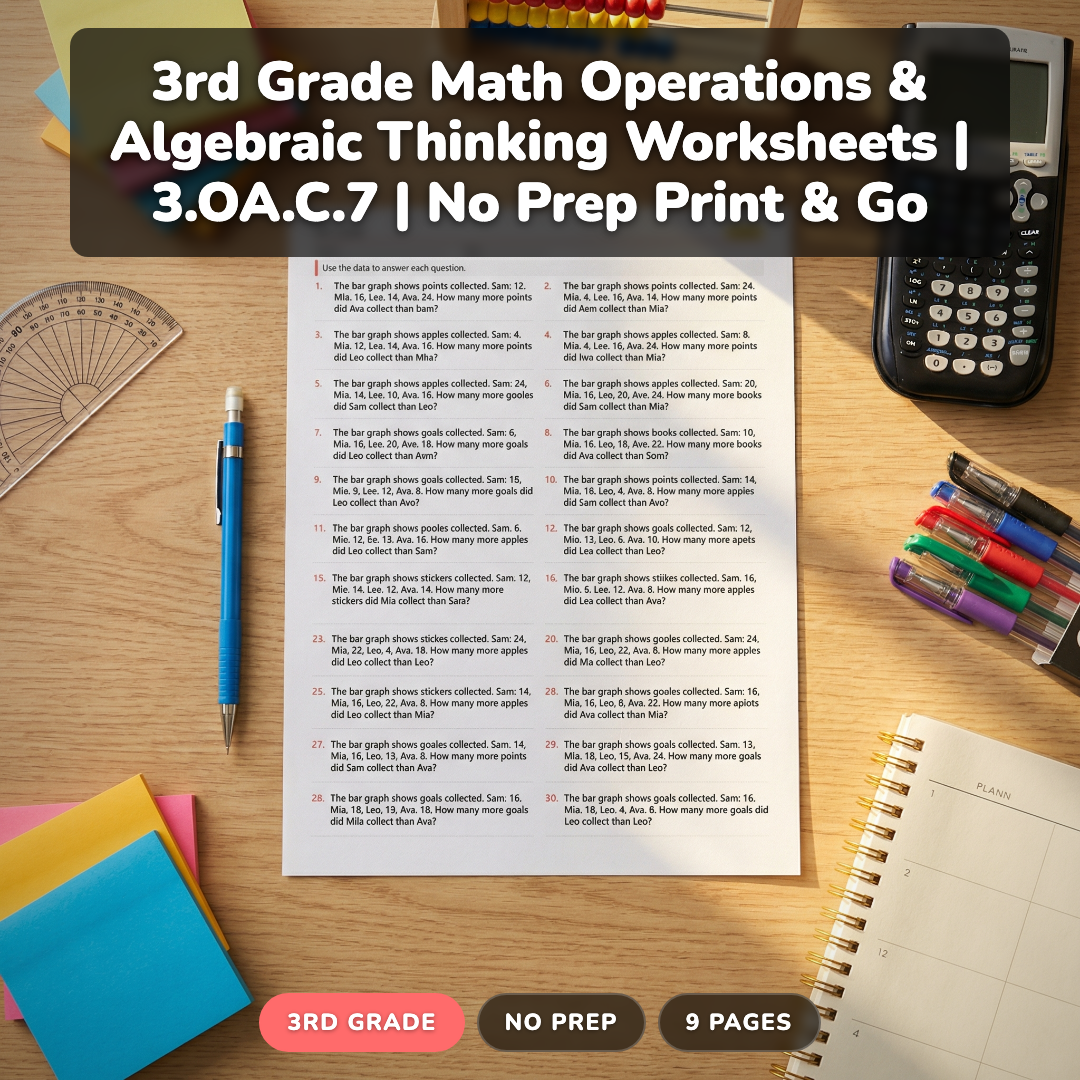
This comprehensive 3rd grade operations pack includes 132 carefully crafted problems across three difficulty levels. The Practice level focuses on foundational fact families with visual supports. On-Level problems target grade-level fluency expectations with varied problem types. Challenge problems extend thinking with multi-step scenarios and strategic reasoning.
What makes this resource different is the intentional progression from concrete to abstract thinking. Each level includes fact family work, real-world applications, and strategic problem-solving that builds the deep understanding required by the Common Core.
The 9-page pack saves you hours of prep time while ensuring every student gets appropriately challenging practice. Answer keys are included for quick checking.
Grab a Free Fact Family Practice Sheet to Try
Want to see how fact family triangles work in practice? I’ve created a free sample worksheet with triangle templates and guided practice problems. Drop your email below and I’ll send it right over.
Frequently Asked Questions About Teaching Operations & Algebraic Thinking
When should third graders achieve fluency with multiplication and division facts?
By the end of third grade, students should know all products of two one-digit numbers from memory according to CCSS.Math.Content.3.OA.C.7. Focus on understanding relationships first, then build toward 3-5 second recall speed through consistent practice.
What’s the difference between fluency and memorization?
Fluency includes speed, accuracy, and flexibility with numbers. Students should be able to recall facts quickly but also use relationships and strategies when needed. Pure memorization lacks the conceptual understanding required for problem-solving.
How do I help students who still struggle with basic addition and subtraction?
Students need solid addition and subtraction fluency within 20 before tackling multiplication and division. Use skip counting and repeated addition to bridge these concepts while continuing to strengthen foundational skills through targeted intervention.
Should I teach multiplication and division facts together or separately?
Always teach them together as inverse operations. This approach reinforces the relationship between operations and helps students use known facts to figure out unknown ones. Fact families make this connection explicit and memorable.
How much time should I spend on fact fluency each day?
Plan 10-15 minutes of focused fact practice daily, but integrate multiplication and division throughout your math block. Quick warm-ups, problem-solving contexts, and games provide additional practice without feeling repetitive or boring.
Building Lasting Multiplication and Division Fluency
Remember that fluency with operations and algebraic thinking develops over time through understanding, practice, and application. Focus on helping students see the patterns and relationships that make math facts logical, not arbitrary.
What’s your go-to strategy for helping students master multiplication and division facts? I’d love to hear what works in your classroom.
Don’t forget to grab your free fact family practice sheet above—it’s a great way to get started with these strategies right away.