If your third graders freeze when they see a word problem with more than one step, you’re not alone. Two-step word problems represent a major cognitive leap for 8-year-olds — they must hold multiple pieces of information in working memory while planning a sequence of operations. This post breaks down five research-backed strategies that help students tackle CCSS.Math.Content.3.OA.D.8 with confidence, plus differentiation tips for every learner in your classroom.
Key Takeaway
Students master two-step word problems when they learn to identify the hidden question first, then solve step-by-step with visual representations and estimation checks.
Why Two-Step Word Problems Matter in Third Grade
Two-step word problems mark a critical transition in mathematical thinking. Unlike the single-step problems students solved in earlier grades, CCSS.Math.Content.3.OA.D.8 requires students to solve multi-step word problems using all four operations, represent problems with equations using variables, and assess answer reasonableness through estimation.
Research from the National Council of Teachers of Mathematics shows that students who master algebraic thinking in elementary grades demonstrate stronger problem-solving skills throughout their mathematical education. This standard typically appears in curriculum units during February through April, after students have solidified their multiplication and division facts.
The cognitive load is significant: students must decode text, identify relevant information, determine operation sequences, and monitor their thinking. Studies indicate that 60% of third-grade math errors in word problems stem from misunderstanding the problem structure rather than computational mistakes.
Looking for a ready-to-go resource? I put together a differentiated two-step word problem pack that covers everything below — but first, the teaching strategies that make it work.
Common Two-Step Word Problem Misconceptions in 3rd Grade
Common Misconception: Students solve problems left-to-right using every number they see.
Why it happens: They apply reading strategies (left-to-right processing) to mathematical reasoning.
Quick fix: Teach them to identify the final question first, then work backwards to find hidden questions.
Common Misconception: Students think they need to use every number in the problem.
Why it happens: Previous word problems typically used all given information.
Quick fix: Include problems with extra information and explicitly discuss which numbers are needed.
Common Misconception: Students write equations that don’t match their thinking process.
Why it happens: They memorize equation formats without understanding variable representation.
Quick fix: Have students explain their equation in words before writing it symbolically.
Common Misconception: Students skip estimation because their answer “looks right.”
Why it happens: They don’t understand estimation as a problem-solving tool.
Quick fix: Model estimation before solving, not just as a check afterward.
5 Research-Backed Strategies for Teaching Two-Step Word Problems
Strategy 1: The Hidden Question Hunt
Students learn to identify the “hidden question” they must answer before solving the final question. This strategy builds problem decomposition skills essential for algebraic thinking.
What you need:
- Word problems on chart paper
- Two different colored markers
- “Question Detective” anchor chart
Steps:
- Read the problem together and circle the final question in red
- Ask: “What do we need to know first to answer this question?”
- Identify and underline the hidden question in blue
- Solve the hidden question first, then use that answer for the final question
- Write two separate equations showing each step
Strategy 2: Visual Story Mapping
Students create visual representations that show the problem’s structure before writing equations. This concrete-to-abstract progression supports diverse learning styles.
What you need:
- Large paper or whiteboards
- Drawing materials
- Problem scenario cards
Steps:
- Students draw the initial situation described in the problem
- Add visual elements showing the first change or action
- Draw the intermediate result (answer to hidden question)
- Show the second change or action
- Circle or highlight the final answer
- Write equations that match their visual story
Strategy 3: Estimation Before Equation
Students make reasonable estimates before solving, developing number sense and creating a reasonableness check for their final answers.
What you need:
- “Estimation Station” poster
- Rounding reference charts
- Think-aloud stems
Steps:
- Read the problem and identify key numbers
- Round numbers to the nearest ten or hundred
- Estimate the answer using rounded numbers and mental math
- Write the estimate range (e.g., “between 40 and 60”)
- Solve the actual problem
- Compare the exact answer to the estimate
Strategy 4: Variable Theater
Students act out word problems using physical movements and props, making abstract variable concepts concrete and memorable.
What you need:
- Manipulatives or props related to problem contexts
- “Mystery box” for unknown quantities
- Variable name cards (x, y, n)
Steps:
- Assign student roles for each element in the problem
- Act out the first action, placing unknown quantities in the mystery box
- Perform the second action
- Discuss what the variable represents at each step
- Write equations using the variable to represent unknown quantities
- Solve and “reveal” what was in the mystery box
Strategy 5: Think-Aloud Problem Solving
Students verbalize their thinking process using structured sentence frames, making their reasoning visible and identifying misconceptions early.
What you need:
- Think-aloud sentence frames poster
- Recording sheets with thinking bubbles
- Partner protocol cards
Steps:
- Model using sentence frames: “First I need to find…” “I know that…” “My equation is…”
- Students practice with partners, taking turns as solver and listener
- Listener asks clarifying questions using provided stems
- Switch roles for the next problem
- Whole group shares different solution paths
How to Differentiate Two-Step Word Problems for All Learners
For Students Who Need Extra Support
Begin with problems that explicitly state both steps: “First find how many… Then find how many…” Use smaller numbers (under 20) and provide visual templates showing where to write each step. Offer choice in problem contexts (sports, animals, food) to increase engagement. Review prerequisite skills like single-step problems and basic fact fluency before introducing two-step complexity.
For On-Level Students
Present standard CCSS.Math.Content.3.OA.D.8 problems with numbers appropriate for grade-level computation skills (products under 100, differences that don’t require regrouping). Include a mix of operation combinations and problem types. Expect students to write equations using variables and explain their reasoning using mathematical vocabulary.
For Students Ready for a Challenge
Introduce problems with larger numbers requiring multi-digit computation, extra information that must be ignored, or multiple solution paths. Challenge students to write their own two-step problems for classmates to solve, or solve problems with missing information where they must determine what additional data they need.
A Ready-to-Use Two-Step Word Problem Resource for Your Classroom
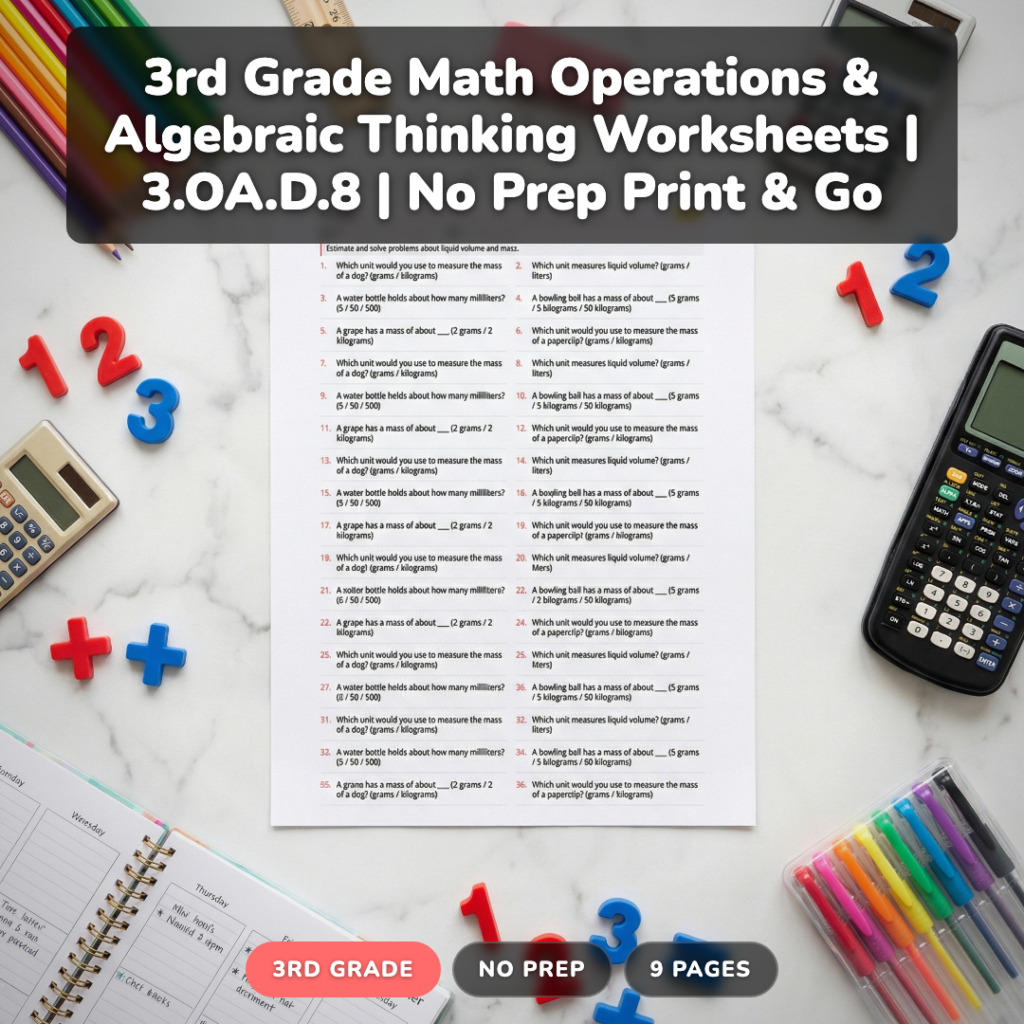
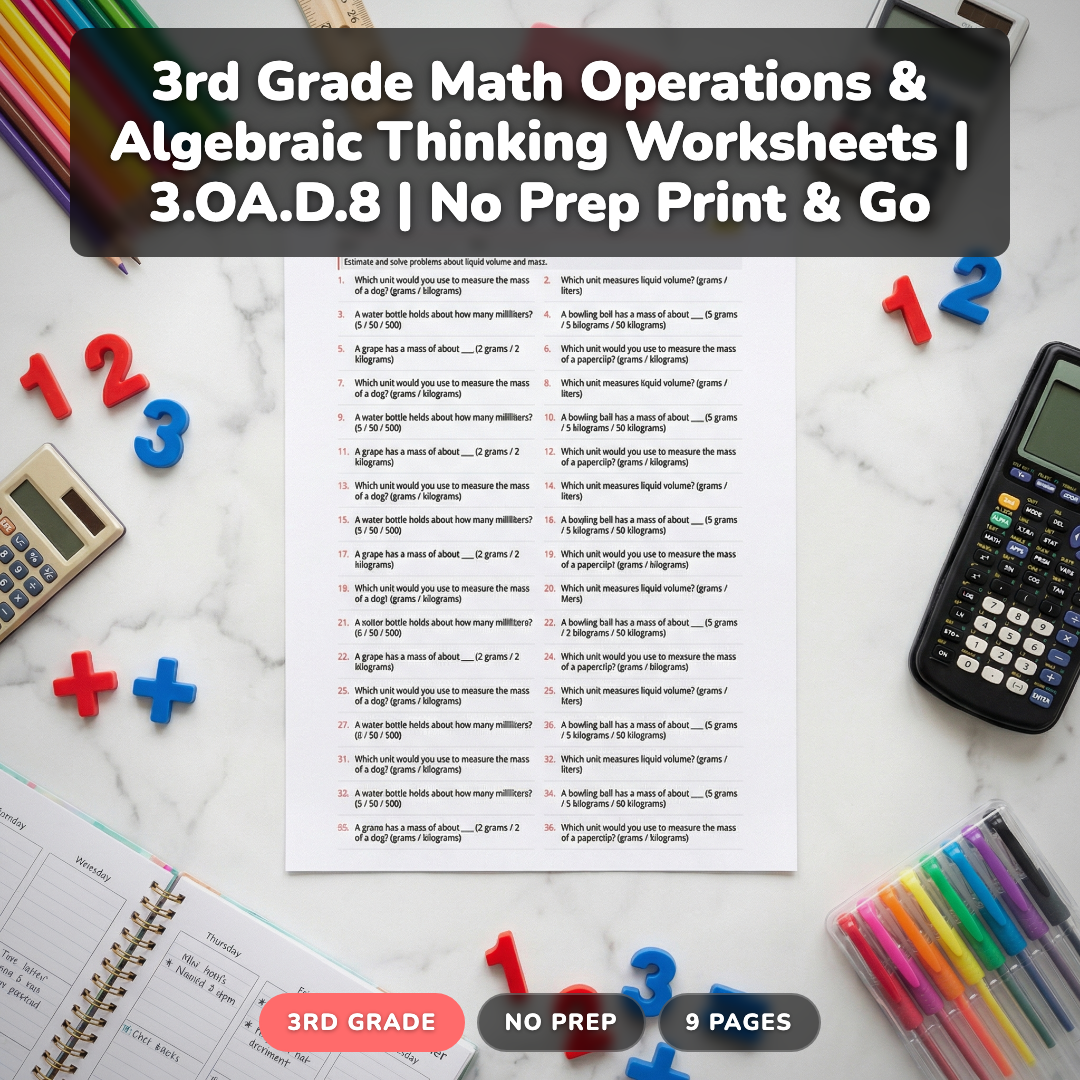
After years of creating word problems from scratch and searching for appropriately leveled practice, I developed a comprehensive resource that addresses every aspect of CCSS.Math.Content.3.OA.D.8. This 9-page pack includes 132 carefully crafted problems across three difficulty levels — practice (37 problems), on-level (50 problems), and challenge (45 problems).
What makes this resource different is the intentional progression within each level. Practice problems explicitly state hidden questions and use smaller numbers. On-level problems mirror typical standardized test formats with grade-appropriate computation. Challenge problems incorporate higher-order thinking with multi-step reasoning and real-world contexts.
Each problem includes space for students to show their estimation, equations with variables, and solution steps. Answer keys are provided for all three levels, making it perfect for independent work, homework, or assessment preparation.
The resource covers every problem type your students need to master: equal groups, comparison, multi-step addition and subtraction, and combination problems with all four operations.
Grab a Free Two-Step Problem Sample to Try
Want to see the resource in action? I’ll send you a free sample with 3 problems from each difficulty level, plus the answer key and teaching tips. Perfect for trying out these strategies with your students!
Frequently Asked Questions About Teaching Two-Step Word Problems
When should I introduce variables in word problem equations?
Introduce variables once students can solve two-step problems with pictures and words. Start with problems where the unknown is the final answer, using simple letters like ‘n’ for ‘number.’ Gradually progress to unknowns in different positions within the problem structure.
How do I help students who rush through word problems?
Implement a “slow down protocol”: read twice, underline key information, estimate first, solve step-by-step, check against estimate. Use timers to encourage thoughtful pacing rather than speed. Celebrate thorough thinking over quick answers.
What’s the best way to teach estimation strategies for word problems?
Model estimation as the first step, not an afterthought. Teach rounding to nearest 10 or 100 based on problem size. Use “about” language and estimation ranges. Show how estimation helps catch unreasonable answers before final submission.
How many two-step word problems should students practice daily?
Start with 2-3 problems during initial instruction, focusing on strategy application over quantity. Once students show understanding, assign 4-5 problems for independent practice. Quality discussion about problem-solving approaches matters more than completing many problems quickly.
Should students always write equations for two-step word problems?
Yes, equation writing is required by CCSS.Math.Content.3.OA.D.8. However, allow flexibility in when they write equations — some students benefit from drawing first, others from writing equations immediately. The key is connecting their thinking process to symbolic representation.
Two-step word problems challenge students to think like mathematicians — breaking complex situations into manageable parts and using multiple strategies to reach solutions. With consistent practice using these five strategies, your students will approach algebraic thinking with confidence and mathematical reasoning skills that serve them well beyond third grade.
What’s your biggest challenge when teaching two-step word problems? Try the free sample problems above and let me know how these strategies work in your classroom!