If your third graders freeze when they see “8 ÷ ? = 2” or struggle to connect multiplication and division, you’re not alone. Teaching division as an unknown-factor problem is one of the trickiest concepts in third grade math, but it’s also one of the most important for building algebraic thinking skills.
Key Takeaway
Division as unknown-factor problems helps students see the relationship between multiplication and division, building the foundation for algebraic thinking and fact fluency.
Why Division as Unknown Factors Matters in Third Grade
Standard CCSS.Math.Content.3.OA.B.6 asks students to understand division as an unknown-factor problem. This means instead of just memorizing division facts, students learn to think: “What number times 2 equals 8?” This conceptual understanding is crucial because it connects multiplication and division as inverse operations.
Research from the National Council of Teachers of Mathematics shows that students who understand the relationship between multiplication and division demonstrate 40% better fact fluency and problem-solving skills. This standard typically appears in the second half of third grade, after students have developed multiplication fluency through CCSS.Math.Content.3.OA.C.7.
The unknown-factor approach also builds algebraic thinking skills that students will need in later grades. When they encounter equations like 3x = 15 in middle school, they’ll already understand the underlying concept from their work with division problems.
Looking for a ready-to-go resource? I put together a differentiated operations and algebraic thinking pack that covers everything below — but first, the teaching strategies that make it work.
Common Division Unknown Factor Misconceptions in 3rd Grade
Common Misconception: Students think division and multiplication are completely separate operations.
Why it happens: They’ve memorized facts without understanding the inverse relationship.
Quick fix: Always present division problems alongside their multiplication counterparts.
Common Misconception: Students believe the missing number always goes in the middle of a multiplication equation.
Why it happens: They see “? × 3 = 12” as the only format for unknown factors.
Quick fix: Practice with missing factors in all three positions: ? × 3 = 12, 4 × ? = 20, and 2 × 5 = ?
Common Misconception: Students try to use addition or subtraction to solve division problems.
Why it happens: They haven’t connected division to multiplication thinking.
Quick fix: Use manipulatives to show equal groups and connect to multiplication arrays.
Common Misconception: Students think larger numbers always come first in multiplication.
Why it happens: They haven’t internalized the commutative property.
Quick fix: Show that 3 × 4 and 4 × 3 both equal 12 using visual models.
5 Research-Backed Strategies for Teaching Division as Unknown Factors
Strategy 1: Fact Family Triangles with Missing Numbers
Fact family triangles help students visualize the relationship between multiplication and division by showing all three numbers in one family together. Students cover different numbers to practice unknown factors.
What you need:
- Fact family triangle cards (drawn or printed)
- Small sticky notes or index cards
- Dry erase markers
Steps:
- Draw triangles with three related numbers (like 3, 4, and 12)
- Place the product at the top, factors at the bottom corners
- Cover one number with a sticky note
- Have students write the missing number and the complete fact family
- Rotate which number is covered to practice all positions
Strategy 2: Array Detective with Missing Dimensions
Arrays provide a concrete visual for understanding how multiplication and division connect. Students become “detectives” finding missing array dimensions.
What you need:
- Square tiles or counters
- Grid paper
- Array cards with missing information
Steps:
- Give students a total number of tiles (like 24)
- Provide one dimension (“Make arrays that are 4 tiles wide”)
- Students build the array and determine the missing dimension
- Connect to both multiplication (4 × ? = 24) and division (24 ÷ 4 = ?)
- Record findings on a chart showing the relationship
Strategy 3: Think Multiplication, Write Division
This strategy explicitly connects students’ multiplication knowledge to division problems by having them “think multiplication” to solve division.
What you need:
- Division problems written as unknown factors
- Multiplication fact charts
- Two-column recording sheets
Steps:
- Present a division problem like “20 ÷ 4 = ?”
- Rewrite as “4 × ? = 20”
- Students think: “What times 4 equals 20?”
- Record both the multiplication thinking and division answer
- Practice with problems where any position could be missing
Strategy 4: Story Problem Connections
Real-world contexts help students understand when to use division as unknown factors and see the practical applications of this mathematical thinking.
What you need:
- Story problem cards
- Manipulatives for acting out scenarios
- Equation recording sheets
Steps:
- Present problems like “Sarah has 18 stickers arranged in 3 equal rows. How many stickers are in each row?”
- Students model with manipulatives first
- Connect to the unknown factor: “3 × ? = 18”
- Write both the multiplication and division equations
- Discuss how the context determines which operation to use
Strategy 5: Missing Factor War Card Game
This engaging partner game reinforces unknown factor thinking while building fact fluency through repeated practice in a fun format.
What you need:
- Playing cards or number cards 1-10
- Equation recording sheets
- Timer (optional)
Steps:
- Each player draws two cards
- Players multiply their numbers to find the product
- One player covers one of their cards (the unknown factor)
- Partner must determine the missing factor
- Players check by revealing the covered card
- Correct answers win both cards
How to Differentiate Division Unknown Factors for All Learners
For Students Who Need Extra Support
Begin with concrete manipulatives and smaller numbers. Use fact families within 25 (like 3 × 4 = 12) and provide multiplication charts as reference tools. Focus on one position for the unknown factor at a time, starting with the quotient position (4 × 3 = ?) before moving to missing factors. Scaffold with visual arrays and encourage students to use skip counting when needed.
For On-Level Students
Practice with fact families through 100, using all three positions for unknown factors. Students should work fluently between multiplication and division representations and begin solving multi-step problems. Encourage mental math strategies and connect to real-world applications. Focus on building automaticity with CCSS.Math.Content.3.OA.B.6 expectations while maintaining conceptual understanding.
For Students Ready for a Challenge
Extend to larger numbers and introduce problems with multiple possible answers. Challenge students to find all factor pairs for a given product or create their own story problems. Introduce early algebraic thinking with simple variables and connect to patterns in multiplication tables. Students can explore the relationship between division and fractions as equal parts of a whole.
A Ready-to-Use Operations & Algebraic Thinking Resource for Your Classroom
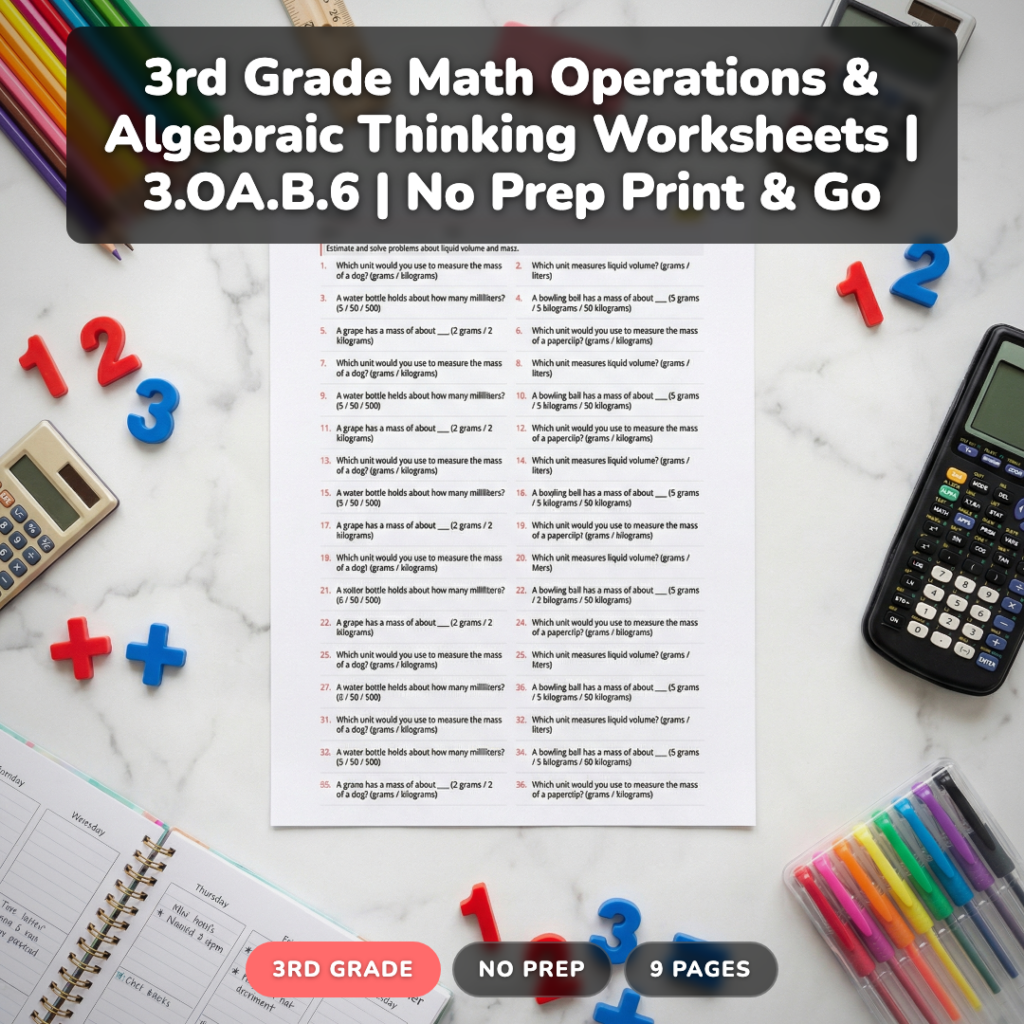
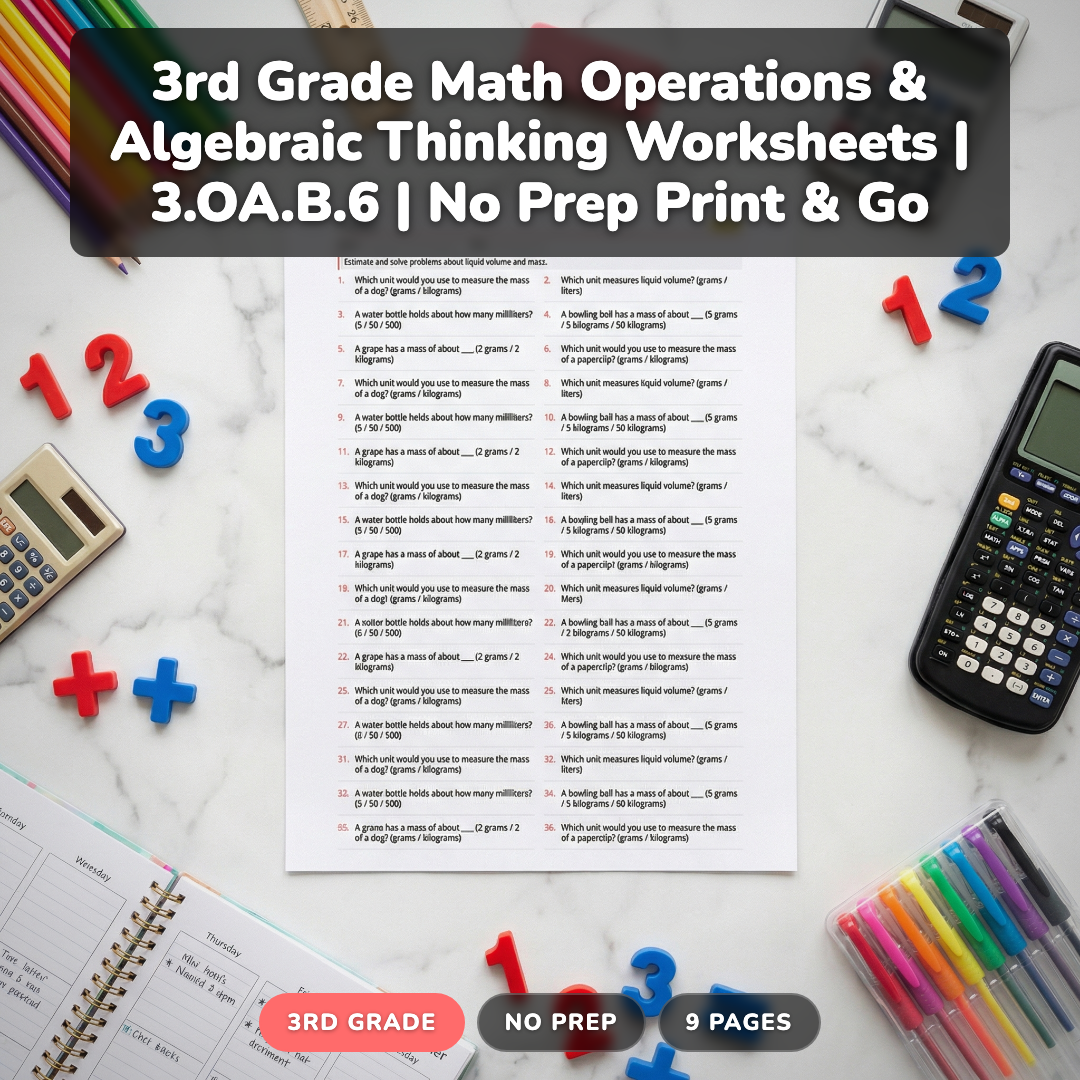
If you want to save prep time while ensuring your students get comprehensive practice with division as unknown factors, I’ve created a differentiated resource that takes the guesswork out of planning. This 9-page pack includes 132 carefully crafted problems across three difficulty levels.
The Practice level (37 problems) focuses on basic fact families and single-digit numbers with visual supports. The On-Level section (50 problems) aligns directly with grade-level expectations for CCSS.Math.Content.3.OA.B.6, while the Challenge level (45 problems) extends learning with multi-step problems and larger numbers.
What makes this resource different is the intentional progression and built-in differentiation. Each level includes answer keys, and problems are designed to build from concrete understanding to abstract thinking. You can use it for whole-class instruction, small group work, or independent practice.
The resource includes scaffolded practice, real-world applications, and extension activities that save you hours of planning time.
Grab a Free Division Practice Sheet to Try
Want to see how these strategies work in practice? I’ll send you a free sample worksheet that includes problems from each difficulty level, plus a quick reference guide for teaching unknown factors.
Frequently Asked Questions About Teaching Division as Unknown Factors
When should I introduce division as unknown factors in third grade?
Introduce this concept after students have developed multiplication fluency with single-digit numbers, typically in the second quarter. Students need solid understanding of multiplication facts before they can effectively use them to solve division problems through unknown factor thinking.
How is this different from traditional division algorithms?
Unknown factor thinking focuses on the relationship between multiplication and division rather than procedural steps. Students think “what times 3 equals 15?” instead of following division steps, building conceptual understanding that supports algebraic thinking and fact fluency.
What manipulatives work best for teaching this concept?
Arrays using square tiles, fact family triangles, and equal grouping materials like counters work well. Visual models help students see the connection between multiplication and division, making the unknown factor relationship concrete before moving to abstract equations.
How do I help students who confuse multiplication and division?
Use consistent language linking the operations: “Division asks what factor is missing from multiplication.” Practice fact families together and always show both equations. Visual models like arrays help students see that 3 × 4 = 12 and 12 ÷ 3 = 4 represent the same relationship.
Should students memorize division facts or understand the concept first?
Conceptual understanding should come first. When students understand division as unknown factors, fact fluency develops naturally because they’re using their multiplication knowledge. This approach builds stronger number sense than rote memorization and supports algebraic thinking skills.
Teaching division as unknown factors transforms how students think about the relationship between multiplication and division. When you help students see that division is really asking “what factor is missing?”, you’re building the foundation for algebraic thinking that will serve them throughout their mathematical journey.
What’s your favorite strategy for helping students connect multiplication and division? The free practice sheet above gives you a great starting point to try these approaches in your classroom.