If your third graders freeze when they see 5 × 7 or think multiplication just means “memorize facts,” you’re not alone. Teaching multiplication as groups and arrays — not just repeated addition — is one of the biggest shifts in elementary math instruction. Here’s how to make CCSS.Math.Content.3.OA.A.1 click for every student in your classroom.
Key Takeaway
Students master multiplication when they see it as “groups of” rather than just repeated addition or memorized facts.
Why Operations & Algebraic Thinking Matters in 3rd Grade
Third grade marks the critical transition from addition and subtraction to multiplicative thinking. CCSS.Math.Content.3.OA.A.1 specifically asks students to interpret products of whole numbers — understanding that 5 × 7 represents 5 groups with 7 objects in each group, not just “five plus seven plus seven plus seven plus seven.”
This conceptual foundation directly impacts students’ success with division, fractions, and area models in fourth grade and beyond. Research from the National Council of Teachers of Mathematics shows that students who develop strong multiplicative reasoning in third grade perform 23% better on standardized assessments through fifth grade.
The standard appears early in the school year (typically September-October) because it builds the foundation for CCSS.Math.Content.3.OA.A.3 (using multiplication within 100) and CCSS.Math.Content.3.OA.A.4 (determining unknown numbers in multiplication equations).
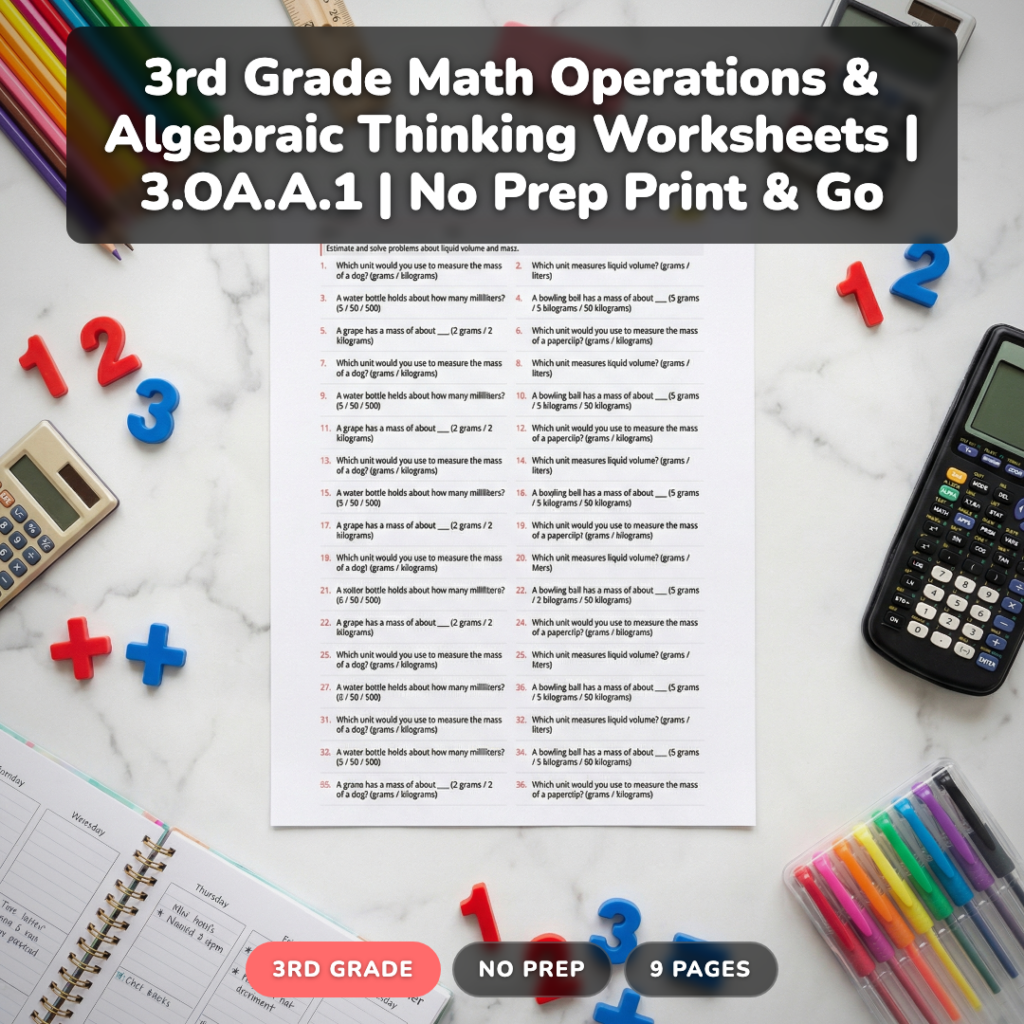
Looking for a ready-to-go resource? I put together a differentiated multiplication interpretation pack with 132 problems across three levels — but first, the teaching strategies that make it work.
Common Multiplication Misconceptions in 3rd Grade
Common Misconception: Students think 5 × 7 and 7 × 5 mean different things.
Why it happens: They interpret the first number as “how many groups” without understanding commutativity.
Quick fix: Show both arrangements with manipulatives — 5 groups of 7 and 7 groups of 5.
Common Misconception: Students add the two numbers instead of multiplying (5 × 7 = 12).
Why it happens: They default to familiar addition strategies when seeing two numbers.
Quick fix: Emphasize the language “groups of” and use physical grouping before showing the × symbol.
Common Misconception: Students think multiplication always makes numbers bigger.
Why it happens: Third-grade multiplication uses whole numbers greater than 1, reinforcing this pattern.
Quick fix: Acknowledge this works for whole numbers, but preview that it changes with fractions later.
Common Misconception: Students confuse “5 groups of 7” with “5 plus 7 groups.”
Why it happens: The word “of” doesn’t clearly signal multiplication in everyday language.
Quick fix: Use consistent language: “5 groups with 7 in each group” instead of just “5 groups of 7.”
5 Research-Backed Strategies for Teaching Multiplication Interpretation
Strategy 1: Concrete Grouping with Manipulatives
Start with physical objects before introducing the multiplication symbol. Students need to see and touch “groups of” before they can visualize it mentally.
What you need:
- Small manipulatives (beans, counters, cubes)
- Paper plates or circles drawn on paper
- Multiplication story problems
Steps:
- Give students a story: “There are 4 tables. Each table has 6 students. How many students total?”
- Have students use plates to represent tables and counters for students
- Students physically create 4 groups with 6 counters each
- Count the total together, emphasizing “4 groups of 6 equals 24”
- Write the equation: 4 × 6 = 24
- Repeat with different numbers, letting students create the groups
Strategy 2: Array Building and Analysis
Arrays help students visualize multiplication as organized rows and columns, connecting to future area model concepts while reinforcing the “groups of” interpretation.
What you need:
- Graph paper or dot paper
- Square tiles or cubes
- Array recording sheets
Steps:
- Start with a story: “The cafeteria has 5 rows of tables with 8 seats in each row”
- Students build the array with tiles — 5 rows, 8 in each row
- Count by rows: “8, 16, 24, 32, 40”
- Record as 5 × 8 = 40
- Rotate the array and discuss: “Now we have 8 rows of 5” (8 × 5 = 40)
- Students draw arrays on graph paper and write matching equations
Strategy 3: Real-World Multiplication Stories
Connect multiplication to students’ experiences through contextualized problems that naturally require “groups of” thinking.
What you need:
- Picture books with multiplication scenarios
- Student-created story problems
- Classroom objects for acting out scenarios
Steps:
- Read scenarios aloud: “Each pizza has 8 slices. We ordered 6 pizzas for the party”
- Students identify the groups (6 pizzas) and what’s in each group (8 slices)
- Act it out with paper circles and squares
- Write the multiplication sentence together: 6 × 8 = 48
- Students create their own multiplication stories
- Partners solve each other’s stories with manipulatives
Strategy 4: Skip Counting Connection Bridge
Bridge students’ existing skip counting skills to multiplication by showing the connection between counting by groups and multiplication equations.
What you need:
- Number lines (0-50)
- Colored markers or crayons
- Skip counting charts
Steps:
- Review skip counting by 5s: “5, 10, 15, 20, 25”
- Show this represents 5 groups: “1 group of 5, 2 groups of 5, 3 groups of 5…”
- Mark jumps on a number line with different colors
- Connect to multiplication: “3 groups of 5 is 3 × 5 = 15”
- Practice with other skip counting patterns (2s, 10s, 3s)
- Students create their own skip counting multiplication problems
Strategy 5: Multiplication Models Comparison
Help students see that different visual models (groups, arrays, number lines) all represent the same multiplication concept.
What you need:
- Chart paper divided into three sections
- Various manipulatives
- Comparison recording sheets
Steps:
- Give one multiplication problem: 4 × 7
- Students solve using three different models: groups, arrays, and skip counting
- Create a class chart showing all three representations
- Discuss what’s the same (total) and what’s different (visual arrangement)
- Students choose their preferred model and explain why
- Practice with new problems, encouraging model flexibility
How to Differentiate Multiplication Interpretation for All Learners
For Students Who Need Extra Support
Focus on numbers 1-5 for the first factor and 1-10 for the second factor. Use larger manipulatives like blocks or toys that are easier to handle. Provide multiplication mats with pre-drawn circles for grouping. Review skip counting by 2s, 5s, and 10s before introducing multiplication symbols. Allow extra time for hands-on exploration before moving to abstract representations.
For On-Level Students
Work with factors 1-10 systematically, following the CCSS.Math.Content.3.OA.A.1 expectations. Use a mix of manipulatives, drawings, and mental math strategies. Practice identifying multiplication in word problems and creating their own story contexts. Connect to repeated addition when helpful, but emphasize “groups of” language. Introduce fact families (3 × 4 and 4 × 3) through arrays and grouping activities.
For Students Ready for a Challenge
Explore two-digit multiplication like 3 × 12 using base-ten blocks and area models. Create complex word problems involving multiple steps. Investigate patterns in multiplication tables and make predictions. Connect multiplication to real-world data collection (surveying classmates about pets, then calculating totals). Begin exploring the relationship between multiplication and division through sharing activities.
A Ready-to-Use Multiplication Interpretation Resource for Your Classroom
Teaching multiplication interpretation effectively requires lots of varied practice at different levels. That’s why I created a comprehensive resource that takes the guesswork out of differentiation while saving you hours of prep time.
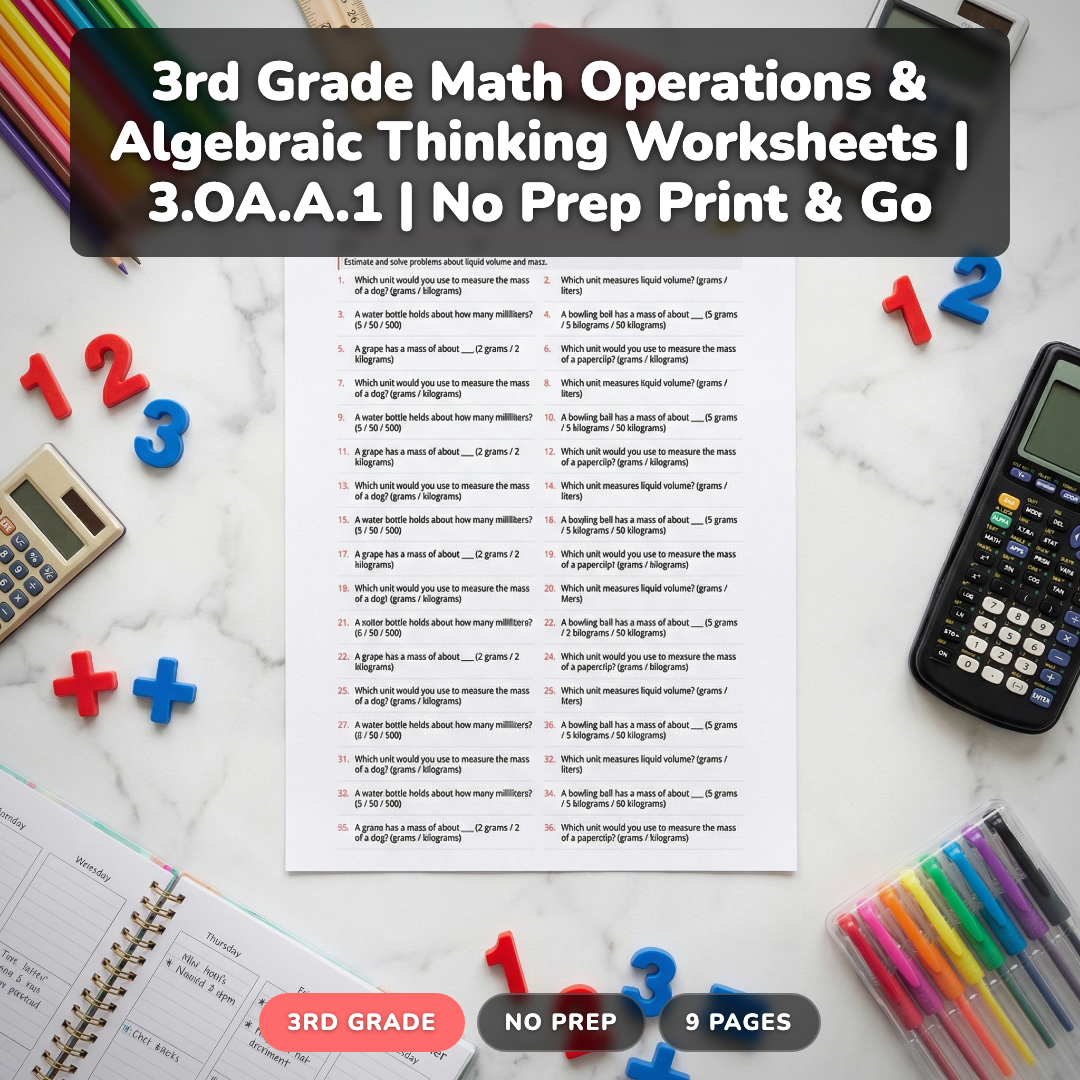
This Operations & Algebraic Thinking pack includes 132 problems across 9 pages, specifically designed for CCSS.Math.Content.3.OA.A.1. You get 37 practice-level problems for students who need extra support, 50 on-level problems for grade-level expectations, and 45 challenge problems for advanced learners.
What makes this different from generic worksheets? Every problem uses clear “groups of” language, includes visual supports like arrays and grouping diagrams, and progresses systematically from concrete to abstract thinking. The practice level focuses on factors 1-5, on-level covers 1-10, and challenge extends to some two-digit scenarios.
No more spending weekend hours creating different versions for your diverse learners. Print, differentiate, and teach with confidence.
Grab a Free Multiplication Sample to Try
Want to see the quality and differentiation levels before you buy? I’ll send you a free sample page from each level — practice, on-level, and challenge — so you can try it with your students first. Drop your email below and I’ll send it right over.
Frequently Asked Questions About Teaching Multiplication Interpretation
When should I introduce the multiplication symbol (×) to third graders?
Introduce the × symbol after students understand “groups of” with manipulatives and can solve problems using concrete materials. This typically happens 2-3 weeks into multiplication instruction. Always connect the symbol back to the grouping language: “4 × 6 means 4 groups with 6 in each group.”
Should I teach multiplication as repeated addition?
Use repeated addition as one strategy, but emphasize “groups of” thinking as the primary concept. CCSS.Math.Content.3.OA.A.1 specifically focuses on interpreting products as groups, which builds stronger foundations for division, fractions, and area models in later grades than repeated addition alone.
How do I help students who confuse multiplication and addition?
Use consistent language and visual cues. Always say “groups with ___ in each group” rather than just showing the equation. Use physical separators like paper plates or circles to make groups obvious. Practice identifying whether word problems ask for groups (multiplication) or combining (addition) before solving.
What’s the difference between 5 × 7 and 7 × 5 for third graders?
Both equal 35, but the grouping is different: 5 × 7 means 5 groups with 7 in each group, while 7 × 5 means 7 groups with 5 in each group. Show both with manipulatives so students see they’re different arrangements with the same total. This builds understanding of commutativity.
How many multiplication facts should third graders memorize?
Focus on conceptual understanding first, then work toward fluency with facts 1-10. CCSS.Math.Content.3.OA.A.7 expects fluency by the end of third grade, but interpretation and understanding (3.OA.A.1) should come first. Students who understand grouping learn facts faster than those who just memorize.
Building Confident Multiplication Thinkers
Teaching multiplication interpretation successfully comes down to helping students see the “groups of” structure in every problem. When third graders understand that 5 × 7 represents 5 groups with 7 objects each, they’re ready for fact fluency, division concepts, and the algebraic thinking that follows.
What’s your go-to strategy for helping students visualize multiplication groups? Try the concrete grouping approach this week and watch how quickly students start using “groups of” language naturally.
Don’t forget to grab your free multiplication sample above — it includes problems from all three differentiation levels so you can see what works best with your students.