If your third graders freeze when they see a division symbol, you’re not alone. Many students struggle to understand what division actually means beyond just “the opposite of multiplication.” The good news? With the right teaching strategies, you can help students visualize division as sharing and grouping — making this abstract concept click in concrete ways.
Key Takeaway
Teaching division through hands-on sharing and grouping activities helps students understand quotients as both “how many in each group” and “how many groups” — the foundation for algebraic thinking.
Why Division Interpretation Matters in Third Grade
Division interpretation forms the cornerstone of algebraic thinking in elementary math. When students understand CCSS.Math.Content.3.OA.A.2 — interpreting whole-number quotients — they’re building the foundation for solving word problems, understanding fractions, and developing proportional reasoning skills they’ll need in upper grades.
Research from the National Council of Teachers of Mathematics shows that students who master division concepts through multiple representations perform 23% better on algebraic reasoning tasks in later grades. This standard appears in most curricula between October and December, building on multiplication fluency from earlier in the year.
The standard specifically asks students to interpret expressions like 56 ÷ 8 in two ways: as 56 objects shared equally among 8 groups (partitive division) or as 56 objects grouped into sets of 8 (quotative division). This dual interpretation develops flexible mathematical thinking.
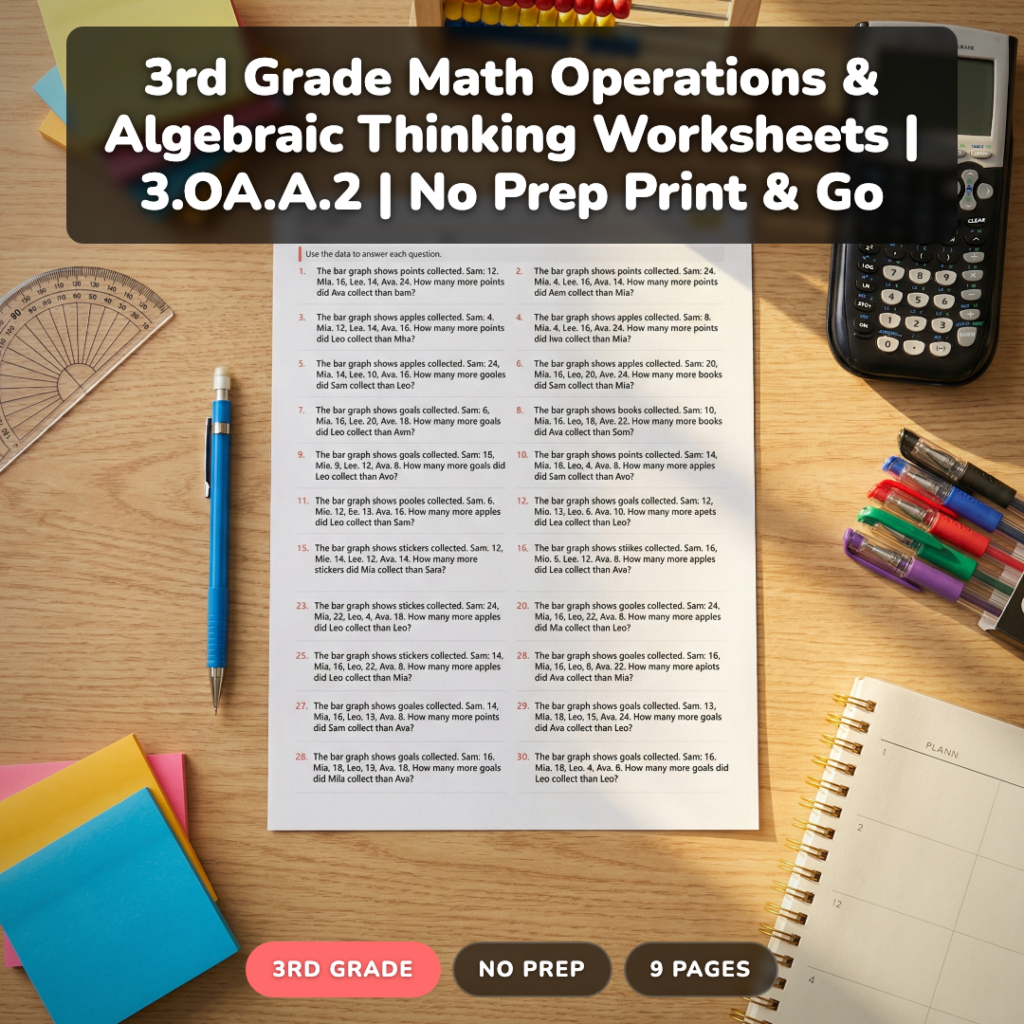
Looking for a ready-to-go resource? I put together a differentiated division interpretation pack with 132 problems across three levels — but first, the teaching strategies that make it work.
Common Division Misconceptions in Third Grade
Common Misconception: Students think division always means “split into equal groups” and miss the “how many groups” interpretation.
Why it happens: Early division instruction often emphasizes sharing equally without showing grouping scenarios.
Quick fix: Use both scenarios with the same problem: “24 ÷ 6 as 24 cookies for 6 kids” and “24 ÷ 6 as 24 cookies in bags of 6.”
Common Misconception: Students confuse the dividend and divisor when interpreting word problems.
Why it happens: They focus on numbers rather than the action described in the problem.
Quick fix: Teach students to identify “what’s being shared” (dividend) and “how we’re sharing it” (divisor) before writing the equation.
Common Misconception: Students think remainders mean they solved the problem incorrectly.
Why it happens: Early practice focuses on problems that divide evenly.
Quick fix: Start with real-world scenarios where remainders make sense: “23 students, 4 per table — how many tables needed?”
These misconceptions stem from students memorizing procedures without understanding the conceptual foundation. When students truly grasp division as both sharing and grouping, they develop the number sense needed for success with CCSS.Math.Content.3.OA.A.2.
5 Research-Backed Strategies for Teaching Division Concepts
Strategy 1: Two-Way Division with Manipulatives
This strategy helps students see that the same division equation can represent two different real-world situations, building the flexible thinking required for algebraic reasoning.
What you need:
- Counters or small objects (beans, blocks, etc.)
- Small paper plates or circles
- Division equation cards
Steps:
- Give students 24 counters and the equation 24 ÷ 6
- First scenario: “Make 6 equal groups. How many in each group?”
- Students create 6 groups and distribute counters equally
- Second scenario: “Make groups of 6. How many groups can you make?”
- Students regroup the same 24 counters into groups of 6
- Discuss how both scenarios give the same answer but represent different situations
Strategy 2: Story Problem Sort and Match
Students practice identifying which type of division situation matches different word problems, strengthening their ability to interpret mathematical language.
What you need:
- Story problem cards with sharing and grouping scenarios
- Two sorting mats labeled “How many in each group?” and “How many groups?”
- Answer recording sheet
Steps:
- Read each story problem aloud as a class
- Students identify the key question being asked
- Place the problem card on the appropriate sorting mat
- Write the division equation and solve using manipulatives if needed
- Discuss why each problem fits its category
Strategy 3: Array Connection Bridge
Since students know arrays from multiplication, this strategy connects their existing knowledge to division interpretation, showing how 4 × 6 and 24 ÷ 6 represent the same relationship.
What you need:
- Square tiles or graph paper
- Array recording sheets
- Multiplication and division equation strips
Steps:
- Students build an array (like 4 rows of 6)
- Write the multiplication equation: 4 × 6 = 24
- Cover one factor and ask: “24 ÷ 6 = ?” (How many rows?)
- Cover the other factor: “24 ÷ 4 = ?” (How many columns?)
- Connect to real situations: “24 chairs in 6 rows” vs. “24 chairs, 6 per row”
Strategy 4: Number Line Division Jumps
Visual learners benefit from seeing division as repeated subtraction on a number line, which also prepares them for fraction concepts later in the year.
What you need:
- Large number line (floor tape or poster)
- Sticky notes or counters
- Jump recording sheets
Steps:
- Start at the dividend on the number line (like 28)
- Make equal jumps backward by the divisor (jumps of 4)
- Count the number of jumps to reach zero
- Connect to division: “28 ÷ 4 = 7 because we made 7 jumps of 4”
- Practice with different problems, recording the jump pattern
Strategy 5: Real-World Division Theater
Students act out division scenarios, making abstract concepts concrete through movement and role-play while building mathematical vocabulary.
What you need:
- Scenario cards with division situations
- Props (paper plates, toys, books)
- Recording sheets for equations
Steps:
- Students draw a scenario card (“15 students, 3 per team”)
- Act out the situation with classmates as props
- Identify whether they’re finding groups or items per group
- Write the division equation and explain their thinking
- Other students guess the equation from watching the performance
How to Differentiate Division Concepts for All Learners
For Students Who Need Extra Support
Start with concrete manipulatives and smaller numbers (dividends under 20). Focus on one division interpretation at a time before introducing both. Provide visual supports like hundreds charts and pre-drawn grouping circles. Review skip counting and basic multiplication facts as prerequisite skills. Use consistent language: “How many groups?” vs. “How many in each group?” Offer sentence frames for explaining their thinking.
For On-Level Students
Practice both division interpretations with numbers appropriate for CCSS.Math.Content.3.OA.A.2 (dividends up to 100). Include word problems that require students to determine which operation to use. Encourage multiple solution strategies and mathematical discussions. Connect division to real-world situations students encounter. Begin introducing problems with remainders and discussing what they mean in context.
For Students Ready for a Challenge
Explore three-digit dividends and connect to estimation strategies. Introduce division with remainders in various contexts, discussing when to round up, round down, or express as a fraction. Create their own word problems for classmates to solve. Explore patterns in division (like dividing by 10) and connect to place value understanding. Begin exploring the relationship between division and fractions.
A Ready-to-Use Division Interpretation Resource for Your Classroom
After using these strategies with my students, I created a comprehensive worksheet pack that addresses all aspects of division interpretation. This resource includes 132 carefully crafted problems across three differentiation levels — 37 practice problems for students needing extra support, 50 on-level problems, and 45 challenge problems.
What makes this pack different is the intentional progression from concrete scenarios to abstract thinking. Each level includes both sharing and grouping situations, word problems that require students to choose the operation, and visual representations that support understanding. The problems align directly with CCSS.Math.Content.3.OA.A.2 and include detailed answer keys with explanations.
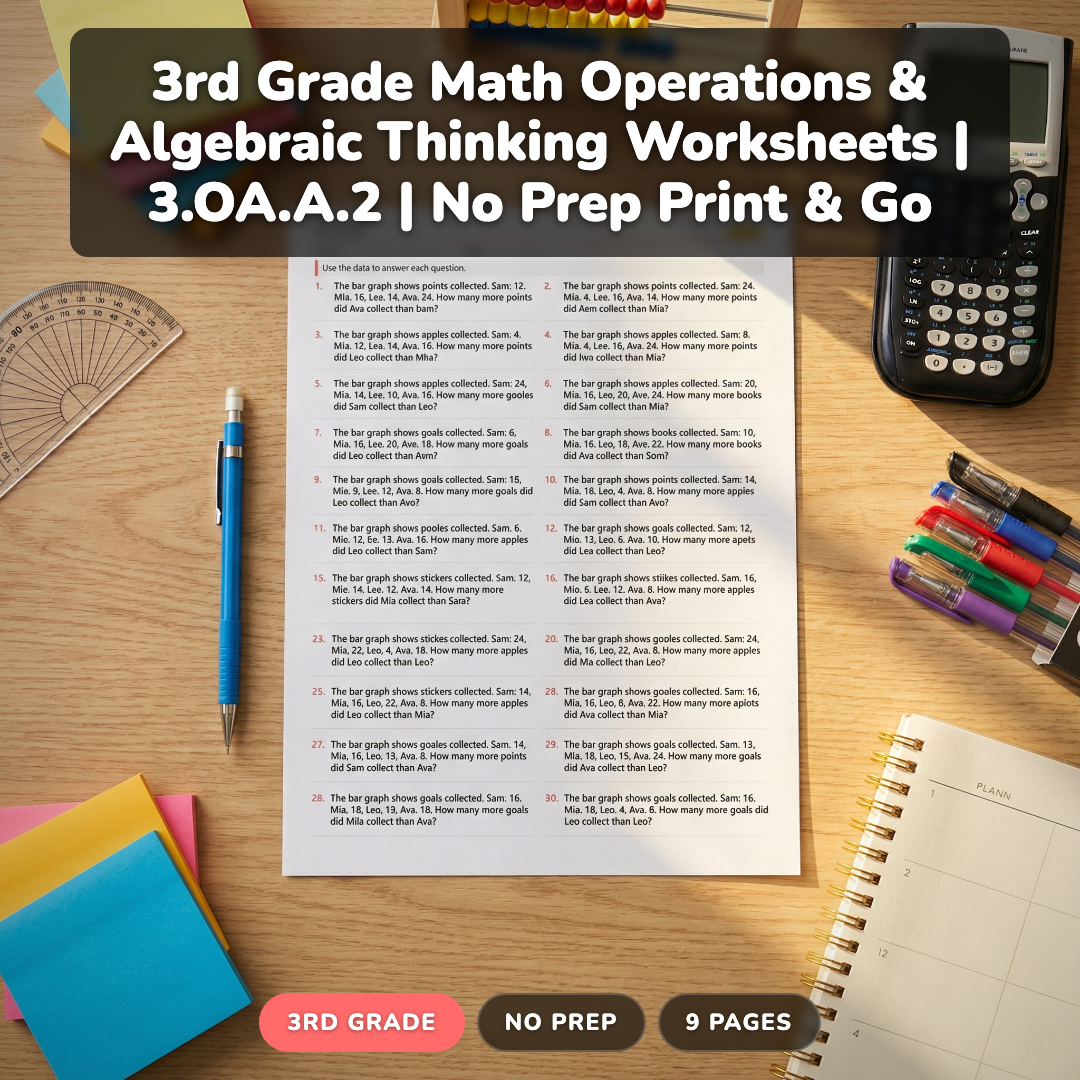
The pack covers everything from basic equal sharing to complex multi-step problems involving remainders. Students practice interpreting quotients in context, writing equations from word problems, and explaining their mathematical reasoning — all essential skills for algebraic thinking.
Grab a Free Division Practice Sheet to Try
Want to see how these strategies work in practice? I’ll send you a free sample worksheet with 10 division interpretation problems across all three levels, plus an answer key with teaching notes.
Frequently Asked Questions About Teaching Division Concepts
When should I introduce division with remainders to third graders?
Introduce remainders after students master basic division interpretation, typically in late fall or winter. Start with real-world contexts where remainders make sense, like “23 students, 4 per table — how many tables needed?” This helps students understand remainders as meaningful, not mistakes.
How do I help students distinguish between the two types of division problems?
Teach students to identify the question being asked. “How many in each group?” indicates partitive division (sharing), while “How many groups?” indicates quotative division (grouping). Use consistent language and visual cues to reinforce this distinction throughout instruction.
What’s the connection between CCSS.Math.Content.3.OA.A.2 and algebraic thinking?
This standard builds algebraic thinking by helping students understand the relationship between operations. When students interpret 56 ÷ 8 as both sharing and grouping, they’re developing flexible thinking about mathematical relationships — the foundation for solving equations and understanding functions.
Should I teach division facts or division concepts first?
Focus on division concepts first through hands-on activities and visual models. Once students understand what division means, fact fluency develops more naturally. Students who memorize facts without understanding struggle with word problems and more complex applications.
How can I assess whether students truly understand division interpretation?
Give students a division equation like 24 ÷ 6 and ask them to create two different word problems — one sharing scenario and one grouping scenario. Students who can do this demonstrate deep understanding of division concepts beyond just computation.
Teaching division interpretation takes time and patience, but when students truly understand these concepts, they’re prepared for success with fractions, multi-step word problems, and algebraic reasoning. The key is providing multiple representations and plenty of hands-on practice.
What’s your go-to strategy for helping students understand division concepts? And don’t forget to grab that free practice sheet above — it’s a great way to try these strategies with your class!