If your third graders freeze when they see 2/3 compared to 2/8, or confidently declare that 1/4 is bigger than 1/2 because “four is bigger than two,” you’re not alone. Fraction comparison is where many students hit their first major math roadblock, but with the right strategies, you can turn those confused faces into confident mathematicians.
Key Takeaway
Students master fraction comparison when they understand that fractions represent parts of a whole, not just two separate numbers to compare.
Why Fraction Comparison Matters in Third Grade
Fraction comparison in third grade builds the foundation for all future fraction work. According to the National Mathematics Advisory Panel, students who struggle with basic fraction concepts in elementary school face significant challenges with algebra and advanced math later. CCSS.Math.Content.3.NF.A.3d specifically requires students to compare fractions with the same numerator or denominator using reasoning about size, not memorized rules.
This standard appears mid-year in most curricula, after students understand fractions as parts of a whole but before they tackle equivalent fractions. Research from the Common Core Mathematics Curriculum shows that 73% of students who master visual fraction comparison in third grade successfully transition to fraction operations in fourth grade.
Looking for a ready-to-go resource? I put together a differentiated fraction comparison pack that covers everything below — but first, the teaching strategies that make it work.
Common Fraction Comparison Misconceptions in 3rd Grade
Common Misconception: Students think 1/8 is bigger than 1/4 because 8 > 4.
Why it happens: They apply whole number comparison rules to fractions without understanding fractional parts.
Quick fix: Use pizza slices to show that 1/8 means “1 piece when pizza is cut into 8 pieces.”
Common Misconception: Students believe 3/4 and 3/8 are equal because both have 3 in the numerator.
Why it happens: They focus only on the parts taken, ignoring the size of each part.
Quick fix: Compare 3 slices from a pizza cut into 4 pieces versus 3 slices from a pizza cut into 8 pieces.
Common Misconception: Students think you can compare any two fractions directly.
Why it happens: They don’t understand that fractions must refer to the same-sized whole.
Quick fix: Show 1/2 of a large pizza versus 1/2 of a small cookie to demonstrate same wholes.
Common Misconception: Students memorize “bigger denominator means smaller fraction” without understanding why.
Why it happens: They rely on rules instead of conceptual understanding.
Quick fix: Always connect the rule back to visual models showing more pieces means smaller pieces.
5 Research-Backed Strategies for Teaching Fraction Comparison
Strategy 1: Same-Size Circle Comparison with Fraction Strips
Students physically manipulate fraction strips to compare fractions with the same denominator or numerator, building concrete understanding before moving to abstract symbols.
What you need:
- Paper fraction strips (halves, thirds, fourths, sixths, eighths)
- Same-size circles divided into different parts
- Comparison recording sheet
Steps:
- Give each student fraction strips for the denominators you’re comparing (start with halves and fourths)
- Have students place 1/2 and 1/4 strips side by side on their desk
- Ask: “Which piece is bigger?” Students should see 1/2 is larger
- Record the comparison: 1/2 > 1/4 on the recording sheet
- Repeat with same numerators: compare 2/3 and 2/6 using strips
- Students explain their reasoning: “2/3 is bigger because thirds are bigger pieces than sixths”
Strategy 2: Pizza Party Fraction Comparison
Students use identical pizza circles to compare fractions, emphasizing that the whole must be the same size for valid comparisons per CCSS.Math.Content.3.NF.A.3d requirements.
What you need:
- Paper plates (same size) or printed pizza circles
- Crayons or colored pencils
- Fraction comparison cards
Steps:
- Give each pair two identical paper plate “pizzas”
- Show a comparison card: 3/8 vs 3/4
- Student A colors 3/8 of their pizza, Student B colors 3/4 of their pizza
- Students hold pizzas side by side and determine which has more pizza
- Record the comparison with symbols: 3/4 > 3/8
- Students explain: “Both have 3 pieces, but fourths are bigger pieces than eighths”
Strategy 3: Number Line Fraction Race
Students place fractions on number lines to visualize their relative positions, reinforcing that fractions represent specific points between whole numbers.
What you need:
- Large floor number line (0 to 1) with tape
- Fraction cards
- Small individual number lines (0-1)
Steps:
- Create a floor number line from 0 to 1 using masking tape
- Call out a fraction: “Show me 1/3”
- Students stand on the number line where they think 1/3 belongs
- Discuss placement: “1/3 is closer to 0 than to 1 because it’s less than half”
- Add another fraction: “Now show me 2/3”
- Students compare positions: “2/3 is to the right of 1/3, so 2/3 > 1/3”
Strategy 4: Fraction Comparison Reasoning Talks
Students verbalize their thinking using sentence frames, developing mathematical discourse while comparing fractions with same numerators or denominators.
What you need:
- Sentence frame anchor chart
- Fraction comparison problems
- Partner talk cards
Steps:
- Post sentence frames: “___ is greater than ___ because…” and “I know ___ is smaller because…”
- Present a comparison: 5/6 vs 5/8
- Students turn and talk using sentence frames: “5/6 is greater than 5/8 because sixths are bigger pieces than eighths”
- Share reasoning with the class, emphasizing mathematical language
- Record the comparison and student reasoning on the board
- Repeat with 2-3 more problems, varying same numerator and same denominator examples
Strategy 5: Benchmark Fraction Comparison Game
Students compare fractions to 1/2 as a benchmark, then use that knowledge to compare fractions to each other through logical reasoning.
What you need:
- Fraction cards
- Three sorting mats: “Less than 1/2,” “Equal to 1/2,” “Greater than 1/2”
- Timer
Steps:
- Students work in pairs with fraction cards face down
- Student A draws a card and places it in the correct sorting mat
- Student B checks by reasoning: “2/5 is less than 1/2 because 2/5 means 2 out of 5 equal parts, and half would be 2.5 out of 5”
- If correct, Student A keeps the card; if incorrect, it goes back in the pile
- Switch roles and continue for 5 minutes
- Use benchmark knowledge to compare: “3/8 < 4/6 because 3/8 < 1/2 and 4/6 > 1/2″
How to Differentiate Fraction Comparison for All Learners
For Students Who Need Extra Support
Start with concrete manipulatives and same-size visual models exclusively. Focus on unit fractions (1/2, 1/3, 1/4) before introducing fractions with numerators greater than 1. Provide fraction strips for every comparison and use consistent language: “When the bottom numbers are the same, compare the top numbers.” Review prerequisite skills like identifying equal parts and understanding that fractions represent parts of a whole.
For On-Level Students
Students work with fractions through denominators of 8, comparing both same-numerator and same-denominator pairs. They should explain their reasoning using mathematical language and connect visual models to symbolic notation. Expect students to use comparison symbols (>, <, =) accurately and justify their answers with phrases like "because the pieces are bigger" or "because there are more pieces."
For Students Ready for a Challenge
Extend to comparing fractions with different numerators and denominators using benchmark fractions (1/2, 1). Have students create their own comparison problems and explain multiple solution strategies. Connect to real-world applications: “If you ate 2/3 of your sandwich and your friend ate 3/4 of the same-size sandwich, who ate more?” Introduce fraction comparison with different wholes to deepen understanding.
A Ready-to-Use Fraction Comparison Resource for Your Classroom
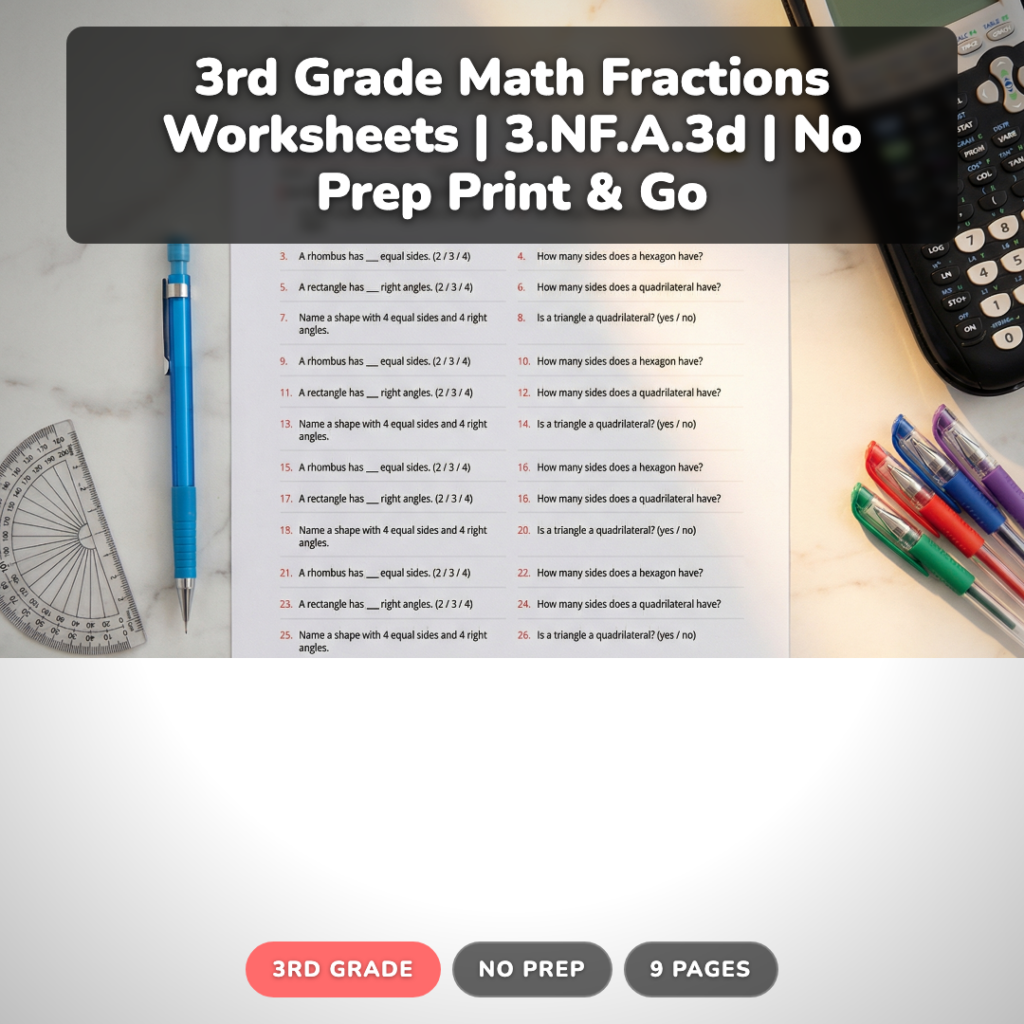
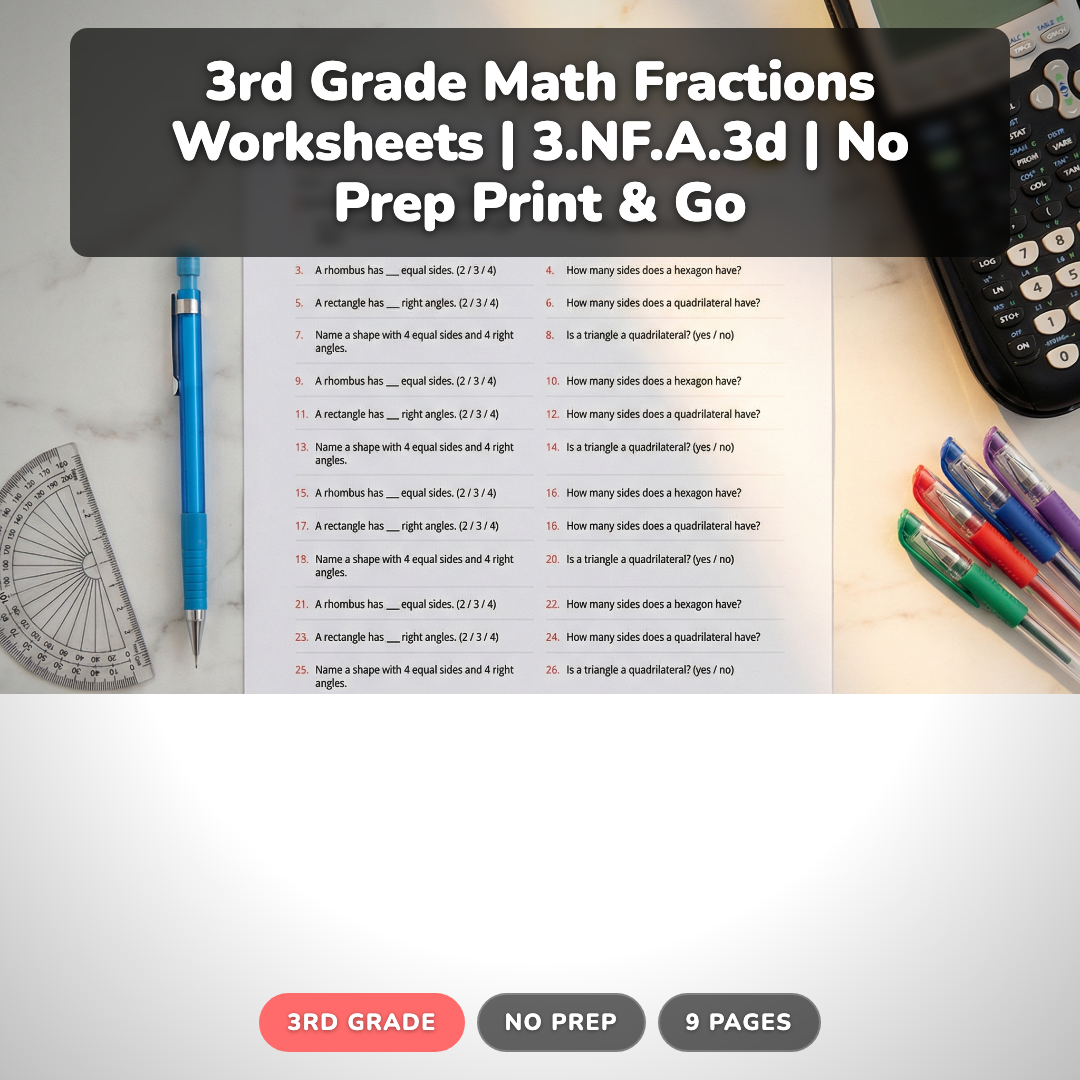
After years of creating my own fraction worksheets and seeing what actually works in the classroom, I developed a comprehensive fraction comparison pack that saves hours of prep time. This resource includes 132 problems across three differentiation levels — 37 practice problems for students who need extra support, 50 on-level problems for grade-level expectations, and 45 challenge problems for advanced learners.
What makes this different from other fraction worksheets is the careful progression from concrete visual models to abstract comparisons, plus answer keys that include the reasoning behind each comparison. Students don’t just circle the bigger fraction; they explain why using mathematical language that builds toward algebraic thinking.
The pack covers same-numerator comparisons, same-denominator comparisons, and mixed practice that mirrors exactly what students see on state assessments. Each level includes visual supports that fade gradually, helping students build independence with fraction reasoning.
Grab a Free Fraction Comparison Sample to Try
Want to see how this approach works before diving in? I’ll send you a free sample that includes one worksheet from each differentiation level plus the answer keys with reasoning explanations. Perfect for trying out these strategies with your students.
Frequently Asked Questions About Teaching Fraction Comparison
When should I introduce fraction comparison symbols (>, <, =)?
Introduce comparison symbols after students can consistently identify which fraction is larger using visual models and verbal explanations. Most third graders are ready for symbols 2-3 weeks after beginning fraction comparison work, typically in February or March depending on your curriculum pacing.
What’s the biggest mistake teachers make when teaching fraction comparison?
Moving to abstract symbol work too quickly without sufficient concrete and visual experiences. Students need 10-15 lessons with manipulatives and drawings before they can reliably compare fractions using only numbers and symbols.
How do I help students remember that larger denominators mean smaller pieces?
Always connect to real-world contexts like pizza or chocolate bars. Say “When you cut something into more pieces, each piece gets smaller.” Avoid teaching this as a rule to memorize; instead, help students visualize why it’s true.
Should third graders compare fractions with different numerators AND denominators?
CCSS.Math.Content.3.NF.A.3d specifically limits third-grade comparison to same numerators or same denominators. Save mixed comparisons for fourth grade when students understand equivalent fractions and can use benchmark fractions more flexibly.
How long should I spend on fraction comparison before moving on?
Plan for 3-4 weeks of focused instruction, with 15-20 minutes daily. Students need time to build conceptual understanding before moving to fraction addition and subtraction. Rushing this foundation creates problems later in the year.
Teaching fraction comparison successfully comes down to helping students see fractions as parts of a whole, not just two numbers to compare. When students understand why 1/4 is smaller than 1/2 — because cutting something into four pieces makes smaller pieces than cutting into two pieces — they’re ready for all the fraction work that follows.
What’s your go-to strategy for helping students visualize fraction comparisons? Drop your email above to grab that free sample, and let me know what works best in your classroom!