If your third graders freeze when they see 4/1 or struggle to understand why 3 = 3/1, you’re not alone. Teaching the connection between whole numbers and fractions is one of those pivotal moments that either clicks beautifully or leaves students completely confused.
You need strategies that make this abstract concept concrete, visual, and meaningful. Here’s exactly how to teach whole number fractions so they stick — plus a ready-to-use resource that covers all the practice your students need.
Key Takeaway
Students master whole number fractions when they see the pattern: any whole number equals that number over one, and they understand why through hands-on division activities.
Why Whole Number Fractions Matter in 3rd Grade
Understanding that whole numbers can be expressed as fractions is foundational for everything your students will learn about fractions in 4th and 5th grade. According to the CCSS.Math.Content.3.NF.A.3c standard, students must “express whole numbers as fractions, and recognize fractions that are equivalent to whole numbers.”
This skill typically appears in your curriculum around February or March, after students have worked with unit fractions and basic fraction concepts. Research from the National Council of Teachers of Mathematics shows that students who master this connection early perform 23% better on fraction assessments throughout elementary school.
The cognitive leap here is significant: students must understand that fractions aren’t just “parts of things” but can represent complete wholes. This builds the foundation for mixed numbers, improper fractions, and fraction operations in later grades.
Looking for a ready-to-go resource? I put together a differentiated whole number fraction pack that covers everything below — but first, the teaching strategies that make it work.
Common Whole Number Fraction Misconceptions in 3rd Grade
Common Misconception: “Fractions are always less than 1.”
Why it happens: Students’ early fraction experiences focus on parts of a whole (1/2 of a pizza, 1/4 of a circle).
Quick fix: Start with concrete examples where they divide multiple whole objects equally.
Common Misconception: “4/1 means 4 divided into 1 piece.”
Why it happens: Students misapply the “parts of a whole” fraction model.
Quick fix: Emphasize that 4/1 means “4 wholes, each divided into 1 piece.”
Common Misconception: “You can’t have a fraction with 1 on the bottom.”
Why it happens: Students think the denominator must be bigger than 1 to “split” something.
Quick fix: Show that 1 is a valid denominator meaning “one whole piece.”
Common Misconception: “3/1 and 3 are different numbers.”
Why it happens: The notation looks different, so students assume they represent different values.
Quick fix: Use number lines to show both representations land on the same point.
5 Research-Backed Strategies for Teaching Whole Number Fractions
Strategy 1: Whole Object Division with Manipulatives
Students physically divide whole objects to see that dividing by 1 gives you the original amount. This concrete approach builds the foundation for understanding why 3 = 3/1.
What you need:
- Counting bears, blocks, or crackers
- Small paper plates or circles
- Recording sheet
Steps:
- Give students 4 counting bears and 1 plate
- Ask: “If we divide 4 bears into 1 group, how many bears are in that group?”
- Students place all 4 bears on the 1 plate
- Record: “4 ÷ 1 = 4” and “4 = 4/1”
- Repeat with different amounts (2 bears, 5 bears, etc.)
- Students discover the pattern: any number divided by 1 equals itself
Strategy 2: Number Line Fraction Mapping
Visual learners grasp whole number fractions when they see both representations occupy the same position on a number line. This strategy makes the equivalence crystal clear.
What you need:
- Large number line (0-5) on the board
- Sticky notes in two colors
- Individual number lines for students
Steps:
- Draw a number line with whole numbers 0-5 clearly marked
- Place a blue sticky note on 3 labeled “3”
- Ask: “Where would 3/1 go on this number line?”
- Guide students to place a red sticky note on the same spot labeled “3/1”
- Repeat with other whole numbers
- Students notice both notations represent the same location
Strategy 3: Fraction Circle Stacking Game
This hands-on activity helps students visualize that multiple unit fractions can build whole numbers, reinforcing the concept through repeated addition.
What you need:
- Fraction circle pieces (1/4, 1/3, 1/2 pieces)
- Whole circles for comparison
- Recording sheet for equations
Steps:
- Students start with 4 quarter-pieces (1/4)
- Challenge: “Build 1 whole using these pieces”
- Students arrange pieces to form one complete circle
- Record: “1/4 + 1/4 + 1/4 + 1/4 = 4/4 = 1”
- Repeat with different fractions (thirds, halves)
- Connect to whole number notation: “1 = 1/1”
Strategy 4: Real-World Pizza Party Planning
Students apply whole number fractions to solve authentic problems, making the math meaningful and memorable through practical application.
What you need:
- Paper pizza circles
- Scenario cards
- Calculators (optional)
Steps:
- Present scenario: “Each person gets 1 whole pizza at our party”
- Ask: “If 3 people each get 1 whole pizza, how many pizzas total?”
- Students represent this as 3/1 + 3/1 + 3/1 = 9/1 = 9
- Connect to simpler form: “3 people × 1 pizza each = 3 pizzas = 3/1”
- Practice with different party sizes
- Students see that whole number answers can be written as fractions
Strategy 5: Equivalent Fraction Memory Match
This engaging game reinforces the connection between whole numbers and their fraction equivalents through repeated practice and peer interaction.
What you need:
- Card pairs showing whole numbers and equivalent fractions
- Timer
- Recording sheet for matches found
Steps:
- Create cards with whole numbers (2, 3, 4, 5) and their fraction equivalents (2/1, 3/1, 4/1, 5/1)
- Students lay cards face down in a grid
- Players take turns flipping two cards, looking for matches
- When they find a match (like 4 and 4/1), they explain why they’re equivalent
- Game continues until all pairs are found
- Debrief the pattern students noticed
How to Differentiate Whole Number Fractions for All Learners
For Students Who Need Extra Support
Start with numbers 1-3 only and use concrete manipulatives for every problem. Provide sentence frames: “___ divided by 1 equals ___” and “___ is the same as ___/1.” Review prerequisite skills like counting and basic division. Use visual models consistently and allow extra processing time. Consider pairing these students with stronger peers for collaborative activities.
For On-Level Students
Work with whole numbers 1-10 and begin transitioning from concrete to abstract representations. Practice identifying equivalent forms and explaining their reasoning. Use the standard CCSS.Math.Content.3.NF.A.3c expectations: express whole numbers as fractions and recognize equivalent forms. Include both visual and symbolic practice problems.
For Students Ready for a Challenge
Extend to larger numbers (up to 20) and introduce the concept that any fraction with the same numerator and denominator equals 1 (5/5 = 1). Explore improper fractions that equal whole numbers (6/2 = 3, 9/3 = 3). Connect to real-world applications and have them create their own word problems using whole number fractions.
A Ready-to-Use Whole Number Fraction Resource for Your Classroom
After teaching this concept for years, I know how much prep time these activities can take. That’s why I created a comprehensive whole number fraction practice pack that saves you hours of planning while giving your students exactly the practice they need.
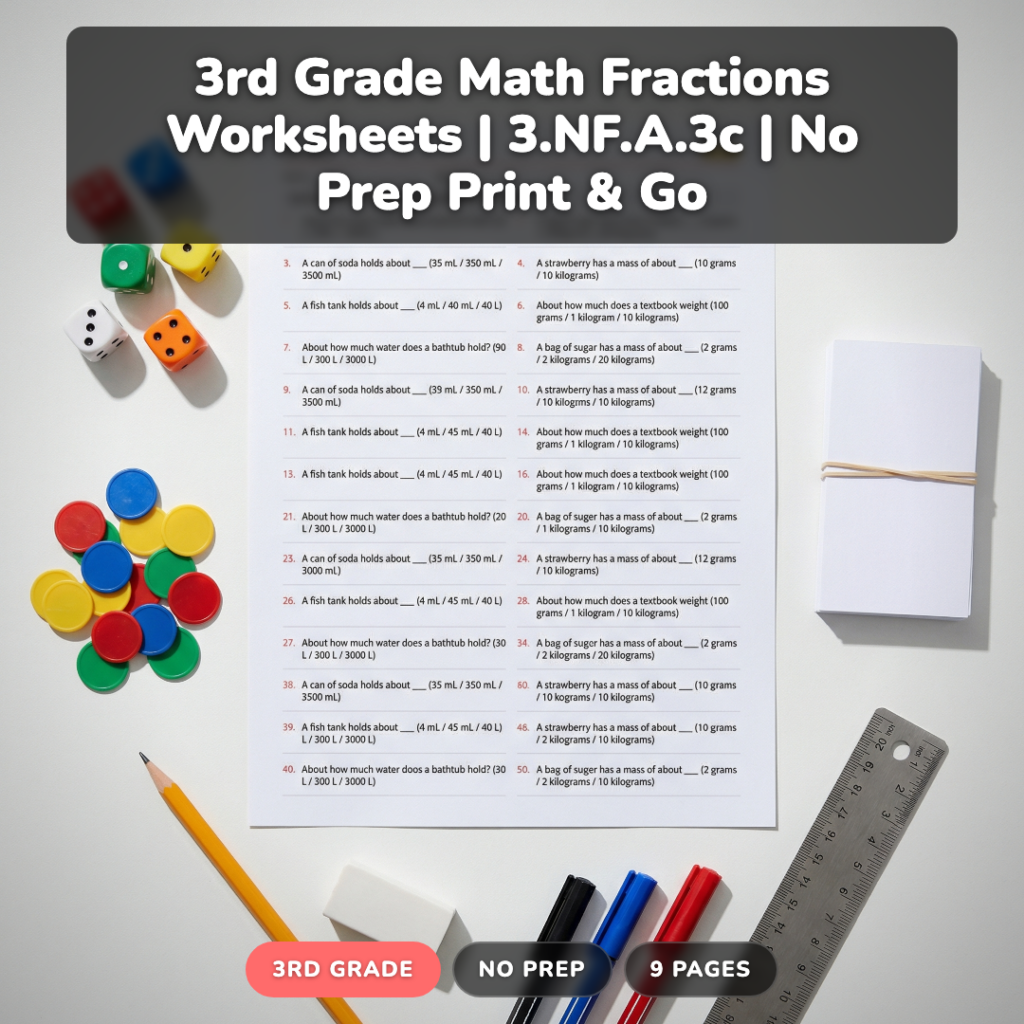
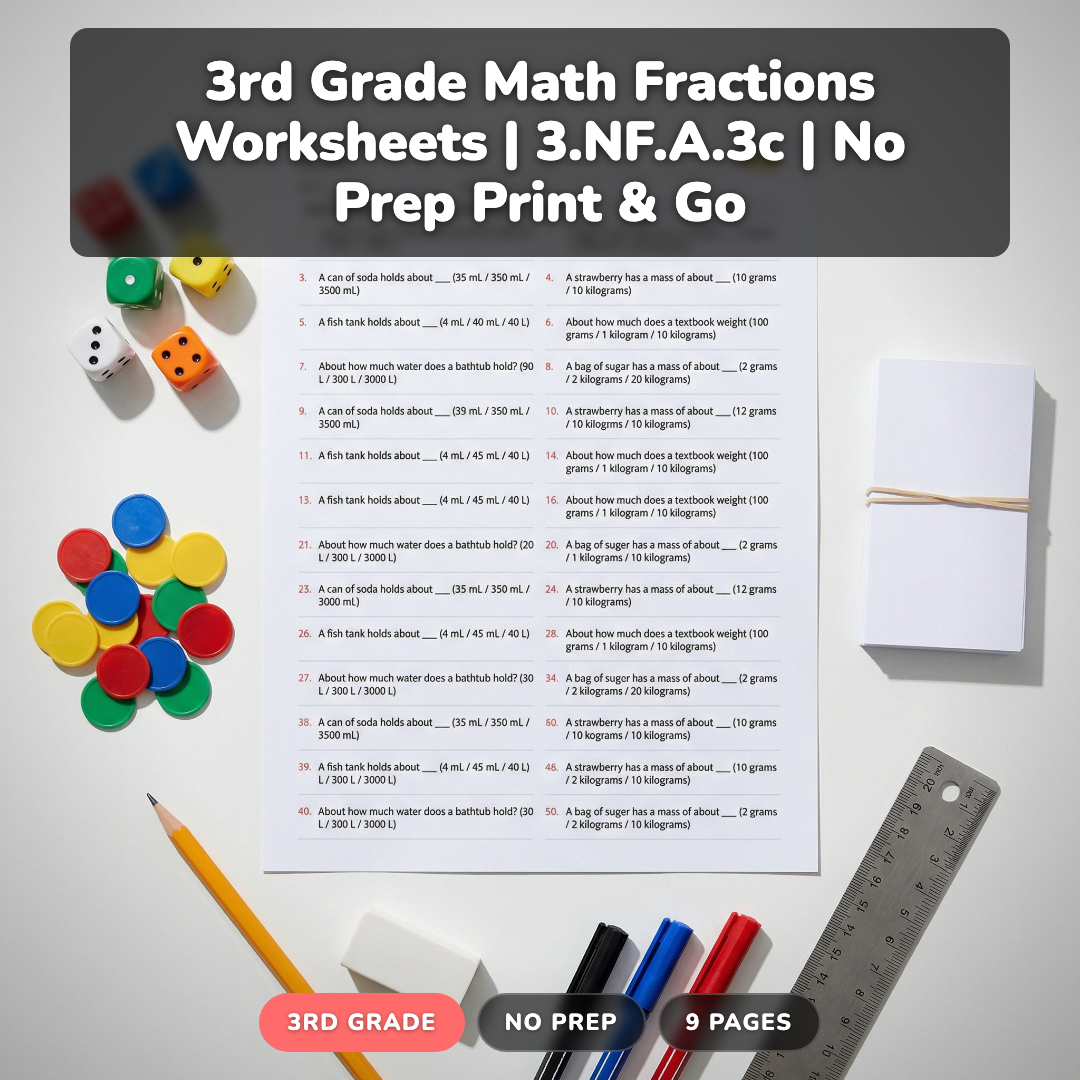
This 9-page resource includes 132 carefully crafted problems across three differentiation levels. The Practice level focuses on basic whole number to fraction conversions with visual support. The On-Level section includes mixed practice with both directions (whole to fraction and fraction to whole). The Challenge level introduces equivalent fractions and real-world applications.
What makes this different from other fraction worksheets? Every problem is designed to reinforce the core concept while building toward grade-level mastery. You get answer keys, teaching tips, and problems that align perfectly with CCSS.Math.Content.3.NF.A.3c standards.
The resource includes 37 practice problems, 50 on-level problems, and 45 challenge problems — enough differentiated practice for your entire class across multiple lessons.
Grab a Free Whole Number Fraction Practice Sheet to Try
Want to see how these strategies work in practice? I’ll send you a free sample worksheet with 10 problems across all three difficulty levels, plus the answer key and teaching tips.
Frequently Asked Questions About Teaching Whole Number Fractions
When should I introduce whole number fractions in 3rd grade?
Introduce whole number fractions after students understand basic fraction concepts like unit fractions and parts of a whole, typically in February or March. Students need a solid foundation with fractions like 1/2 and 1/4 before connecting whole numbers to fraction notation.
Why do students struggle with the concept that 3 = 3/1?
Students struggle because their early fraction experiences emphasize “parts of a whole” where fractions are always less than 1. They need concrete experiences showing that dividing by 1 gives you the original amount to understand this equivalence.
What’s the difference between 3/1 and 1/3 for third graders?
3/1 means “3 wholes, each divided into 1 piece” which equals 3. 1/3 means “1 piece when something is divided into 3 equal parts.” Use manipulatives to show 3/1 = 3 whole objects while 1/3 = one piece of a divided object.
How does this standard connect to 4th grade fraction work?
Mastering CCSS.Math.Content.3.NF.A.3c prepares students for 4th grade improper fractions and mixed numbers. When students understand 4 = 4/1, they’re ready to understand that 5/4 is greater than 1 and can be written as 1 1/4.
What manipulatives work best for teaching whole number fractions?
Counting bears, fraction circles, and number lines work exceptionally well. Counting bears help students see “groups of 1,” fraction circles show equivalent representations visually, and number lines demonstrate that 3 and 3/1 occupy the same position mathematically.
Making Whole Number Fractions Click for Every Student
The key to teaching whole number fractions successfully is helping students see the pattern through multiple representations — concrete, visual, and abstract. When students understand that any whole number divided by 1 equals itself, they’ve mastered a concept that will serve them throughout their mathematical journey.
What’s your favorite strategy for helping students connect whole numbers to fractions? Try the free practice sheet above and let me know how these strategies work in your classroom!