If your third graders look puzzled when you mention that 2/4 equals 1/2, you’re not alone. Teaching equivalent fractions is one of those foundational concepts that can make or break a student’s fraction understanding for years to come. The good news? With the right strategies and plenty of visual support, your students can master this critical skill and build confidence with fractions.
Key Takeaway
Students understand equivalent fractions best when they see, touch, and compare concrete representations before moving to abstract symbols.
Why Equivalent Fractions Matter in Third Grade
Equivalent fractions form the foundation for nearly every fraction operation your students will encounter in fourth grade and beyond. According to research from the National Council of Teachers of Mathematics, students who struggle with equivalent fractions in third grade are 40% more likely to have difficulty with fraction addition and subtraction in fourth grade.
The CCSS.Math.Content.3.NF.A.3a standard requires students to understand that two fractions are equivalent if they represent the same size or the same point on a number line. This conceptual understanding typically develops in late fall or early winter, after students have mastered basic fraction identification and comparison.
Timing matters here. Students need solid experience with unit fractions (1/2, 1/3, 1/4) and fraction comparison before tackling equivalence. Most teachers introduce equivalent fractions around November or December, giving students time to build fraction sense first.
Looking for a ready-to-go resource? I put together a differentiated equivalent fractions pack that covers everything below — but first, the teaching strategies that make it work.
Common Equivalent Fraction Misconceptions in Third Grade
Understanding why students struggle helps you address problems before they become ingrained. Here are the four misconceptions I see most often:
Common Misconception: Students think equivalent fractions must have the same numerators and denominators.
Why it happens: They focus on the numbers rather than the size of the pieces.
Quick fix: Use visual models consistently to show that different numbers can represent the same amount.
Common Misconception: Students believe larger denominators always mean larger fractions.
Why it happens: They apply whole number thinking to fractions (bigger number = bigger amount).
Quick fix: Compare pizza slices — show that 1/8 of a pizza is smaller than 1/4 of the same pizza.
Common Misconception: Students think you can only find one equivalent fraction for any given fraction.
Why it happens: Limited exposure to multiple representations of the same fraction.
Quick fix: Create equivalent fraction families using manipulatives to show 1/2 = 2/4 = 3/6 = 4/8.
Common Misconception: Students assume fractions are equivalent if they look similar on a number line.
Why it happens: They estimate rather than precisely identifying the fraction location.
Quick fix: Use number lines with clear, equal spacing and have students count the divisions carefully.
5 Research-Backed Strategies for Teaching Equivalent Fractions
Strategy 1: Fraction Strip Exploration
Fraction strips provide the most concrete way for students to see that different fractions can represent the same amount. This hands-on approach helps students build the visual foundation they need before working with abstract symbols.
What you need:
- Fraction strips (1/2, 1/3, 1/4, 1/6, 1/8, 1/12)
- One whole strip for comparison
- Recording sheet
Steps:
- Give each student a set of fraction strips and a whole strip
- Have students line up two 1/4 strips against one 1/2 strip
- Ask: “What do you notice about the lengths?”
- Record the equivalence: 2/4 = 1/2
- Repeat with other combinations (3/6 = 1/2, 4/8 = 1/2)
- Have students find all the ways to make 1/2 using their strips
Strategy 2: Circle Model Matching
Circle models help students visualize fractions as parts of a whole, making equivalent relationships clearer than linear models for many learners. This strategy works especially well for kinesthetic learners.
What you need:
- Paper plates or circles cut from cardstock
- Different colored markers or crayons
- Fraction matching cards
Steps:
- Give students pairs of identical circles
- Have them divide one circle into halves, color one half
- Divide the second circle into fourths, color two fourths
- Place circles side by side and compare shaded areas
- Record: 1/2 = 2/4
- Repeat with other equivalent pairs (1/3 = 2/6, 3/4 = 6/8)
Strategy 3: Number Line Alignment
Number lines help students see fractions as positions rather than just parts of shapes. This representation is crucial for developing number sense and preparing students for fraction operations.
What you need:
- Large number line posters (0 to 1)
- Sticky notes in different colors
- Individual student number lines
Steps:
- Create a class number line from 0 to 1 on the board
- Mark and label 1/2 with a blue sticky note
- Below it, create a number line divided into fourths
- Have students identify which fourth mark aligns with 1/2
- Place a blue sticky note on 2/4
- Discuss: “Why are these in the same position?”
- Repeat with other equivalent fractions
Strategy 4: Equivalent Fraction Memory Game
Games provide repeated practice in a low-stress environment. This memory game helps students internalize equivalent fraction pairs while building fluency.
What you need:
- Cards with fraction pictures and symbols
- Timer (optional)
- Recording sheet for matches found
Steps:
- Create cards showing equivalent fractions (both visual and symbolic)
- Students play memory, matching visual representations with equivalent symbols
- When students make a match, they must explain why the fractions are equivalent
- Record successful matches on a class chart
- Play multiple rounds, increasing difficulty
Strategy 5: Real-World Recipe Scaling
Connecting fractions to cooking and recipes helps students see practical applications of equivalent fractions. This strategy builds relevance and helps students understand why equivalent fractions matter.
What you need:
- Simple recipe cards
- Measuring cups and spoons (or pictures)
- Fraction conversion chart
Steps:
- Present a simple recipe calling for 1/2 cup of flour
- Ask: “What if we only have 1/4 cup measures?”
- Guide students to discover they need two 1/4 cups
- Record: 1/2 = 2/4
- Try other scenarios (3/4 cup using 1/8 cup measures)
- Have students create their own recipe scaling problems
How to Differentiate Equivalent Fractions for All Learners
For Students Who Need Extra Support
Start with concrete manipulatives and focus on halves and fourths exclusively. Use fraction strips, pizza models, and chocolate bar representations. Provide a visual reference chart showing common equivalent fractions. Break lessons into shorter segments and offer frequent practice with the same fraction pairs before introducing new ones. Consider using fraction apps or digital manipulatives for additional visual support.
For On-Level Students
Students working at grade level should master CCSS.Math.Content.3.NF.A.3a expectations with halves, thirds, fourths, sixths, and eighths. They should move fluidly between visual models and symbolic notation. Provide opportunities to explain their thinking and justify why fractions are equivalent. Use number lines, area models, and set models to build flexible thinking about fractions.
For Students Ready for a Challenge
Advanced students can explore equivalent fractions with denominators up to 12, work with mixed numbers, and begin making connections to decimal equivalents. Challenge them to find multiple equivalent fractions for the same value and explore patterns in equivalent fraction families. Introduce the concept of simplifying fractions and have them create their own equivalent fraction problems for classmates.
A Ready-to-Use Equivalent Fractions Resource for Your Classroom
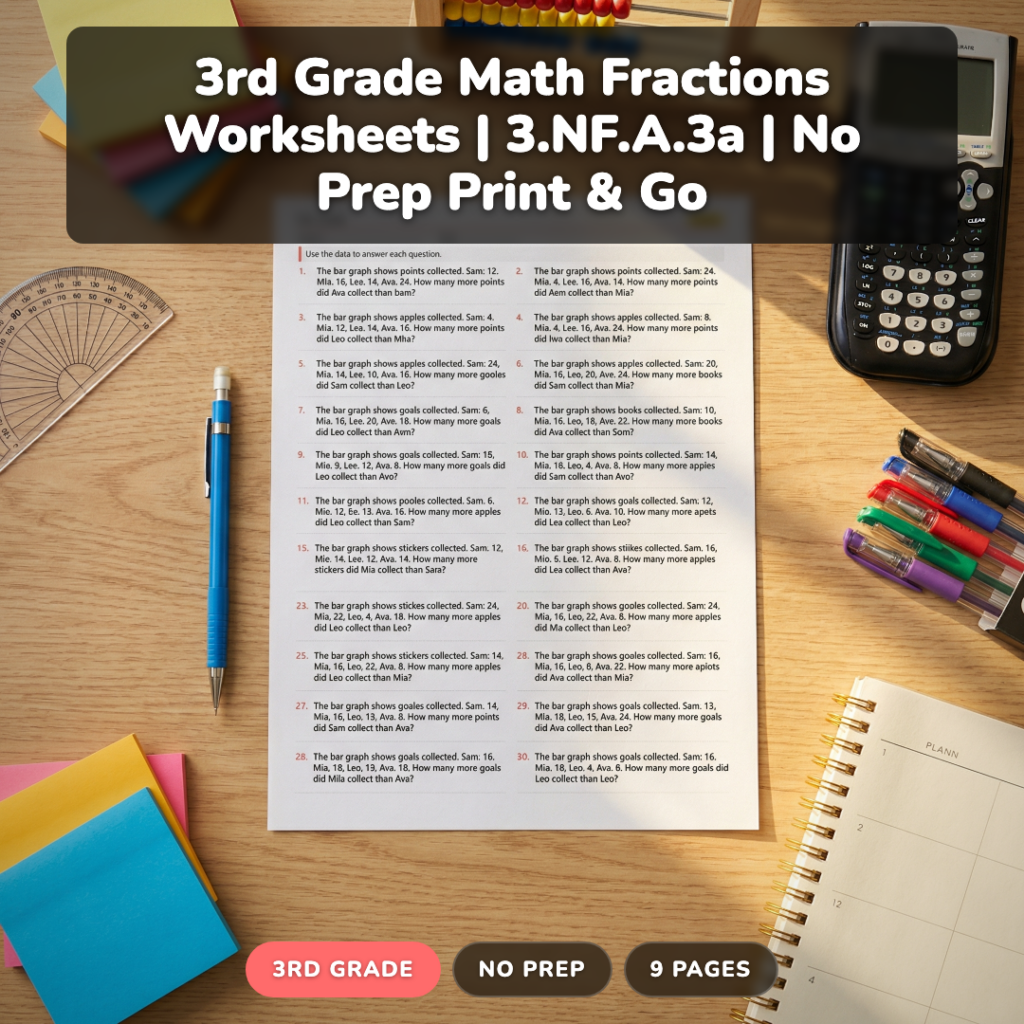
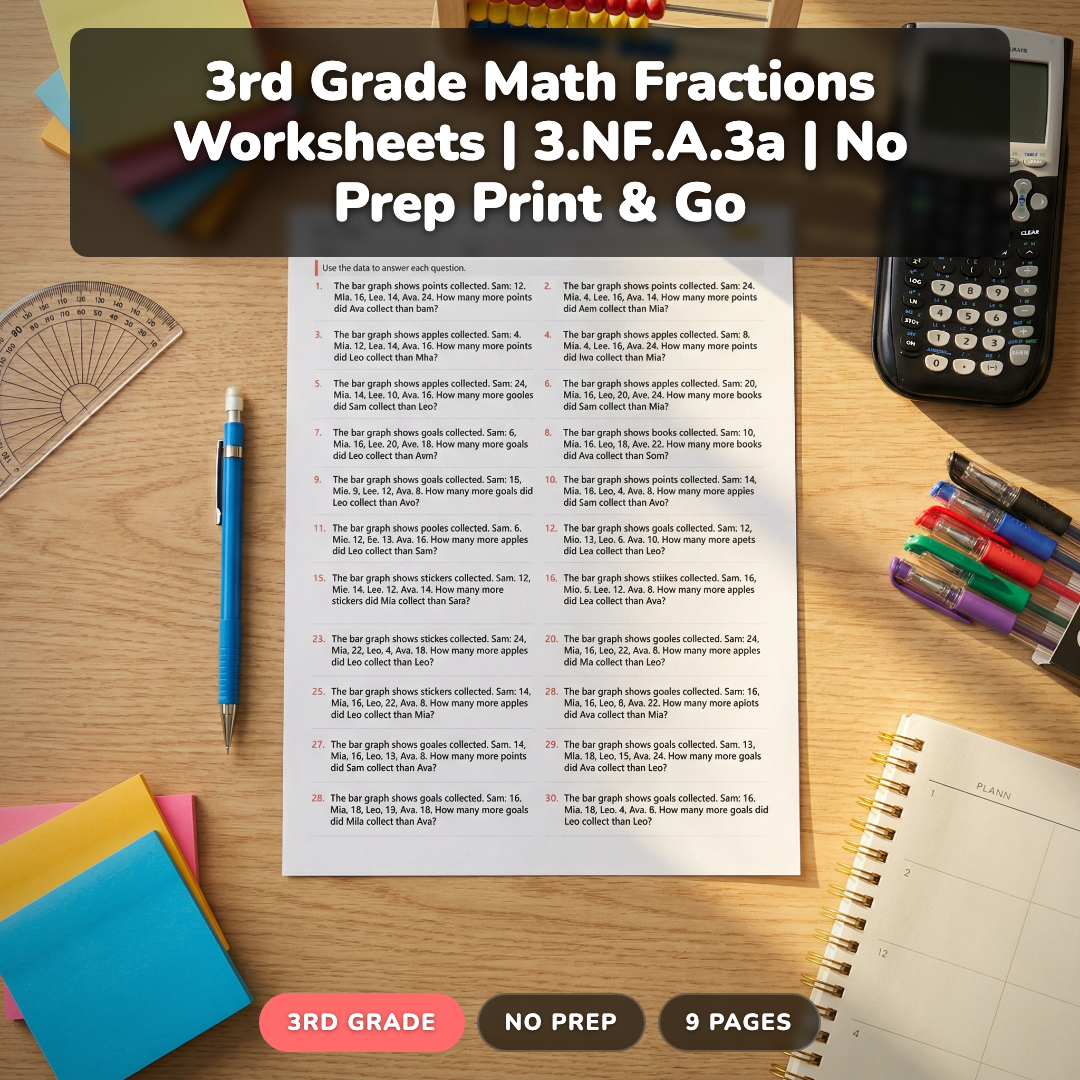
After years of creating and refining fraction activities, I developed a comprehensive equivalent fractions resource that addresses all the strategies above while saving you hours of prep time. This 9-page pack includes 132 carefully crafted problems across three differentiation levels.
The Practice level (37 problems) focuses on basic equivalent fractions with visual support, perfect for students building foundational understanding. The On-Level section (50 problems) aligns directly with CCSS.Math.Content.3.NF.A.3a expectations, covering halves through eighths with both visual and symbolic representations. The Challenge level (45 problems) extends learning with complex equivalent fractions and real-world applications.
What sets this resource apart is the systematic progression from concrete to abstract thinking. Each level includes answer keys and teaching notes, so you can use it for independent practice, math centers, or homework with confidence.
Whether you’re introducing equivalent fractions for the first time or need targeted practice for struggling students, this resource provides everything you need in one organized package.
Grab a Free Equivalent Fractions Sample to Try
Want to see how these strategies work in practice? I’ve created a free sample pack with fraction strips, circle models, and practice problems you can use tomorrow. Drop your email below and I’ll send it right over.
Frequently Asked Questions About Teaching Equivalent Fractions
When should I introduce equivalent fractions in third grade?
Introduce equivalent fractions after students understand basic fraction concepts and can compare unit fractions. Most teachers find success introducing this concept in November or December, allowing time for foundational skills first.
What manipulatives work best for teaching equivalent fractions?
Fraction strips, circle models, and number lines are most effective. Fraction strips provide the clearest visual comparison, while circle models help with part-whole understanding. Use multiple representations for deeper comprehension.
How do I help students who think bigger denominators mean bigger fractions?
Use pizza or chocolate bar models consistently. Show that when you cut a pizza into more pieces (bigger denominator), each piece gets smaller. Compare 1/2 and 1/8 of identical wholes until this concept clicks.
Should third graders memorize equivalent fraction facts?
Focus on understanding before memorization. Students should use visual models to discover equivalent fractions, then gradually build fluency with common pairs like 1/2 = 2/4 = 4/8 through repeated meaningful practice.
How does equivalent fraction understanding connect to fourth grade standards?
Strong equivalent fraction understanding in third grade directly supports fourth grade fraction addition, subtraction, and comparison. Students who master CCSS.Math.Content.3.NF.A.3a are better prepared for finding common denominators and fraction operations.
Teaching equivalent fractions doesn’t have to be overwhelming when you use concrete models, build understanding gradually, and provide plenty of practice at each student’s level. Remember to celebrate those “aha!” moments when students finally see that 2/4 and 1/2 are truly the same size — those breakthroughs make all the careful scaffolding worthwhile.
What’s your favorite strategy for helping students visualize equivalent fractions? I’d love to hear what works in your classroom! And don’t forget to grab that free sample pack to try these strategies with your students.