If your third graders stare blankly at fraction number lines or place fractions in random spots, you’re not alone. Teaching CCSS.Math.Content.3.NF.A.2b — representing fractions on number lines — requires more than just showing students where to put dots. You need concrete strategies that help students visualize equal parts and understand that fractions represent actual positions between whole numbers.
Key Takeaway
Students master fraction number lines when they first understand equal partitioning through hands-on folding and measuring before moving to abstract representations.
Why Fraction Number Lines Matter in Third Grade
Fraction number lines represent a crucial shift in mathematical thinking. Unlike fraction circles or rectangles that students may have seen in second grade, number lines introduce fractions as numbers with specific positions — not just parts of shapes. This aligns perfectly with CCSS.Math.Content.3.NF.A.2b, which requires students to mark off equal lengths and recognize that the endpoint locates the fraction’s position.
Research from the National Mathematics Advisory Panel shows that students who master number line representations in third grade perform significantly better on fraction operations in fourth and fifth grade. The number line builds crucial understanding that fractions exist between whole numbers and follow the same ordering principles as whole numbers.
Most third grade curricula introduce this standard in late fall or early winter, after students have solid understanding of unit fractions and fraction notation. Students should be comfortable identifying fractions like 1/4, 2/3, and 3/8 before tackling number line placement.
Looking for a ready-to-go resource? I put together a differentiated fraction number line pack that covers everything below — but first, the teaching strategies that make it work.
Common Fraction Number Line Misconceptions in Third Grade
Common Misconception: Students place fractions at whole number positions (putting 1/2 at position 1 instead of between 0 and 1).
Why it happens: They confuse the numerator with the position and haven’t internalized that fractions represent parts of one whole unit.
Quick fix: Always start with unit fractions between 0 and 1 before introducing any fractions beyond 1.
Common Misconception: Students create unequal partitions when dividing the number line (making some sections bigger than others).
Why it happens: They lack experience with precise measurement and equal spacing concepts.
Quick fix: Use folding activities and rulers to emphasize that all parts must be exactly the same size.
Common Misconception: Students think larger denominators mean larger fractions (believing 1/8 is bigger than 1/4).
Why it happens: Whole number thinking dominates — they see 8 as bigger than 4 without considering the fraction context.
Quick fix: Use pizza or chocolate bar analogies where cutting into more pieces creates smaller individual pieces.
Common Misconception: Students place fractions like 3/4 by counting three whole units instead of three-fourths of one unit.
Why it happens: They treat the numerator and denominator as separate counting numbers rather than understanding the fraction as a single quantity.
Quick fix: Emphasize that 3/4 means “three of the four equal parts that make one whole.”
5 Research-Backed Strategies for Teaching Fraction Number Lines
Strategy 1: Paper Strip Folding Before Drawing
Students physically create equal parts using paper strips before transferring that understanding to drawn number lines. This concrete-to-abstract progression builds spatial reasoning and equal partitioning skills simultaneously.
What you need:
- Paper strips (1 inch by 12 inches work well)
- Rulers or measuring tools
- Pencils for marking fold lines
- Pre-drawn number lines for transfer practice
Steps:
- Give each student a paper strip representing 0 to 1 on a number line
- Have them fold the strip in half, marking the fold as 1/2
- Fold again to create fourths, marking 1/4 and 3/4 positions
- Open the strip and place it above a drawn number line
- Transfer the fold marks to the drawn number line below
- Practice placing fractions like 2/4 by counting fold marks
Strategy 2: Human Number Line with Yarn Segments
Students become fraction points on a floor number line, using equal yarn lengths to ensure accurate spacing. This kinesthetic approach helps students internalize that fractions represent specific positions, not arbitrary placements.
What you need:
- Long piece of yarn or rope (15-20 feet)
- Fraction cards (1/2, 1/4, 3/4, etc.)
- Measuring tape for verification
- Masking tape to mark 0 and 1 positions
Steps:
- Lay yarn on the floor between 0 and 1 markers
- Students measure the total length and divide by the denominator
- Mark equal segments using the calculated measurements
- Students hold fraction cards and stand at correct positions
- Verify positions by measuring from 0 to each student
- Have students explain why their position represents their fraction
Strategy 3: Fraction Number Line Benchmarking
Students learn to use benchmark fractions (1/2, 1/4, 3/4) as reference points for placing other fractions accurately. This strategy builds number sense and estimation skills crucial for fraction understanding.
What you need:
- Number lines with only 0 and 1 marked
- Colored pencils or markers
- Benchmark fraction reference cards
- Fraction comparison charts
Steps:
- Students first mark and label 1/2 on their number line
- Add 1/4 and 3/4 as additional benchmarks
- Present target fractions like 2/8 or 6/8
- Students determine which benchmark their fraction is closest to
- Place the fraction using benchmark relationships (2/8 = 1/4)
- Verify placement by dividing the line into eighths
Strategy 4: Digital Fraction Number Line Builders
Students use interactive tools or apps to create number lines with adjustable denominators, allowing them to see how partition size affects fraction placement. This visual-digital approach reinforces the relationship between denominators and equal spacing.
What you need:
- Tablets or computers with fraction apps
- Interactive whiteboard for whole-class demonstrations
- Student recording sheets for digital-to-paper transfer
- Timer for rotation activities
Steps:
- Students select a denominator (start with 2, 4, or 8)
- Watch as the app divides the number line into equal parts
- Drag fraction points to correct positions on the digital line
- Receive immediate feedback on correct/incorrect placement
- Transfer successful digital placements to paper number lines
- Compare different denominators to see how spacing changes
Strategy 5: Fraction Story Problems with Number Lines
Students solve real-world problems that require placing fractions on number lines, connecting abstract mathematical concepts to concrete situations. This strategy builds both problem-solving skills and fraction number line fluency.
What you need:
- Story problem cards with measurement contexts
- Blank number lines for student solutions
- Measuring tools (rulers, measuring cups)
- Real objects for concrete verification
Steps:
- Present problems like “Sarah walked 3/4 of the way to school. Show this on a number line.”
- Students identify the whole (distance to school) and the fraction (3/4)
- Create a number line from 0 to 1 representing the complete journey
- Divide the line into fourths and mark the 3/4 position
- Verify the answer using concrete materials when possible
- Explain their reasoning using fraction vocabulary
How to Differentiate Fraction Number Lines for All Learners
For Students Who Need Extra Support
Start with concrete manipulatives before introducing number lines. Use fraction bars or strips that students can physically place on number lines. Focus exclusively on unit fractions (1/2, 1/3, 1/4) until students show mastery. Provide number lines with pre-marked tick marks and ask students only to identify which fraction belongs at each mark. Use consistent denominators (stick with fourths for several lessons) rather than switching between different fractions. Pair struggling students with stronger partners for peer support during hands-on activities.
For On-Level Students
Students at grade level should work with denominators up to 8, placing both unit fractions and non-unit fractions like 3/4 or 5/8. They can handle number lines extending beyond 1, placing mixed numbers like 1 1/2 or 2 3/4. Expect these students to create their own equal partitions on blank number lines and explain their reasoning using proper fraction vocabulary. They should compare fractions using number line positions and identify equivalent fractions (like 2/4 and 1/2) on the same number line.
For Students Ready for a Challenge
Advanced students work with more complex denominators like sixths, tenths, and twelfths. Challenge them to place multiple fractions with different denominators on the same number line, requiring them to find common denominators or equivalent fractions. Introduce decimal connections by showing that 1/2 = 0.5 on number lines marked with both fractions and decimals. Have them solve multi-step word problems requiring fraction addition or subtraction using number line models. Connect to measurement by using actual rulers marked in inches and fractions.
A Ready-to-Use Fraction Number Line Resource for Your Classroom
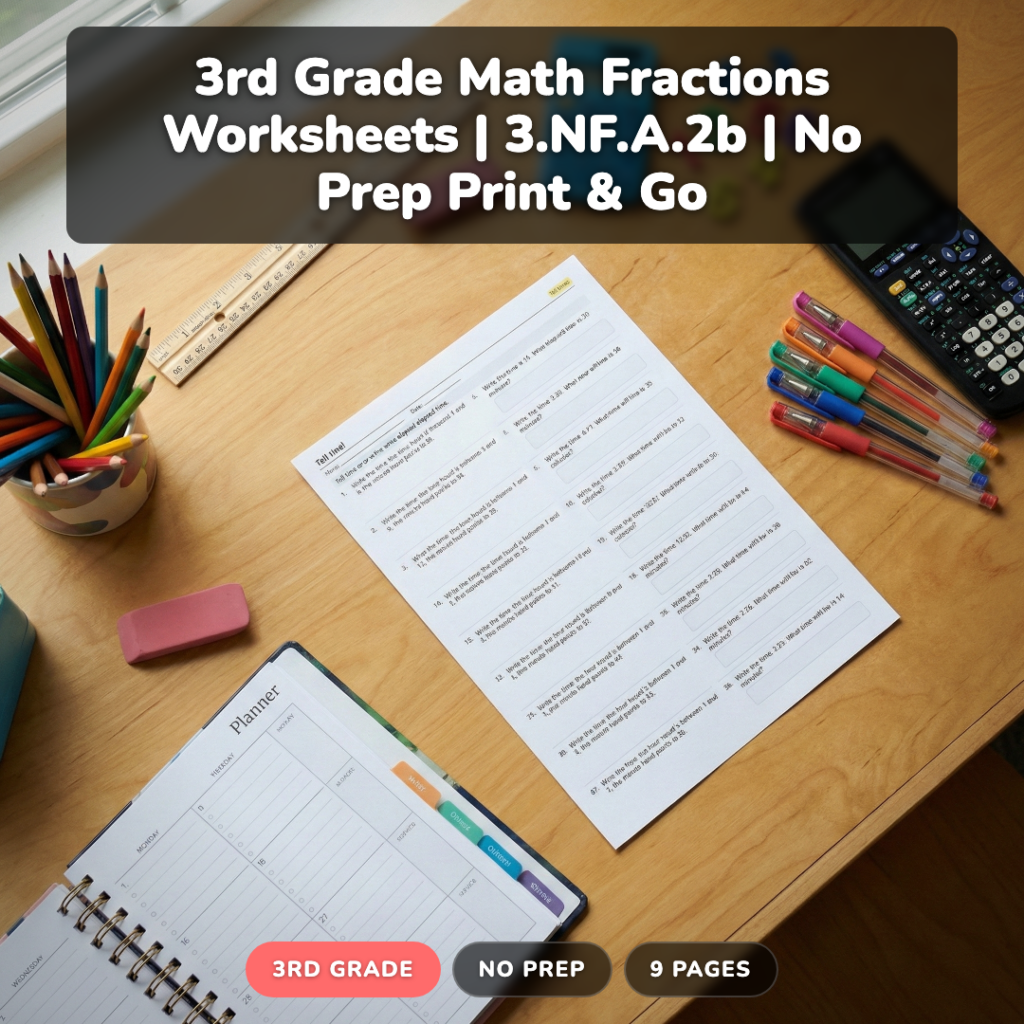
After years of creating fraction number line materials from scratch, I developed a comprehensive resource that saves hours of prep time while providing the differentiation your students need. This 9-page packet includes 132 carefully crafted problems across three difficulty levels, perfectly aligned with CCSS.Math.Content.3.NF.A.2b.
The Practice level (37 problems) focuses on unit fractions and simple placements with pre-marked number lines. Students build confidence with halves, thirds, and fourths before moving to more complex fractions. The On-Level section (50 problems) challenges students to create their own partitions and place non-unit fractions up to eighths. The Challenge level (45 problems) extends beyond 1 with mixed numbers and requires students to compare fractions using number line positions.
What makes this resource different is the careful progression and built-in scaffolding. Each level includes answer keys with visual explanations, so you can quickly identify where students need additional support. The problems move systematically from concrete to abstract, mirroring the teaching strategies that work best in real classrooms.
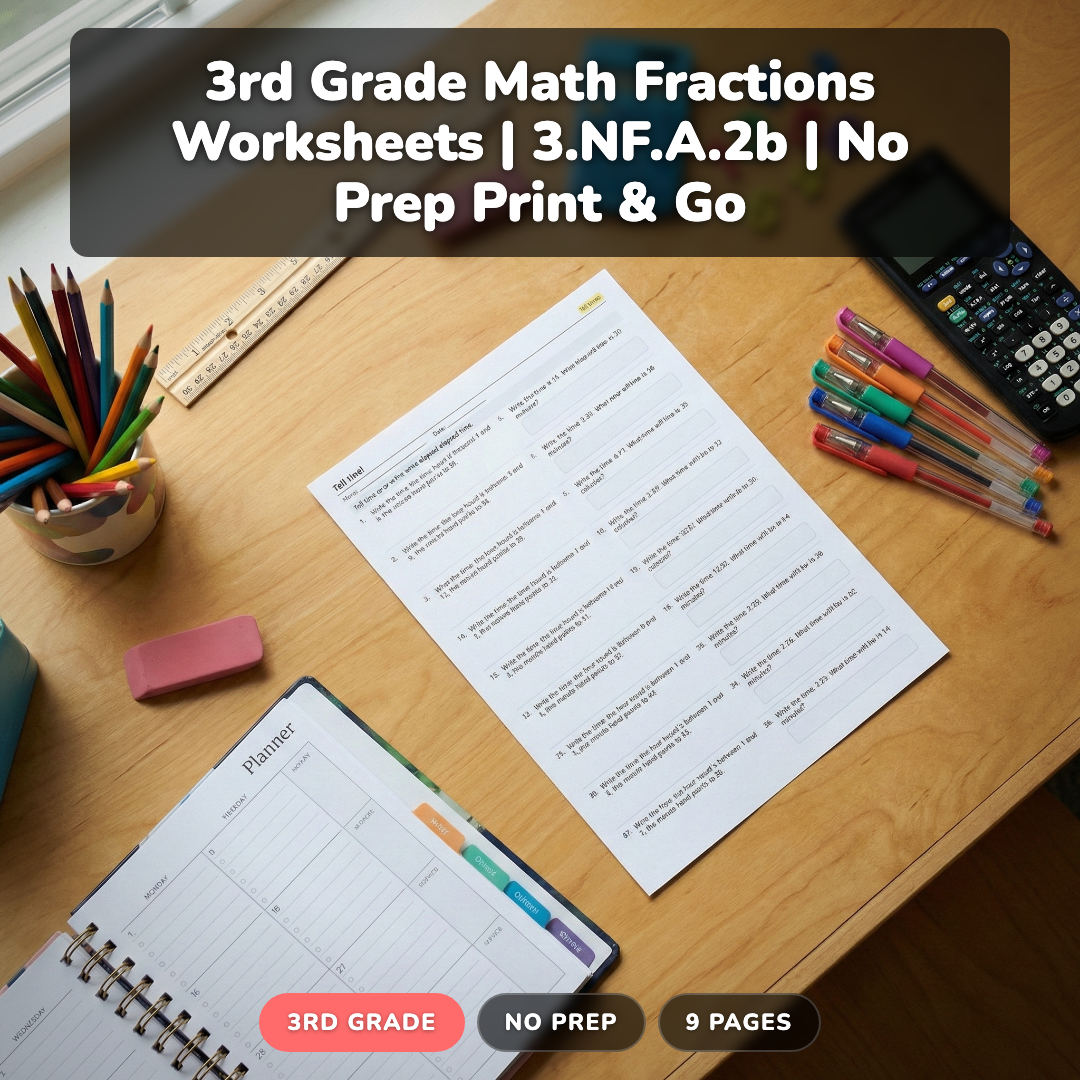
You can grab this time-saving resource and start using it immediately — no prep required beyond printing.
Grab a Free Fraction Number Line Sample to Try
Want to see the quality and format before purchasing? I’ll send you a free sample page from each difficulty level, plus my fraction number line teaching checklist that walks through the progression step-by-step. Perfect for trying these strategies with your students.
Frequently Asked Questions About Teaching Fraction Number Lines
When should I introduce fraction number lines in third grade?
Introduce fraction number lines after students understand fraction notation and can identify unit fractions confidently. Most curricula place this in late fall or early winter, typically after students have worked with fraction circles and rectangles. Students need solid understanding of equal parts before tackling number line placement.
What’s the biggest mistake teachers make with fraction number lines?
Starting with abstract number lines before building concrete understanding through folding, measuring, and hands-on activities. Students need to physically create equal parts and see fractions as positions before they can accurately place them on drawn number lines. Skip the concrete stage and students guess randomly.
How do I help students who place fractions at whole number positions?
Use the paper strip folding strategy extensively and emphasize that fractions live between whole numbers. Start every lesson with “Where does 1/2 go between 0 and 1?” before introducing any other fractions. Use physical benchmarks like “halfway between 0 and 1” rather than abstract positioning rules.
Should third graders work with fractions greater than 1 on number lines?
Yes, but only after mastering fractions between 0 and 1. CCSS.Math.Content.3.NF.A.2b includes fractions greater than 1. Start with simple examples like 3/2 or 5/4, using the same equal partitioning strategies extended beyond the first whole number. This builds understanding that fractions follow consistent patterns.
How can I assess whether students truly understand fraction number line placement?
Ask students to explain their reasoning, not just place fractions correctly. Strong understanding shows when students can describe why 3/4 goes three-fourths of the way from 0 to 1, or why 1/8 is closer to 0 than to 1/2. Look for consistent equal partitioning and accurate use of benchmark fractions as reference points.
Teaching fraction number lines successfully comes down to building understanding step-by-step, from concrete folding activities to abstract number line placement. When students can explain why fractions belong in specific positions, they’ve developed the number sense that will serve them throughout their mathematical journey.
What’s your go-to strategy for helping students visualize equal parts on number lines? And don’t forget to grab that free sample resource above — it’s a great way to try these strategies with your class!