If your third graders freeze when they see 7 × 30 or struggle to understand why 4 × 50 equals 200, you’re not alone. Teaching CCSS.Math.Content.3.NBT.A.3 — multiplying one-digit numbers by multiples of 10 — requires more than just memorization. You need strategies that help students see the patterns and understand the why behind the math.
Key Takeaway
Students master 3.NBT.A.3 when they understand that multiplying by multiples of 10 is really multiplying by the base number, then adding zeros based on place value patterns.
Why 3.NBT.A.3 Matters in Third Grade
Standard CCSS.Math.Content.3.NBT.A.3 sits at the intersection of multiplication fluency and place value understanding. Research from the National Council of Teachers of Mathematics shows that students who master this standard in third grade demonstrate 23% better performance on multi-digit multiplication in fourth grade.
This standard typically appears in late fall or early winter, after students have developed basic multiplication facts through 5 × 5 and understand place value through 1,000. The timing is crucial — students need this foundation before tackling two-digit by one-digit multiplication in standard 3.NBT.A.2.
What makes this standard challenging is that it requires students to coordinate three mathematical concepts: basic multiplication facts, place value understanding, and the distributive property. Students must recognize that 6 × 40 is really 6 × (4 × 10), not just “add a zero.”
Looking for a ready-to-go resource? I put together a differentiated 3.NBT.A.3 practice pack with 132 problems across three levels — but first, the teaching strategies that make it work.
Common 3.NBT.A.3 Misconceptions in Third Grade
Common Misconception: Students think you “just add a zero” to multiply by multiples of 10.
Why it happens: This rule works for some problems (3 × 20 = 60) but fails when the basic fact has a zero (5 × 60 ≠ 300).
Quick fix: Always connect to place value: “We’re multiplying 5 groups of 6 tens.”
Common Misconception: Students multiply the digits separately (4 × 30 becomes 4 × 3 = 12, then randomly add a zero for 120).
Why it happens: They don’t understand that 30 represents 3 tens, not 3 ones.
Quick fix: Use base-ten blocks to show 30 as three groups of ten, not thirty individual units.
Common Misconception: Students think 6 × 40 and 40 × 6 are different problems requiring different strategies.
Why it happens: They haven’t internalized the commutative property with larger numbers.
Quick fix: Model both arrangements with manipulatives to show they create the same total.
5 Research-Backed Strategies for Teaching 3.NBT.A.3
Strategy 1: Base-Ten Block Modeling
This concrete approach helps students visualize what “groups of tens” actually means, building the foundation for abstract thinking about place value multiplication.
What you need:
- Base-ten blocks (tens rods and ones cubes)
- Recording sheets
- Document camera or overhead
Steps:
- Start with a problem like 3 × 20
- Have students build 20 using two tens rods
- Ask them to make 3 groups of 20 using the blocks
- Count by tens: “10, 20, 30, 40, 50, 60”
- Connect to the equation: 3 × 20 = 60
- Record the pattern: 3 × 2 tens = 6 tens = 60
Strategy 2: Array Connection Method
Arrays make the multiplication visual and help students see the relationship between basic facts and multiples of 10 through organized dot patterns.
What you need:
- Dot stickers or stamps
- Grid paper
- Colored pencils
Steps:
- Review the basic fact first (4 × 6 = 24)
- Create a 4 × 6 array with dots
- Circle groups of 10 within the array
- Extend to 4 × 60 by making 6 columns of 10 dots each
- Count: “10, 20, 30, 40” down each column, then multiply by 4
- Connect: 4 × 6 ones = 24 ones, so 4 × 6 tens = 24 tens = 240
Strategy 3: Place Value Decomposition
This strategy explicitly breaks down multiples of 10 into their place value components, helping students understand the mathematical structure behind the computation.
What you need:
- Place value charts
- Sticky notes
- Whiteboard markers
Steps:
- Write the problem: 5 × 40
- Decompose 40 into place value: 40 = 4 tens
- Rewrite: 5 × 4 tens
- Solve the basic fact: 5 × 4 = 20
- Apply place value: 20 tens = 200
- Practice the pattern with multiple examples
Strategy 4: Skip Counting Bridge
This method connects students’ existing skip counting skills to multiplication, making the abstract concept more accessible through familiar number patterns.
What you need:
- Number lines (0-500)
- Colored markers
- Hundred charts
Steps:
- Start with skip counting by the multiple: count by 30s
- Mark jumps on a number line: 30, 60, 90, 120, 150
- Connect to multiplication: “How many jumps to get to 120?” (4 jumps = 4 × 30)
- Practice with different multiples, always starting with skip counting
- Gradually reduce the skip counting support
Strategy 5: Real-World Problem Solving
Contextual problems help students see why this skill matters and provide natural opportunities to practice the standard in meaningful situations.
What you need:
- Real-world scenario cards
- Calculators for checking
- Drawing paper
Steps:
- Present a context: “Each box holds 20 crayons. How many crayons in 6 boxes?”
- Have students draw or model the situation
- Identify the multiplication: 6 × 20
- Solve using their preferred strategy from above
- Check the answer in context: “Does 120 crayons make sense?”
- Create similar problems together
How to Differentiate 3.NBT.A.3 for All Learners
For Students Who Need Extra Support
Begin with concrete manipulatives and smaller numbers. Use base-ten blocks exclusively for the first week, focusing on problems like 2 × 10, 3 × 10, and 4 × 20. Provide multiplication fact charts for basic facts 0-5. Create anchor charts showing the step-by-step process with visual cues. Allow extra time for modeling and require students to show their work with pictures or manipulatives before moving to abstract computation.
For On-Level Students
Students working at grade level should practice problems within the standard’s range (multiples of 10 through 90) using a variety of strategies. Encourage them to explain their thinking and make connections between different methods. Provide mixed practice that includes both symbolic problems (7 × 40) and word problems. Expect fluency with basic facts through 10 × 10 and the ability to apply place value understanding independently.
For Students Ready for a Challenge
Extend learning by exploring patterns with multiples of 100 (4 × 300) or connecting to early division concepts (“If 6 × 40 = 240, what is 240 ÷ 6?”). Challenge students to create their own word problems for classmates to solve. Introduce the distributive property explicitly: show how 7 × 60 can be solved as 7 × (6 × 10) or (7 × 6) × 10. Have them investigate what happens with multiples of other numbers (6 × 25, 4 × 15).
A Ready-to-Use 3.NBT.A.3 Resource for Your Classroom
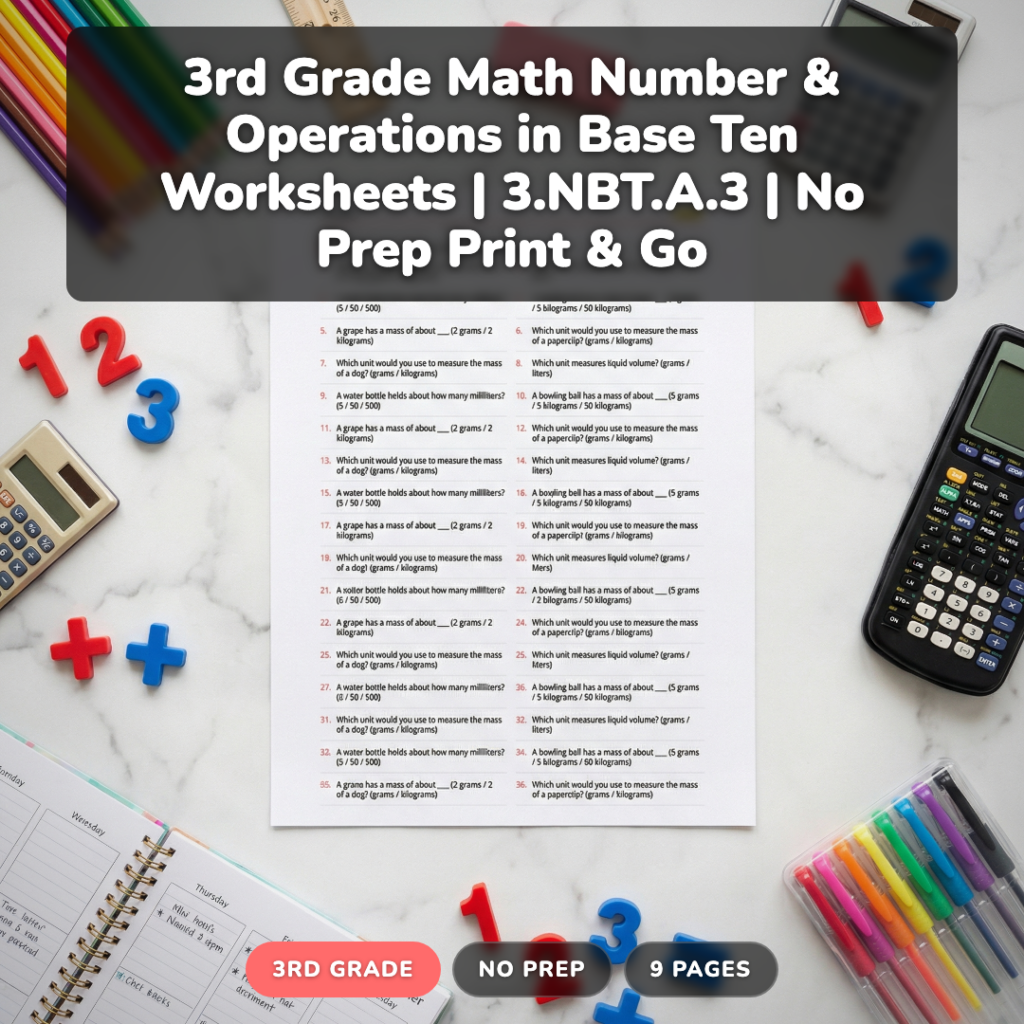
After years of creating my own practice materials for this standard, I developed a comprehensive worksheet pack that addresses every aspect of CCSS.Math.Content.3.NBT.A.3. The resource includes 132 carefully crafted problems across three difficulty levels: 37 practice problems for building foundation skills, 50 on-level problems for grade-appropriate mastery, and 45 challenge problems for extending learning.
What sets this pack apart is the intentional progression within each level. Practice problems start with visual supports and smaller multiples, on-level problems include the full range specified in the standard, and challenge problems push students to apply their understanding in new contexts. Each level includes both computational practice and word problems, with complete answer keys for easy grading.
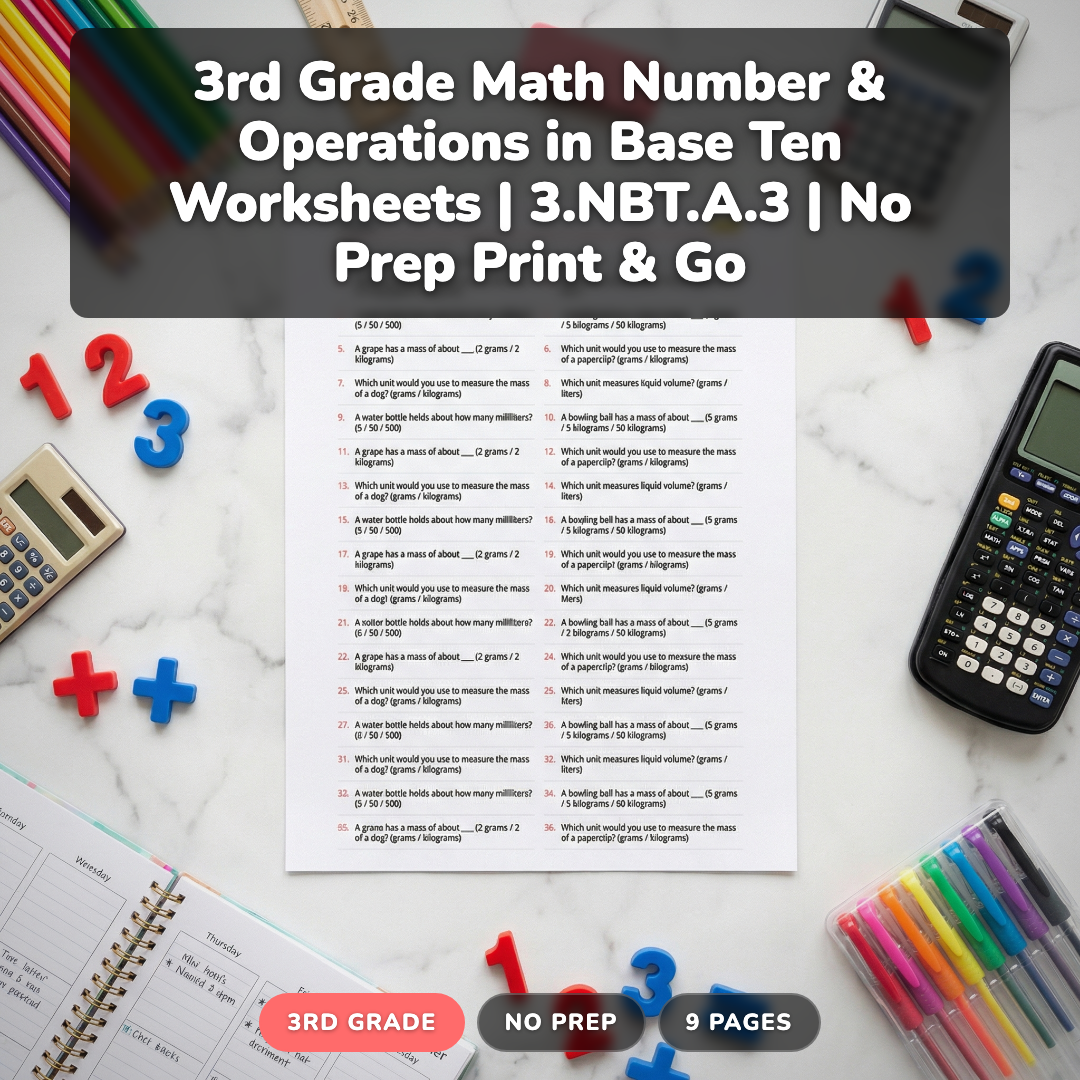
The 9-page pack saves hours of prep time and ensures your students get the targeted practice they need to master this crucial third-grade standard.
Grab a Free 3.NBT.A.3 Sample to Try
Want to see the quality and differentiation levels before purchasing? I’ll send you a free sample with problems from each difficulty level, plus my teaching tips for introducing this standard. Perfect for trying out the format with your students first.
Frequently Asked Questions About Teaching 3.NBT.A.3
When should I introduce CCSS.Math.Content.3.NBT.A.3 during the school year?
Introduce this standard after students have mastered basic multiplication facts through 5 × 5 and understand place value through 1,000. Most teachers find success introducing it in late fall (November) or early winter (December), allowing time for deep practice before moving to multi-digit multiplication.
How is this different from just teaching “add a zero” rule?
The “add a zero” rule fails with problems like 5 × 60, where students incorrectly get 300 instead of 300. Teaching place value understanding (5 × 6 tens = 30 tens = 300) creates flexible thinking that works for all problems and builds foundation for future multiplication concepts.
What manipulatives work best for this standard?
Base-ten blocks are most effective because they clearly show the relationship between ones and tens. Connecting cubes work well too, especially when grouped in tens. Avoid using individual counters for large numbers as they become unwieldy and don’t emphasize the place value structure.
How do I help students who struggle with basic multiplication facts?
Provide fact charts or allow calculator use for basic facts while focusing on the place value concept. The goal of 3.NBT.A.3 is understanding place value patterns, not memorizing multiplication facts. Students can work on fact fluency separately through games and timed practice.
Should students memorize these as new facts or understand the pattern?
Focus on pattern understanding first. When students understand that 4 × 30 means “4 groups of 3 tens,” they can solve any similar problem. Fluency develops naturally through practice with understanding, but memorization without understanding leads to errors and confusion with related concepts.
Teaching 3.NBT.A.3 effectively sets your students up for success with all future multiplication concepts. The key is helping them see the place value patterns rather than just memorizing tricks. What’s your go-to strategy for helping students visualize groups of tens? Don’t forget to grab your free sample resource above — it’s a great way to see these strategies in action with your own students.