If your third graders freeze when they see fractions on a number line, you’re not alone. This single concept—understanding fractions as actual numbers with specific positions—is where many students hit their first real math wall. But with the right strategies, you can help them see fractions as friendly neighbors living between whole numbers.
Key Takeaway
Students master fraction number lines when they connect physical movement, visual models, and number relationships through hands-on practice.
Why Fraction Number Lines Matter in Third Grade
Teaching fractions on number lines addresses CCSS.Math.Content.3.NF.A.2, which requires students to understand fractions as numbers and represent them on number line diagrams. This standard builds the foundation for all future fraction work—from comparing fractions in fourth grade to adding fractions in fifth grade.
Research from the National Council of Teachers of Mathematics shows that students who master number line representations develop stronger fraction sense than those who only work with pie charts or fraction bars. The linear model helps students see that 1/2 is actually halfway between 0 and 1, not just “half of something.”
Most teachers introduce this concept between January and March, after students have solid whole number understanding but before diving into fraction comparisons. The timing matters—students need to see fractions as numbers first, then learn to work with them.
Looking for a ready-to-go resource? I put together a differentiated fraction number line pack that covers everything below — but first, the teaching strategies that make it work.
Common Fraction Number Line Misconceptions in 3rd Grade
Common Misconception: Students think 1/3 goes at the first mark on any number line.
Why it happens: They count marks instead of understanding equal parts.
Quick fix: Always have students count the spaces between marks, not the marks themselves.
Common Misconception: Students believe 1/4 is smaller than 1/8 because 4 < 8.
Why it happens: They apply whole number thinking to fraction denominators.
Quick fix: Use pizza analogies—4 pieces are bigger than 8 pieces when the pizza is the same size.
Common Misconception: Students place fractions randomly between 0 and 1 without considering size.
Why it happens: They lack benchmarks for fraction magnitude.
Quick fix: Establish 1/2 as the “middle” reference point first.
Common Misconception: Students think all fractions live between 0 and 1.
Why it happens: Early instruction focuses only on unit fractions and proper fractions.
Quick fix: Show examples like 3/2 and 5/4 on extended number lines early.
5 Research-Backed Strategies for Teaching Fraction Number Lines
Strategy 1: Human Number Line Walking
Transform your classroom floor into a giant number line where students physically walk to fraction positions. This kinesthetic approach helps students internalize fraction locations through movement and spatial reasoning.
What you need:
- Masking tape for floor number line
- Index cards with fraction labels
- Yarn or rope to mark equal sections
Steps:
- Create a 10-foot number line on your floor with tape, marking 0, 1, and 2
- Use yarn to divide the 0-1 section into halves, then fourths, then eighths
- Call out fractions and have students walk to the correct position
- Ask students to explain why they chose that spot
- Have students place fraction cards at correct positions
Strategy 2: Folding Paper Number Lines
Students create their own number lines by folding paper strips, making the equal parts concept tangible and visual. This hands-on approach connects the abstract number line to concrete manipulation.
What you need:
- 12-inch paper strips (one per student)
- Rulers
- Colored pencils
- Fraction cards
Steps:
- Students fold paper strips in half, then unfold to see the 1/2 mark
- Fold in half again to create fourths, marking each fold
- Label 0, 1/4, 1/2, 3/4, and 1 on their number lines
- Use different colors for different denominators
- Practice placing given fractions on their folded number lines
Strategy 3: Benchmark Fraction Anchoring
Teach students to use 1/2 as their primary reference point, then build understanding of other fractions relative to this benchmark. This strategy develops fraction number sense and estimation skills.
What you need:
- Number line templates
- Fraction cards sorted by size
- “Benchmark Fraction” anchor chart
Steps:
- Establish 1/2 as the “middle” between 0 and 1
- Introduce 1/4 as “halfway to the middle”
- Show 3/4 as “halfway from the middle to 1”
- Practice with “Is this fraction closer to 0, 1/2, or 1?”
- Use comparison language: “1/3 is a little less than 1/2”
Strategy 4: Digital Number Line Builders
Use interactive technology tools where students drag fractions to correct positions on number lines, providing immediate feedback and multiple practice opportunities.
What you need:
- Tablets or computers
- Number line apps or websites
- Fraction manipulation software
Steps:
- Students use digital tools to build number lines with different denominators
- Drag fraction representations to correct positions
- Receive instant feedback on placement accuracy
- Progress from halves to more complex fractions
- Screenshot correct placements for portfolio evidence
Strategy 5: Fraction Number Line Scavenger Hunt
Create an engaging game where students find and place fraction cards on large classroom number lines, combining movement with mathematical reasoning and peer collaboration.
What you need:
- Large poster board number lines
- Laminated fraction cards
- Velcro dots for attachments
- Timer
- Recording sheets
Steps:
- Post several number lines around the room with different denominators
- Give teams sets of fraction cards to place correctly
- Students rotate through stations, checking each other’s work
- Use timer to add excitement and urgency
- Debrief by discussing placement strategies
How to Differentiate Fraction Number Lines for All Learners
For Students Who Need Extra Support
Start with concrete manipulatives before moving to abstract number lines. Use fraction bars alongside number lines so students can see the connection between the two representations. Focus on halves and fourths initially, ensuring mastery before introducing other denominators. Provide number lines with pre-marked divisions and let students practice placement before creating their own. Review whole number placement on number lines first to ensure foundational understanding of the number line concept itself.
For On-Level Students
Students working at grade level should master CCSS.Math.Content.3.NF.A.2 by accurately placing unit fractions (1/2, 1/3, 1/4, 1/6, 1/8) on number lines and understanding their relative positions. They should create their own number line divisions and explain their reasoning for fraction placement. Introduce equivalent fractions on the same number line (2/4 and 1/2 at the same position) and have students identify patterns in fraction families.
For Students Ready for a Challenge
Advanced students can work with mixed numbers, placing fractions like 1 2/3 on number lines extending beyond 2. Introduce comparing fractions using number line reasoning (“1/3 is left of 1/2, so 1/3 < 1/2"). Challenge them to create number lines with unusual denominators like fifths or tenths, connecting to decimal understanding. Have them solve word problems requiring number line representations and explain why certain fractions cluster near specific benchmarks.
A Ready-to-Use Fraction Number Line Resource for Your Classroom
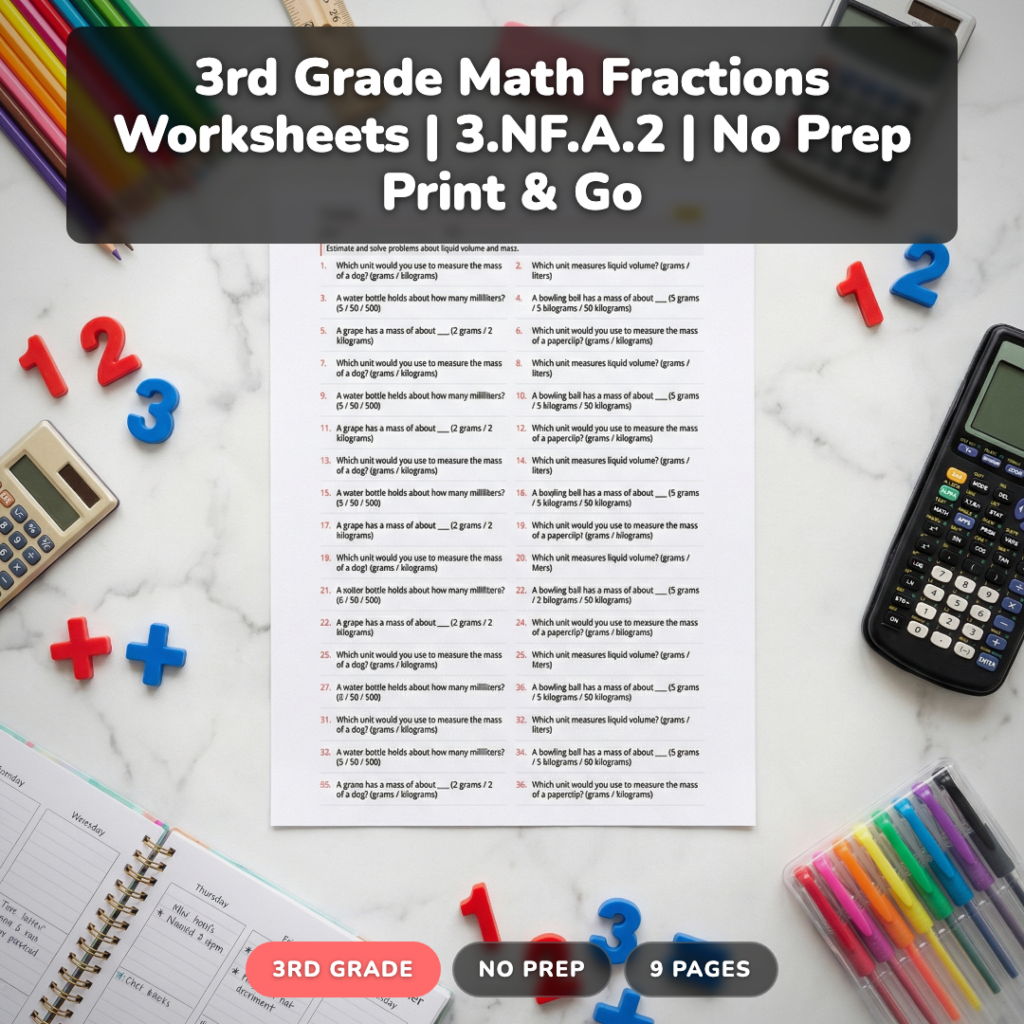
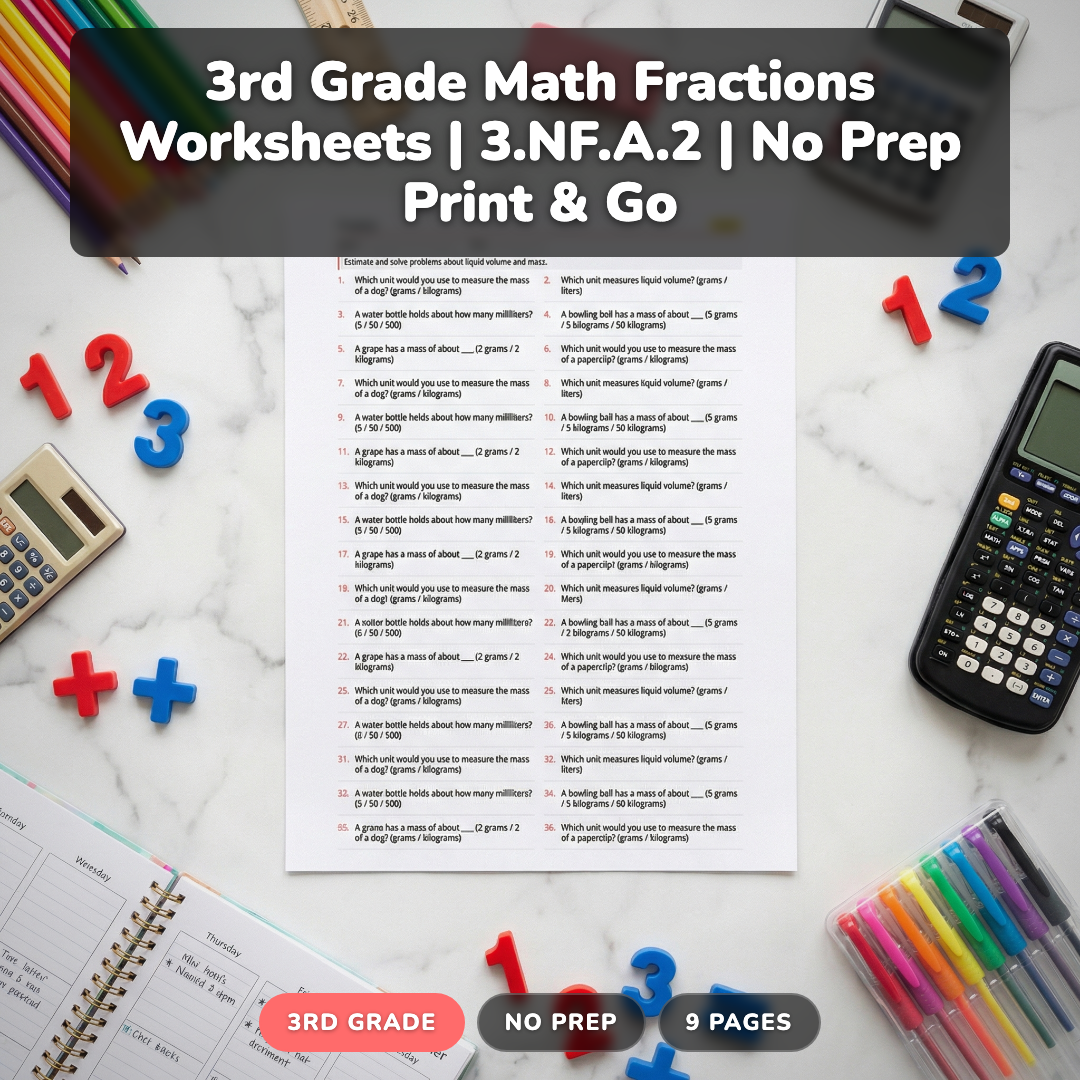
After years of creating fraction number line activities from scratch, I developed a comprehensive resource that saves hours of prep time while providing the differentiated practice your students need. This 9-page packet includes 132 carefully crafted problems across three difficulty levels.
The Practice level (37 problems) focuses on basic fraction placement with clear visual supports. On-Level problems (50 total) align perfectly with CCSS.Math.Content.3.NF.A.2 expectations, while Challenge problems (45 questions) extend learning with mixed numbers and complex reasoning tasks.
What sets this resource apart is the scaffolded progression—students aren’t thrown into difficult problems without preparation. Each level builds systematically, and the answer keys show step-by-step reasoning so you can support students who get stuck.
The resource includes everything you need for successful fraction number line instruction, from basic unit fraction placement to advanced mixed number work. No prep required—just print and go.
Grab a Free Fraction Number Line Sample to Try
Want to see the quality and format before purchasing? I’ll send you a free sample page from each difficulty level, plus my “Fraction Number Line Teaching Tips” guide that breaks down the most effective instructional sequence.
Frequently Asked Questions About Teaching Fraction Number Lines
When should I introduce fraction number lines in third grade?
Introduce fraction number lines after students understand basic fraction concepts and can identify equal parts. Most teachers find January through March optimal, allowing time for whole number mastery first. Students need solid understanding of number lines with whole numbers before adding fractions.
Should I teach fraction bars or number lines first?
Start with fraction bars or circles to build part-whole understanding, then transition to number lines for the measurement model. CCSS.Math.Content.3.NF.A.2 specifically requires number line representations, but students benefit from seeing multiple models. Use both together for deeper understanding.
How do I help students who place fractions randomly on number lines?
Focus on benchmark fractions first, especially 1/2 as the midpoint. Use physical number lines where students can walk to positions. Ask “Is this fraction closer to 0, 1/2, or 1?” before placing. Provide number lines with helpful reference marks until students internalize fraction sizes.
What’s the biggest mistake teachers make with fraction number lines?
Moving too quickly to abstract representations without enough concrete experience. Students need to physically manipulate and see fractions before working on paper. Also, focusing only on unit fractions—students need to see fractions like 2/3 and 3/4 to understand numerators greater than one.
How can I assess student understanding of fraction number lines?
Use exit tickets asking students to place specific fractions and explain their reasoning. Watch for common errors like counting marks instead of spaces, or placing all fractions randomly. Have students create their own number line problems for classmates—this reveals their depth of understanding.
Making Fraction Number Lines Click for Every Student
The key to successful fraction number line instruction is connecting movement, visuals, and reasoning. When students can walk a number line, fold their own divisions, and explain their thinking, fractions stop being mysterious and start making sense.
What’s your go-to strategy for helping students visualize fractions as numbers? I’d love to hear what works in your classroom—and don’t forget to grab that free sample above to see these strategies in action.