If your third graders freeze when they see “round 47 to the nearest 10” or confidently announce that 156 rounds to 200, you’re not alone. Rounding is one of those skills that seems simple on the surface but requires deep place value understanding that many students haven’t fully developed yet.
You need concrete strategies that build number sense step by step, address the most common misconceptions head-on, and give every student multiple pathways to success. This post breaks down exactly how to teach rounding so it actually sticks.
Key Takeaway
Effective rounding instruction starts with place value visualization, uses the number line as the primary tool, and explicitly teaches the “look to the right” strategy with concrete examples.
Why Rounding Matters in Third Grade
Rounding whole numbers to the nearest 10 or 100 is the foundation skill outlined in CCSS.Math.Content.3.NBT.A.1. This standard appears in the first quarter of most third-grade curricula because it builds essential number sense for estimation, mental math, and problem-solving throughout the year.
Research from the National Council of Teachers of Mathematics shows that students who master place value concepts like rounding perform 23% better on standardized assessments. The skill directly connects to money concepts (rounding to the nearest dollar), measurement estimation, and serves as prerequisite knowledge for fourth-grade multi-digit operations.
Timing matters with this standard. Most districts introduce rounding in September or October, after students have solidified two-digit place value but before diving into multi-digit addition and subtraction. Students need approximately 2-3 weeks of focused instruction to move from concrete manipulation to abstract application.
Looking for a ready-to-go resource? I put together a differentiated rounding pack that covers everything below — but first, the teaching strategies that make it work.
Common Rounding Misconceptions in 3rd Grade
Understanding where students go wrong helps you address confusion before it becomes entrenched. Here are the four misconceptions I see most often:
Common Misconception: Students always round up, regardless of the digit.
Why it happens: They misunderstand “rounding” to mean “making bigger.”
Quick fix: Use number line visualization to show that sometimes the nearest ten is smaller.
Common Misconception: Students look at the wrong digit when rounding.
Why it happens: They focus on the place value they’re rounding TO instead of the digit to the right.
Quick fix: Teach the “circle and arrow” method — circle the rounding place, draw an arrow to the helper digit.
Common Misconception: Students change multiple digits when rounding.
Why it happens: They don’t understand that only the target place value changes, and everything to the right becomes zero.
Quick fix: Use place value blocks to physically show what stays and what changes.
Common Misconception: Students think 5 always rounds down.
Why it happens: Inconsistent exposure to the “5 or more rounds up” rule.
Quick fix: Create an anchor chart with 5 as the “tipping point” and practice with multiple examples.
5 Research-Backed Strategies for Teaching Rounding
Strategy 1: Number Line Neighborhoods
This visual approach helps students see rounding as finding the “closest house” on a number line street. Students physically place numbers between tens or hundreds to determine which is closer.
What you need:
- Large floor number line (or tape numbers 0-100 on classroom floor)
- Index cards with 2-digit numbers
- “House” markers for multiples of 10
Steps:
- Place “houses” at 10, 20, 30, etc. on your floor number line
- Give students number cards (like 23, 47, 85)
- Have them stand at their number and look left and right to find the closest “house”
- Walk to that house together, emphasizing the shorter distance
- Record the rounding on chart paper: “23 lives closer to house 20”
Strategy 2: Circle and Arrow Method
This systematic approach gives students a consistent process for identifying which digits to examine when rounding any number.
What you need:
- Colored pencils or markers
- Laminated hundreds charts
- Practice worksheets with various numbers
Steps:
- Circle the digit in the place value you’re rounding TO (tens place for nearest 10)
- Draw an arrow pointing to the digit immediately to the right (the “helper digit”)
- If helper digit is 5 or more, round the circled digit UP
- If helper digit is 4 or less, keep the circled digit the SAME
- Replace all digits to the right of the circled digit with zeros
Strategy 3: Place Value Block Modeling
Using manipulatives helps students understand that rounding involves regrouping and exchanging, not just changing digits on paper.
What you need:
- Base-10 blocks (ones, tens, hundreds)
- Place value mats
- Recording sheets
Steps:
- Build the original number with blocks (example: 47 = 4 tens, 7 ones)
- Identify whether you have “enough” ones to make another ten (5 or more)
- If yes, trade 10 ones for 1 ten rod, remove remaining ones
- If no, simply remove all the ones blocks
- Count your remaining blocks to find the rounded number
Strategy 4: Rounding Race Game
This partner activity builds fluency while maintaining engagement through friendly competition and immediate feedback.
What you need:
- Deck of number cards (20-99)
- Timer
- Recording sheets
- Answer key for self-checking
Steps:
- Partner A draws a card and reads the number aloud
- Partner B has 10 seconds to round to the nearest 10
- Both partners check the answer using the answer key
- Correct answers earn 1 point; switch roles
- Play for 10 rounds, then compare total points
Strategy 5: Real-World Rounding Scenarios
Connecting rounding to authentic contexts helps students understand why this skill matters beyond the math classroom.
What you need:
- Store advertisements or catalogs
- Play money
- Calculators for checking
Steps:
- Present a shopping scenario: “You have $50. Can you buy items costing $23 and $19?”
- Students round each price to the nearest $10 ($20 + $20 = $40)
- Make the purchase decision based on rounded estimates
- Check with exact calculation to verify the estimate was helpful
- Discuss when rounding up vs. down matters for budgeting
How to Differentiate Rounding for All Learners
For Students Who Need Extra Support
Start with numbers where the ones digit is clearly 1-4 or 6-9 to avoid the confusion around 5. Use hundreds charts with the multiples of 10 highlighted in color. Provide sentence frames like “___ is between ___ and ___, so it rounds to ___.” Focus on rounding to the nearest 10 before introducing nearest 100. Review prerequisite skills like identifying place value and counting by tens.
For On-Level Students
Practice with the full range of two-digit numbers, including those with 5 in the ones place. Introduce rounding to the nearest 100 after mastering nearest 10. Use mixed practice that requires students to determine whether to round to tens or hundreds based on the problem context. Connect to estimation strategies in word problems. Meet the CCSS.Math.Content.3.NBT.A.1 expectations with independence.
For Students Ready for a Challenge
Extend to three-digit numbers and rounding to nearest 1,000. Explore what happens when the helper digit causes a cascade of changes (like 597 rounding to 600). Compare different rounding strategies and discuss when each is most useful. Apply rounding to real data sets like school enrollment numbers or sports statistics. Connect to fourth-grade concepts like rounding in multi-step word problems.
A Ready-to-Use Rounding Resource for Your Classroom
After years of creating rounding materials from scratch, I put together a comprehensive resource that saves you hours of prep time while ensuring every student gets the right level of challenge.
This 9-page differentiated pack includes 132 problems across three distinct levels. The Practice level (37 problems) focuses on numbers with clear rounding decisions and includes visual supports. The On-Level section (50 problems) covers the full standard with mixed two-digit and three-digit numbers. The Challenge level (45 problems) extends to larger numbers and multi-step applications.
What makes this different from other rounding worksheets is the intentional progression within each level and the inclusion of real-world contexts that help students see why rounding matters. Each level includes answer keys and can be used for centers, homework, or assessment preparation.
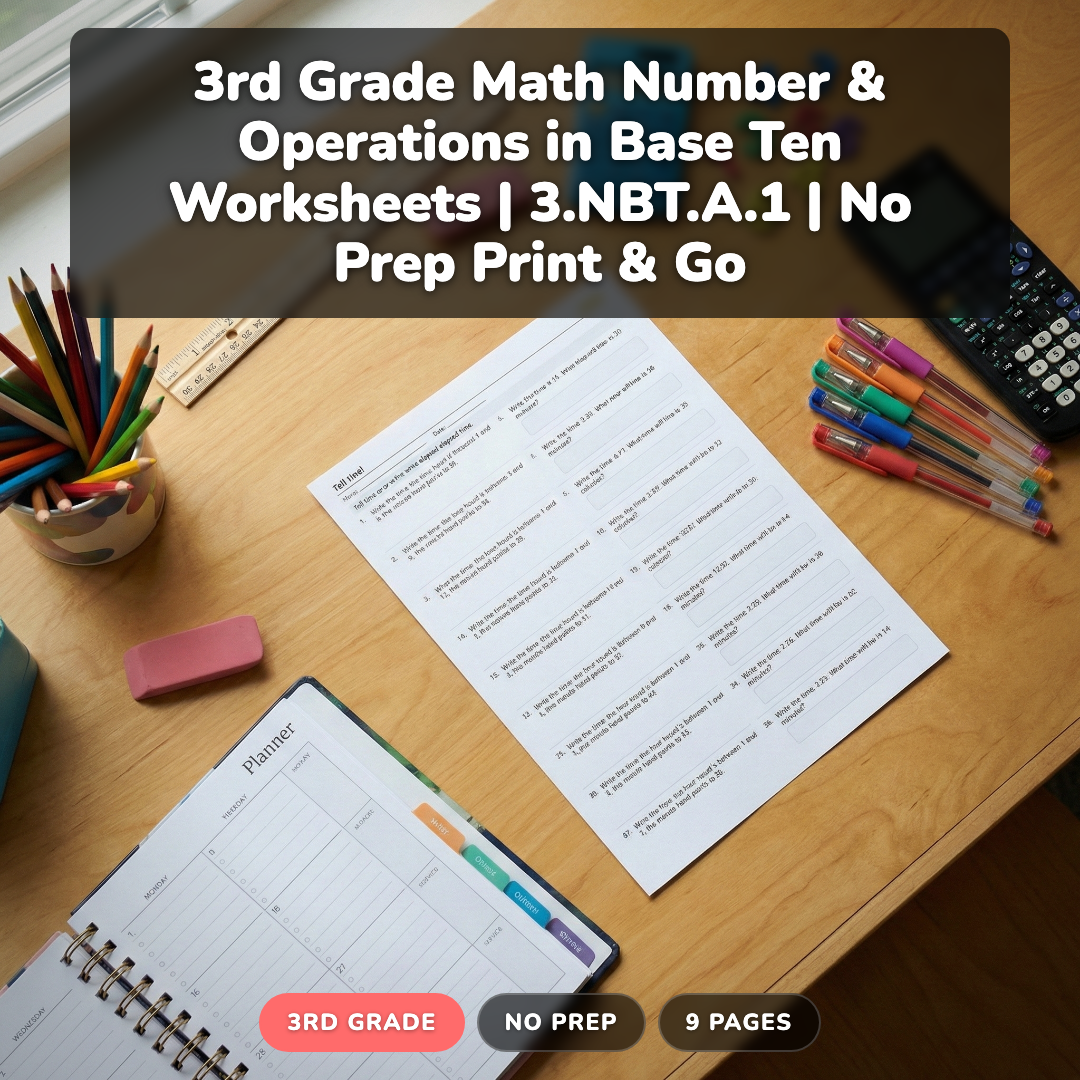
The resource aligns perfectly with CCSS.Math.Content.3.NBT.A.1 and includes everything you need for 2-3 weeks of differentiated practice.
Grab a Free Rounding Practice Sheet to Try
Want to see the quality and format before committing? I’ll send you a free sample page with 10 problems across all three difficulty levels, plus the answer key.
Frequently Asked Questions About Teaching Rounding
When should I introduce rounding to the nearest 100?
Introduce rounding to nearest 100 after students consistently round two-digit numbers to nearest 10. Most students need 1-2 weeks with tens before tackling hundreds. The same strategies apply, but students must identify the hundreds place as their target digit.
Why do students struggle with numbers ending in 5?
Numbers ending in 5 are exactly halfway between two multiples of 10, making the decision less intuitive. The mathematical convention is to round up, but students need explicit instruction and repeated practice with this rule to internalize it consistently.
How do I help students remember which digit to look at?
Teach the “circle and arrow” method consistently. Students circle the place value they’re rounding TO, then draw an arrow to the helper digit immediately to the right. This visual cue prevents the common error of looking at the wrong digit.
Should I teach rounding rules or number line visualization first?
Start with number line visualization to build conceptual understanding, then introduce the systematic rules. Students who see rounding as “finding the closest landmark number” develop stronger number sense than those who only memorize abstract rules.
How does rounding connect to other third-grade math skills?
Rounding supports estimation in addition and subtraction, money concepts (rounding to nearest dollar), and measurement (rounding lengths to nearest inch). It’s also prerequisite knowledge for fourth-grade multiplication and division estimation strategies.
Teaching rounding effectively comes down to building strong place value understanding first, then giving students multiple ways to visualize and practice the concept. The key is moving from concrete experiences with manipulatives and number lines to abstract application with systematic strategies.
What’s your go-to strategy for helping students master rounding? I’d love to hear what works in your classroom! And don’t forget to grab that free sample resource above — it’s a great way to see these strategies in action.