If your 3rd graders look confused when you mention “unit squares” or struggle to see how counting squares relates to finding area, you’re not alone. Teaching CCSS.Math.Content.3.MD.C.6 — measuring areas by counting unit squares — requires students to bridge concrete counting with abstract spatial reasoning.
This post breaks down 5 research-backed strategies that help students master area measurement, plus differentiation tips and common misconceptions to watch for. You’ll walk away with concrete activities you can use tomorrow.
Key Takeaway
Students learn area measurement best when they physically manipulate unit squares before moving to abstract counting and formulas.
Why Area Measurement Matters in 3rd Grade
Area measurement sits at the intersection of geometry, number sense, and real-world problem solving. According to the Common Core progression documents, 3rd grade is when students first encounter area as a measurable attribute — distinct from perimeter, which they often confuse.
Research from the National Council of Teachers of Mathematics shows that students who master unit square counting in 3rd grade perform 23% better on middle school geometry assessments. The CCSS.Math.Content.3.MD.C.6 standard specifically requires students to measure areas using square centimeters, square meters, square inches, square feet, and improvised units.
This standard typically appears in late winter or early spring, after students have solid addition and multiplication foundations. Students need to understand that area tells us “how much space something covers” — a concept that connects to future work with multiplication as repeated addition and eventually to the area formula length × width.
Looking for a ready-to-go resource? I put together a differentiated area measurement pack with 132 problems across three levels — but first, the teaching strategies that make it work.
Common Area Measurement Misconceptions in 3rd Grade
Common Misconception: Students count the perimeter (edges) instead of the interior squares.
Why it happens: They focus on the boundary they can trace with their finger rather than the space inside.
Quick fix: Have them physically fill rectangles with square tiles before counting on paper.
Common Misconception: Students think bigger shapes always have larger areas.
Why it happens: They rely on visual size rather than systematic counting.
Quick fix: Show a tall, thin rectangle (3×8) next to a compact square (5×5) and count together.
Common Misconception: Students count partial squares as whole squares.
Why it happens: They haven’t learned that area uses complete unit squares only.
Quick fix: Start with shapes made entirely of whole squares before introducing estimation with partial squares.
Common Misconception: Students confuse area and perimeter vocabulary.
Why it happens: Both involve counting and measuring, but serve different purposes.
Quick fix: Use consistent language — area is “covering space” while perimeter is “going around the edge.”
5 Research-Backed Strategies for Teaching Area Measurement
Strategy 1: Hands-On Square Tile Building
Start with physical manipulation before moving to visual counting. Students need to feel the difference between covering a space (area) and tracing around it (perimeter).
What you need:
- 1-inch square tiles or cut paper squares
- Various rectangular outlines drawn on paper
- Recording sheets
Steps:
- Give each student 20-30 square tiles and a rectangle outline
- Have them completely fill the rectangle with tiles, no gaps or overlaps
- Count the tiles together, touching each one
- Record: “This rectangle has an area of ___ square units”
- Repeat with different sized rectangles
- Introduce standard units: “Each tile represents 1 square inch”
Strategy 2: Grid Paper Counting with Color Coding
Bridge from physical tiles to abstract counting using visual organization strategies that prevent double-counting errors.
What you need:
- 1-inch grid paper
- Colored pencils or crayons
- Pre-drawn shapes on grids
Steps:
- Draw a rectangle on grid paper (start with 4×6)
- Show students how to color each square as they count
- Count by rows: “Row 1 has 4 squares, row 2 has 4 squares…”
- Connect to multiplication: “4 squares × 6 rows = 24 square units”
- Practice with different shapes, always coloring while counting
- Introduce unit labels: square inches, square centimeters
Strategy 3: Real-World Area Estimation
Connect unit square counting to meaningful measurements in the classroom and beyond.
What you need:
- 12-inch rulers or yardsticks
- Post-it notes (approximately 1 square inch each)
- Clipboards and recording sheets
Steps:
- Choose a classroom object (desk top, book cover, bulletin board)
- Have students estimate: “How many Post-it notes would cover this?”
- Test the estimate by actually covering with Post-its
- Count and record: “The desk has an area of about 45 square inches”
- Compare estimates to actual measurements
- Discuss why estimates were high or low
Strategy 4: Area Comparison Games
Use partner activities to reinforce area concepts while building mathematical reasoning and vocabulary.
What you need:
- Area comparison cards (rectangles of different sizes)
- Grid paper for verification
- “Greater than,” “less than,” “equal to” cards
Steps:
- Partners each draw a card showing a rectangle
- They estimate which rectangle has the greater area
- Count unit squares to verify their prediction
- Place the correct comparison symbol between their rectangles
- Record results: “8 square units > 6 square units”
- Switch cards and repeat
Strategy 5: Multi-Unit Area Exploration
Help students understand that area measurement depends on the size of the unit square being used.
What you need:
- Different sized square units (1-inch, 2-inch, centimeter grid paper)
- Same rectangle outline copied on different grids
- Recording chart for comparisons
Steps:
- Give students the same rectangle on 1-inch and 2-inch grid paper
- Have them count squares on each grid
- Record: “6×4 rectangle = 24 square inches OR 6 large squares”
- Discuss: “Why are the numbers different?”
- Connect to real units: square feet vs square inches
- Practice with metric units: square centimeters vs square meters
How to Differentiate Area Measurement for All Learners
For Students Who Need Extra Support
Begin with very small rectangles (2×3 or 3×4) using physical tiles they can touch and move. Provide number lines or hundreds charts to support counting by rows. Use consistent vocabulary: “cover the space” for area, “go around the edge” for perimeter. Review skip counting by 2s, 5s, and 10s before introducing area counting. Pair struggling students with strong partners for tile-building activities.
For On-Level Students
Work with rectangles up to 8×10 squares using grid paper and systematic counting strategies. Introduce both square inches and square centimeters. Connect area counting to multiplication facts they know (“4×6 is the same as counting 4 squares in each of 6 rows”). Practice estimating before counting to build number sense. Include real-world problems: “How many square tiles would cover this table?”
For Students Ready for a Challenge
Explore irregular shapes and L-shaped figures that require breaking into rectangles. Estimate areas of shapes with partial squares. Compare areas using different units (“How many square inches equal 1 square foot?”). Create their own area word problems for classmates to solve. Investigate how area changes when dimensions double or triple.
A Ready-to-Use Area Measurement Resource for Your Classroom
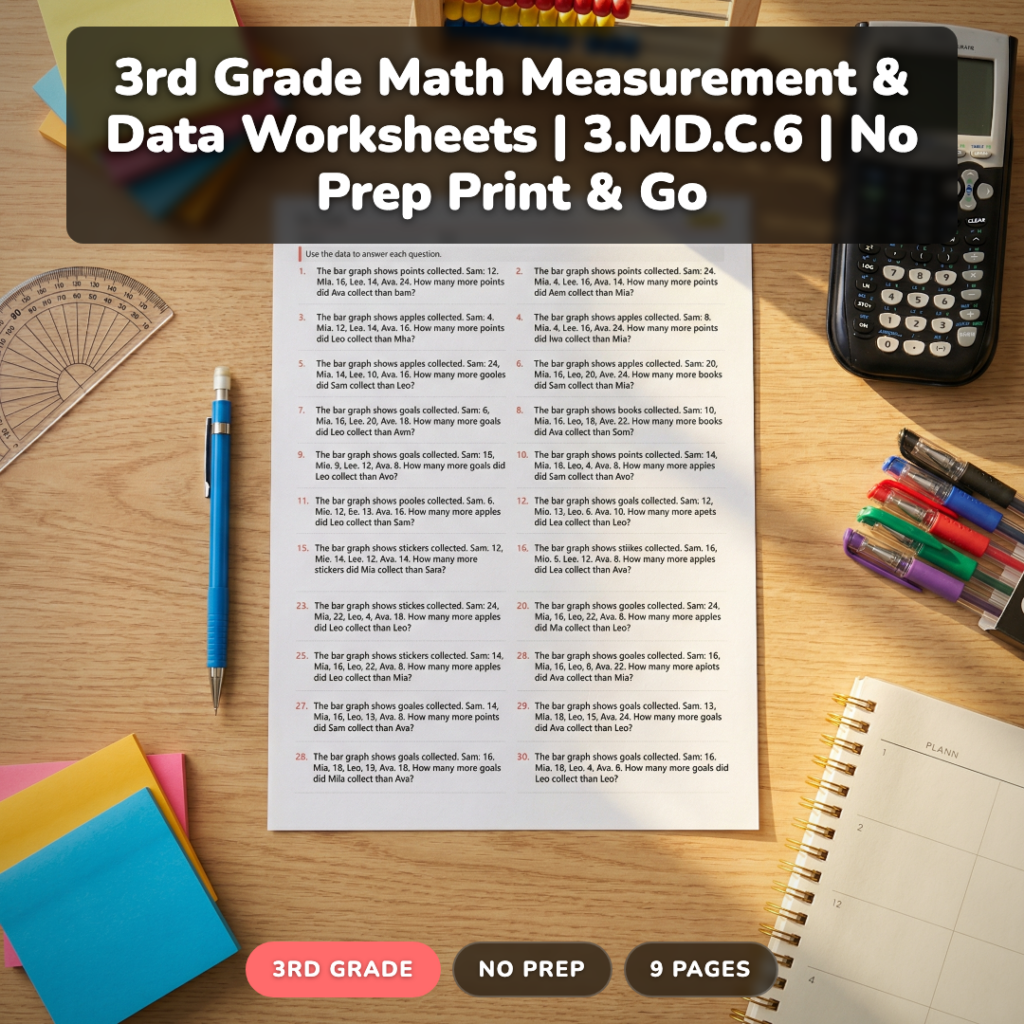
Teaching area measurement effectively requires lots of practice problems at just the right level for each student. That’s why I created this comprehensive area measurement pack specifically aligned to CCSS.Math.Content.3.MD.C.6.
The resource includes 132 carefully crafted problems across three difficulty levels: 37 practice problems for students who need extra support, 50 on-level problems for grade-level expectations, and 45 challenge problems for advanced learners. Each level uses different rectangle sizes and unit types (square inches, square feet, square centimeters) to match student readiness.
What makes this different from other area worksheets is the systematic progression from simple counting to more complex shapes, plus built-in differentiation that lets every student work at their level while covering the same standard. Answer keys are included for quick checking.
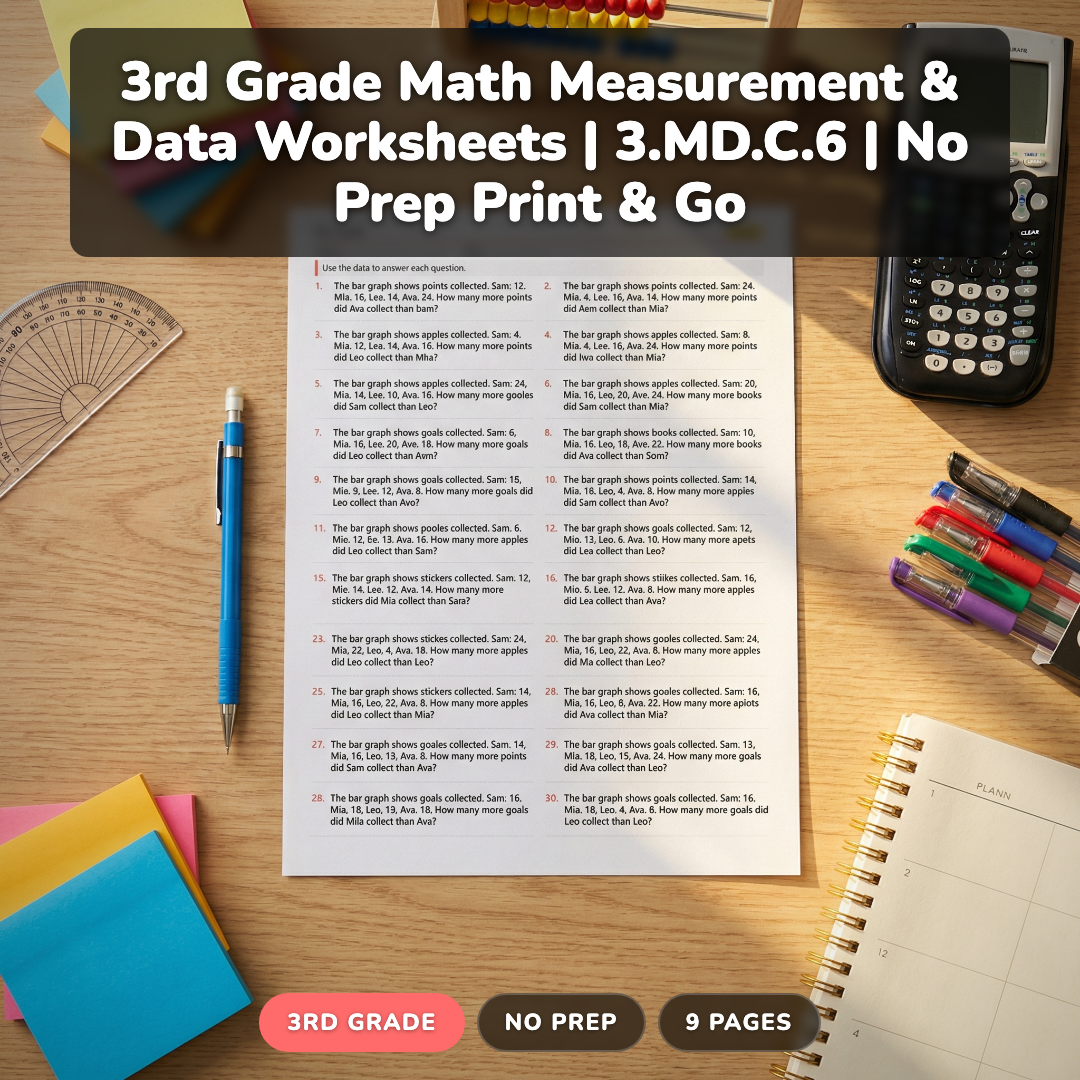
You can grab this time-saving resource and start using it tomorrow in your math centers or for independent practice.
Grab a Free Area Measurement Sample to Try
Want to see how these differentiated problems work in your classroom? I’ll send you a free sample with 6 problems from each level, plus a quick reference guide for teaching area vocabulary.
Frequently Asked Questions About Teaching Area Measurement
When should I introduce the area formula length × width?
Wait until students consistently count unit squares accurately. The CCSS.Math.Content.3.MD.C.6 standard focuses on counting, not formulas. Most students are ready for the multiplication connection in late 3rd grade or 4th grade after mastering systematic counting strategies.
What’s the difference between area and perimeter for 3rd graders?
Use concrete language: area is “how many squares fit inside” while perimeter is “how far around the outside.” Have students trace perimeter with their finger, then color area squares. This physical difference helps prevent confusion between the two measurements.
Should 3rd graders work with partial squares when measuring area?
Start with shapes made entirely of whole unit squares. Once students master complete square counting, introduce estimation with partial squares as an extension activity. The standard emphasizes accuracy with unit squares before approximation skills.
How do I help students remember which units to use for area?
Connect units to real objects: “Square inches are about the size of a Post-it note, square feet are about the size of a piece of paper.” Practice measuring actual classroom objects so students develop intuition for appropriate units.
What manipulatives work best for teaching area concepts?
One-inch square tiles, unifix cubes arranged in squares, or cut paper squares work well. Avoid circular or irregular manipulatives that don’t tessellate properly. Students need to see how unit squares fit together with no gaps or overlaps.
Teaching area measurement successfully comes down to giving students plenty of hands-on experience before moving to abstract counting. Start with physical tiles, move to grid paper, and always connect to real-world objects they can measure.
What’s your favorite way to help students visualize area? Try out these strategies and grab the free sample problems to see how differentiated practice can support every learner in your classroom.