If your third graders still struggle to tell time to the nearest minute or freeze when they see elapsed time word problems, you’re not alone. Time and measurement concepts hit a complexity wall in third grade that catches many students off guard.
You’ll discover five research-backed strategies that make abstract time concepts concrete, plus differentiation tips for every learner in your classroom. By the end of this post, you’ll have a clear roadmap for teaching CCSS.Math.Content.3.MD.A.1 with confidence.
Key Takeaway
Students master time measurement when they connect analog clocks to number lines and practice with real-world scenarios that make minutes meaningful.
Why Time Measurement Matters in Third Grade
Third grade marks a critical transition in time concepts. Students move from telling time to the hour and half-hour to precise minute-by-minute accuracy. The CCSS.Math.Content.3.MD.A.1 standard requires students to tell and write time to the nearest minute, measure time intervals, and solve word problems involving addition and subtraction of time intervals.
Research from the National Council of Teachers of Mathematics shows that students who struggle with time concepts in elementary school often carry these difficulties into middle school mathematics, particularly when working with fractions and decimals. Time measurement builds foundational understanding of part-whole relationships and number sense.
This skill typically appears in curriculum around February or March, after students have solidified place value and basic addition/subtraction facts. Students need automatic recall of skip counting by 5s and understanding of fraction concepts like halves and quarters.
Looking for a ready-to-go resource? I put together a differentiated time measurement pack that covers everything below — but first, the teaching strategies that make it work.
Common Time Measurement Misconceptions in 3rd Grade
Common Misconception: Students think the hour hand jumps directly from number to number.
Why it happens: Digital clocks show discrete hour changes, not gradual movement.
Quick fix: Use a demonstration clock to show how the hour hand moves gradually as minutes pass.
Common Misconception: Students count by ones instead of fives when reading minutes.
Why it happens: They haven’t internalized that each number represents 5 minutes.
Quick fix: Practice skip counting by 5s daily and label clock numbers with their minute values.
Common Misconception: Students subtract incorrectly when crossing hour boundaries in elapsed time.
Why it happens: They don’t understand that 60 minutes equals one hour.
Quick fix: Use number lines and break problems into smaller chunks at hour marks.
Common Misconception: Students confuse AM and PM in word problems.
Why it happens: They lack real-world connections to daily routines.
Quick fix: Connect times to familiar activities like breakfast, lunch, and bedtime.
5 Research-Backed Strategies for Teaching Time Measurement
Strategy 1: Clock and Number Line Connection
Students understand elapsed time better when they see the connection between circular clock faces and linear number lines. This dual representation helps them visualize time intervals as measurable distances.
What you need:
- Demonstration clock
- Number line (0-60 and 0-12 hours)
- Colored markers
- Student whiteboards
Steps:
- Show a start time on the demonstration clock (e.g., 2:15)
- Mark the same time on a number line, explaining that 2:15 = 135 minutes from midnight
- Present an end time (e.g., 2:45) on both representations
- Have students count the interval on the number line, then verify on the clock
- Practice with problems that cross hour boundaries using both tools
Strategy 2: Real-World Schedule Building
Students develop time sense when they create and analyze schedules based on familiar activities. This strategy builds conceptual understanding while practicing calculation skills.
What you need:
- Blank schedule templates
- Activity cards (recess, lunch, math class)
- Timer for demonstrations
- Sample school schedules
Steps:
- Give students a list of activities with durations (Math: 60 minutes, Recess: 20 minutes)
- Have them create a daily schedule starting at 8:00 AM
- Students calculate end times for each activity and start times for the next
- Check schedules by acting out transitions with the timer
- Solve word problems based on their created schedules
Strategy 3: Fraction-Time Connection Games
Third graders strengthen time concepts when they connect clock fractions to time intervals. This strategy builds on their growing fraction understanding while reinforcing time skills.
What you need:
- Paper plate clocks
- Fraction circles (halves, quarters)
- Time interval cards
- Partner recording sheets
Steps:
- Students draw clock faces divided into quarters and label each quarter-hour
- Partner A draws a time interval card (e.g., ‘half past 3 to quarter past 4’)
- Partner B shows the interval on their clock and calculates minutes elapsed
- They verify by counting by 15s or using the fraction connection (1/4 hour = 15 minutes)
- Switch roles and repeat with different intervals
Strategy 4: Timeline Problem Solving
Students visualize elapsed time problems more clearly when they draw timeline diagrams. This strategy particularly helps with word problems involving multiple time intervals.
What you need:
- Timeline templates
- Word problem cards
- Colored pencils
- Rulers for drawing
Steps:
- Read a multi-step time problem aloud (e.g., ‘Soccer practice starts at 3:30 and lasts 45 minutes. Then Maria walks home for 15 minutes. What time does she arrive?’)
- Students draw a horizontal timeline and mark the start time
- They add each time interval as a segment, labeling durations
- Calculate the final time by adding intervals step by step
- Verify the answer by checking their timeline drawing
Strategy 5: Digital-Analog Time Translation
Students build flexibility with time representations when they regularly convert between digital and analog formats. This strategy reinforces minute-reading skills while building real-world connections.
What you need:
- Digital time cards
- Individual analog clocks
- Time conversion worksheets
- Stopwatch for timing
Steps:
- Flash a digital time card (e.g., 4:37) for 5 seconds
- Students quickly set their analog clocks to match
- Check accuracy and discuss any errors as a class
- Reverse the process: show analog times for students to write digitally
- Time students to build fluency, celebrating improvement rather than speed alone
How to Differentiate Time Measurement for All Learners
For Students Who Need Extra Support
Begin with concrete manipulatives and simplified problems. Use clocks with only hour and minute hands (remove second hands). Start with 15-minute intervals before progressing to 5-minute increments. Provide number lines marked in 5-minute intervals. Review skip counting by 5s daily. Use real photographs of daily activities paired with appropriate times to build time sense. Break elapsed time problems into smaller steps, solving one interval at a time.
For On-Level Students
Focus on grade-level expectations from CCSS.Math.Content.3.MD.A.1: telling time to the nearest minute, measuring time intervals, and solving word problems with time. Practice with both analog and digital formats regularly. Use word problems involving familiar scenarios like school schedules, sports practices, and family activities. Encourage students to explain their thinking and check answers using multiple strategies.
For Students Ready for a Challenge
Extend learning with complex multi-step problems involving multiple time zones or 24-hour time format. Introduce elapsed time problems that span multiple days. Have students create their own word problems for classmates. Explore connections to other measurement units like seconds and hours. Practice with irregular intervals like 7 minutes or 23 minutes to build flexible thinking.
A Ready-to-Use Time Measurement Resource for Your Classroom
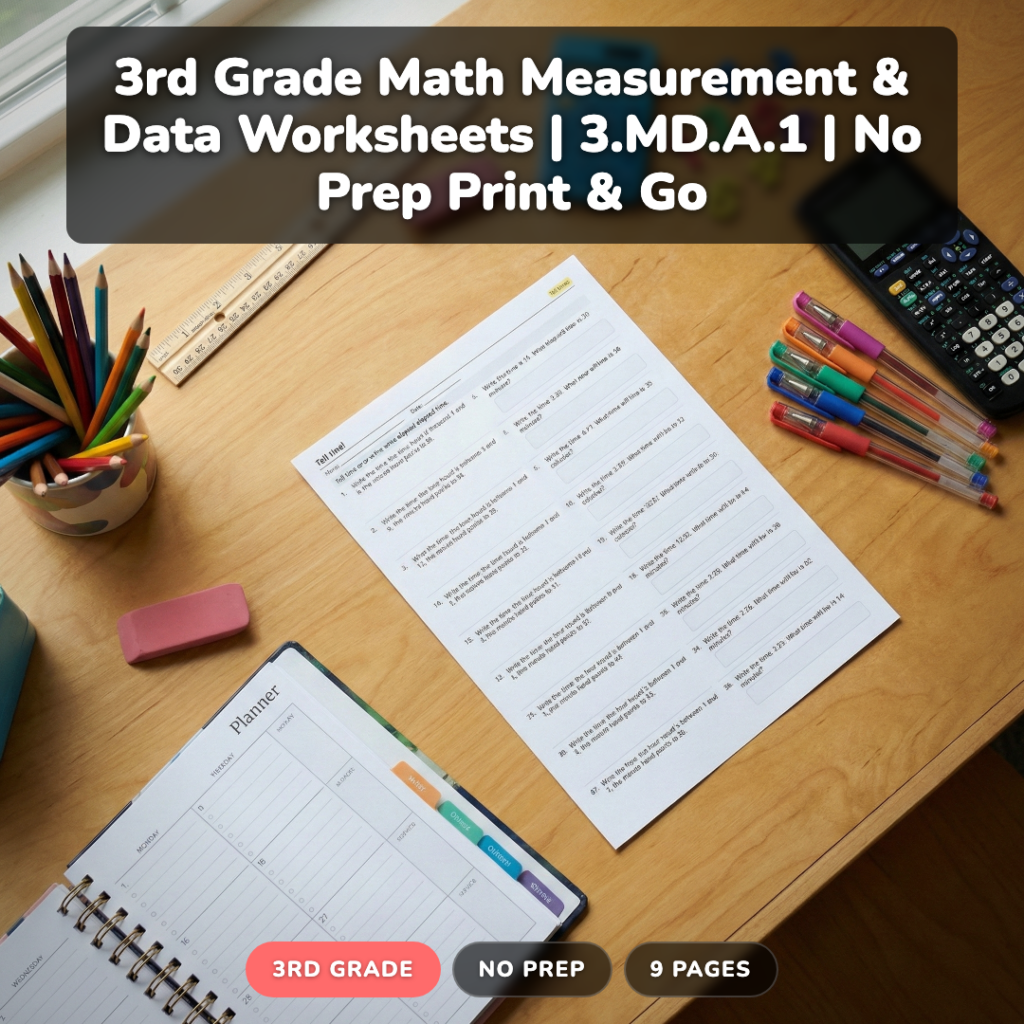
Teaching time measurement requires extensive practice with varied problem types, which means hours of prep time creating differentiated worksheets. After years of making my own materials, I developed a comprehensive measurement and data pack that saves you that preparation time.
This resource includes 132 carefully crafted problems across three difficulty levels: 37 practice problems for students needing support, 50 on-level problems aligned to grade expectations, and 45 challenge problems for advanced learners. Each level includes time-telling practice, elapsed time calculations, and word problems with real-world contexts.
What makes this different from generic worksheets is the intentional progression within each level. Problems start simple and gradually increase in complexity, building student confidence while maintaining appropriate challenge. Answer keys are included for quick checking, and problems are designed to spark mathematical discussions rather than just drill facts.
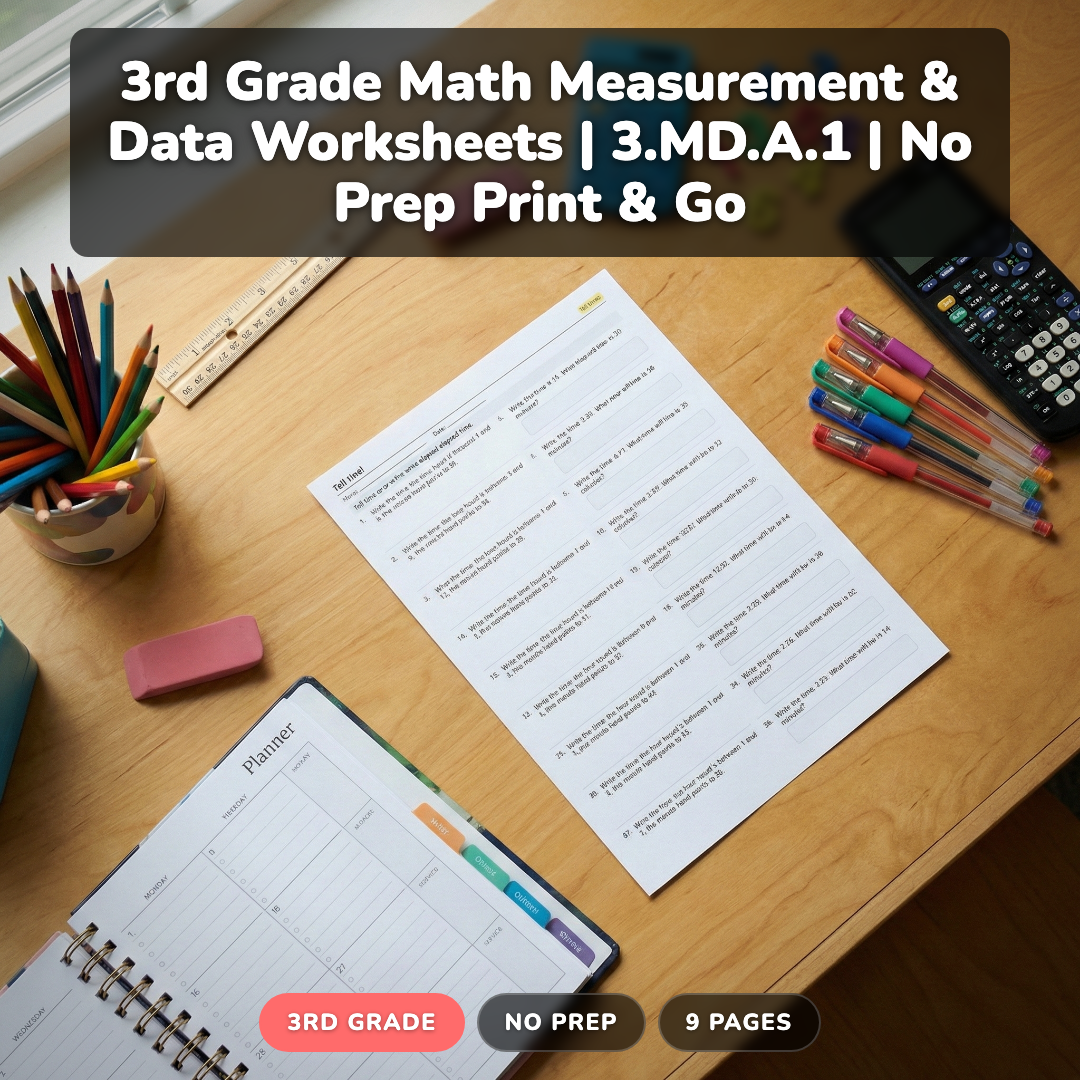
The pack covers everything from telling time to the nearest minute through complex elapsed time word problems, all aligned to CCSS.Math.Content.3.MD.A.1. Perfect for math centers, homework, or assessment preparation.
Grab a Free Time Measurement Sample to Try
Want to see the quality and format before committing? I’ll send you a free sample page from each difficulty level, plus my time-teaching tips checklist that helps you troubleshoot common student errors.
Frequently Asked Questions About Teaching Time Measurement
When should students master telling time to the nearest minute?
Most students master this skill by the end of third grade, as required by CCSS.Math.Content.3.MD.A.1. However, some students need continued practice into fourth grade, particularly with times like 7:58 or 11:03 that require careful attention to hour hand position.
Why do students struggle more with elapsed time than telling time?
Elapsed time requires multiple skills simultaneously: telling time accurately, understanding time intervals, and performing mental math across hour boundaries. Students often struggle because they haven’t automated basic time-telling skills before attempting calculations.
Should I teach analog or digital time first?
Start with analog clocks because they provide visual representation of time passing and fraction relationships. Digital time can seem arbitrary without the conceptual foundation that analog clocks provide. Introduce digital format after students understand analog time relationships.
How can I help students with AM and PM confusion?
Connect times to daily routines consistently. Create a classroom timeline showing typical activities at different times. Use real photographs of morning, afternoon, and evening activities. Practice with familiar scenarios before introducing abstract word problems.
What’s the best way to teach time intervals that cross midnight?
Use number lines and break the problem into parts. For example, 11:30 PM to 1:15 AM becomes 11:30 PM to 12:00 AM (30 minutes) plus 12:00 AM to 1:15 AM (75 minutes). This approach prevents the common error of subtracting incorrectly across the day boundary.
Time measurement builds critical mathematical foundations that extend far beyond telling time. When students master these concepts through concrete experiences and meaningful practice, they develop number sense and problem-solving skills that serve them throughout their mathematical journey.
What’s your biggest challenge when teaching time concepts? The free sample resource above includes my troubleshooting guide for the most common student difficulties — grab it and see what resonates with your classroom experience.