If your 2nd graders look confused when you mention arrays, you’re not alone. Arrays bridge concrete counting and abstract multiplication concepts, making them one of the trickiest skills in 2nd grade math. You need students to see patterns, write equations, and connect visual arrangements to addition—all while keeping it concrete and engaging.
This post breaks down exactly how to teach arrays using research-backed strategies that work in real classrooms. You’ll get step-by-step activities, common misconception fixes, and differentiation tips for every learner in your room.
Key Takeaway
Arrays teach foundational multiplication concepts through repeated addition, helping 2nd graders visualize equal groups and write corresponding equations.
Why Arrays Matter in 2nd Grade Math
Arrays introduce students to multiplicative thinking without formal multiplication. According to CCSS.Math.Content.2.OA.C.4, students must “use addition to find the total number of objects arranged in rectangular arrays with up to 5 rows and up to 5 columns; write an equation to express the total as a sum of equal addends.”
This standard appears in Quarter 3 of most 2nd grade curricula, after students master basic addition facts but before formal multiplication in 3rd grade. Research from the National Council of Teachers of Mathematics shows that students who understand arrays as equal groups perform 23% better on early multiplication assessments.
Arrays connect to several mathematical concepts: spatial reasoning, pattern recognition, and the commutative property of addition. Students learn that 3 rows of 4 objects equals 4 rows of 3 objects—a crucial foundation for multiplication facts.
Looking for a ready-to-go resource? I put together a differentiated arrays practice pack that covers everything below — but first, the teaching strategies that make it work.
Common Array Misconceptions in 2nd Grade
Understanding where students get stuck helps you address confusion before it becomes entrenched. Here are the four most common misconceptions I see with arrays:
Common Misconception: Students count individual objects instead of seeing equal groups.
Why it happens: They rely on one-by-one counting rather than recognizing patterns.
Quick fix: Cover one row at a time and have them count by the row total.
Common Misconception: Students write equations like 12 = 12 instead of 3 + 3 + 3 + 3 = 12.
Why it happens: They focus on the final answer rather than the addition process.
Quick fix: Model writing equations step-by-step, emphasizing equal addends.
Common Misconception: Students think arrays must be oriented horizontally.
Why it happens: Initial examples often show rows going left to right.
Quick fix: Rotate arrays and ask students to describe both row and column arrangements.
Common Misconception: Students can’t connect the array to the written equation.
Why it happens: Abstract symbols don’t clearly link to concrete arrangements.
Quick fix: Use colored rows and match equation addends to row colors.
5 Research-Backed Strategies for Teaching Arrays
Strategy 1: Physical Array Building with Manipulatives
Start with concrete objects students can touch and move. This builds the foundational understanding that arrays are organized arrangements, not random collections.
What you need:
- Small objects (counting bears, blocks, or beans)
- Grid paper or array mats
- Recording sheets for equations
Steps:
- Give students 12 objects and ask them to arrange them in equal rows
- Have them try different arrangements (2 rows of 6, 3 rows of 4, etc.)
- For each arrangement, count one row and write the number
- Write the addition equation showing repeated addition of that number
- Compare different arrangements and discuss which equations work
Strategy 2: Array Detective with Visual Models
Students analyze pre-made arrays to develop pattern recognition and equation-writing skills without the cognitive load of building arrangements.
What you need:
- Array cards or worksheets with dot arrangements
- Colored pencils or crayons
- Equation recording template
Steps:
- Show an array (like 4 rows of 3 dots)
- Have students trace around each row with a different color
- Count objects in one complete row
- Write that number as many times as there are rows (3 + 3 + 3 + 3)
- Solve the equation to find the total
- Check by counting all objects
Strategy 3: Interactive Array Stories
Connect arrays to real-world contexts through storytelling, helping students see practical applications and remember the concept better.
What you need:
- Story scenarios (classroom desks, garden plots, egg cartons)
- Drawing paper
- Crayons or markers
Steps:
- Present a story: “Mrs. Garcia arranges 15 desks in equal rows for group work”
- Students draw possible arrangements (3 rows of 5, 5 rows of 3)
- Write equations for each arrangement they draw
- Discuss which arrangement works best for the story context
- Create their own array stories for classmates to solve
Strategy 4: Array Memory Game
This partner game reinforces the connection between visual arrays and addition equations through repeated practice in an engaging format.
What you need:
- Array picture cards
- Equation cards
- Timer (optional)
Steps:
- Create matching pairs: one card shows an array, its partner shows the equation
- Place cards face down in a grid
- Players take turns flipping two cards
- If cards match (array and its equation), player keeps the pair
- If not, cards flip back over
- Player with most pairs wins
Strategy 5: Digital Array Builder
Technology integration allows students to quickly test multiple arrangements and see immediate feedback on their equation writing.
What you need:
- Tablets or computers
- Digital array app or simple drawing program
- Recording sheet for equations
Steps:
- Students use digital tools to create arrays with given totals
- Drag and drop objects into rows and columns
- Write equations for each arrangement they create
- Screenshot their work to share with partners
- Compare different solutions for the same total
How to Differentiate Arrays for All Learners
For Students Who Need Extra Support
Start with arrays no larger than 2×5 or 3×4. Use physical manipulatives exclusively before moving to pictures. Provide equation templates with blanks: __ + __ + __ = __. Focus on one arrangement per problem rather than finding multiple solutions. Review skip counting by 2s, 3s, and 5s as prerequisite skills. Pair struggling students with stronger partners for array building activities.
For On-Level Students
Work with arrays up to 5×5 as specified in CCSS.Math.Content.2.OA.C.4. Mix physical manipulatives with visual representations. Expect students to write complete equations independently. Challenge them to find 2-3 different arrangements for the same total. Include both horizontal and vertical orientations. Connect arrays to real-world scenarios they can relate to.
For Students Ready for a Challenge
Introduce arrays larger than 5×5 (staying within addition fact limits). Ask them to find ALL possible arrangements for a given total. Have them explain why some numbers have more arrangements than others. Connect to early multiplication language (“3 groups of 4”). Challenge them to create word problems involving arrays for classmates to solve. Explore rectangular vs. square arrays and their properties.
A Ready-to-Use Arrays Resource for Your Classroom
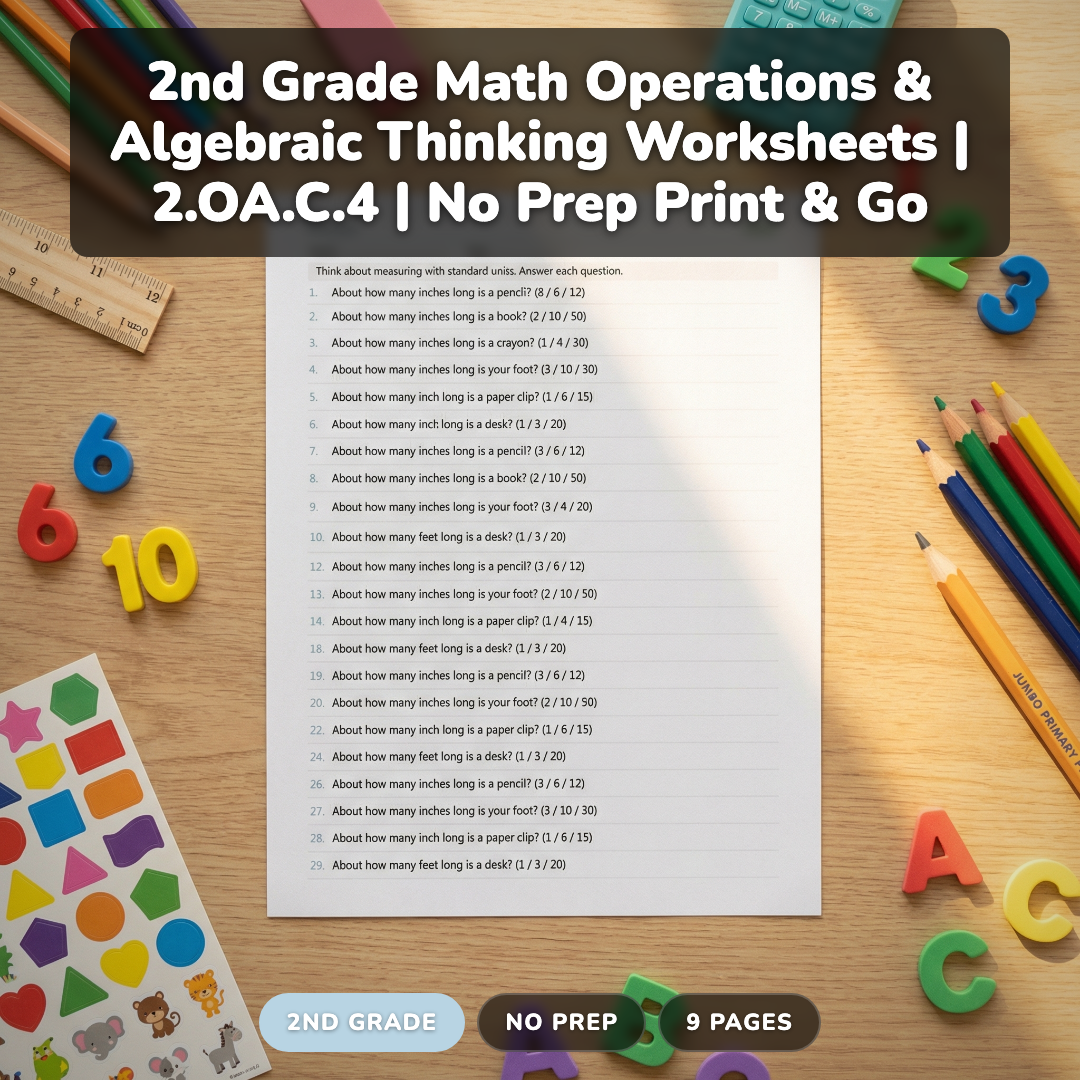
Teaching arrays effectively requires the right balance of visual clarity and progressive difficulty. After years of creating my own materials, I developed a comprehensive arrays practice pack that saves hours of prep time while ensuring every student gets appropriate challenge.
This resource includes 106 carefully scaffolded problems across three difficulty levels. The Practice level (30 problems) focuses on arrays with 6-12 objects, perfect for building foundational understanding. On-Level problems (40 problems) cover the full CCSS.Math.Content.2.OA.C.4 standard with arrays up to 5×5. Challenge problems (36 problems) extend learning with larger arrays and multi-step thinking.
What makes this different from generic worksheets? Each level uses consistent visual formatting so students focus on mathematical thinking, not decoding new layouts. Answer keys show both the array counting and equation writing, helping you quickly identify where students need support. Problems progress logically from concrete representations to more abstract thinking.
The resource covers 9 pages of differentiated practice, letting you meet every learner where they are while building toward grade-level expectations.
Grab a Free Arrays Practice Sheet to Try
Want to see how differentiated arrays practice works in your classroom? I’ll send you a free sample page from each difficulty level, plus my arrays teaching checklist that breaks down the progression from concrete to abstract thinking.
Frequently Asked Questions About Teaching Arrays
When should I introduce arrays in 2nd grade?
Introduce arrays after students master addition facts to 20, typically in January or February. Students need fluent addition before connecting it to array patterns and repeated addition equations.
How do arrays connect to multiplication?
Arrays show equal groups visually, which becomes multiplication in 3rd grade. The equation 4+4+4 (3 groups of 4) becomes 3×4=12. This visual foundation makes multiplication facts more meaningful.
What if students can only see one arrangement for an array?
Use physical manipulatives to show different arrangements of the same total. Have students build 12 objects as 3×4, then rearrange as 4×3. This hands-on approach helps them see multiple possibilities.
Should I teach rows vs. columns terminology?
Yes, but keep it simple. “Rows go this way” (gesture horizontally) and “columns go this way” (gesture vertically). Use consistent language and have students practice identifying both in arrays.
How do I assess array understanding?
Look for three skills: building arrays with manipulatives, writing correct addition equations from visual arrays, and explaining why different arrangements give the same total. All three show conceptual understanding.
Arrays bridge the gap between concrete counting and abstract mathematical thinking, giving your 2nd graders a visual foundation for multiplication concepts they’ll use for years. The key is moving gradually from hands-on building to visual recognition to equation writing, always connecting the concrete arrangement to the abstract symbols.
What’s your biggest challenge when teaching arrays? Try the free sample resource above and see how differentiated practice can support every learner in your classroom.