If your second graders freeze when you ask them to mentally add or subtract 10 or 100 from a three-digit number, you’re not alone. This foundational skill trips up many students because they’re still building number sense and place value understanding. You’ll discover five research-backed strategies that make mental math with 10 and 100 feel natural and intuitive for your students.
Key Takeaway
Students master mental addition and subtraction of 10 and 100 when they understand that only one place value changes at a time.
Why Mental Math with 10 and 100 Matters in Second Grade
Mental addition and subtraction of 10 and 100 forms the foundation for all future place value work. When students can quickly add 10 to 247 and know it becomes 257, they’re demonstrating deep understanding of our base-ten number system. This skill directly supports CCSS.Math.Content.2.NBT.B.8, which requires students to mentally add 10 or 100 to numbers 100-900 and subtract 10 or 100 from numbers 100-900.
Research from the National Council of Teachers of Mathematics shows that students who develop strong mental math strategies in second grade perform significantly better on standardized assessments throughout elementary school. The ability to manipulate numbers mentally also builds number sense, which is the most reliable predictor of mathematical success in later grades.
This skill typically appears in the spring of second grade, after students have solid understanding of two-digit addition and subtraction. You’ll want to introduce it once your students can confidently work with place value to the hundreds place and understand that 10 ones equals 1 ten.
Looking for a ready-to-go resource? I put together a differentiated mental math pack that covers everything below — but first, the teaching strategies that make it work.
Common Mental Math Misconceptions in Second Grade
Common Misconception: Students add or subtract from the wrong place value (adding 10 to 234 and getting 244).
Why it happens: They focus on the digits rather than place value meaning.
Quick fix: Use place value charts and emphasize which column changes.
Common Misconception: Students think adding 100 means adding 1 to the hundreds place regardless of what’s there (100 + 100 = 200, but 200 + 100 = 300).
Why it happens: They memorize patterns without understanding regrouping.
Quick fix: Model with base-ten blocks showing the exchange.
Common Misconception: Students subtract 10 from numbers like 305 and get 295 instead of 295.
Why it happens: They don’t understand borrowing across zeros.
Quick fix: Start with numbers that don’t require regrouping, then gradually introduce zeros.
Common Misconception: Students use finger counting or written algorithms instead of mental strategies.
Why it happens: They haven’t internalized place value patterns.
Quick fix: Provide number lines and hundreds charts for visual support before moving to mental-only work.
5 Research-Backed Strategies for Teaching Mental Math with 10 and 100
Strategy 1: Place Value Slide Method
This visual strategy helps students see exactly which digit changes when adding or subtracting 10 or 100. Students use a place value chart with moveable number cards to physically demonstrate the changes.
What you need:
- Place value charts (hundreds, tens, ones columns)
- Number cards 0-9
- Dry erase markers
- Laminated charts for reuse
Steps:
- Give students a three-digit number like 347 using number cards in the place value chart
- Ask them to add 10 mentally first, then show the change by moving only the tens digit
- Have them verbalize: ‘When I add 10, only the tens place changes from 4 to 5’
- Practice with multiple examples, then try subtracting 10
- Repeat the process with adding and subtracting 100, focusing on the hundreds place
- Gradually remove the visual support as students internalize the pattern
Strategy 2: Number Line Jumps
Using number lines helps students visualize the distance of 10 and 100, making mental calculations more intuitive. This strategy particularly supports kinesthetic learners who need movement to understand mathematical concepts.
What you need:
- Large floor number line (or tape on floor with numbers)
- Individual student number lines (0-1000)
- Colored counters or game pieces
- Jump recording sheets
Steps:
- Start with a number like 256 and place a counter on the number line
- Demonstrate a ‘jump’ of 10 by moving the counter forward 10 spaces
- Count aloud: ‘256, 266’ and emphasize the tens digit changed
- Have students practice physical jumps on the floor number line
- Move to individual number lines where students draw arrows for their jumps
- Progress to mental jumps without the physical number line
Strategy 3: Base-Ten Block Building
Manipulatives make abstract place value concepts concrete. Students physically add and remove tens and hundreds blocks to see the mathematical relationships in action.
What you need:
- Base-ten blocks (units, tens rods, hundreds flats)
- Place value mats
- Recording sheets for drawing representations
- Small group workspace
Steps:
- Have students build a number like 342 using base-ten blocks on their mat
- To add 10, they add one tens rod and count the new total
- Discuss what changed: ‘I added one ten, so now I have 5 tens instead of 4 tens’
- Practice with subtraction by removing one tens rod
- Repeat with hundreds flats for adding and subtracting 100
- Transition to drawing the blocks, then to mental visualization
Strategy 4: Pattern Recognition Games
Making mental math into a game increases engagement while building automaticity. Students discover patterns through repeated practice in a low-pressure environment.
What you need:
- Number cards with three-digit numbers
- Timer for quick rounds
- Partner recording sheets
- Small prizes or stickers for motivation
Steps:
- Partners take turns drawing number cards and adding 10 mentally
- The other partner checks the answer using a hundreds chart if needed
- Play ‘Quick Draw’ where students have 5 seconds to mentally add or subtract
- Create ‘number chains’ where students add 10 repeatedly: 234 → 244 → 254 → 264
- Introduce ‘mixed practice’ with both adding/subtracting 10 and 100
- End with reflection: ‘What patterns did you notice?’
Strategy 5: Real-World Application Stories
Connecting mental math to real situations helps students understand why this skill matters beyond the classroom. Story problems make abstract numbers meaningful and memorable.
What you need:
- Story problem cards with real-world scenarios
- Student journals for creating their own problems
- Pictures or props related to the stories
- Chart paper for class problem-solving
Steps:
- Present a story: ‘The school has 347 students. 10 new students enroll. How many students now?’
- Have students identify the mental math strategy needed (adding 10)
- Solve together, emphasizing the place value change
- Let students create their own story problems using given numbers
- Share student-created problems with the class
- Connect to other subjects: social studies (population changes), science (measurement)
How to Differentiate Mental Math for All Learners
For Students Who Need Extra Support
Start these students with two-digit numbers before moving to three-digit numbers. Provide hundreds charts and number lines as permanent supports, not temporary scaffolds. Focus on one operation at a time (just adding 10 for several days) before introducing subtraction. Use concrete manipulatives longer than typical, and allow students to draw pictures or use tools during independent practice. Consider reviewing prerequisite skills like skip counting by 10s and place value identification.
For On-Level Students
These students should work with three-digit numbers from 100-900 as specified in CCSS.Math.Content.2.NBT.B.8. They can handle mixed practice with both addition and subtraction of 10 and 100 within the same lesson. Expect them to transition from concrete to abstract thinking within 2-3 weeks of instruction. Provide moderate scaffolding that you gradually remove as they build confidence and automaticity.
For Students Ready for a Challenge
Extend these students to four-digit numbers or introduce adding/subtracting multiples of 10 (adding 20, 30, 40). Challenge them with multi-step problems: ‘Start with 456, add 100, then subtract 10. What’s your final answer?’ Connect to real-world applications like calculating distances on maps or working with money amounts. Have them create and solve their own problems to share with classmates.
A Ready-to-Use Mental Math Resource for Your Classroom
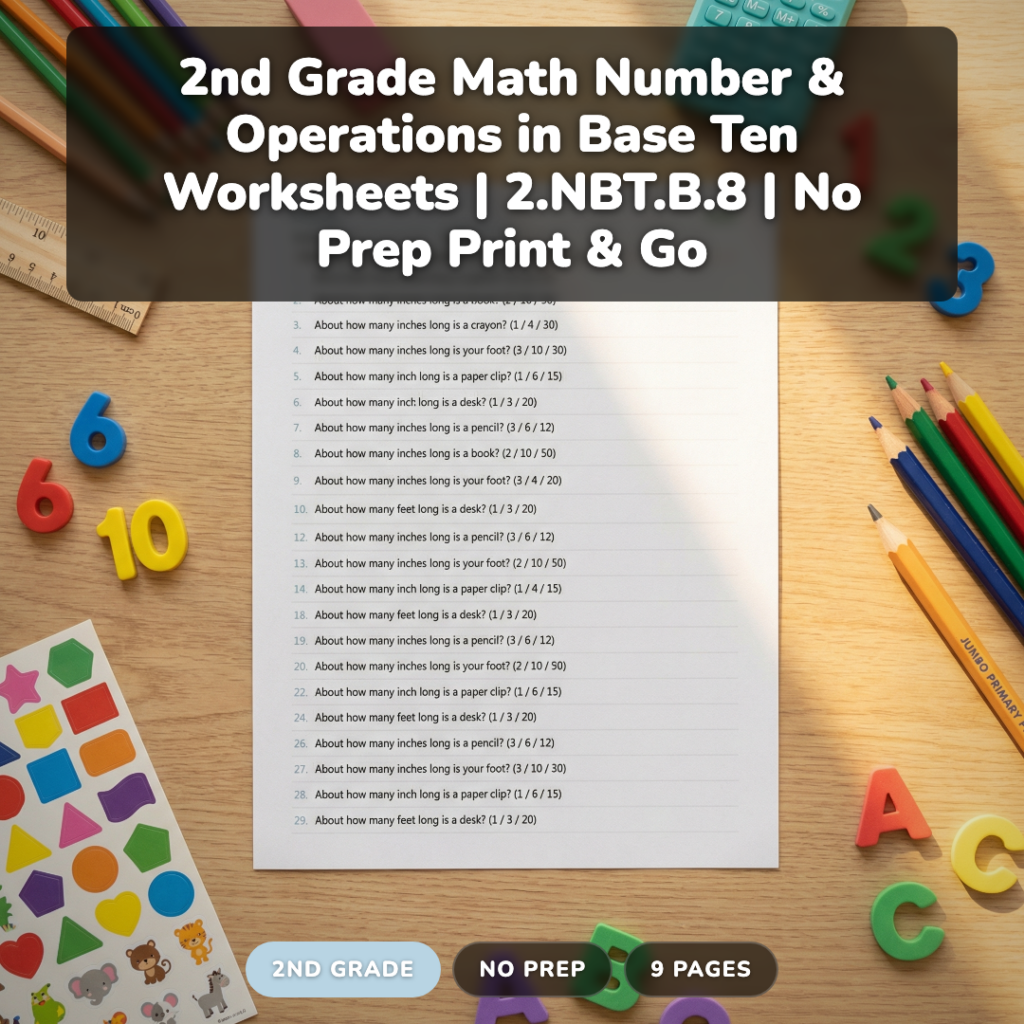
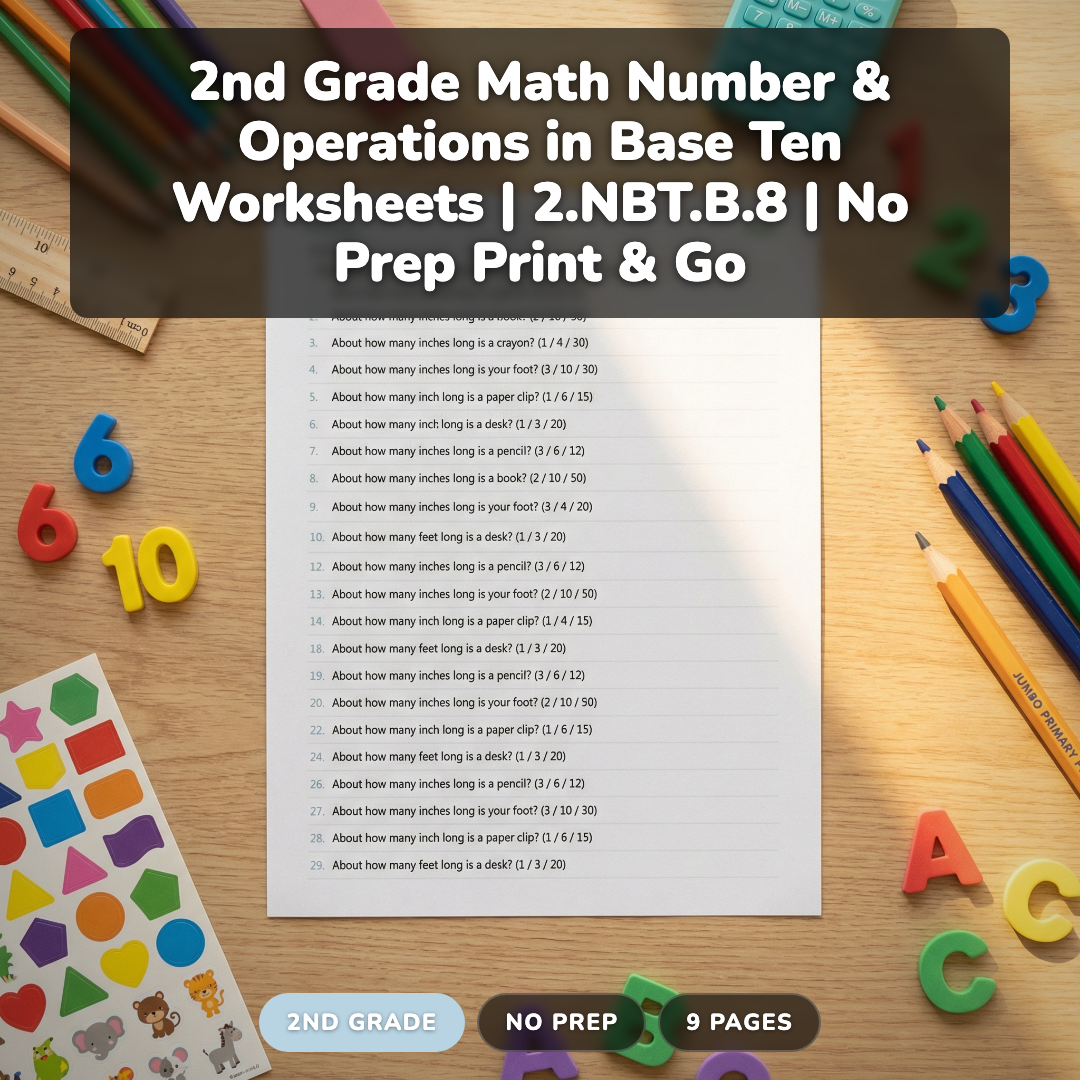
After teaching this skill for years, I know how much prep time goes into creating differentiated practice that actually meets every student’s needs. That’s why I created a comprehensive mental math resource that takes the guesswork out of planning.
This 9-page resource includes 106 carefully crafted problems across three difficulty levels. The Practice level (30 problems) focuses on basic addition and subtraction of 10 and 100 with visual supports. The On-Level section (40 problems) provides grade-appropriate practice aligned to CCSS.Math.Content.2.NBT.B.8. The Challenge level (36 problems) extends learning with multi-step problems and real-world applications.
What makes this resource different is the thoughtful progression within each level. Problems start simple and gradually increase in complexity, so students build confidence before tackling harder challenges. Each page includes clear directions and plenty of white space for student work. Answer keys are included for quick grading.
You can save hours of prep time and ensure every student gets the right level of practice.
Grab a Free Mental Math Sample to Try
Want to see how these strategies work in practice? I’ll send you a free sample page from each difficulty level, plus a quick reference guide for teaching mental math strategies. Perfect for trying out the approach before diving in.
Frequently Asked Questions About Teaching Mental Math
When should I introduce adding and subtracting 10 and 100 mentally?
Introduce this skill in late winter or early spring of second grade, after students have mastered two-digit addition and subtraction with regrouping. Students need solid place value understanding through the hundreds place before tackling mental calculations with three-digit numbers.
What if students want to use written algorithms instead of mental strategies?
This is normal! Start by allowing written work, then gradually encourage mental strategies by providing time limits or ‘mental math only’ practice sessions. Emphasize that mental math is faster and more efficient for these specific problems involving 10 and 100.
How do I help students who struggle with numbers containing zeros?
Begin with numbers that don’t require regrouping across zeros (like 234, 567). Once students master the basic pattern, introduce numbers with zeros in the tens place (like 305, 407) and explicitly model the regrouping process using base-ten blocks.
Should students memorize these facts or understand the process?
Focus on understanding first, then build toward automaticity. Students who understand why adding 10 changes only the tens digit will remember the pattern longer than those who simply memorize isolated facts. Use visual models until the pattern becomes automatic.
How does this skill connect to third grade standards?
This foundation supports third grade work with rounding, estimation, and multi-digit arithmetic. Students who can mentally add and subtract 10 and 100 more easily understand place value relationships in larger numbers and develop stronger number sense overall.
Teaching mental math with 10 and 100 doesn’t have to feel overwhelming when you have the right strategies and resources. Focus on building deep understanding through visual models and concrete experiences, then gradually move toward mental calculations. Remember to grab your free sample pages to get started right away!
What’s your biggest challenge when teaching mental math strategies? I’d love to hear about your experiences in the comments below.