If your second graders freeze when they see a word problem, you’re not alone. Many students can add and subtract numbers perfectly but panic when those same operations are wrapped in a story. The key isn’t more practice problems — it’s teaching students how to decode what the problem is actually asking.
Key Takeaway
Second graders need explicit instruction in identifying problem types and choosing the right operation, not just more computation practice.
Why Operations & Algebraic Thinking Matters in 2nd Grade
Operations and Algebraic Thinking forms the foundation for all future math learning. In second grade, students transition from concrete counting to abstract thinking about mathematical relationships. CCSS.Math.Content.2.OA.A.1 requires students to solve one- and two-step word problems within 100, but the real skill being developed is mathematical reasoning.
Research from the National Council of Teachers of Mathematics shows that students who master word problem solving in elementary grades are 40% more likely to succeed in algebra. The timing matters — second grade is when students develop their problem-solving identity. If they see themselves as “bad at word problems” now, that mindset can persist for years.
This standard appears throughout the school year, typically introduced in October after students have solid addition and subtraction facts within 20. You’ll revisit it monthly, increasing problem complexity as students grow more confident with two-step problems by spring.
Looking for a ready-to-go resource? I put together a differentiated word problem pack that covers everything below — but first, the teaching strategies that make it work.
Common Word Problem Misconceptions in 2nd Grade
Common Misconception: Students always add when they see “altogether” or “total.”
Why it happens: They memorize keywords instead of understanding the problem structure.
Quick fix: Teach them to act out problems with manipulatives first, then identify the operation.
Common Misconception: Students subtract the smaller number from the larger number, regardless of problem context.
Why it happens: They haven’t learned that subtraction order matters in word problems.
Quick fix: Use number lines to show “start here, move this way” for subtraction problems.
Common Misconception: Students think two-step problems require two different operations.
Why it happens: They assume “two-step” means “addition then subtraction.”
Quick fix: Show examples where both steps use the same operation, like “add the boys, add the girls, then add both groups.”
Common Misconception: Students ignore the unknown’s position and always solve for the last number mentioned.
Why it happens: They haven’t learned that the question determines what to find.
Quick fix: Highlight the question in every problem and restate it before solving.
5 Research-Backed Strategies for Teaching Word Problems
Strategy 1: Problem Type Sorting with Visual Anchors
Students learn to categorize problems by type before solving them. This builds pattern recognition and helps them choose the correct operation automatically.
What you need:
- Poster board for anchor charts
- Sample problems for each type
- Colored markers
- Problem sorting cards
Steps:
- Create anchor charts for each problem type: Add To, Take From, Put Together/Take Apart, and Compare
- Use consistent visual representations — boxes for unknown quantities, arrows for change
- Give students 8-10 mixed problems to sort into categories before solving
- Have students explain their sorting choices to a partner
- Only after sorting, students solve one problem from each category
Strategy 2: Act It Out with Mathematical Language
Students use manipulatives to model problems while verbalizing their thinking. This bridges concrete and abstract understanding while building math vocabulary.
What you need:
- Two-color counters or cubes
- Small cups or plates for grouping
- Sentence frames for math talk
Steps:
- Read the problem aloud together, identifying the characters and action
- Students use counters to represent each group or quantity mentioned
- Act out the problem’s action — combining groups, removing items, or comparing sets
- Students use sentence frames: “I started with ___, then I ___, so now I have ___”
- Write the equation that matches their actions
Strategy 3: Number Line Problem Solving
Students visualize addition as moving forward and subtraction as moving backward on a number line. This strategy works especially well for change problems and builds number sense.
What you need:
- Large floor number line (0-100)
- Individual student number lines
- Game pieces or counters for markers
Steps:
- Identify the starting number in the problem
- Place a marker at that position on the number line
- Determine whether the action means moving forward (addition) or backward (subtraction)
- Count the moves needed and mark the ending position
- Write the equation: starting number + or – change = ending number
Strategy 4: Three-Read Protocol for Comprehension
Students read each problem three times with different purposes, building comprehension before attempting to solve. This reduces impulsive solving and increases accuracy.
What you need:
- Highlighters or colored pencils
- Three-read bookmark with prompts
- Chart paper for class modeling
Steps:
- First read: “What is this problem about?” Students identify the context and characters
- Second read: “What is happening?” Students highlight the action words and numbers
- Third read: “What is the question asking?” Students circle the question and restate it in their own words
- Only after three reads, students choose their strategy and solve
- Check the answer against the original question
Strategy 5: Equation Building with Unknown Boxes
Students write equations with boxes representing unknown quantities, then solve systematically. This prepares them for algebraic thinking and variable use in later grades.
What you need:
- Dry erase boards and markers
- Pre-drawn equation templates
- Number cards or tiles
Steps:
- Read the problem and identify all known quantities
- Draw boxes for unknown quantities
- Write an equation using numbers and boxes: 25 + □ = 37
- Use inverse operations or counting strategies to find the unknown
- Substitute the answer back into the equation to verify
How to Differentiate Word Problems for All Learners
For Students Who Need Extra Support
Start with single-step problems using smaller numbers (within 20). Provide manipulatives for every problem and use consistent problem types for several days before introducing variety. Consider problems with simple, familiar contexts like classroom objects or snacks. Pre-teach vocabulary words like “altogether,” “left,” and “more than” in isolation before using them in problems.
For On-Level Students
Use the full range of CCSS.Math.Content.2.OA.A.1 expectations: one- and two-step problems within 100 with unknowns in all positions. Mix problem types within each lesson and encourage multiple solution strategies. Students should explain their thinking using mathematical vocabulary and check their answers for reasonableness.
For Students Ready for a Challenge
Introduce three-step problems or problems with extra information that isn’t needed for solving. Use larger numbers (within 200) or problems requiring multiple operations. Challenge students to write their own word problems for given equations or to solve problems with multiple possible answers.
A Ready-to-Use Word Problem Resource for Your Classroom
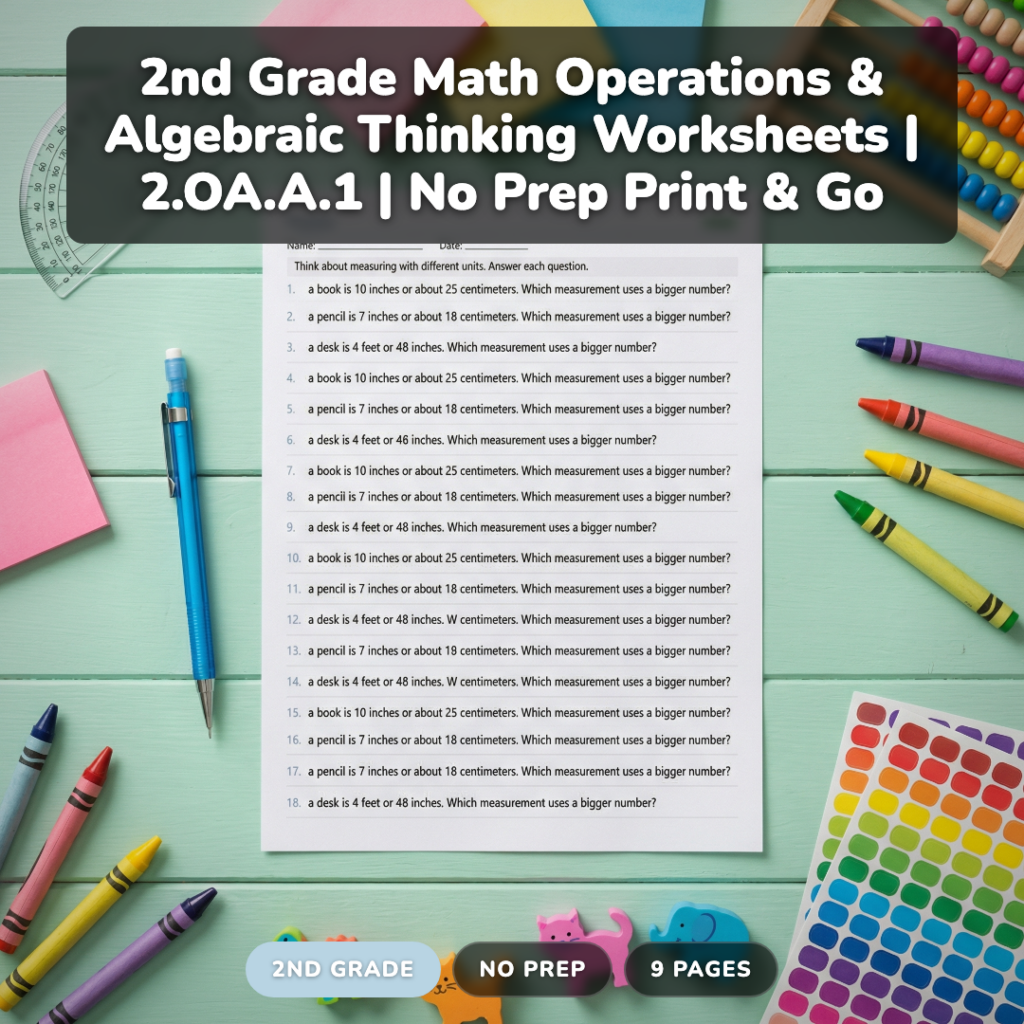
After years of creating word problems from scratch, I developed a comprehensive resource that saves hours of prep time while ensuring proper differentiation. This 9-page pack includes 106 carefully crafted problems across three difficulty levels.
The Practice level features 30 single-step problems with numbers within 50, perfect for students building confidence. The On-Level section provides 40 problems that fully address the 2nd grade standard, including two-step problems and unknowns in various positions. The Challenge level offers 36 complex problems that push thinking beyond grade level expectations.
What makes this different from other word problem resources is the intentional progression within each level and the inclusion of all problem types required by the standard. Each problem is tested with real second graders to ensure age-appropriate language and contexts.
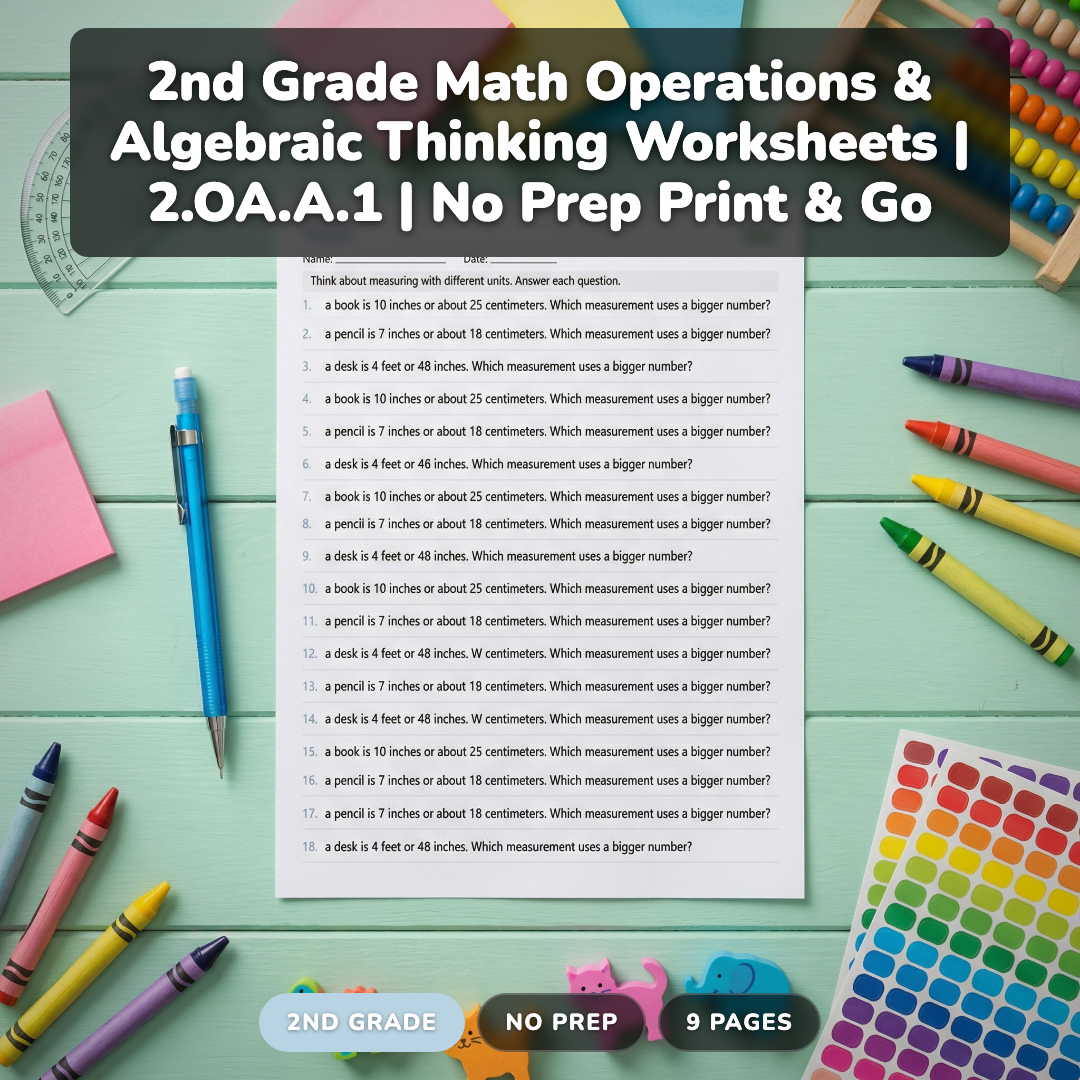
The resource includes detailed answer keys and teaching notes for each section, making it perfect for math centers, homework, or assessment preparation.
Grab a Free Word Problem Sample to Try
Want to see these strategies in action? I’ve created a free sample pack with 6 differentiated word problems and a strategy reference sheet. Perfect for trying these techniques with your students before committing to the full resource.
Frequently Asked Questions About Teaching Word Problems
When should I introduce two-step word problems in 2nd grade?
Introduce two-step problems after students consistently solve single-step problems in all four operation types (add to, take from, put together, compare). This typically happens in January or February, allowing time for mastery before state testing.
How do I help students who always add regardless of the problem type?
Focus on acting out problems with manipulatives before writing equations. When students physically remove objects or separate groups, they naturally understand that subtraction is needed. Avoid teaching keyword strategies that can mislead students.
What’s the difference between Put Together/Take Apart and Add To problems?
Add To problems involve a change over time (“Maria had 15 stickers, then got 8 more”). Put Together problems combine static groups (“There are 15 red balloons and 8 blue balloons”). The mathematical operation is the same, but the context differs.
How many word problems should 2nd graders solve per day?
Quality over quantity — 2-3 well-discussed problems with multiple strategies shown is better than 10 problems solved quickly. Students need time to explain their thinking and learn from different approaches to build deep understanding.
Should I teach students to look for keywords in word problems?
No, keyword strategies often mislead students. Instead, teach them to understand the problem structure and action. For example, “How many more” can require either addition or subtraction depending on the problem context, making keywords unreliable.
Teaching word problems effectively requires patience and explicit strategy instruction, but the payoff is huge. When students learn to approach problems systematically, they develop confidence that serves them throughout their mathematical journey. Remember to grab that free sample pack above — your students will thank you for the extra practice!
What’s your biggest challenge when teaching word problems? I’d love to hear how these strategies work in your classroom.