If your second graders can count to 100 but freeze when you ask them to skip count by 10s from 47, you’re not alone. Skip counting is one of those skills that seems simple until you’re actually teaching it — and watching students count “47, 48, 49, 50…” instead of jumping straight to 57.
This comprehensive guide will give you five research-backed strategies to make skip counting click for every student in your classroom, plus differentiation tips and common misconceptions to watch for.
Key Takeaway
Effective skip counting instruction builds on number patterns, uses visual models, and connects to place value understanding rather than rote memorization.
Why Skip Counting Matters in 2nd Grade
Skip counting is a foundational skill that bridges basic counting and multiplication concepts. According to CCSS.Math.Content.2.NBT.A.2, second graders should count within 1000 and skip-count by 5s, 10s, and 100s. This standard typically appears in the first quarter of second grade, building on first grade’s counting to 120.
Research from the National Council of Teachers of Mathematics shows that students who master skip counting patterns perform 23% better on multiplication assessments in third grade. The skill develops number sense, pattern recognition, and place value understanding — all critical for future math success.
Skip counting also connects to real-world applications: counting money (nickels, dimes), telling time (by 5s on a clock face), and organizing objects in groups. When students can flexibly skip count, they’re building the foundation for understanding multiplication as repeated addition.
Looking for a ready-to-go resource? I put together a differentiated skip counting pack that covers everything below — but first, the teaching strategies that make it work.
Common Skip Counting Misconceptions in 2nd Grade
Understanding where students get stuck helps you address these misconceptions before they become ingrained habits.
Common Misconception: Students think they must start skip counting from the target number (counting by 10s from 10, 20, 30…).
Why it happens: Most practice starts from multiples, so students don’t learn to skip count from any starting point.
Quick fix: Practice skip counting from random starting numbers daily during calendar time.
Common Misconception: Students count by ones to find the next number in a skip counting sequence.
Why it happens: They haven’t internalized the pattern and fall back on what they know best.
Quick fix: Use a hundred chart to highlight patterns and have students predict before counting.
Common Misconception: Students think skip counting by 100s means adding 100 to any number.
Why it happens: They don’t understand place value — that adding 100 only changes the hundreds digit.
Quick fix: Use base-ten blocks to show that 100 is one flat, not ten separate cubes.
Common Misconception: Students can’t skip count backwards or from numbers that aren’t multiples.
Why it happens: Limited practice with flexible starting points and directions.
Quick fix: Include backwards skip counting and random starting points in daily practice.
5 Research-Backed Strategies for Teaching Skip Counting
Strategy 1: Hundred Chart Pattern Discovery
Students use hundred charts to discover and visualize skip counting patterns, making abstract number relationships concrete and predictable.
What you need:
- Hundred charts (one per student)
- Colored pencils or crayons
- Transparent counters
Steps:
- Give each student a hundred chart and ask them to color every 10th number (10, 20, 30, etc.) in blue
- Have students describe the pattern they see (all numbers end in 0, they’re in a straight column)
- Repeat with 5s using red (notice they end in 0 or 5, create a zigzag pattern)
- For 100s, use a different colored chart and highlight 100, 200, 300, etc.
- Ask students to predict the next three numbers in each pattern before checking
Strategy 2: Movement-Based Skip Counting
Kinesthetic learning helps students internalize skip counting rhythms through physical movement, making abstract number patterns memorable and engaging.
What you need:
- Open floor space
- Number cards 1-100
- Upbeat music (optional)
Steps:
- Arrange students in a circle with number cards spread in the center
- Start skip counting by 10s while students march in place on each number
- Students take turns jumping to grab the next number card in the sequence
- Add clapping patterns: clap once for 5s, twice for 10s, stomp for 100s
- Practice skip counting while doing jumping jacks, with one jump per number
Strategy 3: Base-Ten Block Building
Students use manipulatives to build skip counting sequences, connecting the abstract numbers to concrete place value representations.
What you need:
- Base-ten blocks (units, rods, flats)
- Recording sheets
- Small group workspace
Steps:
- Students build 23 using base-ten blocks (2 rods, 3 units)
- To skip count by 10s, they add one rod at a time: 33, 43, 53
- Record each number as they build, emphasizing that only the tens digit changes
- For 100s, start with flats: build 245, add one flat to get 345, then 445
- Challenge students to predict the next number before building it
Strategy 4: Number Line Jumping Games
Interactive number line activities help students visualize the distance between numbers in skip counting sequences, building number sense and pattern recognition.
What you need:
- Floor number line (0-100)
- Small toys or game pieces
- Dice or spinner
Steps:
- Students place their game piece on a starting number (like 17)
- Roll dice to determine skip counting interval (5s, 10s, or 100s)
- Students physically jump their piece along the number line
- Say each number aloud as they land on it: “17, 27, 37, 47”
- First player to reach 100 (or closest without going over) wins
Strategy 5: Real-World Application Centers
Students practice skip counting through meaningful contexts like money counting, time telling, and organizing classroom materials.
What you need:
- Play money (nickels, dimes)
- Clock faces
- Small classroom objects to count
- Recording sheets
Steps:
- Money Center: Students count collections of nickels (by 5s) and dimes (by 10s)
- Time Center: Skip count by 5s around clock faces to tell time
- Organization Center: Group classroom supplies by 10s and count the total
- Students rotate through centers, recording their skip counting on worksheets
- Share findings with the class, explaining which skip counting pattern they used
How to Differentiate Skip Counting for All Learners
For Students Who Need Extra Support
Start with concrete manipulatives and visual supports. Use hundred charts with pre-highlighted patterns, focusing on skip counting by 10s first since the pattern is most obvious. Provide number lines with tick marks already showing the skip counting intervals. Practice starting from multiples (10, 20, 30) before introducing random starting points. Use songs and chants to help students remember patterns, and allow students to use finger counting or quiet counting-on strategies initially.
For On-Level Students
Students at grade level should master CCSS.Math.Content.2.NBT.A.2 expectations: skip counting by 5s, 10s, and 100s within 1000. They should be able to start from any number, count both forwards and backwards, and identify missing numbers in skip counting sequences. Provide mixed practice with all three intervals, and include word problems that require skip counting to solve. Students should explain the patterns they notice and make predictions about what comes next.
For Students Ready for a Challenge
Extend learning by introducing skip counting by 2s, 3s, and 4s. Challenge students to skip count by 25s or 50s, and work with larger numbers beyond 1000. Have them create their own skip counting patterns and teach them to classmates. Introduce the connection between skip counting and multiplication: skip counting by 5s four times gives the same result as 5 × 4. Students can also explore what happens when you skip count by different intervals starting from the same number.
A Ready-to-Use Skip Counting Resource for Your Classroom
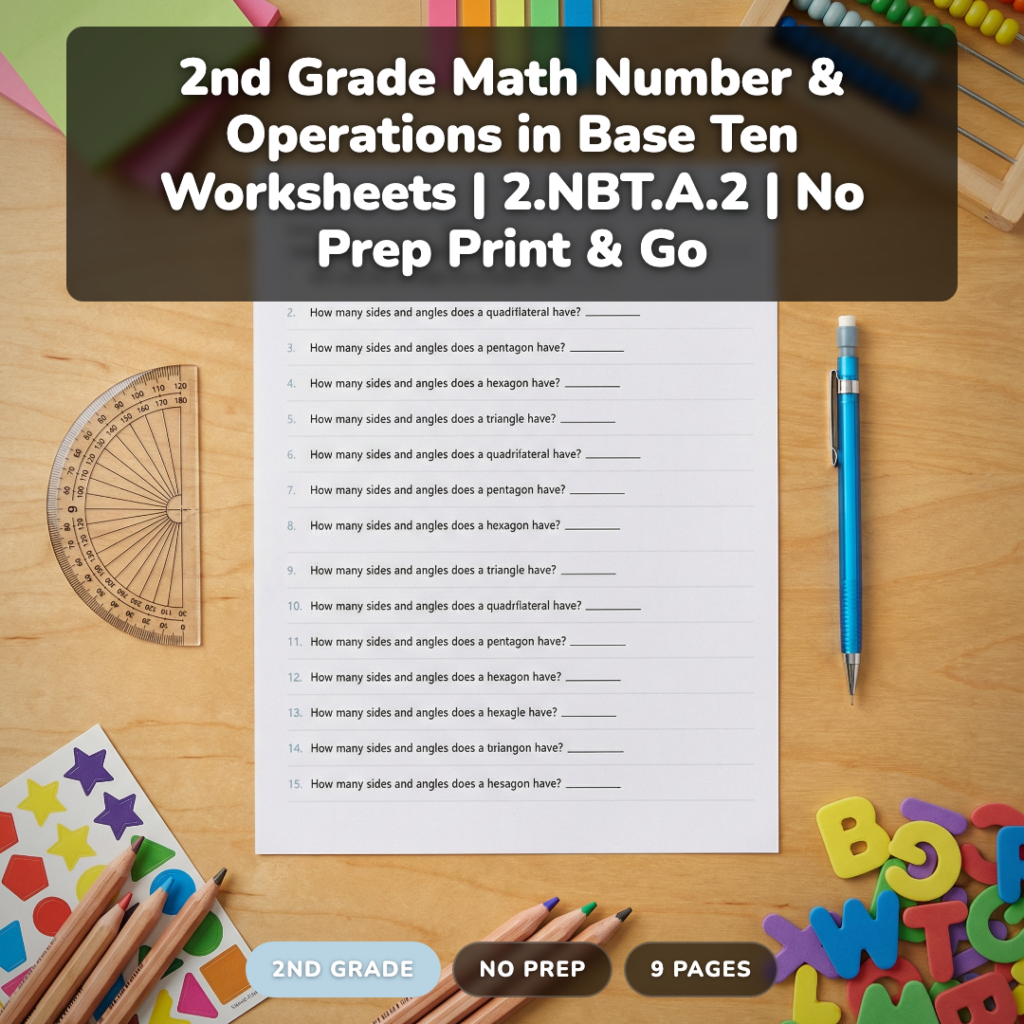
After years of creating skip counting materials from scratch, I developed a comprehensive resource that saves hours of prep time while providing exactly the right level of challenge for every student. This Number & Operations in Base Ten worksheet pack includes 106 problems across three differentiated levels.
The Practice level (30 problems) focuses on basic skip counting by 10s with visual supports and smaller numbers. On Level worksheets (40 problems) cover all three intervals (5s, 10s, 100s) with mixed starting points. The Challenge level (36 problems) includes backwards skip counting, missing number sequences, and real-world applications.
What makes this resource different is the careful progression within each level — students aren’t just getting random skip counting problems. Each worksheet builds systematically from easier to more complex applications, with clear visual models and answer keys included.
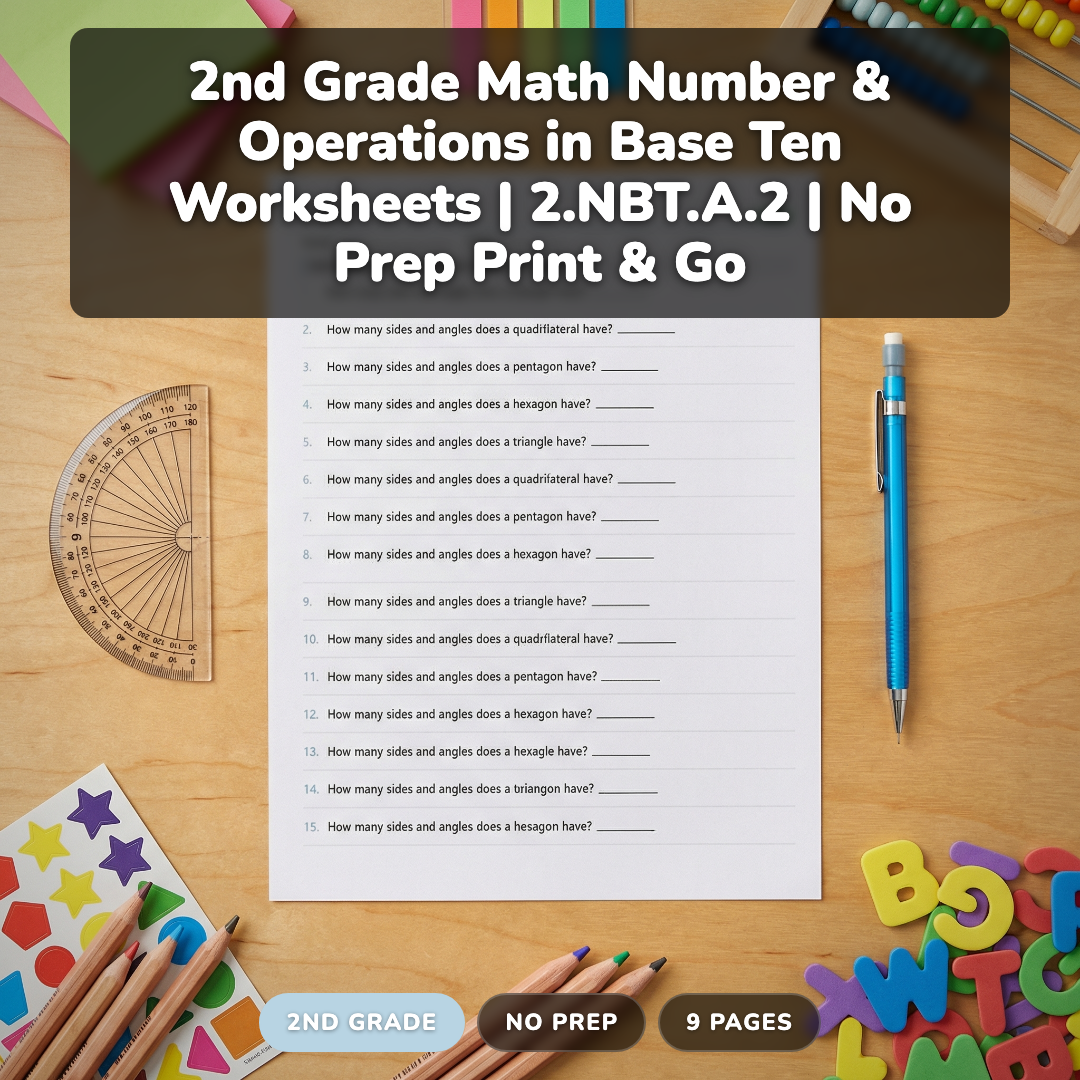
The 9-page pack covers everything you need for solid skip counting instruction, from introducing patterns to independent practice. Perfect for math centers, homework, or quick assessments.
Grab a Free Skip Counting Sample to Try
Want to see how the differentiated approach works? I’ll send you a free sample worksheet from each level so you can try it with your students before committing to the full pack.
Frequently Asked Questions About Teaching Skip Counting
When should I introduce skip counting by 100s in 2nd grade?
Introduce skip counting by 100s after students master counting by 10s, typically in October or November. Students need solid place value understanding to see that adding 100 only changes the hundreds digit. Start with round numbers like 200, 300, 400 before using numbers like 347, 447, 547.
How do I help students who can skip count by 10s but struggle with 5s?
Use a hundred chart to show that skip counting by 5s creates a zigzag pattern, alternating between columns ending in 0 and 5. Practice with nickels and clock faces where 5s are naturally emphasized. Start from 0 or 5 initially, then introduce other starting points once the pattern is solid.
What’s the difference between skip counting and multiplication?
Skip counting is repeated addition (5 + 5 + 5 = 15) while multiplication is a more abstract operation (3 × 5 = 15). In 2nd grade, focus on skip counting as the foundation. Students will connect it to multiplication in 3rd grade when they learn CCSS.Math.Content.3.OA.A.1.
Should students memorize skip counting sequences?
Students should understand patterns rather than just memorize sequences. While fluency is important, focus first on helping students see why 47 + 10 = 57 using place value reasoning. Memorization comes naturally once students understand the underlying patterns and have sufficient practice.
How can I assess skip counting understanding beyond worksheets?
Use oral assessments where students skip count aloud from random starting points. Have students identify and correct errors in skip counting sequences. Ask them to explain patterns they notice or predict what comes next. Observe students using skip counting to solve real problems like counting classroom supplies.
Skip counting mastery sets your students up for success with multiplication, money concepts, and time telling. Focus on building understanding of patterns rather than rote memorization, and remember that consistent practice with visual supports helps every learner succeed.
What’s your favorite way to practice skip counting with second graders? I’d love to hear what works in your classroom!