If your second graders freeze when they see a number like 347 and you ask them to write it in expanded form, you’re not alone. Teaching base ten concepts—reading, writing, and understanding numbers to 1000—is one of those foundational skills that can make or break a student’s math confidence. The good news? With the right strategies, your students will master CCSS.Math.Content.2.NBT.A.3 and actually understand what those digits mean.
Key Takeaway
Students master base ten when they connect concrete manipulatives to visual models to abstract number forms through systematic, hands-on practice.
Why Base Ten Matters in Second Grade
Base ten understanding forms the foundation for all future math learning. When students truly grasp place value, they’re ready for multi-digit addition and subtraction, understanding of fractions, and even early multiplication concepts. CCSS.Math.Content.2.NBT.A.3 specifically requires students to read and write numbers to 1000 using base-ten numerals, number names, and expanded form.
Research from the National Council of Teachers of Mathematics shows that students who struggle with place value in second grade often continue to struggle with multi-digit operations throughout elementary school. The key is building conceptual understanding before moving to procedural fluency.
This standard typically appears in the first quarter of second grade, building on first grade’s work with numbers to 120. Students need to understand that 347 means 3 hundreds, 4 tens, and 7 ones—not just three random digits in a row.
Looking for a ready-to-go resource? I put together a differentiated base ten practice pack that covers everything below — but first, the teaching strategies that make it work.
Common Base Ten Misconceptions in 2nd Grade
Common Misconception: Students write ‘three hundred forty-seven’ as 30047.
Why it happens: They write each word they hear as a separate number without understanding place value.
Quick fix: Use base ten blocks to show the actual value of each digit position.
Common Misconception: Students think the 4 in 347 means ‘four’ instead of ‘forty.’
Why it happens: They focus on digit recognition rather than positional value.
Quick fix: Always say ‘four tens’ or ‘forty’ when pointing to the tens place.
Common Misconception: Students write expanded form as 3 + 4 + 7 instead of 300 + 40 + 7.
Why it happens: They add the digits without considering their place values.
Quick fix: Connect expanded form directly to base ten block representations.
Common Misconception: Students reverse digits when writing numbers from dictation (writing 74 instead of 47).
Why it happens: They write digits in the order they hear them without understanding place value structure.
Quick fix: Use place value mats and have students build numbers with manipulatives first.
5 Research-Backed Strategies for Teaching Base Ten
Strategy 1: The Concrete-Representational-Abstract (CRA) Progression
Start with physical base ten blocks, move to drawings, then transition to numbers. This research-backed sequence helps students build deep conceptual understanding before working with abstract symbols.
What you need:
- Base ten blocks (hundreds flats, tens rods, unit cubes)
- Place value mats
- Whiteboard and markers
Steps:
- Show students 247 using base ten blocks on a place value mat
- Have them draw the blocks (2 squares, 4 lines, 7 dots)
- Write the number in standard form: 247
- Write in expanded form: 200 + 40 + 7
- Say the number name: ‘two hundred forty-seven’
Strategy 2: Number Building Races
Turn place value practice into an engaging game where students race to build numbers correctly using base ten blocks. This builds fluency while maintaining the concrete connection.
What you need:
- Base ten blocks for each team
- Number cards (written in word form)
- Place value mats
- Timer
Steps:
- Divide class into teams of 3-4 students
- Call out a number in word form: ‘four hundred twenty-six’
- Teams race to build the number with blocks on their mat
- First team to build correctly gets a point
- Have teams write the number in standard and expanded form
- Rotate through 8-10 numbers per round
Strategy 3: Place Value Mystery Numbers
Students become detectives, using clues about place value to identify mystery numbers. This strategy builds logical reasoning while reinforcing digit positions.
What you need:
- Clue cards with place value hints
- Hundreds chart
- Individual whiteboards
- Base ten blocks for verification
Steps:
- Give students clues like ‘My number has 3 tens’ or ‘The hundreds digit is 5’
- Students write possible numbers on whiteboards
- Add more clues to narrow down the answer
- Students build the final answer with base ten blocks
- Verify by writing in all three forms: standard, expanded, and word form
Strategy 4: Expanded Form Flip Books
Students create interactive flip books that show the connection between standard form, expanded form, and base ten representations. This kinesthetic activity reinforces the relationship between different number forms.
What you need:
- Card stock or construction paper
- Scissors and stapler
- Crayons or colored pencils
- Number list for reference
Steps:
- Students fold paper into thirds to create three flaps
- On the front flap, write a 3-digit number in standard form
- Under the first flap, draw the base ten block representation
- Under the second flap, write the expanded form
- Under the third flap, write the number in word form
- Create 5-6 different numbers per book
Strategy 5: Digital Place Value Sorts
Use technology to create interactive sorting activities where students categorize numbers by their characteristics. This builds pattern recognition and deepens place value understanding.
What you need:
- Tablets or computers with sorting software
- Digital number cards
- Sorting categories (by hundreds digit, tens digit, etc.)
- Recording sheet for offline work
Steps:
- Display numbers like 234, 345, 432, 543 on screen
- Students sort by categories: ‘numbers with 3 in tens place’
- Change sorting criteria: ‘numbers greater than 400’
- Students explain their reasoning for each sort
- Record findings on paper using expanded form
How to Differentiate Base Ten for All Learners
For Students Who Need Extra Support
Start with numbers under 100 to build confidence with two-digit place value. Use larger manipulatives and provide place value mats with clear visual boundaries. Focus on one representation at a time—don’t introduce expanded form until students are solid with standard form and base ten blocks. Provide number lines and hundreds charts as constant references. Practice counting by tens and hundreds daily to build number sense.
For On-Level Students
Work systematically through 3-digit numbers, ensuring students can move fluidly between all three representations required by CCSS.Math.Content.2.NBT.A.3. Include regular practice with number dictation—you say ‘four hundred sixty-two’ and students write 462. Practice identifying patterns in place value and comparing numbers using base ten understanding. Include real-world contexts like reading prices or measuring distances.
For Students Ready for a Challenge
Extend to 4-digit numbers and introduce decimal place value with tenths. Have students create their own base ten word problems and teach younger students using manipulatives. Explore different number bases (base 5, base 12) to deepen understanding of our base ten system. Connect place value to early multiplication concepts—understanding that 3 × 100 = 300 relates directly to place value structure.
A Ready-to-Use Base Ten Resource for Your Classroom
After years of creating place value activities, I’ve learned that the key is having differentiated practice that meets students exactly where they are. My 2nd Grade Number & Operations in Base Ten Worksheets includes 106 carefully crafted problems across three difficulty levels.
The practice level focuses on 2-digit numbers and basic place value concepts. The on-level worksheets tackle the full CCSS.Math.Content.2.NBT.A.3 standard with 3-digit numbers in all required forms. The challenge level pushes students to apply their understanding in complex problem-solving situations.
What makes this resource different is the systematic progression—each worksheet builds on the previous one, and every problem connects back to concrete base ten understanding. You get answer keys, teaching tips, and suggestions for using the worksheets in centers or small groups.
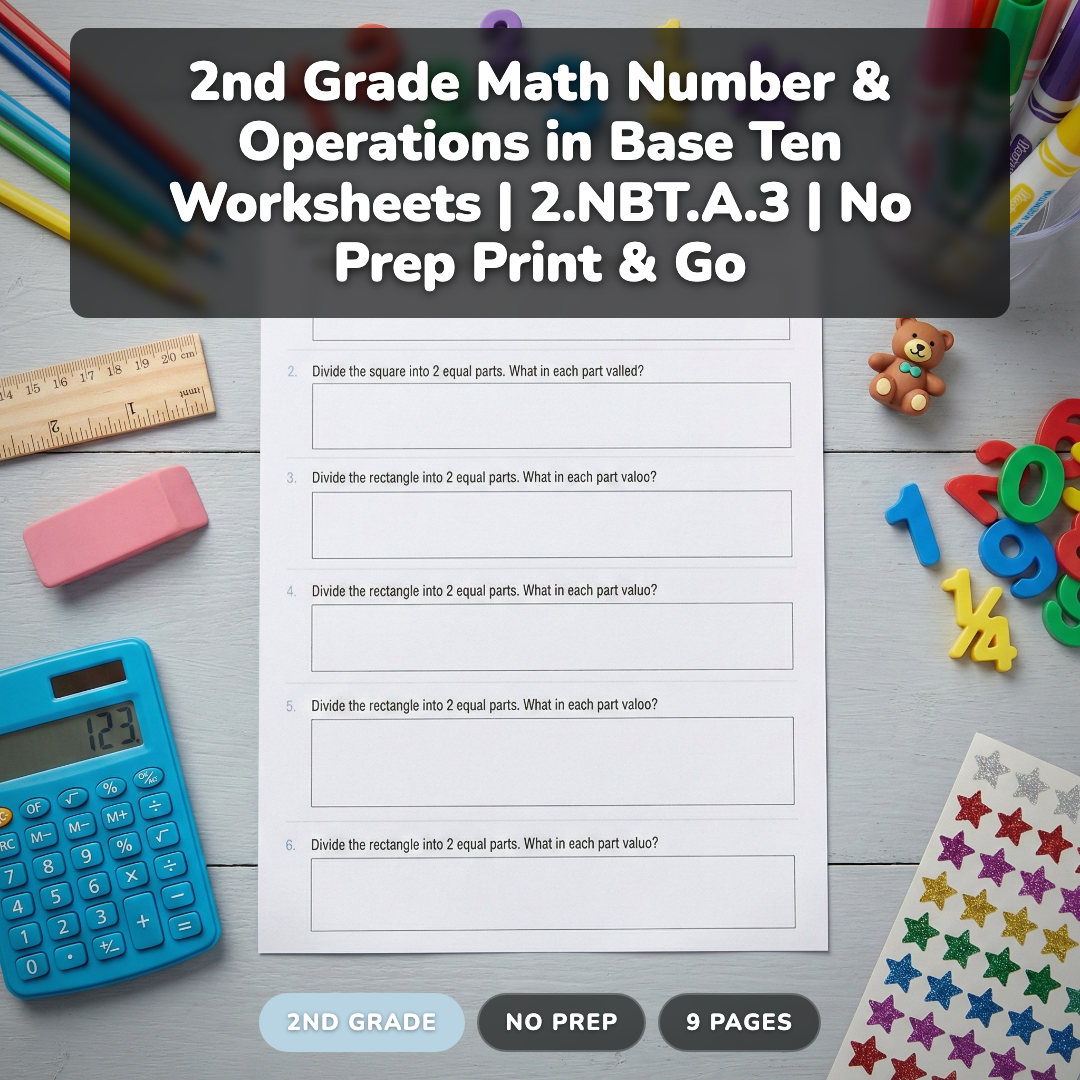
The worksheets are completely no-prep—just print and go. Perfect for morning work, math centers, homework, or assessment preparation.
Grab a Free Place Value Practice Sheet to Try
Want to see the quality before you buy? I’ll send you a free sample worksheet that includes all three difficulty levels plus the answer key. Just drop your email below and I’ll send it right over.
Frequently Asked Questions About Teaching Base Ten
When should students master reading and writing 3-digit numbers?
Most students should master CCSS.Math.Content.2.NBT.A.3 by mid-October of second grade. However, some students need until December to feel confident with all three number forms (standard, expanded, word). Focus on conceptual understanding before speed.
What’s the best way to teach expanded form to struggling students?
Always start with base ten blocks. Show 347 as 3 hundreds blocks, 4 tens rods, and 7 unit cubes. Then write 300 + 40 + 7 directly below the blocks. Students need to see that expanded form represents actual quantities, not just digits.
Should students memorize place value names or understand the concept first?
Understanding comes first. Students should know that the middle digit in a 3-digit number represents groups of ten before memorizing terms like ‘tens place.’ Use language like ‘the tens column’ while building conceptual understanding with manipulatives.
How do I help students who reverse digits when writing numbers?
Use place value mats religiously. When you dictate ‘forty-seven,’ students should place 4 tens rods in the tens column and 7 unit cubes in the ones column before writing any digits. This physical process prevents reversal errors.
What manipulatives work best for teaching base ten concepts?
Traditional base ten blocks are ideal because the size relationships are proportional—a tens rod is actually ten times longer than a unit cube. Avoid using different colored cubes to represent different values since this doesn’t show the mathematical relationship between place values.
Teaching base ten effectively comes down to helping students see the patterns and relationships in our number system. When students understand that each place represents ten times more than the place to its right, they’re ready for advanced math concepts. Remember to keep manipulatives central to your instruction, and don’t rush to abstract symbols before students have solid conceptual understanding.
What’s your favorite strategy for helping students master place value? Try the mystery number activity with your class this week and watch their engagement soar!