If your 2nd graders look confused when you say “100 is ten tens,” you’re not alone. The concept that 100 can be thought of as a bundle of ten tens is one of the most important foundational skills in elementary math — and one of the trickiest to teach. This post breaks down exactly how to make base ten concepts click for your students, with concrete strategies you can use tomorrow.
Key Takeaway
Students master base ten when they physically manipulate groups of tens before moving to abstract number work.
Why Base Ten Matters in 2nd Grade
Understanding that 100 equals ten groups of ten (CCSS.Math.Content.2.NBT.A.1a) forms the foundation for everything your students will do with larger numbers. This isn’t just about counting — it’s about developing number sense that will support addition, subtraction, and place value work for years to come.
Research from the National Council of Teachers of Mathematics shows that students who struggle with grouping concepts in 2nd grade often have difficulty with multi-digit operations in later grades. The timing matters too — this standard typically appears in the first quarter of 2nd grade, right after students have solidified counting to 100.
The CCSS.Math.Content.2.NBT.A.1a standard specifically focuses on the conceptual understanding that 100 is “a bundle of ten tens.” This language is intentional — students need to see 100 not just as a number that comes after 99, but as a collection of ten groups.
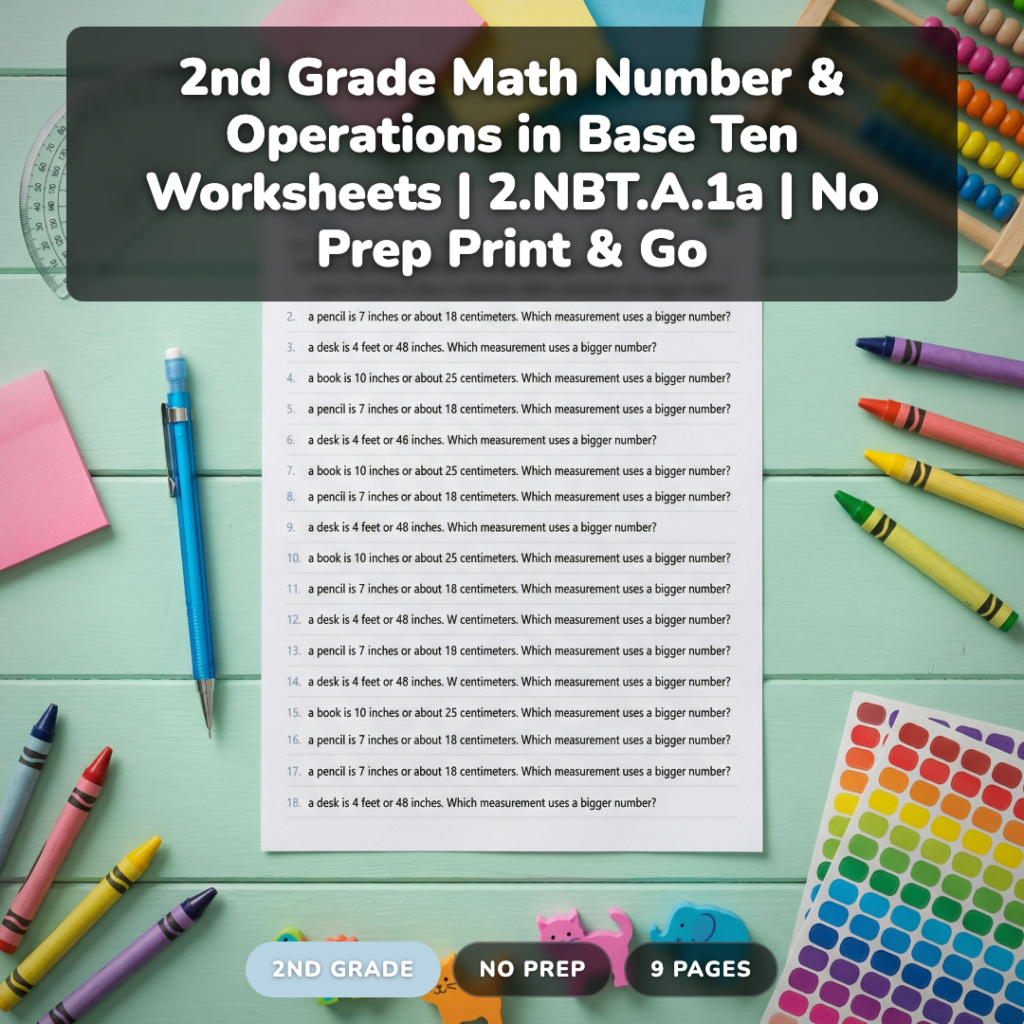
Looking for a ready-to-go resource? I put together a differentiated base ten practice pack with 106 problems across three levels — but first, the teaching strategies that make it work.
Common Base Ten Misconceptions in 2nd Grade
Common Misconception: Students think 100 is just “a really big number” without understanding its structure.
Why it happens: They’ve memorized the counting sequence but haven’t connected it to grouping.
Quick fix: Always pair counting with physical grouping activities using manipulatives.
Common Misconception: Students confuse “ten tens” with “twenty” because they hear “ten” twice.
Why it happens: The language is abstract without visual support.
Quick fix: Use consistent language like “ten groups of ten” while showing physical bundles.
Common Misconception: Students think you need exactly 100 individual objects to make 100.
Why it happens: They haven’t grasped that groups can be counted as single units.
Quick fix: Demonstrate that ten groups of ten objects equals the same amount as 100 individual objects.
Common Misconception: Students believe bigger numbers are always “harder” and shut down.
Why it happens: They lack strategies for working with larger quantities.
Quick fix: Start with smaller groupings (five groups of ten = 50) before moving to 100.
5 Research-Backed Strategies for Teaching Base Ten
Strategy 1: Bundle Building with Craft Sticks
This hands-on approach helps students physically create the “ten tens” that equal 100, making the abstract concept concrete and memorable.
What you need:
- 100 craft sticks per student pair
- Rubber bands
- Small containers or cups
Steps:
- Give each pair 100 loose craft sticks
- Have them count out groups of 10 and bundle each group with a rubber band
- Once they have 10 bundles, count the bundles together: “1 ten, 2 tens, 3 tens…”
- Emphasize: “We have 10 bundles of 10 sticks each. That’s ten tens, which equals 100.”
- Let students unbundle and recount to verify they still have 100 individual sticks
Strategy 2: Base Ten Block Exploration
Using standard base ten blocks helps students visualize the relationship between ones, tens, and hundreds in a systematic way.
What you need:
- Base ten blocks (ones, tens, hundreds)
- Recording sheet with place value charts
- Document camera or interactive whiteboard
Steps:
- Show students one “tens rod” and have them count the individual cubes (10)
- Display 10 tens rods and ask: “How many groups of ten do we have?”
- Arrange the 10 tens rods into a square shape
- Reveal the hundreds flat and show how it matches their arrangement
- Have students trace the outline of 10 tens on the hundreds flat
- Practice the language: “Ten tens equals one hundred”
Strategy 3: The Penny Collection Game
This real-world connection uses money concepts students already understand to reinforce grouping by tens.
What you need:
- 100 pennies per group
- 10 dimes
- 1 dollar bill
- Small cups labeled “groups of 10”
Steps:
- Give students 100 pennies in a pile
- Challenge them to organize the pennies into groups of 10
- Once they have 10 groups, trade each group for a dime
- Count the dimes: “1 dime, 2 dimes… 10 dimes”
- Explain: “10 dimes equals 100 pennies, just like 10 tens equals 100”
- Trade the 10 dimes for a dollar bill to show the complete relationship
Strategy 4: Movement and Grouping
This kinesthetic approach gets students moving while reinforcing the concept that groups can be counted as single units.
What you need:
- Open space (classroom or hallway)
- Hula hoops or rope circles (10 total)
- Index cards numbered 1-100
Steps:
- Place 10 hula hoops around the room
- Give 10 students index cards and have them stand in each hoop
- Point to each hoop and count: “1 group of ten, 2 groups of ten…”
- Have students in each hoop count off 1-10
- Ask the class: “How many students total?” (100)
- Emphasize: “10 groups of 10 students equals 100 students”
Strategy 5: Dot Pattern Recognition
Visual patterns help students recognize groups of ten quickly and understand how they combine to make 100.
What you need:
- Dot pattern cards (10 dots arranged in 2×5 arrays)
- Hundreds chart
- Dry erase markers
Steps:
- Show students a card with 10 dots arranged in a 2×5 pattern
- Have them identify this as “one group of ten”
- Display 10 cards and arrange them in a 10×10 grid
- Count by tens: “10, 20, 30, 40, 50, 60, 70, 80, 90, 100”
- Circle each group of ten on a hundreds chart
- Connect the visual: “10 groups of 10 dots equals 100 dots”
How to Differentiate Base Ten for All Learners
For Students Who Need Extra Support
Start with smaller numbers and more concrete manipulatives. Use 5 groups of ten (50) before attempting 10 groups of ten (100). Provide individual counting bears or cubes so students can physically move objects into groups. Review counting by tens to 50 before extending to 100. Use consistent language and repeat the same activities multiple times with different materials.
For On-Level Students
Focus on the standard expectation: understanding that 100 equals ten groups of ten. Use a variety of manipulatives and representations. Practice both building 100 from ten groups and breaking 100 into ten groups. Connect to place value concepts and begin introducing the hundreds place on a place value chart. Encourage students to explain their thinking using mathematical language.
For Students Ready for a Challenge
Extend beyond 100 to explore patterns with larger numbers. Ask: “If 10 tens equal 100, what would 20 tens equal?” Introduce the concept that 1,000 equals ten hundreds. Connect to real-world applications like counting large collections or understanding how money works in larger amounts. Have them create their own grouping problems for classmates to solve.
A Ready-to-Use Base Ten Resource for Your Classroom
After teaching these concepts, students need plenty of practice to solidify their understanding. That’s where targeted, differentiated practice becomes essential.
I’ve created a comprehensive base ten worksheet pack that includes 106 problems across three differentiation levels. The practice level (30 problems) focuses on basic grouping with visual supports. The on-level section (40 problems) targets grade-level expectations with varied representations. The challenge level (36 problems) pushes students to apply their understanding in new contexts.
What makes this resource different is the careful scaffolding — each level builds conceptual understanding before moving to abstract work. All worksheets include answer keys and can be used for independent practice, math centers, or homework.
The complete pack covers everything from basic ten-grouping to complex hundred-building activities, saving you hours of prep time while ensuring every student gets appropriate practice.
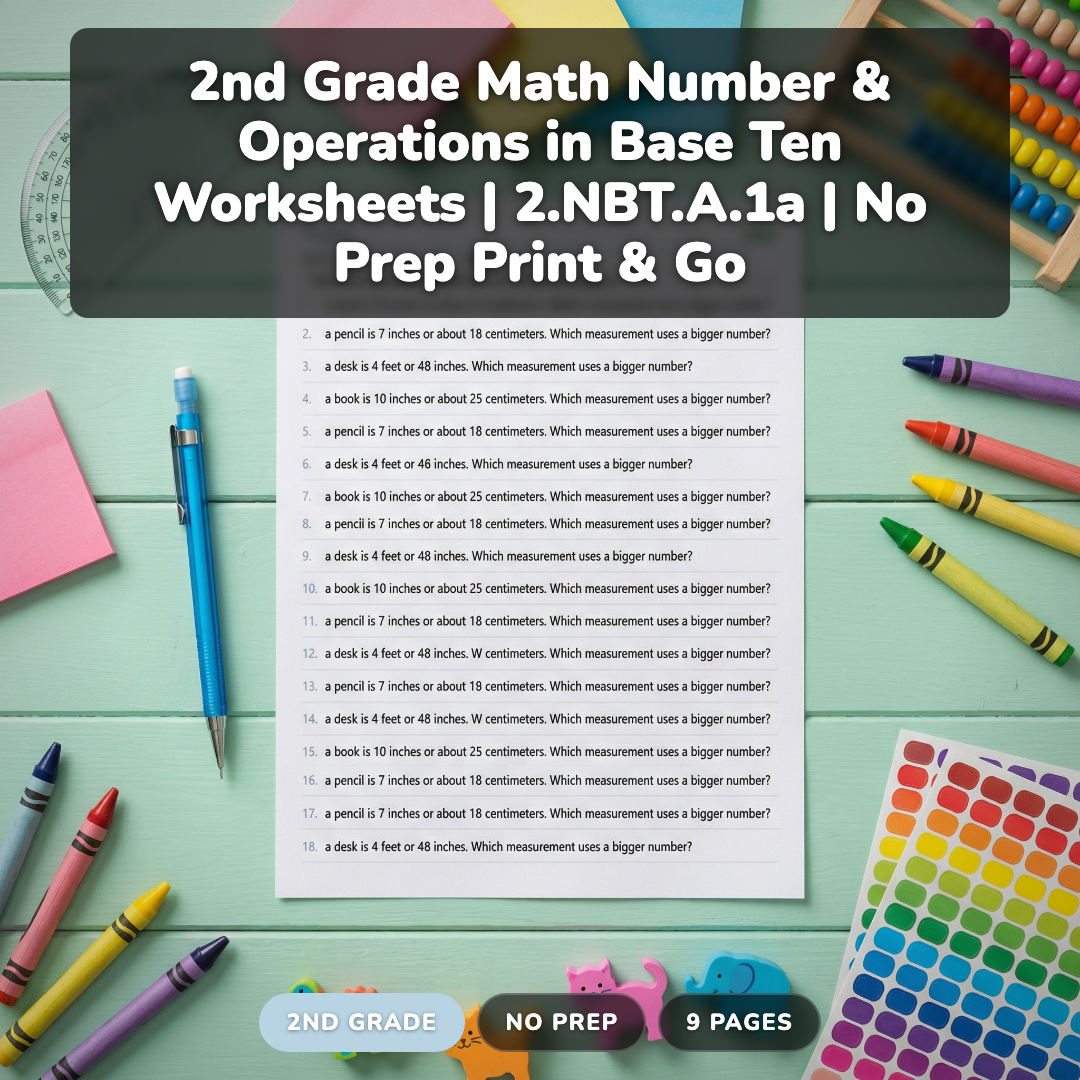
Grab a Free Base Ten Practice Sheet to Try
Want to see how these strategies work in practice? I’ll send you a free sample worksheet that includes problems from each differentiation level, plus a quick reference guide for teaching base ten concepts.
Frequently Asked Questions About Teaching Base Ten
When should I introduce the concept that 100 equals ten tens?
Introduce this concept after students can confidently count to 100 and understand basic grouping by tens. Most 2nd graders are ready for CCSS.Math.Content.2.NBT.A.1a in the first quarter, typically September or October, once they’ve mastered counting patterns.
What manipulatives work best for teaching base ten concepts?
Base ten blocks are ideal because they show the visual relationship clearly. Craft sticks with rubber bands, counting bears in cups, and pennies/dimes also work well. The key is using materials students can physically group and regroup to see the ten-to-one relationship.
How do I help students who confuse “ten tens” with twenty?
Use visual supports and consistent language. Say “ten groups of ten” while showing ten bundles of ten objects. Have students count the groups (1 group, 2 groups, 3 groups…) then count by tens within each group. Physical manipulation prevents the language confusion.
Should students memorize that 10 tens equals 100?
Understanding comes before memorization. Students should first build the concept through hands-on activities, then practice until the relationship becomes automatic. Memorization without understanding leads to confusion with larger numbers and place value concepts later.
How does this standard connect to other 2nd grade math concepts?
Base ten understanding supports place value work (CCSS.Math.Content.2.NBT.A.1), two-digit addition and subtraction, and counting patterns. It’s foundational for understanding that digits in different positions have different values — the “1” in 100 represents one hundred, not one.
Making Base Ten Stick
The key to teaching base ten successfully is giving students multiple ways to experience the concept that 100 equals ten groups of ten. When students can build it, see it, and explain it, they own the understanding that will support their math learning for years to come.
What’s your favorite strategy for helping students understand base ten concepts? Try the free practice sheet above and let me know how these approaches work in your classroom!
Don’t forget to grab your free base ten practice sheet — it’s a great way to see these strategies in action with your students.