If your second graders freeze when they see a word problem about buying lunch with a $5 bill, you’re not alone. Teaching money skills combines multiple complex concepts — coin values, addition, subtraction, and decimal notation — that can overwhelm young learners. You need concrete strategies that break down these skills into manageable steps while keeping students engaged.
Key Takeaway
Successful money instruction starts with hands-on coin manipulation before moving to abstract word problems and decimal notation.
Why Money Skills Matter in Second Grade
Money concepts in second grade serve as a critical bridge between basic counting and more advanced decimal work in third grade. According to CCSS.Math.Content.2.MD.C.8, students must solve word problems involving dollar bills, quarters, dimes, nickels, and pennies while using $ and ¢ symbols appropriately.
Research from the National Council of Teachers of Mathematics shows that students who master coin recognition and counting in second grade perform 23% better on fraction concepts in third grade. This connection exists because both skills require understanding part-whole relationships and place value concepts.
The timing matters too. Second graders typically encounter money skills in the spring semester, after they’ve solidified two-digit addition and subtraction. This allows them to focus on the unique challenges of money notation and real-world problem solving without struggling with basic computation.
Looking for a ready-to-go resource? I put together a differentiated money practice pack that covers everything below — but first, the teaching strategies that make it work.
Common Money Misconceptions in Second Grade
Common Misconception: Students think a nickel is worth more than a dime because it’s physically larger.
Why it happens: Young children naturally associate size with value from their everyday experiences.
Quick fix: Use the phrase “small but mighty” for dimes and practice sorting by value, not size.
Common Misconception: Students count coins by ones instead of using coin values (counting 3 dimes as “1, 2, 3” instead of “10, 20, 30”).
Why it happens: They apply familiar counting-by-ones strategies to unfamiliar objects.
Quick fix: Teach the “coin chant” — quarters say “25,” dimes say “10,” nickels say “5,” pennies say “1.”
Common Misconception: Students write 67 cents as “67$” instead of “67¢” or “$0.67.”
Why it happens: They see the dollar sign more frequently and assume it works for all money amounts.
Quick fix: Use the rule “cents symbol for under a dollar, dollar sign for a dollar or more.”
Common Misconception: Students struggle to make change because they don’t understand “counting up” from the purchase price.
Why it happens: Making change requires working backward, which contradicts their forward-counting experience.
Quick fix: Practice “counting up” with number lines before introducing money problems.
5 Research-Backed Strategies for Teaching Money Skills
Strategy 1: Coin Value Chant with Movement
Students learn coin values through repetitive chanting paired with physical movements that reinforce the value differences.
What you need:
- Large coin posters or real coins
- Open floor space
- Rhythm instruments (optional)
Steps:
- Teach the chant: “Quarter, quarter, 25! Dime, dime, 10! Nickel, nickel, 5! Penny, penny, 1!”
- Add movements: 25 jumping jacks for quarters, 10 toe touches for dimes, 5 arm circles for nickels, 1 clap for pennies
- Practice daily for 2-3 minutes until automatic
- Gradually remove the movements, keeping only the chant
- Test recognition by showing coins randomly and having students chant the value
Strategy 2: Real-World Shopping Centers
Students practice money skills through role-playing activities that mirror actual shopping experiences they encounter outside school.
What you need:
- Play money or coin manipulatives
- Small classroom items with price tags (erasers, stickers, etc.)
- Cash register or calculator
- Shopping bags or baskets
Steps:
- Set up 3-4 “stores” around the classroom with items priced between 25¢ and $1.00
- Give each student a specific amount of money (like $2.00)
- Students rotate through stores, deciding what they can afford
- Practice making exact change and counting money received
- Debrief by discussing strategies for counting money quickly
Strategy 3: Money Number Lines for Problem Solving
Students use specialized number lines marked in coin increments to visualize addition and subtraction with money amounts.
What you need:
- Number lines marked in 5¢ or 10¢ increments
- Coin manipulatives
- Word problem cards
- Individual whiteboards
Steps:
- Model how to “hop” by coin values on the number line (quarters = 4 hops of 5, etc.)
- Start with simple addition: “I have 35¢. I find a dime. How much do I have now?”
- Students place coins above the number line and hop to find totals
- Progress to subtraction: “I had 85¢. I spent 30¢. How much is left?”
- Connect to written problems by having students draw their hops
Strategy 4: Coin Combination Challenges
Students explore multiple ways to make the same money amount, building flexibility with coin relationships and preparing them for making change.
What you need:
- Sets of coins for each student
- Recording sheets
- Target amount cards
- Timer (optional)
Steps:
- Give students a target amount like 47¢
- Challenge them to find 3 different coin combinations that equal this amount
- Students record each combination using pictures or symbols
- Share strategies and discuss which combination uses the fewest coins
- Progress to “making change” scenarios where they find the difference
Strategy 5: Money Symbol Detective Work
Students become “detectives” who identify and correct money notation errors, building awareness of proper $ and ¢ symbol usage.
What you need:
- Sample problems with notation errors
- Red pens for corrections
- Magnifying glasses (optional, for fun)
- Detective badges or hats
Steps:
- Present problems with common errors: “The toy costs 50$ and 25¢”
- Students identify what’s wrong and explain the correct notation
- Create a class “rule book” for money symbols
- Students write their own “tricky” problems for classmates to solve
- Practice switching between cents notation (67¢) and dollar notation ($0.67)
How to Differentiate Money Skills for All Learners
For Students Who Need Extra Support
Start with penny and dime recognition since these follow the base-10 pattern students already know. Use real coins whenever possible — the tactile experience helps with memory. Focus on exact-change scenarios before introducing “making change” concepts. Provide hundreds charts to support skip-counting by 10s and 5s. Break word problems into smaller steps, solving for the total cost first, then determining if there’s enough money.
For On-Level Students
Students at grade level should master all four coin types and their combinations by spring. They need practice with CCSS.Math.Content.2.MD.C.8 word problems involving multiple coins and simple change-making. Focus on problems with totals under $1.00 initially, then extend to amounts like $1.25. Emphasize both ¢ and $ notation, helping students choose the appropriate symbol for different amounts.
For Students Ready for a Challenge
Advanced students can work with dollar bills combined with coins, solving problems that require regrouping (like making change from $5.00). Introduce them to rounding money amounts to the nearest 5¢ or 10¢. Challenge them with multi-step problems: “Buy 3 items, calculate tax, determine change.” Connect money skills to real-world scenarios like calculating tips or comparing prices per unit.
A Ready-to-Use Money Skills Resource for Your Classroom
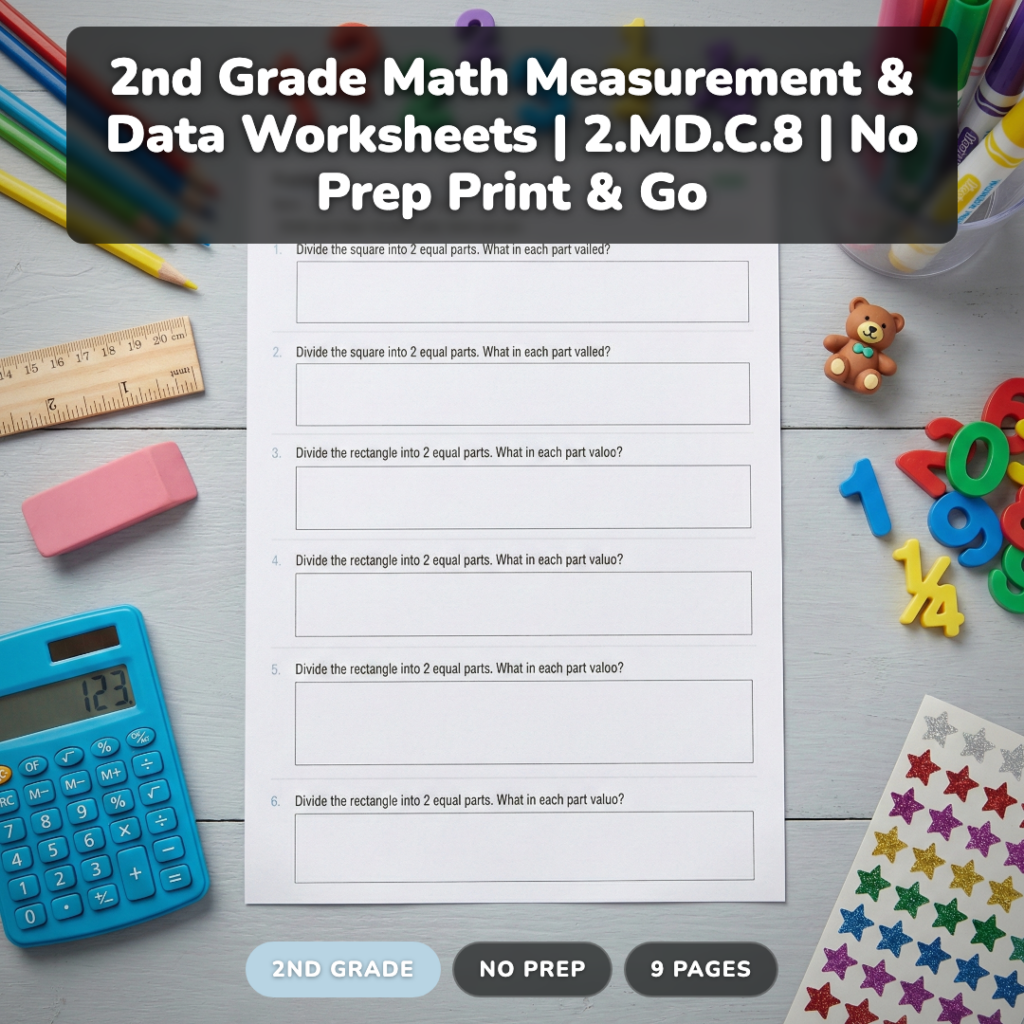
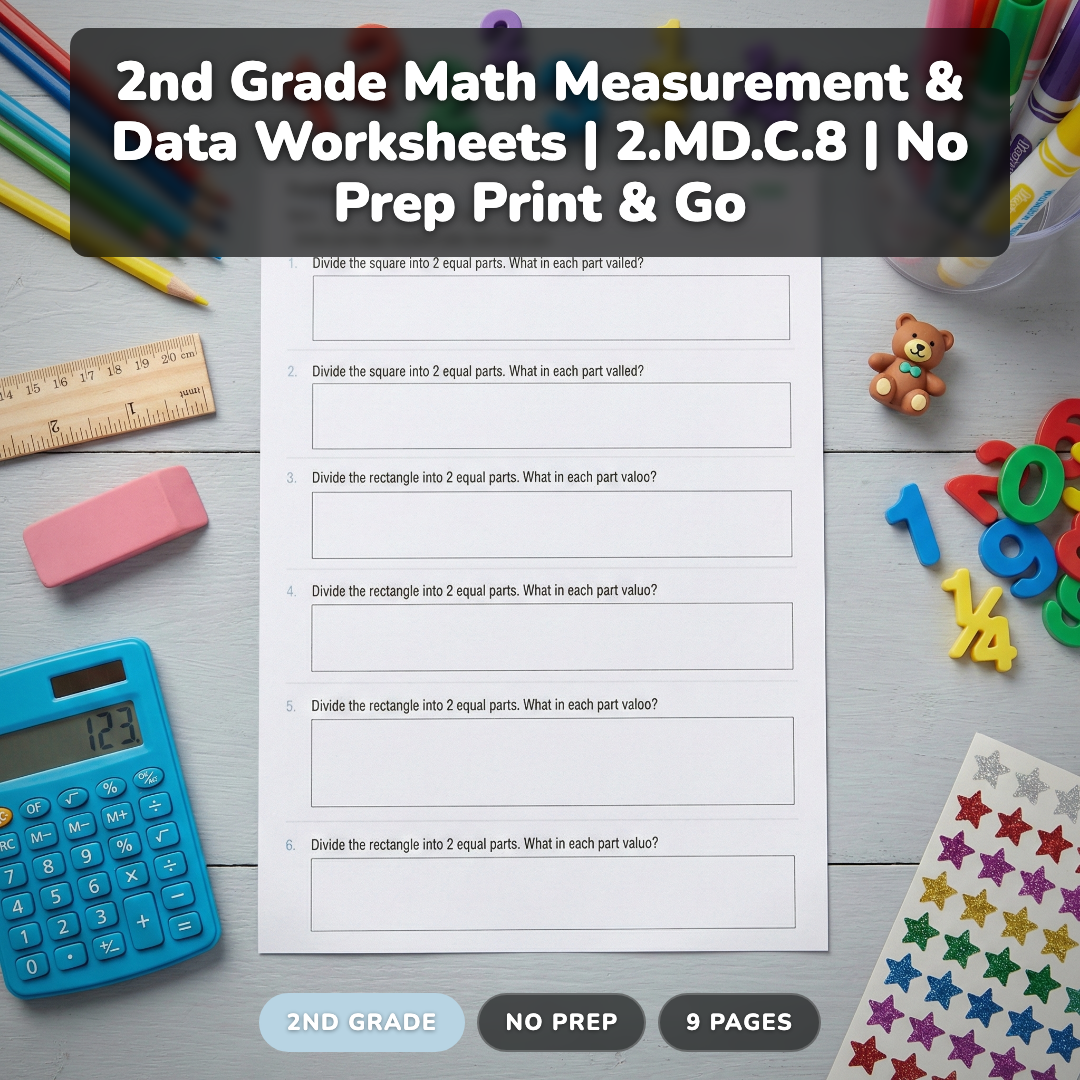
After years of creating money worksheets from scratch, I developed a comprehensive practice pack that addresses every aspect of CCSS.Math.Content.2.MD.C.8. This resource includes 106 carefully crafted problems across three difficulty levels, ensuring every student gets appropriate practice.
The Practice level (30 problems) focuses on coin recognition and simple combinations. On Level worksheets (40 problems) tackle grade-appropriate word problems with multiple coins and basic change scenarios. The Challenge level (36 problems) extends learning with complex multi-step problems and mixed dollar-cent notation.
What makes this different from other money worksheets is the careful progression and real-world contexts. Problems feature familiar scenarios like school lunch, toy purchases, and saving money — situations your students actually encounter. Each level includes complete answer keys and teaching notes for quick implementation.
The 9-page pack saves hours of prep time while ensuring your students get differentiated practice that meets them exactly where they are.
Grab a Free Money Skills Sample to Try
Want to see how these differentiated worksheets work in your classroom? I’ll send you a free sample pack with problems from each level, plus my coin value anchor chart that students love.
Frequently Asked Questions About Teaching Money Skills
When should I introduce decimal notation for money amounts?
Introduce decimal notation after students master coin values and can count mixed coin combinations fluently. Most second graders are ready for simple decimal notation (like $0.47) in late spring, but focus on cent notation (47¢) for most of the year.
Should I use real coins or play money for instruction?
Real coins are more effective for initial learning because the size, weight, and texture differences help students distinguish between coin types. Switch to play money for games and activities where coins might get lost or damaged.
How do I help students who struggle with skip counting for coin values?
Start with dimes only since students can count by 10s. Once automatic, add quarters using the “count by 25s” pattern. Practice skip counting without coins first, then connect the counting pattern to the physical coins during hands-on activities.
What’s the most common mistake students make with money word problems?
Students often add coin quantities instead of coin values — counting 2 dimes and 3 pennies as 5 instead of 23¢. Emphasize that each coin “says” its value, not just “1,” when counting collections.
How can I connect money skills to other math concepts?
Money naturally reinforces place value (dollars = tens place, cents = ones place), addition and subtraction strategies, and early fraction concepts (quarters = 1/4 of a dollar). Use money problems to practice these skills simultaneously rather than in isolation.
Teaching money skills successfully comes down to making abstract concepts concrete through hands-on practice and real-world connections. When students can confidently count coins, solve word problems, and use proper notation, they’re building essential life skills alongside mathematical understanding.
What’s your biggest challenge when teaching money concepts? Try the free sample worksheets above and see how differentiated practice can support every learner in your classroom.
Remember to grab your free money skills sample — it includes problems from all three levels plus the anchor chart that makes coin values stick.