If your second graders confuse squares with diamonds or think all four-sided shapes are squares, you’re not alone. Teaching geometry to 7 and 8-year-olds requires moving beyond simple shape recognition to understanding attributes — and that’s where many students get stuck. You’ll discover five research-backed strategies that help students master CCSS.Math.Content.2.G.A.1 while building a strong foundation for future geometry learning.
Key Takeaway
Second graders learn geometry best through hands-on exploration of shape attributes rather than memorizing shape names.
Why 2nd Grade Geometry Matters More Than You Think
Second grade geometry forms the foundation for spatial reasoning skills that students will use throughout their mathematical journey. Research from the National Council of Teachers of Mathematics shows that students who develop strong geometric thinking in elementary school perform 23% better on standardized math assessments in middle school.
The CCSS.Math.Content.2.G.A.1 standard requires students to recognize and draw shapes with specific attributes — not just identify them by appearance. This means students must understand that a triangle has three sides and three angles, regardless of its orientation or size. They also need to identify three-dimensional shapes like cubes by counting faces, edges, and vertices.
This standard typically appears in the spring semester, after students have mastered basic addition and subtraction. It connects directly to measurement standards and prepares students for third-grade work with area and perimeter. Students should spend 2-3 weeks on intensive geometry instruction, with ongoing review throughout the year.
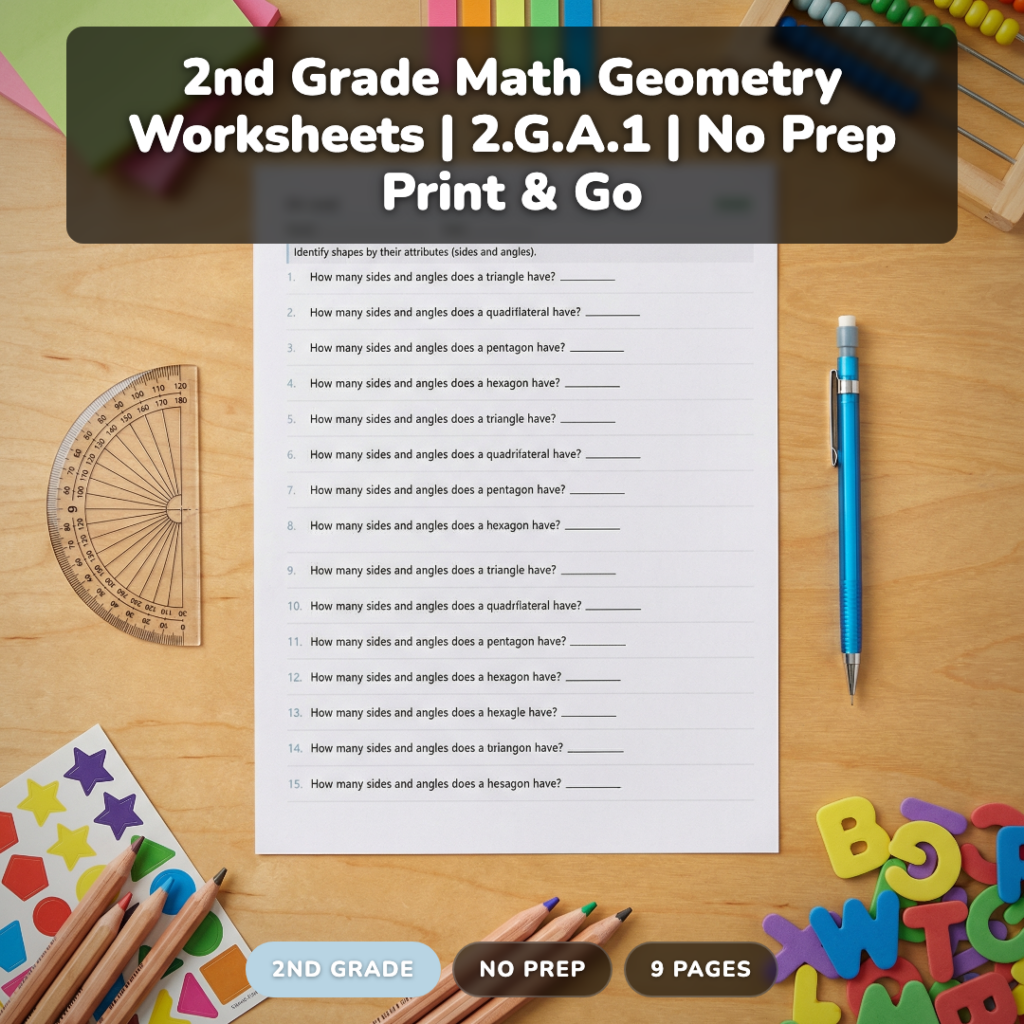
Looking for a ready-to-go resource? I put together a differentiated 2nd grade geometry pack with 106 problems across three levels — but first, the teaching strategies that make it work.
Common Geometry Misconceptions in 2nd Grade
Common Misconception: Students think rotated squares are diamonds or different shapes entirely.
Why it happens: They rely on visual orientation rather than counting sides and angles.
Quick fix: Rotate shapes physically while students count attributes together.
Common Misconception: All four-sided shapes are squares or rectangles.
Why it happens: Limited exposure to irregular quadrilaterals in their environment.
Quick fix: Show trapezoids, parallelograms, and irregular quadrilaterals early and often.
Common Misconception: Confusing faces, edges, and vertices on 3D shapes.
Why it happens: Abstract vocabulary without concrete manipulation experience.
Quick fix: Use physical objects and finger-pointing while naming each attribute.
Common Misconception: Thinking size determines shape classification.
Why it happens: Focusing on overall appearance rather than geometric properties.
Quick fix: Show the same shape in multiple sizes and orientations simultaneously.
5 Research-Backed Strategies for Teaching 2nd Grade Geometry
Strategy 1: Attribute Detective with Shape Sorting
Students become geometry detectives, sorting shapes based on specific attributes rather than names. This builds the foundation for understanding that shapes are defined by their properties, not their appearance or orientation.
What you need:
- Mixed collection of 2D shapes in various sizes and orientations
- Sorting mats or hula hoops
- Magnifying glasses (optional but engaging)
Steps:
- Give each student 8-10 mixed shapes without naming them
- Call out one attribute: “Find all shapes with exactly 4 sides”
- Students sort shapes into groups, explaining their choices
- Rotate through different attributes: number of angles, curved vs. straight sides
- End by having students create their own sorting rule for partners to guess
Strategy 2: Shape Building with Everyday Materials
Students construct shapes using manipulatives, which helps them internalize the relationship between sides, angles, and vertices. Building shapes is more effective than just identifying them because it requires understanding geometric properties.
What you need:
- Craft sticks or straws for sides
- Play-doh or pipe cleaners for vertices
- Geoboards with rubber bands
- Pattern blocks
Steps:
- Start with triangles: “Use exactly 3 sticks to build a shape”
- Students build, then count sides and vertices together
- Progress to quadrilaterals, pentagons, and hexagons
- Challenge: “Can you build a quadrilateral that’s not a square or rectangle?”
- Students share their creations and explain the attributes
Strategy 3: 3D Shape Scavenger Hunt with Real Objects
Students explore three-dimensional shapes by finding real-world examples and analyzing their faces, edges, and vertices. This concrete experience makes abstract geometric vocabulary meaningful and memorable.
What you need:
- Collection of 3D objects (dice, boxes, balls, cans, pyramids)
- Recording sheets for counting attributes
- Classroom items for scavenger hunt
Steps:
- Introduce vocabulary with a cube: trace faces, run fingers along edges, point to vertices
- Students hunt for cube-shaped objects in the classroom
- Record findings: “This die has 6 faces, 12 edges, 8 vertices”
- Expand to other 3D shapes: spheres, cylinders, pyramids
- Create a class chart comparing different 3D shapes
Strategy 4: Shape Art Gallery with Drawing Practice
Students create artwork using specific geometric shapes, then describe their creations using mathematical vocabulary. This strategy combines creativity with geometric precision, making learning memorable and personally meaningful.
What you need:
- Drawing paper and colored pencils
- Shape templates for tracing (optional)
- Gallery walk recording sheets
Steps:
- Assign each student a shape focus: “Create a picture using at least 5 triangles”
- Students draw and color their geometric artwork
- Gallery walk: students view artwork and identify shapes used
- Artists present their work: “I used 7 triangles, 3 rectangles, and 1 hexagon”
- Class votes on most creative use of each shape type
Strategy 5: Geometry Movement Game
Students use their bodies to form shapes and act out geometric concepts. Movement-based learning helps kinesthetic learners while reinforcing shape attributes through physical experience.
What you need:
- Open space for movement
- Shape cards for reference
- Music for transitions (optional)
Steps:
- Start with individual shapes: “Make your body into a triangle”
- Progress to partner shapes: “Work together to form a square”
- Small groups create pentagons and hexagons
- Call out attributes: “Form a shape with exactly 4 vertices”
- End with 3D shapes: groups form cube corners or sphere huddles
How to Differentiate 2nd Grade Geometry for All Learners
For Students Who Need Extra Support
Begin with concrete manipulatives before moving to abstract representations. Provide shape templates for tracing and focus on one attribute at a time. Use consistent vocabulary and visual cues like color-coding different shape types. Review basic counting skills if students struggle with counting sides or vertices. Pair struggling students with geometry-confident partners for peer support.
For On-Level Students
Students work with a variety of shapes in different orientations and sizes. They should be able to identify triangles, quadrilaterals, pentagons, and hexagons by counting attributes, not just visual recognition. Include both regular and irregular examples of each shape type. Students should draw shapes accurately and explain their geometric properties using mathematical vocabulary.
For Students Ready for a Challenge
Introduce more complex polygons like heptagons and octagons. Explore the relationship between 2D and 3D shapes (squares are faces of cubes). Have students create their own shape classification systems or investigate why certain combinations of sides and angles are impossible. Connect geometry to real-world architecture and design projects.
A Ready-to-Use 2nd Grade Geometry Resource for Your Classroom
Teaching geometry effectively requires the right balance of practice problems across different difficulty levels. You need worksheets that reinforce shape attributes without becoming repetitive busywork, plus activities that challenge advanced learners while supporting struggling students.
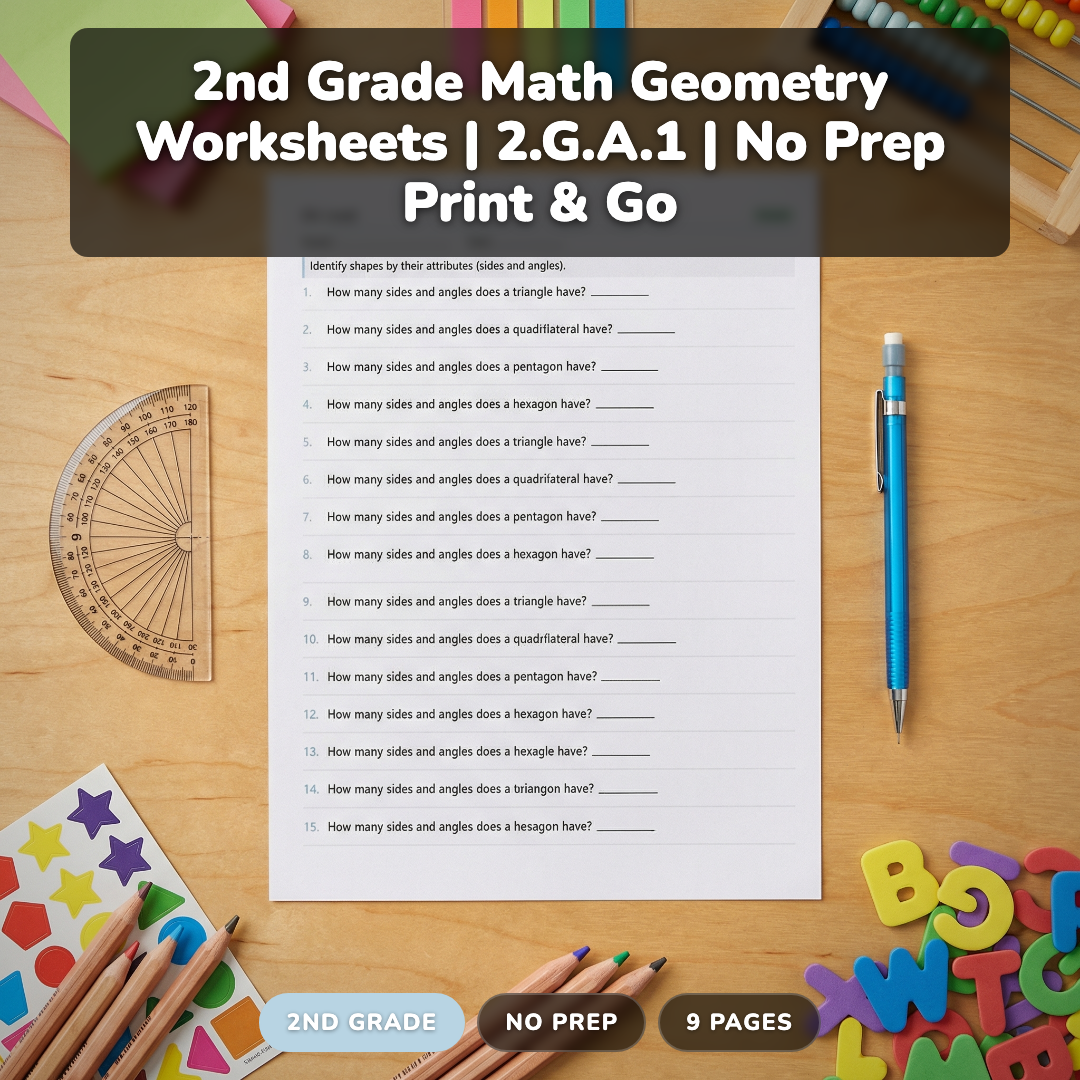
This comprehensive geometry pack includes 106 carefully crafted problems across three differentiation levels. The Practice level focuses on basic shape recognition and counting attributes. On-Level problems require students to draw shapes with specific properties and solve multi-step geometry challenges. The Challenge level introduces irregular polygons and real-world applications.
What makes this resource different is the systematic progression from concrete to abstract thinking. Each level includes visual supports, clear directions, and answer keys that explain common student errors. The problems align directly with CCSS.Math.Content.2.G.A.1 while preparing students for third-grade geometry standards.
Nine ready-to-print pages save you hours of prep time while ensuring every student gets appropriately challenging practice. The differentiated format means you can meet individual needs without creating separate lesson plans.
Grab a Free Geometry Sample to Try
Want to see how these differentiated geometry problems work in your classroom? I’ll send you a free sample pack with problems from each level, plus my shape attribute anchor chart that students love. Drop your email below and I’ll send it right over.
Frequently Asked Questions About Teaching 2nd Grade Geometry
When should I teach 2nd grade geometry during the school year?
Most teachers introduce geometry in late winter or early spring, after students master addition and subtraction facts. This timing allows 2-3 weeks of focused instruction while connecting to measurement units. Plan ongoing review through math centers and morning work.
How do I help students who confuse squares and diamonds?
Use physical rotation activities where students turn square objects while counting sides and angles. Emphasize that orientation doesn’t change a shape’s properties. Practice with squares in multiple positions daily until recognition becomes automatic across all orientations.
What’s the difference between teaching shape names versus attributes?
CCSS.Math.Content.2.G.A.1 focuses on attributes over names. Students should identify shapes by counting sides, angles, and vertices rather than memorizing visual patterns. This builds deeper understanding for future geometry learning and problem-solving.
How much time should I spend on 3D shapes versus 2D shapes?
Spend roughly 60% of time on 2D shapes and 40% on 3D shapes. Students need extensive practice with polygons since they appear more frequently in later math. However, 3D shape exploration builds spatial reasoning essential for future geometry success.
What if students struggle with geometry vocabulary like vertices and edges?
Introduce one term at a time with physical demonstrations. Use consistent hand gestures and visual cues. Practice vocabulary daily through games and songs. Connect to familiar words: vertices are “corners,” edges are “sides” of 3D shapes.
Teaching second grade geometry successfully comes down to helping students see shapes as collections of attributes rather than visual patterns. When students understand that a triangle always has three sides and three angles regardless of size or orientation, they’ve built the foundation for all future geometric thinking.
What’s your biggest challenge when teaching geometry to second graders? Remember to grab your free sample pack above — it includes my favorite shape sorting activity that students ask to repeat every year.