If your first graders are memorizing math facts without understanding why 3 + 2 equals 2 + 3, they’re missing a crucial foundation. Teaching the properties of operations isn’t just about addition and subtraction — it’s about building number sense that will support your students through years of mathematics ahead.
Key Takeaway
First graders learn addition and subtraction properties best through hands-on exploration, visual models, and repeated practice with concrete examples before moving to abstract thinking.
Why Operations Properties Matter in First Grade
The CCSS.Math.Content.1.OA.B.3 standard asks first graders to apply properties of operations as strategies to add and subtract. This means students learn that addition is commutative (3 + 2 = 2 + 3), that adding zero doesn’t change a number, and that subtraction has an inverse relationship with addition.
Research from the National Research Council shows that students who understand these properties early perform 23% better on standardized assessments by third grade. These concepts typically appear in your curriculum between October and February, building on basic addition and subtraction fluency.
The timing matters because students need solid counting skills and number recognition before they can grasp why switching addends doesn’t change the sum. Most first graders develop this understanding through repeated exposure to concrete examples rather than abstract explanations.
Looking for a ready-to-go resource? I put together a differentiated operations practice pack that covers everything below — but first, the teaching strategies that make it work.
Common Operations Misconceptions in First Grade
Common Misconception: Students think 5 – 3 and 3 – 5 give the same answer.
Why it happens: They overgeneralize the commutative property from addition.
Quick fix: Use physical objects to show subtraction as “taking away” — you can’t take 5 from 3 blocks.
Common Misconception: Adding zero makes numbers bigger because “you’re adding something.”
Why it happens: Students focus on the action word “adding” rather than the quantity being added.
Quick fix: Use empty containers or zero manipulatives to show that adding “nothing” changes nothing.
Common Misconception: Students memorize that “addition and subtraction are opposites” without understanding what that means.
Why it happens: They hear the rule but haven’t experienced it concretely.
Quick fix: Use the same manipulatives to build up (addition) then break down (subtraction) the same number story.
5 Research-Backed Strategies for Teaching Operations Properties
Strategy 1: Twin Number Stories with Manipulatives
Students explore the commutative property by acting out the same story with switched addends. This concrete approach helps them see that order doesn’t matter in addition.
What you need:
- Two-color counters or beans
- Small paper plates
- Number story cards
Steps:
- Tell a story: “3 red birds and 2 blue birds sit on a fence.”
- Students place 3 red counters and 2 blue counters on their plate
- Count together: “3 + 2 = 5 birds total”
- Retell with switched colors: “2 blue birds and 3 red birds sit on a fence”
- Students rearrange the same counters: 2 blue, then 3 red
- Count again: “2 + 3 = 5 birds total”
- Ask: “What do you notice about both stories?”
Strategy 2: Zero the Hero Visual Models
Students understand the identity property of addition through dramatic play and visual representations that make “adding nothing” concrete and memorable.
What you need:
- Empty containers or boxes
- Counting bears or blocks
- “Zero the Hero” character card
- Ten frames
Steps:
- Introduce “Zero the Hero” who has special powers — he doesn’t change anything
- Show 4 bears in a ten frame
- Bring out an empty container: “Zero the Hero brings 0 more bears”
- Add the empty container’s contents (nothing) to the ten frame
- Count: “4 + 0 = 4. Zero the Hero didn’t change our number!”
- Try with different starting numbers
- Let students predict what happens before revealing
Strategy 3: Build and Break Number Bonds
Students use the same manipulatives to create addition problems, then immediately model the related subtraction, making the inverse relationship visible and tactile.
What you need:
- Unifix cubes or snap blocks
- Number bond mats
- Recording sheets
Steps:
- Students build a tower of 6 cubes using two colors (like 4 red + 2 blue)
- Record the addition: “4 + 2 = 6”
- Break the tower at the color change
- Remove one color group: “6 – 4 = 2”
- Put it back and remove the other group: “6 – 2 = 4”
- Discuss: “Addition builds up, subtraction breaks down the same numbers”
- Try with different number combinations
Strategy 4: Commutative Property Dance
Students use movement and music to internalize that addition order doesn’t matter, creating a memorable kinesthetic experience that reinforces the mathematical concept.
What you need:
- Number cards (1-10)
- Plus and equals signs
- Open floor space
- Optional: simple background music
Steps:
- Three students hold cards to make an equation (like 3 + 5 = 8)
- The class reads the equation aloud together
- The two addend students “dance” (switch places) while the sum stays put
- Now they show 5 + 3 = 8
- Class reads the new equation
- Discuss: “The dancers switched, but the answer stayed the same!”
- Rotate students through different equations
Strategy 5: Properties Detective Game
Students become mathematical detectives, hunting for examples of operations properties in their daily math work and real-world situations.
What you need:
- Detective badges or magnifying glasses
- “Evidence” recording sheets
- Math problems from various sources
- Classroom objects for counting
Steps:
- Introduce the three “cases” detectives will solve: Commutative Property, Identity Property, Inverse Operations
- Give students detective tools and recording sheets
- Present mixed math problems and real situations
- Students identify which property each example shows
- Record their “evidence” with drawings and numbers
- Share findings during a “detective debrief”
- Celebrate successful property identification
How to Differentiate Operations Properties for All Learners
For Students Who Need Extra Support
Focus on numbers 0-5 initially, using physical manipulatives for every problem. Provide visual cue cards showing each property with pictures. Practice one property at a time for several days before introducing the next. Use consistent language and gestures for each property. Pair struggling students with math buddies during activities.
For On-Level Students
Work with numbers 0-10, balancing concrete manipulatives with visual representations like ten frames and number lines. Students should recognize and apply all three properties within the CCSS.Math.Content.1.OA.B.3 standard. Encourage verbal explanations of their thinking. Provide independent practice with varied problem formats.
For Students Ready for a Challenge
Extend to numbers beyond 10, introduce three-addend problems (2 + 3 + 1), and explore properties in subtraction contexts. Challenge students to create their own property examples or teach younger students. Connect to skip counting patterns and early multiplication concepts. Provide open-ended problem-solving opportunities.
A Ready-to-Use Operations Properties Resource for Your Classroom
Teaching these concepts takes significant prep time — creating differentiated worksheets, finding the right balance of visual and abstract problems, and ensuring you’re hitting all the property types your students need to master.
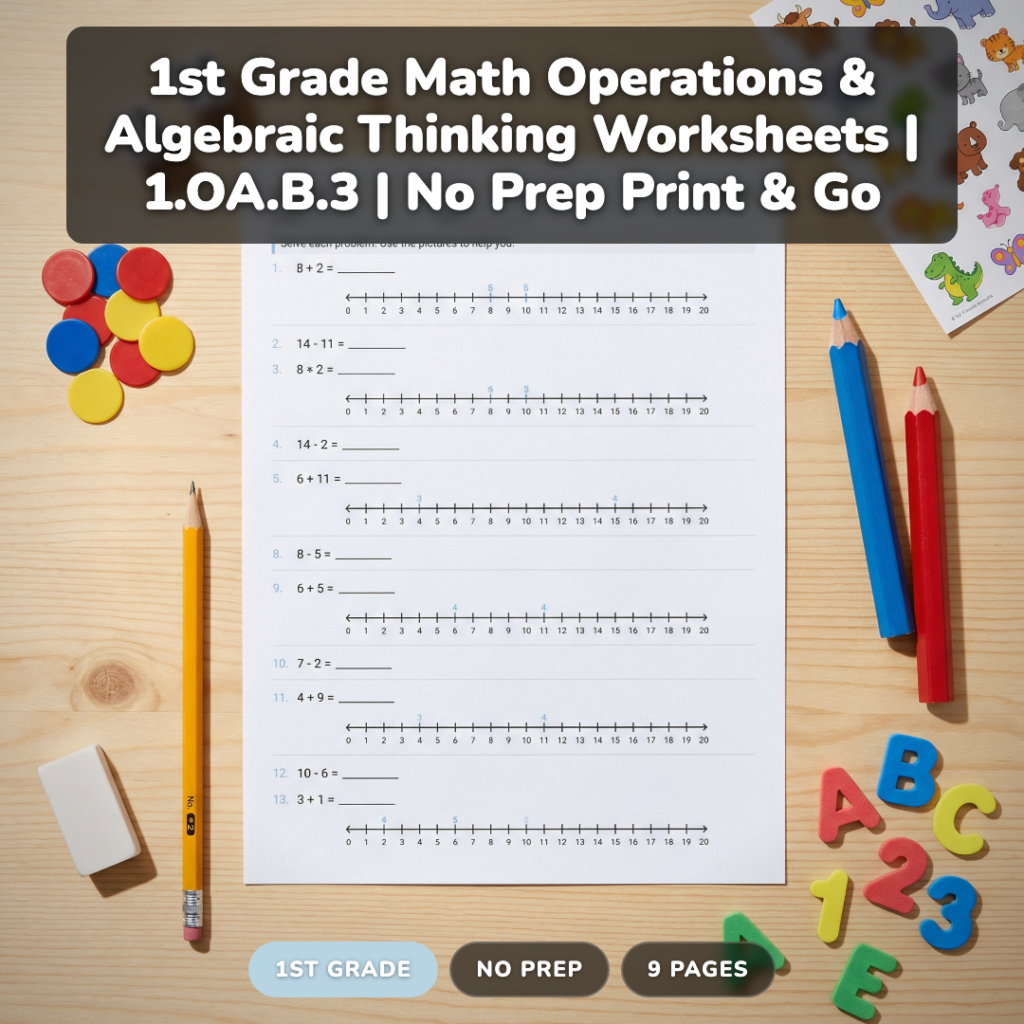
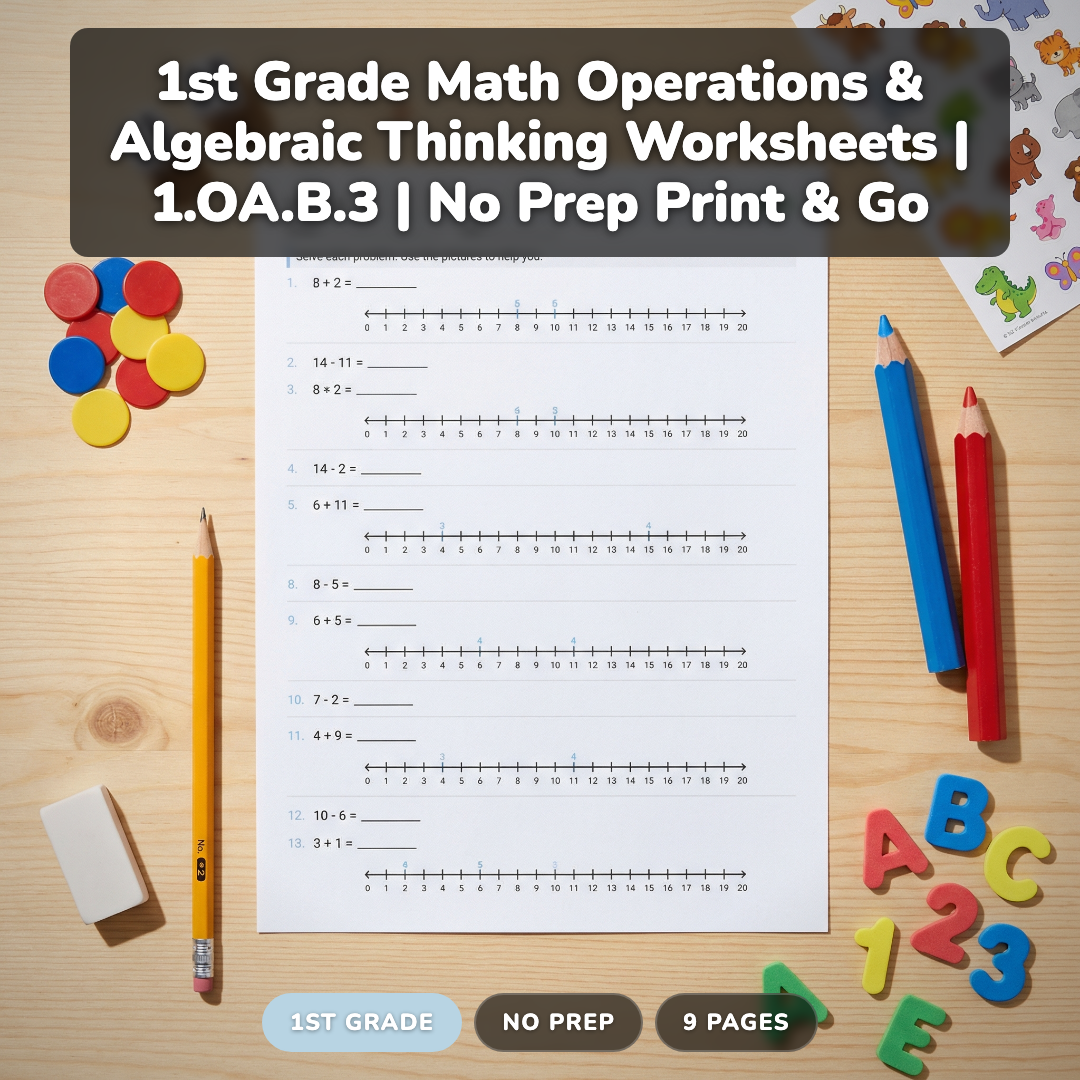
That’s exactly why I created this comprehensive operations and algebraic thinking resource. It includes 106 carefully scaffolded problems across three difficulty levels: 30 practice problems for students who need extra support, 40 on-level problems for grade-level expectations, and 36 challenge problems for advanced learners.
What makes this different from generic worksheets is the intentional progression — each level builds understanding systematically, with visual supports where needed and abstract thinking where appropriate. The problems specifically target the commutative property, identity property, and inverse operations that CCSS.Math.Content.1.OA.B.3 requires.
All 9 pages are print-and-go ready with clear answer keys, so you can focus on teaching rather than prep work.
Grab a Free Properties Practice Sheet to Try
Want to see the quality and format before committing? I’ll send you a free sample worksheet that includes problems from each difficulty level, plus a quick reference guide for teaching the three main properties.
Frequently Asked Questions About Teaching Operations Properties
When should first graders master the commutative property?
Most first graders understand the commutative property by mid-year, typically February or March. However, they need repeated exposure through concrete examples starting in October. Mastery means they can apply it as a strategy, not just recite the rule.
Should I teach the formal names like “commutative property”?
Use child-friendly language first: “switching numbers,” “adding zero,” “opposite operations.” Introduce formal terms gradually once students understand the concepts. Many teachers use both: “Let’s try the switching rule — that’s called the commutative property.”
How do I know if students really understand versus just memorizing?
Ask students to explain their thinking, create their own examples, or solve problems in multiple ways. True understanding shows when they can apply properties to new situations and explain why the property works, not just that it works.
What’s the biggest mistake teachers make with operations properties?
Moving to abstract thinking too quickly. First graders need extensive hands-on experience before they can work with numbers alone. Spend at least 2-3 weeks with manipulatives before introducing symbolic representations. The concrete foundation is essential for lasting understanding.
How do operations properties connect to later math skills?
These properties become strategies for mental math, multi-digit addition and subtraction, and eventually algebraic thinking. Students who understand that 7 + 3 = 3 + 7 will later grasp that 27 + 13 = 13 + 27 and even that x + y = y + x.
The key to teaching operations properties successfully is giving students time to explore, discover, and practice with concrete materials before expecting abstract understanding. When first graders can confidently apply these properties as strategies, they’re building mathematical thinking that will serve them for years to come.
What’s your go-to strategy for helping students understand why 4 + 3 equals 3 + 4? And don’t forget to grab that free practice sheet above — it’s a great way to see these concepts in action.