If your first graders freeze when they see “9 – ? = 5” or struggle to understand what the missing number could be, you’re not alone. Teaching subtraction as an unknown-addend problem is one of the trickiest concepts in first grade math — but when students finally grasp it, their number sense transforms completely.
Key Takeaway
Students master subtraction as unknown addition when they see the connection between fact families and use concrete manipulatives to build understanding before moving to abstract symbols.
Why Teaching Subtraction as Unknown Addition Matters
The CCSS.Math.Content.1.OA.B.4 standard asks students to “understand subtraction as an unknown-addend problem.” This means transforming problems like 10 – 6 = ? into “6 + ? = 10.” Research from the National Research Council shows that students who master this connection develop stronger algebraic thinking skills and perform 23% better on problem-solving assessments by third grade.
This skill typically emerges in late fall or winter of first grade, after students have solid addition facts to 10. It bridges concrete counting strategies with abstract mathematical reasoning, setting the foundation for fact families, missing addends, and eventually algebraic equations.
The timing matters because students need automatic recall of addition facts before they can mentally flip between addition and subtraction. Without this foundation, they resort to counting backwards — a strategy that becomes inefficient and error-prone with larger numbers.
Looking for a ready-to-go resource? I put together a differentiated 1.OA.B.4 practice pack that covers everything below — but first, the teaching strategies that make it work.
Common Subtraction Misconceptions in 1st Grade
Common Misconception: Students think subtraction and addition are completely separate operations.
Why it happens: They memorize procedures without seeing the inverse relationship.
Quick fix: Always present fact families together and use the same manipulatives for both operations.
Common Misconception: Students believe “8 – ? = 3” means “take away the question mark.”
Why it happens: They interpret the question mark as a physical object to remove.
Quick fix: Use “mystery number” language and emphasize that the question mark represents a hidden amount.
Common Misconception: Students count backwards from the larger number instead of thinking addition.
Why it happens: Counting backwards feels like the “subtraction way” to solve problems.
Quick fix: Model both strategies side-by-side and show how addition is often faster and more reliable.
Common Misconception: Students think missing addend problems are harder than regular subtraction.
Why it happens: The unfamiliar format creates anxiety even when the math is identical.
Quick fix: Start with familiar subtraction problems and transform them into addition format together.
5 Research-Backed Strategies for Teaching Subtraction as Unknown Addition
Strategy 1: Fact Family Houses with Physical Manipulation
Students use triangle fact family houses to physically see how three numbers create both addition and subtraction problems. This concrete approach helps them understand that 5 + 3 = 8 and 8 – 3 = 5 use the same three numbers in different arrangements.
What you need:
- Triangle fact family mats (draw or print)
- Number cards or tiles
- Small counters or manipulatives
Steps:
- Place the largest number at the top of the triangle
- Put the two smaller numbers in the bottom corners
- Have students create all four fact family equations using these numbers
- Focus on how “8 – 5 = ?” becomes “5 + ? = 8”
- Let students physically move the question mark tile to see the missing addend
Strategy 2: Number Line Jumping with Story Context
Students use number lines to “jump forward” instead of counting backward, making the addition connection visible. This kinesthetic approach helps them see subtraction as “what do I add to get there?”
What you need:
- Floor number line or individual number line strips
- Small toys or game pieces for jumping
- Story problem cards
Steps:
- Present a subtraction story: “Sam had 9 stickers and gave some away. He has 4 left. How many did he give away?”
- Place the game piece on 4 (what’s left)
- Ask: “How many jumps to get to 9?”
- Count the jumps forward: “4 + ? = 9”
- Connect back to the original subtraction: “9 – 5 = 4”
Strategy 3: Part-Part-Whole Mats with Missing Parts
Students use visual organizers to see how subtraction problems are really asking for a missing part when the whole and one part are known. This strategy directly supports algebraic thinking by making the unknown visible.
What you need:
- Part-part-whole mats (circles or boxes)
- Two-color counters
- Dry erase markers
Steps:
- Write the total (whole) in the top circle
- Write the known part in one bottom circle
- Cover the other bottom circle with a sticky note labeled “?”
- Have students use counters to figure out the hidden part
- Reveal and write both the subtraction and addition equations
Strategy 4: Ten Frame Mystery Numbers
Students use ten frames to visualize missing addends, making the abstract concept concrete. The visual structure of ten frames helps students see patterns and develop mental math strategies.
What you need:
- Ten frames (printed or drawn)
- Two-color counters
- Index cards for covering sections
Steps:
- Show a filled ten frame with some spaces covered
- Ask: “I see 6 counters, and this ten frame shows 10 total. How many are hidden?”
- Let students add counters to find the missing amount
- Write the equation: “6 + ? = 10” and “10 – 6 = ?”
- Practice with different combinations that make 10
Strategy 5: Think Addition Memory Game
Students play a matching game where subtraction problems pair with their equivalent addition problems, reinforcing the connection through repeated practice and game-based learning.
What you need:
- Card pairs: subtraction problems and matching addition problems
- Timer (optional)
- Recording sheet
Steps:
- Create card pairs like “9 – 4 = ?” and “4 + ? = 9”
- Students flip two cards and determine if they match
- When they find a match, they write both equations on their recording sheet
- Discuss how the problems are the same math, different format
- Play until all matches are found
How to Differentiate Unknown Addition for All Learners
For Students Who Need Extra Support
Start with concrete manipulatives and limit problems to sums within 5. Use consistent language like “mystery number” instead of varying terms. Provide fact family triangles as reference tools during independent work. Focus on one fact family per day rather than mixing multiple families. Allow students to use fingers or counters as long as needed — the goal is understanding the relationship, not speed.
For On-Level Students
Work with fact families through 10, using the CCSS.Math.Content.1.OA.B.4 standard expectations. Students should fluently move between subtraction and addition formats within the same lesson. Introduce mixed practice where some problems show “8 – ? = 3” and others show “3 + ? = 8.” Encourage mental math strategies while still allowing manipulative support when needed.
For Students Ready for a Challenge
Extend to fact families with sums to 20 and introduce problems with multiple missing addends like “? + 4 + ? = 12 with equal mystery numbers.” Connect to real-world situations requiring unknown addition thinking. Have students create their own word problems and teach the strategy to younger students or classmates who need support.
A Ready-to-Use Unknown Addition Resource for Your Classroom
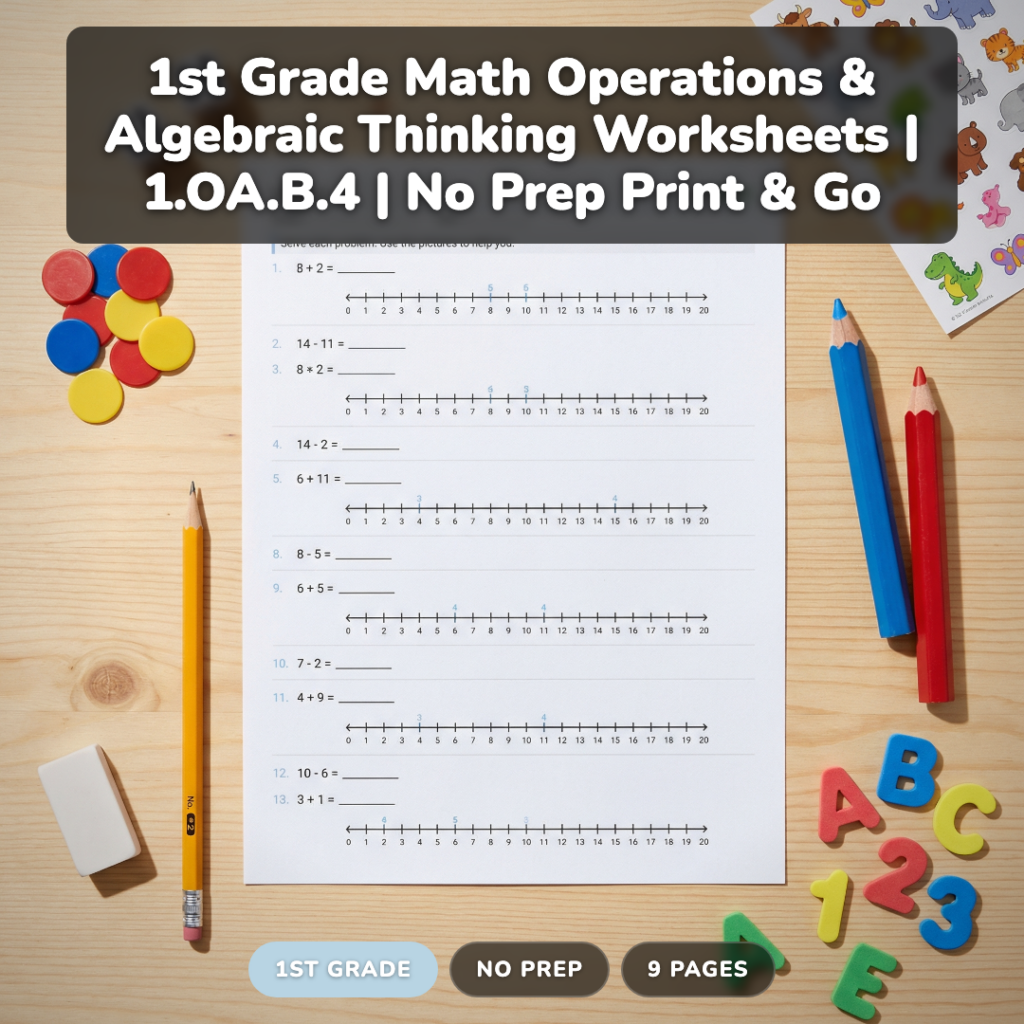
Teaching this concept requires tons of differentiated practice, but creating 106 problems across three difficulty levels takes hours of prep time. That’s why I created this comprehensive CCSS.Math.Content.1.OA.B.4 worksheet pack that does the heavy lifting for you.
The resource includes 30 practice problems for students building foundational skills, 40 on-level problems that meet grade-level expectations, and 36 challenge problems for advanced learners. Each level uses different visual supports — practice problems include ten frames and pictures, on-level problems mix formats, and challenge problems focus on abstract number relationships.
What makes this different from generic worksheets is the careful progression within each level. Problems start with smaller numbers and familiar contexts, then gradually increase in complexity. Answer keys show multiple solution strategies, so you can conference with students about their thinking processes.
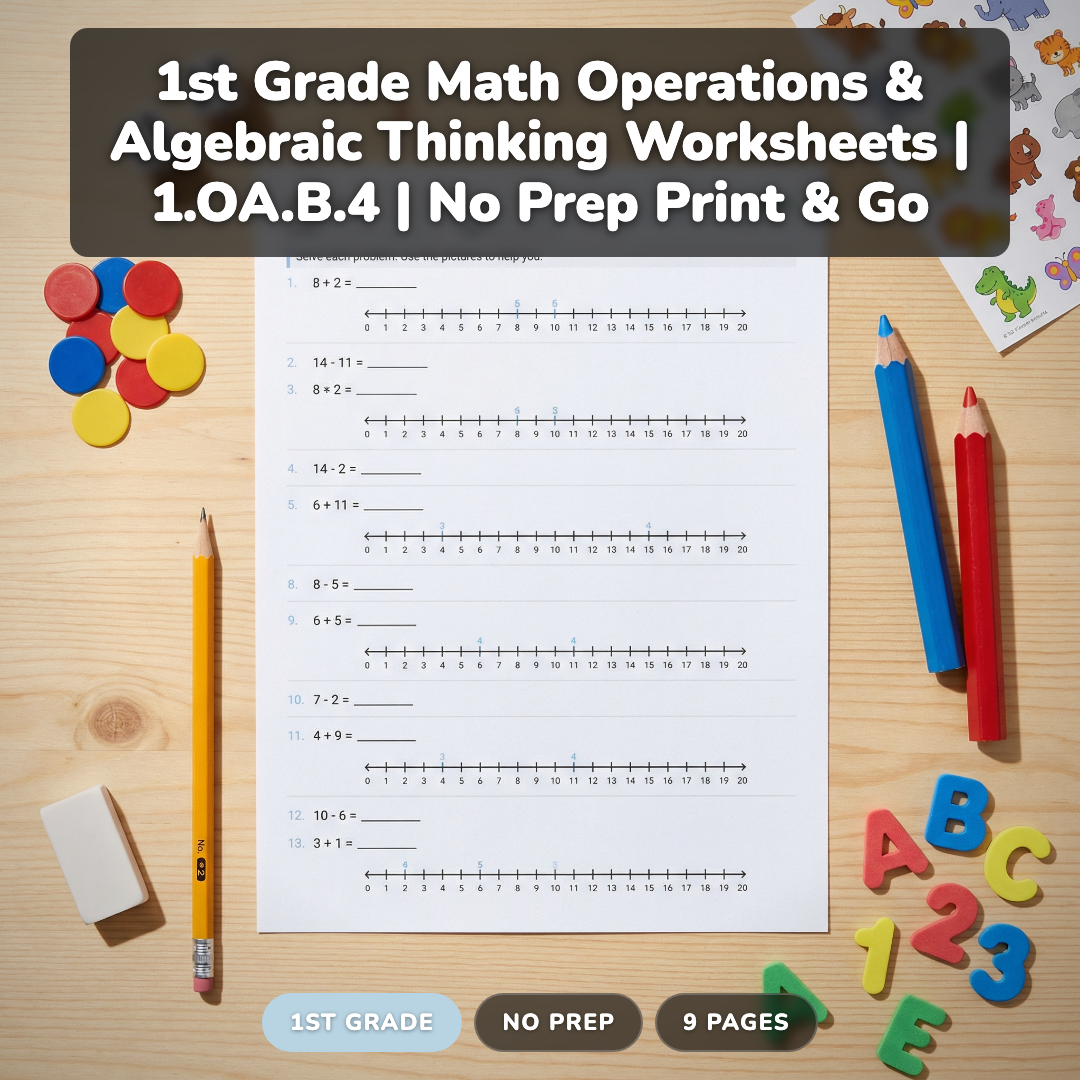
The pack saves hours of prep time and ensures every student gets appropriately challenging practice. You can use it for whole-class instruction, math centers, intervention groups, or homework that actually reinforces what you’ve taught.
Grab a Free Unknown Addition Sample to Try
Want to see the quality and format before you buy? I’ll send you a free 3-page sample that includes one problem from each difficulty level, plus the answer key with teaching notes. Perfect for trying the approach with your class first.
Frequently Asked Questions About Teaching Unknown Addition
When should I introduce subtraction as unknown addition in first grade?
Introduce this concept after students have mastered addition facts to 10, typically in late fall or winter. Students need automatic recall of basic addition before they can mentally flip between operations. Start with fact families to 5, then gradually expand to 10.
What’s the difference between missing addends and unknown addition problems?
They’re the same mathematical concept with different presentations. Missing addend problems show “5 + ? = 8” while unknown addition problems transform “8 – 5 = ?” into addition format. Both require students to find what number makes the equation true.
How do I help students who still count backwards for subtraction?
Model both strategies side-by-side using manipulatives. Show how counting up from the smaller number (addition thinking) is often faster than counting backwards. Practice with number lines where students physically jump forward instead of stepping backward.
Should students memorize subtraction facts or think addition?
Both strategies work together. Students should understand the addition connection first, then develop automatic recall through practice. The CCSS.Math.Content.1.OA.B.4 standard emphasizes understanding the relationship, not just memorizing isolated facts.
How can I assess if students truly understand this concept?
Give students problems in multiple formats: “9 – ? = 4,” “4 + ? = 9,” and word problems requiring the same thinking. Students who understand the concept solve all formats with similar ease and can explain why they’re the same math.
Teaching subtraction as unknown addition transforms how students think about number relationships. When they see that 7 – 3 = ? and 3 + ? = 7 ask the same mathematical question, they develop the algebraic thinking skills that will serve them through high school and beyond.
What’s your favorite strategy for helping students make this connection? Try the free sample above and let me know how it works with your class!