If your first graders are counting on their fingers to find 10 more or 10 less than a number, you’re not alone. This foundational skill trips up many students because it requires understanding place value patterns rather than just counting. You’ll discover five research-backed strategies that help students visualize and mentally calculate 10 more and 10 less with confidence.
Key Takeaway
Students master 10 more/10 less when they understand that adding or subtracting 10 only changes the tens digit, not the ones digit.
Why 10 More/10 Less Matters in First Grade
The ability to mentally find 10 more or 10 less than a two-digit number is a cornerstone of number sense development. CCSS.Math.Content.1.NBT.C.5 specifically requires students to perform this calculation without counting and explain their reasoning. This standard typically appears in the second half of first grade, after students have developed solid understanding of place value through 99.
Research from the National Council of Teachers of Mathematics shows that students who master mental math strategies like 10 more/10 less perform 23% better on standardized assessments. The skill connects directly to addition and subtraction strategies students will use throughout elementary school, particularly when working with multiples of 10 and developing number line reasoning.
This concept bridges concrete counting experiences with abstract number relationships. Students must recognize that our base-ten system allows them to add or subtract 10 by simply changing the tens digit while keeping the ones digit constant. When students grasp this pattern, they develop the mental math fluency essential for CCSS.Math.Content.2.NBT.B.8 in second grade.
Looking for a ready-to-go resource? I put together a differentiated 10 more/10 less practice pack that covers everything below — but first, the teaching strategies that make it work.
Common 10 More/10 Less Misconceptions in 1st Grade
Common Misconception: Students add 1 to both digits when finding 10 more.
Why it happens: They think “more” means adding to every part of the number.
Quick fix: Use base-ten blocks to show that 10 ones equal 1 ten.
Common Misconception: Students count by ones from the starting number.
Why it happens: They haven’t connected the pattern to place value understanding.
Quick fix: Practice with a hundreds chart to visualize the “jump down one row” pattern.
Common Misconception: Students think 10 less than 15 is 5 instead of 5.
Why it happens: They subtract from the ones place instead of the tens place.
Quick fix: Use place value charts to show which digit changes.
Common Misconception: Students can’t explain their reasoning beyond “I just know.”
Why it happens: They memorized the pattern without understanding the why.
Quick fix: Require students to point to the tens digit and explain what happens to it.
5 Research-Backed Strategies for Teaching 10 More/10 Less
Strategy 1: Hundreds Chart Pattern Recognition
The hundreds chart provides the perfect visual foundation for understanding 10 more and 10 less patterns. Students can see that adding 10 means moving down one row, while subtracting 10 means moving up one row.
What you need:
- Large classroom hundreds chart
- Individual student hundreds charts
- Colored counters or sticky dots
- Dry erase markers
Steps:
- Start with a number like 23 and place a counter on it
- Ask students to predict where 10 more would be without counting
- Move the counter down exactly one row to 33
- Repeat with several examples, highlighting the pattern
- Have students practice finding 10 less by moving up one row
- Challenge students to explain why this works using place value language
Strategy 2: Base-Ten Block Exchanges
Manipulating base-ten blocks helps students understand that 10 more means adding one ten-rod, not ten individual ones. This concrete representation builds the conceptual foundation for mental math.
What you need:
- Base-ten blocks (ones and tens)
- Place value mats
- Recording sheets
Steps:
- Model a two-digit number like 34 using 3 ten-rods and 4 ones
- Ask “How can we show 10 more without counting by ones?”
- Add one ten-rod to show 44, emphasizing that ones stay the same
- Record the change: 34 + 10 = 44
- Practice 10 less by removing one ten-rod
- Have students build their own numbers and find 10 more/less
Strategy 3: Number Line Jumps
Number line representations help students visualize 10 more and 10 less as consistent jumps rather than counting sequences. This strategy builds mental math confidence through spatial reasoning.
What you need:
- Large floor number line (or tape)
- Individual number line worksheets
- Jump markers or game pieces
Steps:
- Start at a number like 27 on the floor number line
- Demonstrate a “big jump” of 10 spaces to reach 37
- Show how this is different from 10 small jumps of 1
- Practice jumping backward 10 spaces for 10 less
- Transfer to paper number lines with curved jump arrows
- Have students explain their jumps using place value reasoning
Strategy 4: Place Value Chart Focus
Place value charts isolate the tens and ones digits, making it crystal clear which digit changes when adding or subtracting 10. This strategy directly addresses the most common misconceptions.
What you need:
- Two-column place value charts (tens/ones)
- Number cards or digit tiles
- Highlighters or colored pencils
Steps:
- Write 45 in a place value chart (4 in tens, 5 in ones)
- Ask students which digit will change for 10 more
- Change only the tens digit to 5, keeping ones at 5
- Highlight the tens column to emphasize the pattern
- Practice with multiple examples, always highlighting the changing digit
- Have students create their own examples and explain the pattern
Strategy 5: Mental Math Talk Moves
Structured conversation protocols help students articulate their thinking and learn from each other’s reasoning strategies. This approach builds both computational fluency and mathematical communication skills.
What you need:
- Sentence frames posted on wall
- Partner talk cards
- Timer for discussions
Steps:
- Provide sentence frames: “To find 10 more than ___, I…”
- Model thinking aloud: “To find 10 more than 28, I change the 2 to a 3 because I’m adding one ten”
- Give partners 2 minutes to solve and explain to each other
- Have students share different reasoning strategies with the class
- Emphasize explanations that focus on place value patterns
- Challenge students to convince others their method works
How to Differentiate 10 More/10 Less for All Learners
For Students Who Need Extra Support
Students struggling with this concept often need to strengthen their understanding of teen numbers and place value to 20 first. Use numbers 10-19 exclusively, providing base-ten blocks for every problem. Create anchor charts showing the pattern with visual supports: “When I add 10, the tens digit goes up by 1.” Practice with the same starting numbers multiple times until the pattern becomes automatic. Consider using a modified hundreds chart that only shows 1-50 to reduce cognitive load.
For On-Level Students
Grade-level expectations include mentally calculating 10 more and 10 less for any two-digit number and explaining the reasoning using place value language. Students should work with numbers 20-99 and begin to see the pattern without manipulatives. Encourage multiple solution strategies and have students compare their methods. Introduce word problems that require finding 10 more or 10 less in context, such as “Maria has 34 stickers. Her friend gives her 10 more. How many does she have now?”
For Students Ready for a Challenge
Advanced students can explore three-digit numbers and discover that the same pattern applies. Introduce problems like “What number is 10 more than 195?” and connect this to future work with CCSS.Math.Content.2.NBT.B.8. Challenge students to find patterns in sequences: 25, 35, 45, 55… or work backward from a sum: “I added 10 to a number and got 67. What was my starting number?” These students can also create their own 10 more/10 less word problems for classmates to solve.
A Ready-to-Use 10 More/10 Less Resource for Your Classroom
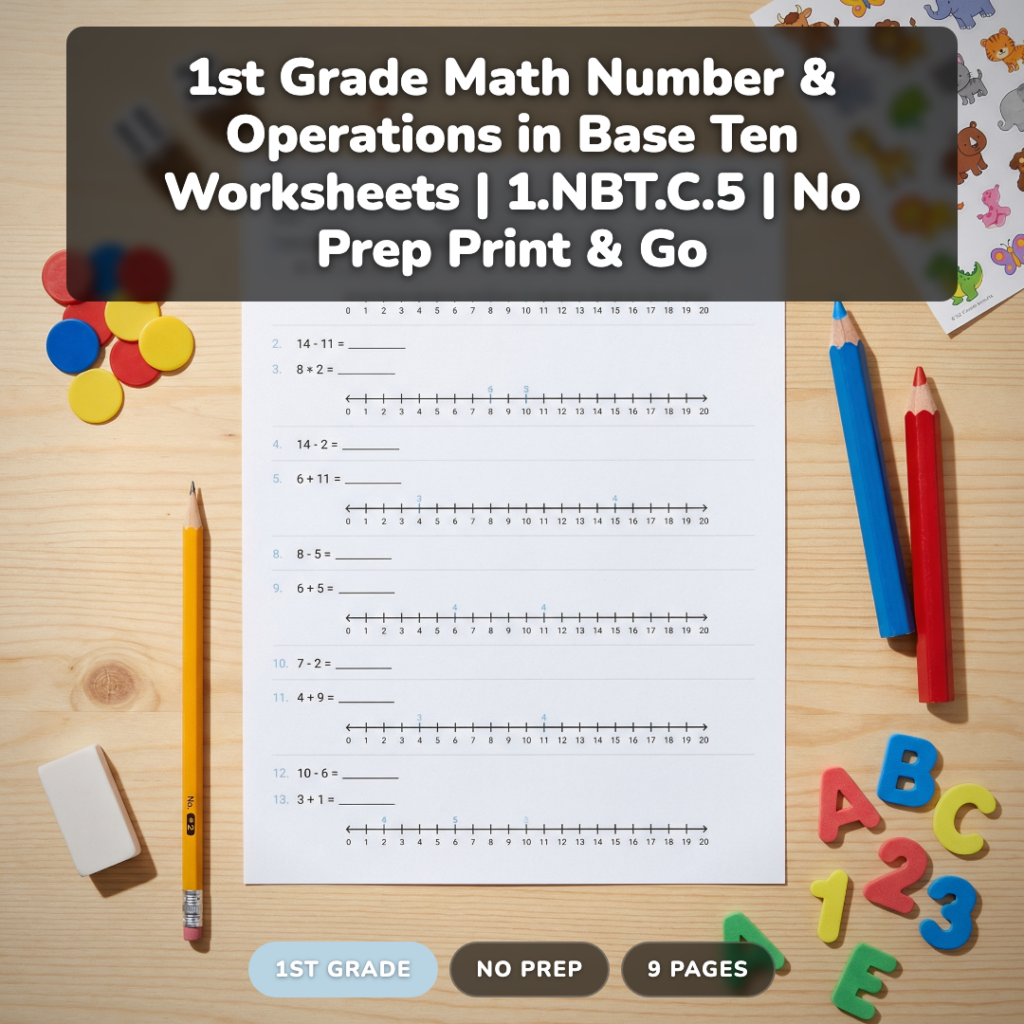
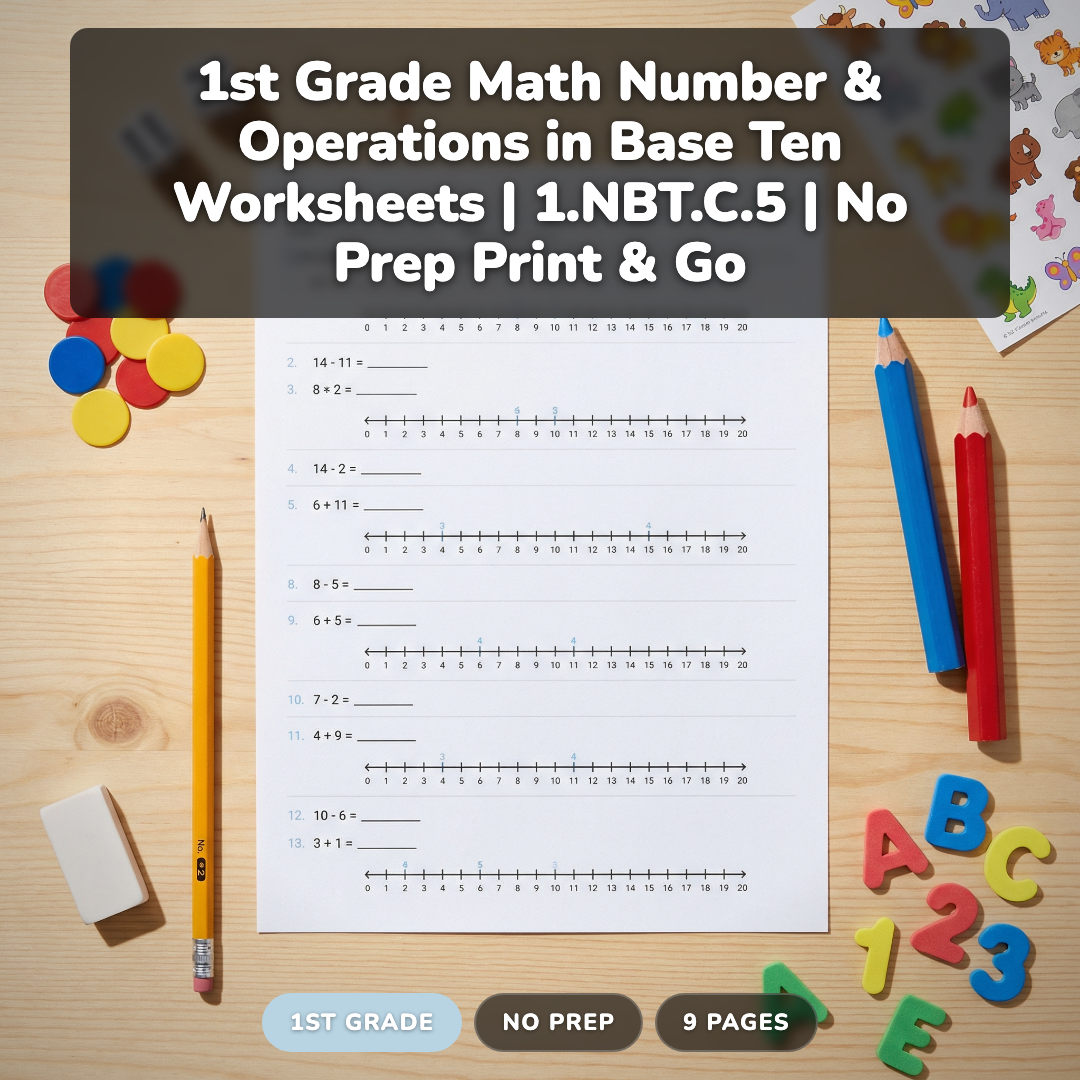
After years of creating 10 more/10 less activities from scratch, I developed a comprehensive practice pack that saves hours of prep time while providing the differentiation every classroom needs. This resource includes 106 carefully crafted problems across three difficulty levels, ensuring every student gets appropriate practice.
The Practice level focuses on numbers 10-50 with visual supports, perfect for students building foundational understanding. On-Level problems use numbers 20-99 and require students to show their thinking using place value reasoning. The Challenge level introduces three-digit numbers and multi-step problems that extend learning beyond grade-level expectations.
What makes this resource different is the intentional progression within each level. Problems start with concrete representations and gradually move toward abstract thinking. Answer keys include common student errors to watch for, plus intervention suggestions for each misconception. The no-prep format means you can print and use immediately, whether for whole group instruction, math centers, or homework practice.
Each worksheet includes clear directions and consistent formatting that students can navigate independently. The 9-page pack covers everything you need to build fluency with this essential first-grade standard.
Grab a Free 10 More/10 Less Sample to Try
Want to see the quality and differentiation before you buy? I’ll send you a free sample worksheet that includes all three levels plus an answer key. Perfect for trying out the format with your students first.
Frequently Asked Questions About Teaching 10 More/10 Less
When should I introduce 10 more and 10 less in first grade?
Introduce this concept after students understand place value through 99 and can identify tens and ones digits consistently. This typically occurs in February or March, following CCSS.Math.Content.1.NBT.B.2 mastery. Students need solid teen number understanding before tackling mental math strategies.
What if students keep counting by ones instead of using the pattern?
This indicates they haven’t connected the concept to place value understanding. Return to concrete manipulatives like base-ten blocks and hundreds charts. Explicitly teach that adding 10 means adding one ten-rod, not ten ones. Practice identifying which digit changes before attempting mental calculations.
How do I help students explain their reasoning for 10 more/10 less?
Provide sentence frames like “To find 10 more, I change the ___ digit from ___ to ___ because I’m adding one ten.” Model mathematical language consistently and have students practice explaining to partners before sharing with the whole group. Focus on place value vocabulary.
Should first graders work with three-digit numbers for 10 more/10 less?
CCSS.Math.Content.1.NBT.C.5 specifies two-digit numbers only. However, students who master the standard early can explore three-digit examples as enrichment. The same place value pattern applies, building foundation for second-grade work with numbers to 1,000.
What manipulatives work best for teaching this concept?
Base-ten blocks provide the clearest concrete representation, showing that 10 ones equal 1 ten. Hundreds charts offer excellent visual patterns, while number lines help students see consistent jumps. Choose manipulatives that match your students’ learning preferences and comfort with place value concepts.
Building Mental Math Confidence
Teaching 10 more and 10 less effectively sets the foundation for all future mental math strategies your students will learn. When students understand that our number system follows predictable patterns, they develop the confidence to tackle increasingly complex problems. Remember to celebrate their reasoning as much as their correct answers — mathematical thinking matters more than speed.
What strategies have worked best in your classroom for teaching 10 more and 10 less? I’d love to hear about your successes and challenges in the comments below. Don’t forget to grab your free sample worksheet to try these strategies with your students right away.