If your first graders still count on their fingers for numbers past 10, or they write “21” as “12” because they hear “twenty-one” and write the sounds they hear, you’re not alone. Teaching number and operations in base ten is one of the most critical foundations in first grade math — and one of the trickiest to get right.
You need strategies that help students truly understand place value, not just memorize counting patterns. This post breaks down five research-backed approaches that transform how first graders think about numbers, plus differentiation tips for every learner in your classroom.
Key Takeaway
First graders master base ten concepts through concrete manipulation before abstract number work — they need to see, touch, and build numbers to understand place value.
Why Base Ten Matters in First Grade
Number and operations in base ten forms the foundation for every math concept your students will learn. According to the National Council of Teachers of Mathematics, students who struggle with place value concepts in first grade are 60% more likely to have difficulty with multi-digit operations in later grades.
The CCSS.Math.Content.1.NBT.A.1 standard requires students to count to 120, starting at any number less than 120, read and write numerals, and represent quantities with written numerals. This isn’t just about counting — it’s about understanding that our number system groups by tens and recognizing patterns in how numbers work.
First grade is when students transition from counting individual objects to understanding that ten ones make one ten. Research from Dr. Karen Fuson shows that students need extensive experience with concrete materials before they can work with abstract numerals effectively.
Looking for a ready-to-go resource? I put together a differentiated base ten practice pack that covers everything below — but first, the teaching strategies that make it work.
Common Base Ten Misconceptions in First Grade
Common Misconception: Students write numbers as they hear them (“twenty-one” becomes “201”).
Why it happens: They’re processing language sounds rather than understanding place value structure.
Quick fix: Use base ten blocks while saying numbers — show two tens and one unit as you say “twenty-one.”
Common Misconception: Students think “eleven” and “twelve” follow the same pattern as “twenty-one” and “thirty-two.”
Why it happens: English number names are irregular for 11-19, unlike other decades.
Quick fix: Explicitly teach that teen numbers are “ten and some more” using visual models.
Common Misconception: Students count by ones when asked to count by tens.
Why it happens: They haven’t internalized that ten is a unit, not just a collection of ones.
Quick fix: Bundle ten objects together and treat the bundle as one unit during counting activities.
Common Misconception: Students lose track when counting past 100.
Why it happens: They don’t understand the hundreds place or how the pattern continues.
Quick fix: Use a hundreds chart and highlight the repeating patterns in each row.
5 Research-Backed Strategies for Teaching Base Ten
Strategy 1: Concrete Bundling with Real Objects
Students physically group objects into tens and ones to build number sense through manipulation. This concrete approach helps them see that ten individual items become one group of ten — a fundamental place value concept.
What you need:
- Counting bears, beans, or small manipulatives (200+ pieces)
- Small cups or rubber bands for bundling
- Recording sheets
Steps:
- Give students 47 counting bears and ask them to count by ones
- Introduce bundling: “Let’s make groups of ten to count faster”
- Have students bundle ten bears in each cup, counting “ten, twenty, thirty, forty”
- Count remaining individual bears: “forty-one, forty-two, forty-three…”
- Record on paper: 4 groups of ten, 7 individual ones = 47
- Practice with different quantities, always bundling first
Strategy 2: Base Ten Block Building and Recording
Students use base ten blocks to represent numbers, then record their work symbolically. This bridges concrete manipulation with abstract number representation, essential for CCSS.Math.Content.1.NBT.A.1 mastery.
What you need:
- Base ten blocks (tens rods and ones units)
- Place value mats
- Number cards 1-120
- Recording paper
Steps:
- Show a number card (like 35)
- Students build the number using base ten blocks on their mat
- Count aloud: “Ten, twenty, thirty… thirty-one, thirty-two, thirty-three, thirty-four, thirty-five”
- Record: Draw 3 tens rods and 5 ones units
- Write the numeral and number word
- Practice reading the number starting from different points (“Start counting from 30”)
Strategy 3: Interactive Hundreds Chart Exploration
Students discover number patterns using hundreds charts, developing skills to count forward and backward from any starting point. This visual tool reveals the structure of our base ten system.
What you need:
- Large hundreds chart (1-120)
- Individual student hundreds charts
- Colored chips or markers
- Number cards
Steps:
- Start with a number card (like 67)
- Students find and mark 67 on their hundreds chart
- Count forward by ones: 67, 68, 69, 70, 71…
- Count forward by tens: 67, 77, 87, 97, 107, 117
- Count backward from 67: 66, 65, 64…
- Discuss patterns: “What do you notice when we count by tens?”
Strategy 4: Number Line Jumping Games
Students physically move along floor number lines or use manipulatives to “jump” by ones and tens. This kinesthetic approach reinforces counting sequences and helps students visualize number relationships.
What you need:
- Floor number line (tape or chalk, 0-120)
- Small toy frogs or counters
- Dice or number cards
- Recording sheets
Steps:
- Students start at a given number (like 43)
- Roll dice to determine jump size (ones or tens)
- Make physical jumps along the number line, counting aloud
- Record each jump: “Started at 43, jumped 10, landed on 53”
- Continue jumping and recording for 5-6 moves
- Practice jumping backward as well as forward
Strategy 5: Number Writing and Reading Practice
Students practice writing numerals while saying numbers aloud, connecting oral language with written symbols. This multi-sensory approach reinforces proper numeral formation and number recognition.
What you need:
- Whiteboard and markers
- Number formation guides
- Sand trays or finger paint
- Number dictation cards
Steps:
- Say a number aloud (like “seventy-eight”)
- Students repeat the number while writing it in sand
- Check formation and place value understanding
- Practice reading numbers in random order
- Dictate numbers for students to write on whiteboards
- Include both numeral and word form practice
How to Differentiate Base Ten for All Learners
For Students Who Need Extra Support
Focus on numbers 1-50 first, using concrete manipulatives for every activity. Provide number charts with missing numbers filled in, and practice counting by ones before introducing counting by tens. Use consistent language: always say “groups of ten” rather than switching between “tens,” “groups,” and “bundles.” Review counting to 20 daily and ensure students can recognize numerals 1-20 before moving to larger numbers.
For On-Level Students
Work with the full range 1-120 as specified in CCSS.Math.Content.1.NBT.A.1. Students should practice starting counts from any number less than 120, write numerals independently, and represent quantities using both concrete materials and symbols. Include regular practice with teen numbers (11-19) since these don’t follow standard place value patterns in English.
For Students Ready for a Challenge
Extend counting beyond 120 to explore patterns in the hundreds. Introduce skip counting by 2s and 5s using base ten understanding. Practice writing numbers in expanded form (47 = 40 + 7) and compare numbers using place value reasoning. Connect base ten concepts to early addition and subtraction: “If I have 34 and add one ten, what number do I get?”
A Ready-to-Use Base Ten Resource for Your Classroom
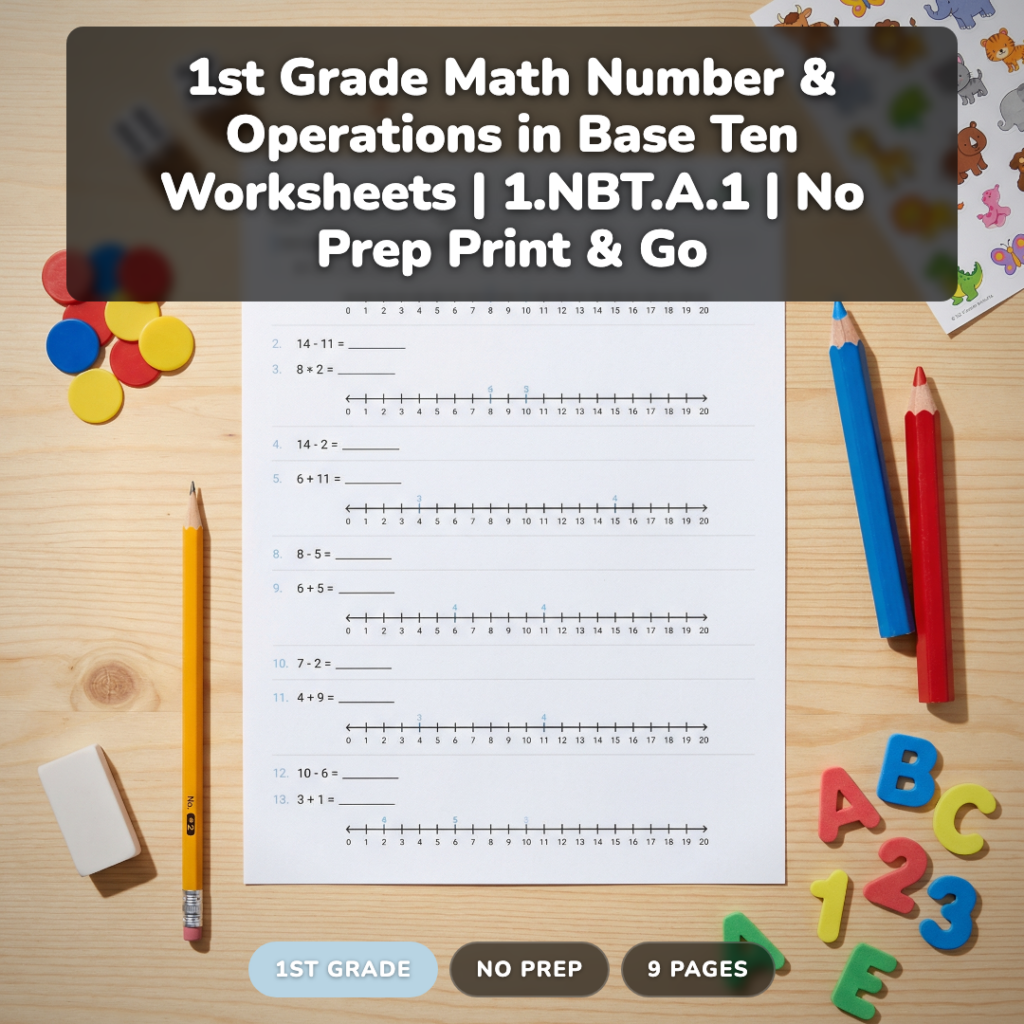
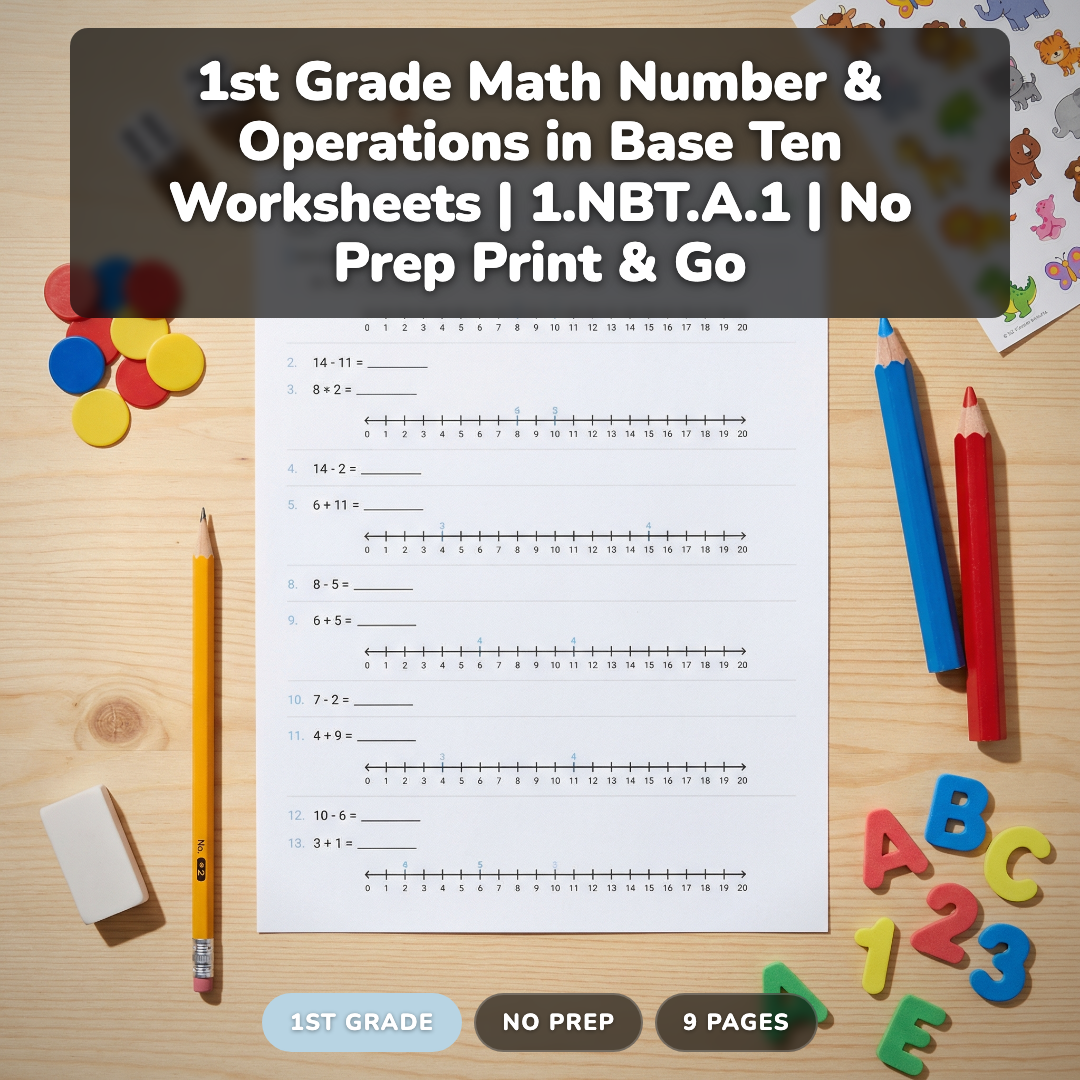
After using these strategies in my classroom for years, I created a comprehensive practice pack that saves you prep time while giving students exactly the practice they need. This Number & Operations in Base Ten Worksheets pack includes 106 differentiated problems across 9 pages — everything you need to reinforce these concepts.
The pack includes three difficulty levels: Practice (30 problems for students building foundational skills), On-Level (40 problems aligned to grade-level expectations), and Challenge (36 problems for students ready to extend their thinking). Each level includes counting practice, numeral writing, and number representation activities that connect directly to the teaching strategies above.
What makes this resource different is the systematic progression — students start with concrete representations and gradually move to abstract number work, just like the research recommends. Answer keys are included for quick grading, and the no-prep format means you can use these immediately.
You can grab this time-saving resource and start using it with your students tomorrow.
Grab a Free Base Ten Practice Sheet to Try
Want to see how these strategies work in practice? I’ll send you a free sample worksheet that includes all three differentiation levels, plus a quick implementation guide for your classroom.
Frequently Asked Questions About Teaching Base Ten
When should first graders master counting to 120?
Most first graders should count to 120 by mid-year, but focus on understanding rather than speed. Students need solid counting to 50 before tackling larger numbers. The CCSS.Math.Content.1.NBT.A.1 standard expects mastery by year-end, with counting from any starting point being the most challenging component.
Why do students write numbers backward or incorrectly?
Number reversals are common in first grade due to developing fine motor skills and incomplete understanding of place value. Students often write what they hear (“twenty-one” as “201”) rather than understanding the base ten structure. Use concrete manipulatives and explicit place value instruction to address this.
How can I help students who struggle with teen numbers?
Teen numbers (11-19) are irregular in English, unlike other decades. Use base ten blocks to show that 16 is “ten and six more,” not “six-teen.” Practice with concrete materials first, then move to symbolic representation. Daily practice with teen number patterns helps students internalize these exceptions.
What’s the difference between counting and understanding place value?
Counting is reciting number names in sequence, while place value understanding means knowing that 47 represents 4 tens and 7 ones. Students can count to 100 without understanding that 23 is composed of 2 tens and 3 ones. Use bundling activities and base ten blocks to build true place value understanding.
How often should students practice base ten concepts?
Daily practice is essential for first graders learning base ten concepts. Spend 10-15 minutes daily on place value activities, rotating between concrete manipulation, hundreds chart work, and number writing. Consistent, short practice sessions are more effective than longer, infrequent lessons for building automaticity.
Teaching base ten in first grade sets the foundation for every math concept your students will encounter. Focus on concrete understanding before abstract work, and remember that students need multiple exposures to truly grasp place value concepts.
What’s your biggest challenge when teaching base ten concepts? Drop your email above for that free practice sheet, and let me know what strategies work best in your classroom!