If your first graders can name a triangle but think a rotated square is a diamond, you’re not alone. Teaching geometry to six-year-olds means helping them move beyond surface-level shape recognition to understanding what actually makes a triangle a triangle — no matter how it’s positioned or what color it is.
This post walks you through five research-backed strategies that help first graders master the defining attributes of shapes, plus differentiation tips and common misconceptions to watch for.
Key Takeaway
First graders learn geometry best through hands-on exploration that focuses on counting sides and corners rather than memorizing shape names.
Why Geometry Matters in First Grade
Geometry forms the foundation for spatial reasoning, measurement, and even algebraic thinking in later grades. CCSS.Math.Content.1.G.A.1 specifically asks students to distinguish between defining attributes (the features that make a shape what it is) and non-defining attributes (features like color, size, or orientation that don’t change the shape’s identity).
Research from the National Council of Teachers of Mathematics shows that students who develop strong spatial reasoning skills in elementary school perform 15% better on standardized math assessments through middle school. The key is moving beyond rote memorization of shape names to understanding geometric properties.
This standard typically appears in the second quarter of first grade, after students have mastered basic counting and number recognition. It connects directly to measurement units later in the year and sets the stage for second grade’s work with angles and equal shares.
Looking for a ready-to-go resource? I put together a differentiated geometry pack that covers everything below — but first, the teaching strategies that make it work.
Common Geometry Misconceptions in First Grade
Common Misconception: A square rotated 45 degrees is a diamond, not a square.
Why it happens: Students rely on visual orientation rather than counting sides and corners.
Quick fix: Rotate shapes while counting sides together — “Still four sides, still a square!”
Common Misconception: All triangles must point upward like a mountain.
Why it happens: Most early shape books show triangles in the same orientation.
Quick fix: Show triangles in multiple positions and have students trace the three sides with their finger.
Common Misconception: Rectangles and squares are completely different shapes.
Why it happens: Students see them as separate categories rather than understanding squares as special rectangles.
Quick fix: Focus on “four corners, four sides” for both, then explore what makes squares special.
Common Misconception: Bigger shapes are “better” or more important.
Why it happens: Size is the most obvious visual difference to young children.
Quick fix: Use identical shapes in different sizes and ask, “Are these both triangles? How do you know?”
5 Research-Backed Strategies for Teaching Geometry
Strategy 1: Shape Detective with Attribute Focus
Turn students into shape detectives who solve mysteries by examining evidence — the defining attributes of shapes. This strategy builds analytical thinking while making geometry feel like a game.
What you need:
- Collection of 2D shapes in various sizes, colors, and orientations
- Magnifying glasses (optional but engaging)
- “Detective notebook” (paper for recording findings)
- Shape mystery cards with clues
Steps:
- Present a mystery: “A shape has been stolen! The only clues are: three sides, three corners, closed figure.”
- Students examine shape suspects, counting sides and corners with their detective tools
- Record findings: “This red triangle has three sides… this blue triangle has three sides…”
- Eliminate suspects based on evidence: “This circle has no corners, so it can’t be our shape!”
- Conclude with the defining attributes: “All triangles have three sides and three corners, no matter what color or size”
Strategy 2: Build-a-Shape Challenge
Students construct shapes using everyday materials, focusing on the essential features that define each shape. This kinesthetic approach helps cement understanding of geometric properties.
What you need:
- Craft sticks or straws for sides
- Play dough or clay for corners
- Pipe cleaners
- Geoboards and rubber bands
- Challenge cards with shape requirements
Steps:
- Give each group a challenge card: “Build a shape with exactly 4 sides and 4 corners”
- Students select materials and construct their shape
- Test their creation: “Count the sides together… count the corners… is it closed?”
- Compare different groups’ rectangles: “Sam’s is tall, Maria’s is wide, but both have 4 sides and 4 corners”
- Introduce the shape name after they’ve discovered the properties
Strategy 3: Shape Sort Showdown
Students sort shapes based on defining attributes, making their reasoning visible through explanation and debate. This strategy develops classification skills and mathematical vocabulary.
What you need:
- Large collection of mixed shapes (various sizes, colors, orientations)
- Sorting hoops or boxes
- Labels for sorting categories
- Timer for added excitement
Steps:
- Scatter shapes randomly and announce the sorting rule: “Find all shapes with exactly 3 sides”
- Students race to sort, but must explain their choices: “This goes here because it has 1, 2, 3 sides”
- Check results together, discussing any disagreements: “Why did you put this here?”
- Introduce “trick” shapes in different orientations to test understanding
- Students create their own sorting rules for classmates to follow
Strategy 4: Shape Story Theater
Students create and act out stories where shapes are characters with specific defining attributes. This narrative approach helps students remember geometric properties through storytelling.
What you need:
- Large cardboard shapes for costumes
- Simple props (hats, scarves for non-defining attributes)
- Story prompt cards
- Recording device for sharing stories
Steps:
- Assign shape characters: “You’re Triangle — you always have exactly 3 sides and 3 corners”
- Create a scenario: “The shapes are going to a costume party, but they can’t change their defining attributes”
- Students act out the story: Triangle tries on different hats and scarves but always keeps 3 sides
- Audience identifies the shapes: “Even with that funny hat, Triangle still has 3 sides!”
- Debrief the lesson: “What stayed the same about Triangle? What could change?”
Strategy 5: Real-World Shape Hunt
Students identify shapes in their environment, distinguishing between defining and non-defining attributes in authentic contexts. This strategy connects classroom learning to everyday experiences.
What you need:
- Clipboards and recording sheets
- Digital cameras or tablets
- Classroom objects with clear geometric shapes
- Outdoor exploration permission (if going outside)
Steps:
- Explain the mission: “Find rectangles hiding in our classroom — remember, 4 sides and 4 corners”
- Students explore systematically, recording discoveries: “The door is a rectangle — 4 sides, 4 corners”
- Photograph or sketch findings with explanations
- Share discoveries and debate borderline cases: “Is this table a rectangle? Let’s count sides together”
- Create a classroom shape museum with documented findings
How to Differentiate Geometry for All Learners
For Students Who Need Extra Support
Focus on one shape at a time, starting with the most distinct (circle, triangle, square). Use consistent vocabulary and provide physical models students can trace and manipulate. Break down CCSS.Math.Content.1.G.A.1 by first mastering shape identification before moving to attribute analysis. Provide sentence frames like “This shape has ___ sides and ___ corners.”
For On-Level Students
Work with 3-4 basic shapes simultaneously, comparing and contrasting their attributes. Students should identify shapes in various orientations and sizes, explaining their reasoning clearly. They can complete independent sorting activities and create simple shape patterns while articulating the defining attributes that make each shape unique.
For Students Ready for a Challenge
Introduce more complex polygons (pentagon, hexagon, octagon) and explore the relationship between shapes (squares as special rectangles). Challenge students to create shape riddles, design geometric art projects, and identify shapes within shapes. Have them explore how shapes combine to form new shapes and make connections to everyday architecture and design.
A Ready-to-Use Geometry Resource for Your Classroom
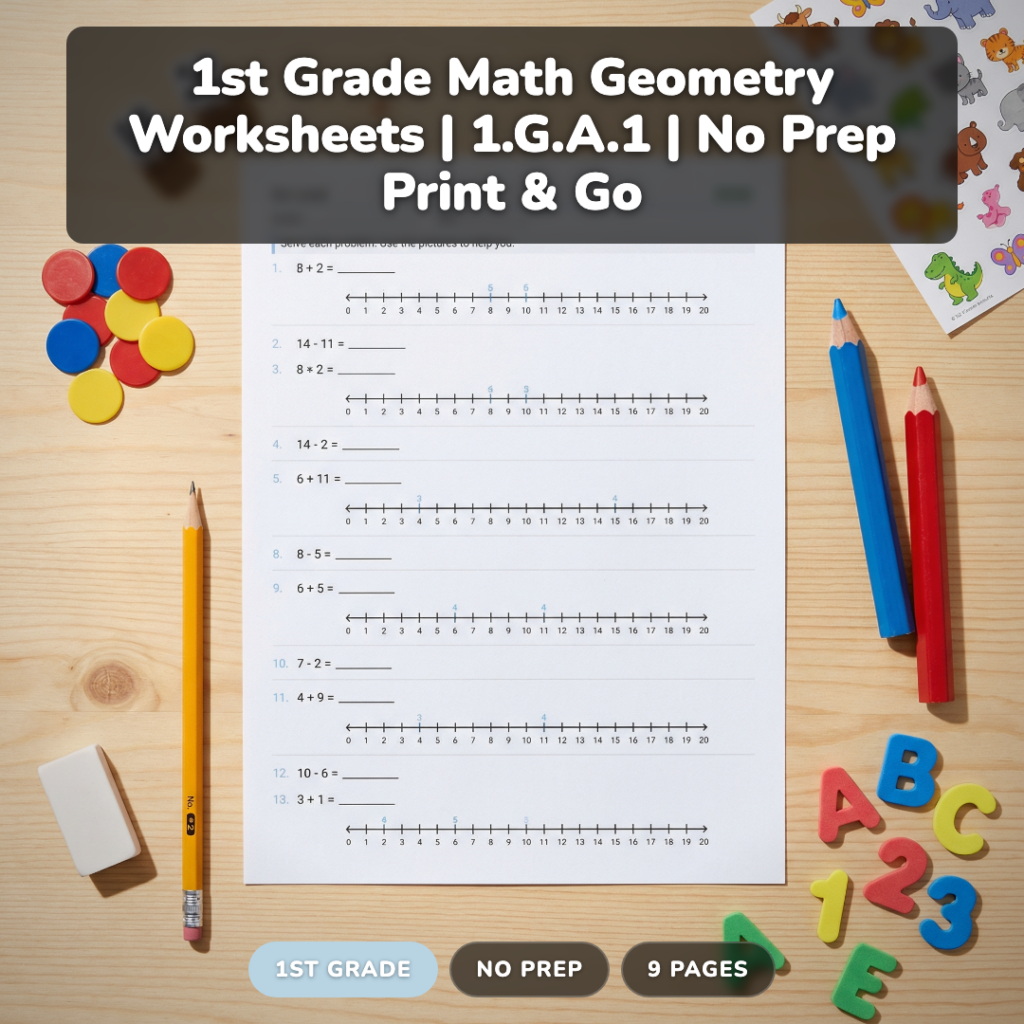
Teaching geometry effectively requires lots of varied practice opportunities, which is where a comprehensive worksheet collection becomes invaluable. This differentiated geometry pack includes 106 problems across three levels — perfect for meeting every student where they are.
The Practice level (30 problems) focuses on basic shape identification with clear, simple examples. On-Level worksheets (40 problems) challenge students to identify shapes in different orientations and explain their reasoning. The Challenge level (36 problems) includes complex sorting tasks and real-world applications that extend beyond the standard.
What makes this resource different is the careful scaffolding — each level builds systematically from concrete identification to abstract reasoning. Answer keys are included for quick checking, and the no-prep format means you can differentiate instantly without extra planning time.
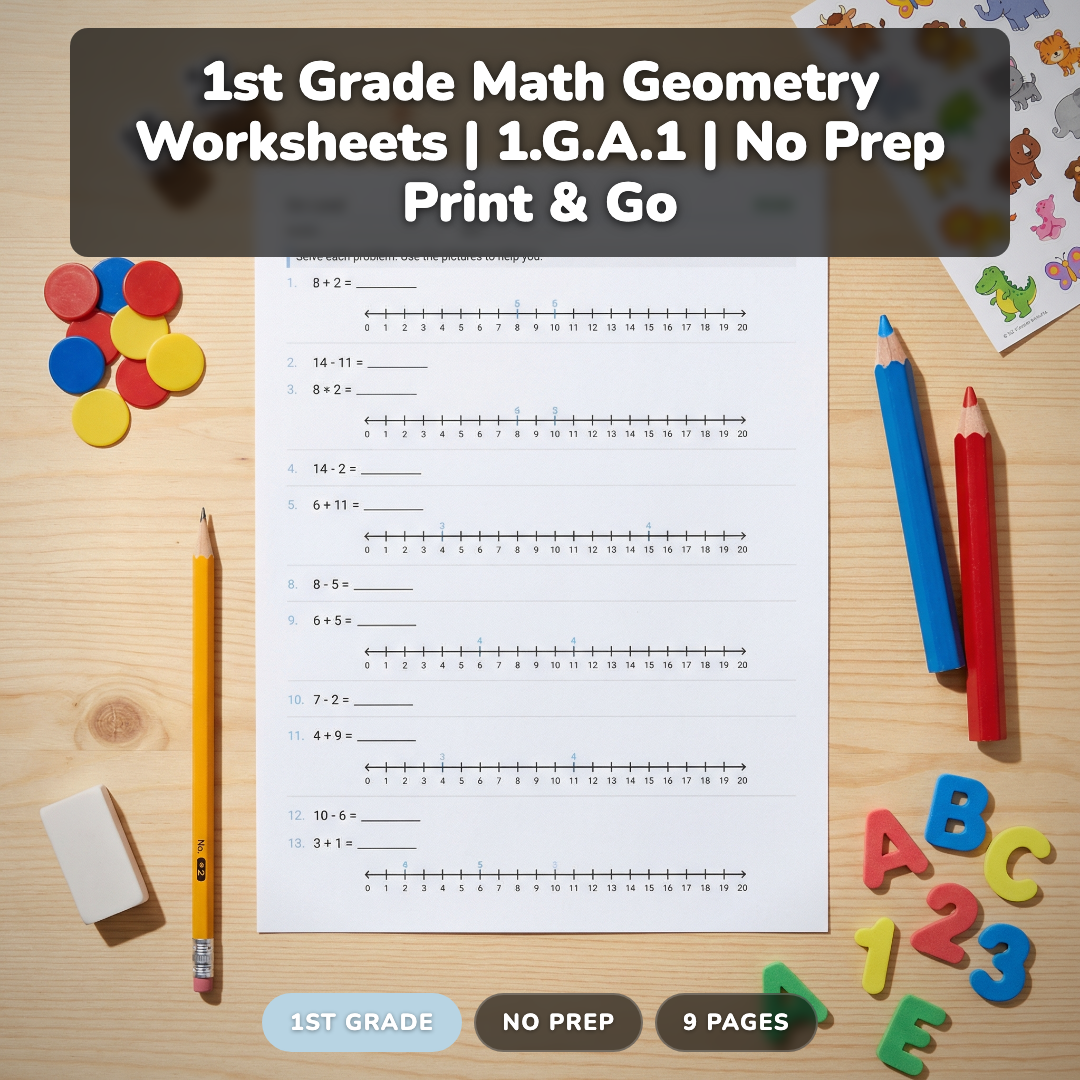
The pack covers all aspects of the 1.G.A.1 standard with engaging visuals and age-appropriate challenges that keep first graders motivated while building essential geometric reasoning skills.
Grab a Free Shape Sorting Activity to Try
Want to test these strategies with your students? I’ve created a free shape detective activity that gets kids thinking about defining attributes right away. Drop your email below and I’ll send it right over.
Frequently Asked Questions About Teaching Geometry
When should first graders master shape identification?
Most first graders can identify basic shapes (circle, triangle, square, rectangle) by mid-year, but understanding defining versus non-defining attributes develops throughout the year. Focus on one shape family at a time, ensuring mastery before moving forward.
How do I help students who confuse squares and diamonds?
Emphasize counting sides and corners rather than orientation. Rotate squares together while counting “1, 2, 3, 4 sides” to show that position doesn’t change the shape’s identity. Use the term “tilted square” instead of diamond initially.
What’s the difference between defining and non-defining attributes?
Defining attributes are essential features that make a shape what it is (number of sides, corners, whether it’s closed). Non-defining attributes are features that can change without changing the shape’s identity (color, size, orientation, pattern).
Should I teach shape names or properties first?
Teach properties first. Let students discover that “shapes with 3 sides and 3 corners” exist before introducing the term “triangle.” This builds deeper understanding than memorizing names without understanding underlying attributes.
How can I assess geometry understanding in first grade?
Use performance tasks where students sort shapes and explain their reasoning aloud. Avoid multiple-choice tests — instead, have students build shapes with given attributes or identify shapes in various orientations while verbalizing their thinking process.
The key to successful geometry instruction is helping students see that math shapes follow rules, just like everything else in their world. When they can articulate why a triangle is always a triangle, regardless of its size or color, they’ve mastered the essence of geometric reasoning.
What’s your biggest challenge when teaching shapes to first graders? Try one of these strategies this week and see how your students respond. And don’t forget to grab that free shape detective activity above — it’s a great way to start building those critical thinking skills right away.