Planning a full year of 6th grade math can feel overwhelming. You’re covering five major domains, 47 different standards, and trying to differentiate for students who range from struggling with basic fractions to ready for pre-algebra concepts. Finding quality resources for every single standard — from ratios and proportional relationships to statistics and probability — takes hours you don’t have.
This comprehensive guide breaks down the entire 6th grade math curriculum domain by domain, giving you concrete strategies for teaching each area plus ready-to-use resources that cover all 47 standards. By the end, you’ll have a clear roadmap for the entire year and access to differentiated materials that make planning simple.
Key Takeaway
6th grade math covers five domains with 47 standards total, requiring a strategic approach that builds algebraic thinking while strengthening number sense foundations.
6th Grade Math: What Students Need to Master This Year
Sixth grade represents a crucial transition in mathematical thinking. Students move from arithmetic to algebraic reasoning, developing the foundation for all future math courses. The Common Core framework organizes 6th grade math into five interconnected domains that build conceptual understanding alongside procedural fluency.
Ratios & Proportional Relationships (7 standards): Students discover the multiplicative relationships that govern much of mathematics, from unit rates to percent problems.
The Number System (15 standards): Students extend their understanding to include negative numbers, rational numbers, and operations with fractions and decimals.
Expressions & Equations (12 standards): Students begin formal algebraic thinking, writing expressions, solving equations, and working with variables for the first time.
Geometry (4 standards): Students calculate area, surface area, and volume while developing spatial reasoning skills.
Statistics & Probability (9 standards): Students learn to analyze data distributions and understand statistical measures of center and variation.
Developmentally, 6th graders are ready for abstract thinking but still need concrete connections. They can handle multi-step problems but benefit from visual models and real-world contexts. Most importantly, they’re building the algebraic reasoning skills that will carry them through middle and high school mathematics.
Need ready-to-go resources for every standard below? I put together a complete 6th grade math bundle with worksheets and review games for each one — but first, here’s your domain-by-domain guide.
Ratios & Proportional Relationships: What 6th Students Learn
This domain introduces students to multiplicative reasoning — the foundation for algebra, geometry, and advanced mathematics. Students learn that ratios describe relationships between quantities, rates compare different units, and proportional relationships maintain constant ratios.
Ratios & Proportional Relationships: Building Multiplicative Thinking
Students work with standards like CCSS.Math.Content.6.RP.A.1 (understanding ratio concepts) and CCSS.Math.Content.6.RP.A.3 (using ratios to solve problems). They learn to write ratios in multiple forms, find unit rates, and solve percent problems using proportional reasoning.
Key instructional strategies include starting with concrete manipulatives like colored tiles or beans to build ratio concepts, then moving to visual models like tape diagrams and double number lines. Students need extensive practice recognizing when quantities are in proportional relationships versus when they’re not.
Common struggles include confusing additive and multiplicative relationships (thinking 2:3 is the same as 5:6 because both have a difference of 1), and difficulty scaling ratios up or down. Worksheets with visual models help students see these relationships, while interactive games let them practice identifying equivalent ratios quickly.
The basketball review games are particularly effective here because students can immediately see whether their ratio calculations produce correct answers, building confidence with proportional reasoning through repeated practice.
The Number System: What 6th Students Learn
This domain extends students’ number understanding to include negative numbers and all rational numbers. Students learn that numbers can represent quantities less than zero, that fractions and decimals are different representations of the same values, and that operations with rational numbers follow consistent patterns.
The Number System: Expanding Number Concepts
Students master standards like CCSS.Math.Content.6.NS.A.1 (interpreting quotients of fractions) and CCSS.Math.Content.6.NS.C.6 (understanding rational numbers on the coordinate plane). They learn to divide fractions, work with negative numbers, and plot points in all four quadrants.
Effective teaching strategies include using real-world contexts like temperature, elevation, and financial situations to make negative numbers meaningful. The coordinate plane becomes a powerful tool for visualizing positive and negative relationships, while fraction division builds on students’ understanding of multiplication as repeated addition.
Students often struggle with the concept that negative numbers exist and follow logical patterns. They may think that -5 is greater than -2 because 5 > 2, or become confused about which direction represents positive versus negative on coordinate axes.
Differentiated worksheets help by providing multiple entry points — some students need concrete models like thermometers and number lines, while others can work abstractly with rational number operations. Games reinforce these concepts through immediate feedback and repeated practice.
For detailed strategies and free resources for each standard, see our posts on teaching variables and equations in 6th grade and teaching order of operations with proven strategies.
Expressions & Equations: What 6th Students Learn
This domain marks students’ first formal introduction to algebraic thinking. Students learn that letters can represent unknown quantities, that expressions can be simplified and evaluated, and that equations represent balanced relationships that can be solved systematically.
Expressions & Equations: Beginning Algebraic Reasoning
Students work with standards like CCSS.Math.Content.6.EE.A.2 (writing and evaluating expressions) and CCSS.Math.Content.6.EE.B.5 (solving one-step equations). They learn to translate word problems into algebraic expressions, apply the order of operations with variables, and solve equations using inverse operations.
Key teaching strategies include using algebra tiles or other manipulatives to make variables concrete, connecting algebraic expressions to familiar arithmetic patterns, and emphasizing that equations represent balance — what you do to one side, you must do to the other.
Students commonly struggle with the abstract nature of variables, often thinking that ‘x’ always equals a specific number rather than understanding it as a placeholder. They may also apply operations incorrectly when simplifying expressions or forget to check their equation solutions.
Worksheets with step-by-step guided practice help students internalize the procedures for simplifying expressions and solving equations. Interactive games provide immediate feedback on whether students have correctly evaluated expressions or solved equations, building fluency through repetition.
For comprehensive teaching strategies, see our guides on teaching variables and expressions, teaching 6th grade equations, teaching inequalities that work, and teaching equivalent expressions.
Geometry: What 6th Students Learn
The geometry domain focuses on measurement and spatial reasoning. Students learn to find areas of complex shapes by decomposing them into familiar figures, calculate surface areas and volumes of three-dimensional objects, and represent geometric problems on the coordinate plane.
Geometry: Measurement and Spatial Reasoning
Students master standards like CCSS.Math.Content.6.G.A.1 (finding area of triangles and quadrilaterals) and CCSS.Math.Content.6.G.A.2 (finding volume of rectangular prisms). They learn to break complex shapes into simpler parts, use formulas for area and volume, and solve real-world measurement problems.
Effective instruction includes using manipulatives like pattern blocks and unit cubes to build understanding of area and volume concepts. Students benefit from seeing how formulas connect to the actual process of measuring — area as covering a region with unit squares, volume as filling a space with unit cubes.
Common difficulties include confusing area and perimeter, forgetting to include units in measurements, and struggling to visualize three-dimensional objects from two-dimensional drawings. Students may also have trouble decomposing irregular shapes into familiar figures.
Worksheets with visual diagrams help students practice applying geometric formulas in various contexts. Games that require quick area and volume calculations build computational fluency while reinforcing the connection between formulas and their geometric meanings.
Statistics & Probability: What 6th Students Learn
This domain introduces students to data analysis and statistical reasoning. Students learn to describe data distributions, calculate measures of center and variation, and display data in various graphical formats that highlight different aspects of the information.
Statistics & Probability: Analyzing Data Distributions
Students work with standards like CCSS.Math.Content.6.SP.A.2 (understanding distributions) and CCSS.Math.Content.6.SP.B.5 (summarizing numerical data). They learn to create histograms and box plots, calculate mean and median, and describe the shape and spread of data distributions.
Key instructional approaches include collecting authentic data from classroom activities, using technology tools to create various graphs quickly, and emphasizing that different displays highlight different aspects of the same data set. Students need practice moving between different representations and explaining what each reveals.
Students often confuse mean and median, struggle to interpret what measures of variation tell us about data, and have difficulty choosing appropriate graphical displays for different types of data. They may focus on individual data points rather than overall patterns and trends.
Differentiated worksheets provide practice with data interpretation at various levels of complexity. Interactive games can simulate data collection and analysis, letting students see immediately how changing data affects statistical measures and graphical displays.
What’s in the 6th Grade Complete Math Bundle?
47 Differentiated Worksheet Sets
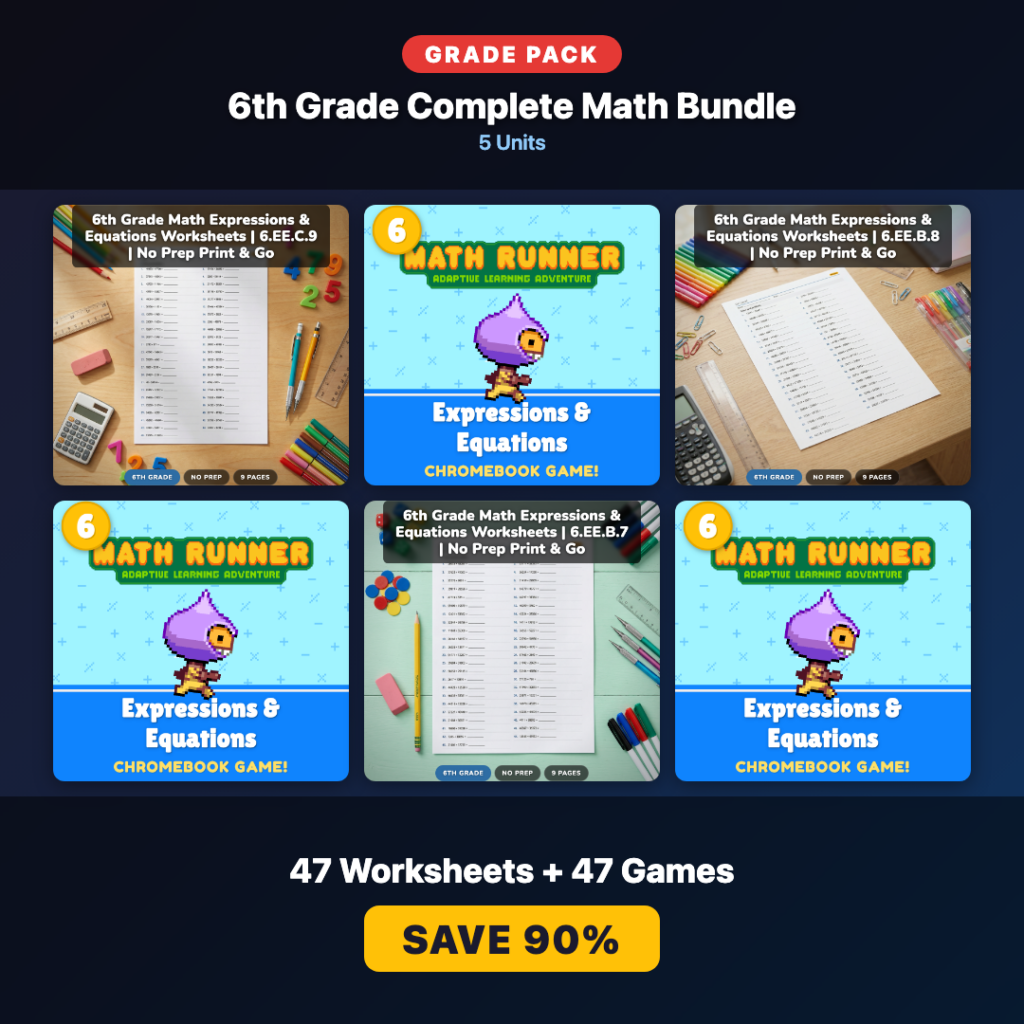
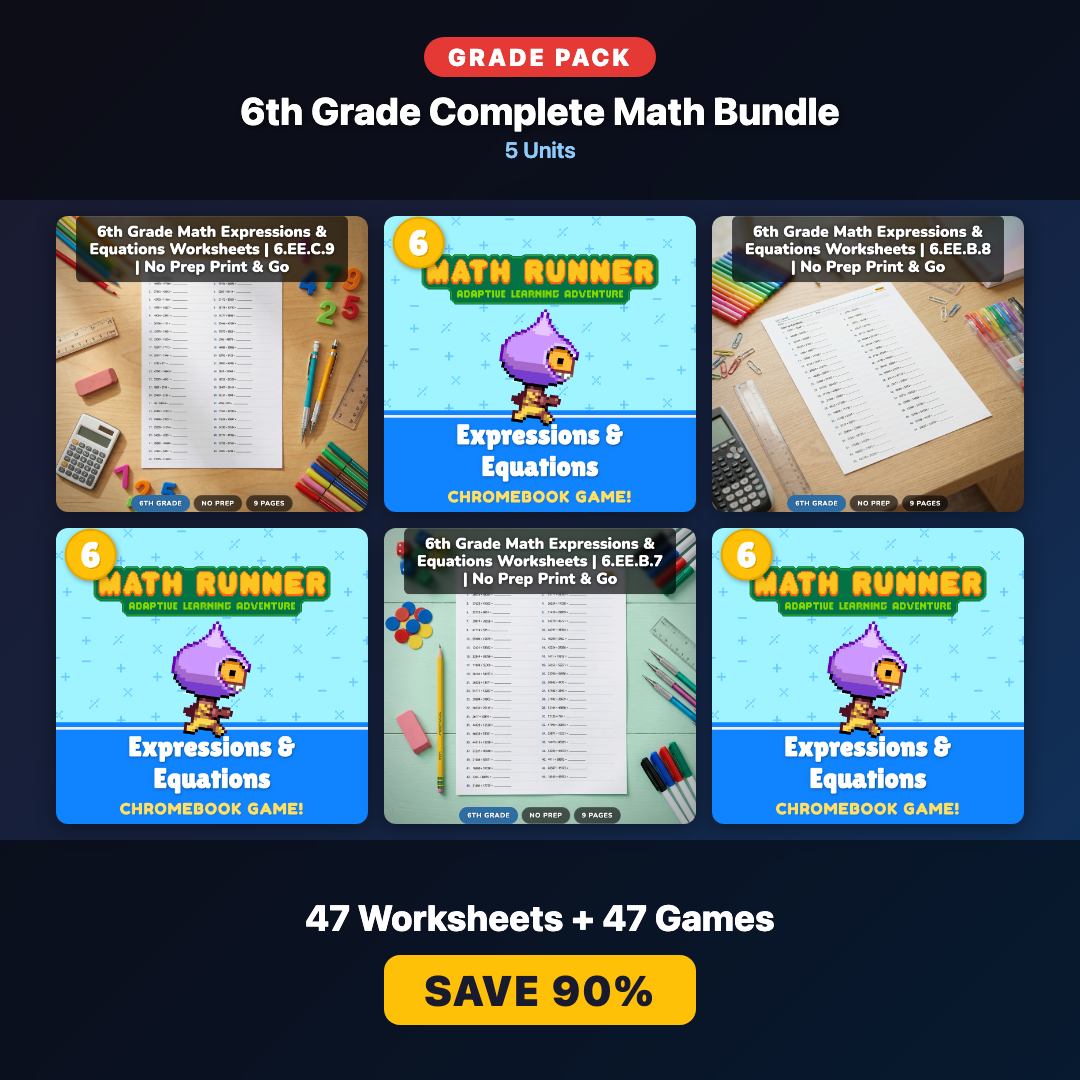
Each standard includes a complete worksheet set with color PDF, black-and-white version, detailed answer keys, and Google Slides format for digital learning. Every worksheet offers three difficulty levels — approaching grade level, on grade level, and above grade level — so you can differentiate for every student in your classroom. The bundle includes over 999+ total pages of ready-to-use practice materials.
47 Interactive Basketball Review Games
Every standard also includes a custom basketball review game with 60+ questions across three difficulty levels. These HTML5 games work perfectly on Smartboards, Chromebooks, and iPads, featuring 2-team competition that gets students excited about math practice. With 2,820+ total questions across all games, you have endless review material for the entire year. Try the free demo game to see how engaging these are for students.
Bundle Savings
Purchasing each resource individually would cost $282.00, but the complete bundle is just $27.00 — that’s 90% savings! At less than $0.60 per standard, you get comprehensive coverage of the entire 6th grade curriculum. School licenses are available for $40.50, allowing unlimited classroom use across your building.
5 Ways to Use This Bundle All Year Long
1. Daily Practice & Warm-Ups
Use the differentiated worksheets for daily spiral review and warm-up activities. The three difficulty levels let you assign appropriate practice to each student while covering the same standard across your entire class.
2. Test Prep & Review
Fire up the basketball games before unit tests and state assessments. The competitive format motivates students to engage with review content, while the immediate feedback helps identify areas needing additional support.
3. Math Centers & Stations
Set up Chromebook stations with different games for independent practice during math centers. Students can work at their own pace while you facilitate small group instruction with other learners.
4. Sub Plans
Leave a basketball game and corresponding worksheet for easy substitute coverage. The games are self-explanatory and engaging, while worksheets provide meaningful practice that connects to your current unit.
5. Differentiated Small Groups
Use the three difficulty levels to target instruction during guided math groups. Struggling students start with approaching-level materials, while advanced learners tackle above-level challenges that extend their thinking.
Supporting Every Learner in 6th Grade Math
For Struggling Students
Start with the approaching grade level worksheets that include additional scaffolds like visual models and step-by-step examples. The basketball games on easy difficulty provide confidence-building practice with immediate feedback. Focus on concrete representations before moving to abstract concepts.
For On-Level Students
Use the grade-level worksheets for independent practice and homework assignments. Medium difficulty games provide appropriate challenge during review sessions. These students benefit from seeing multiple solution strategies and making connections between different representations.
For Advanced Students
Challenge these learners with above grade level worksheets that include extension problems and cross-curricular connections. Hard difficulty games push their thinking with complex multi-step problems. Encourage them to explain their reasoning and explore alternative solution methods.
Get the Complete 6th Grade Math Bundle
This comprehensive bundle gives you everything needed for a full year of 6th grade math instruction. With 47 differentiated worksheet sets, 47 interactive basketball games, and coverage of all Common Core standards, you’ll save hours of planning time while providing engaging, effective instruction for every student.
 Get the Complete Bundle on TpT
Want to see the quality first? Try our free demo basketball game and experience how these resources work in your classroom.
Try a Free Sample First
Not quite ready for the full bundle? Drop your email below and I’ll send you a free 6th grade math worksheet pack with three different standards so you can see the quality and differentiation levels firsthand.
Frequently Asked Questions About 6th Grade Math Resources
What standards does this bundle cover?
The bundle includes all 47 Common Core 6th grade math standards across five domains: Ratios & Proportional Relationships (7 standards), The Number System (15 standards), Expressions & Equations (12 standards), Geometry (4 standards), and Statistics & Probability (9 standards).
How do the basketball review games work?
Each game is an HTML5 interactive experience with 60+ questions across three difficulty levels. Students choose answers to advance down the basketball court, with immediate feedback for correct and incorrect responses. Games work on any device with internet access.
Can I use these on Chromebooks and iPads?
Yes! The basketball games are HTML5-based and work perfectly on Chromebooks, iPads, laptops, and interactive whiteboards. The worksheets are available as PDFs and Google Slides for seamless digital integration across all devices.
Is there a school license option?
Absolutely! The school license costs $40.50 and allows unlimited use across all classrooms in your building. This is perfect for grade-level teams, math departments, or schools implementing consistent 6th grade math resources.
Do the worksheets include answer keys?
Every worksheet set includes detailed answer keys with step-by-step solutions. This makes grading quick and helps you identify exactly where students need additional support or clarification on specific problems.
How much time will this save me in planning?
Teachers report saving 3-5 hours per week in planning time. Instead of searching for quality materials for each standard, you have everything ready to go with appropriate differentiation levels and engaging review activities built in.
Teaching 6th grade math doesn’t have to mean spending every evening searching for quality resources. With one comprehensive bundle covering all 47 standards, you can focus on what matters most — helping your students develop the algebraic thinking and mathematical reasoning skills they’ll need for years to come.
What’s your biggest challenge when teaching 6th grade math? Have you found effective ways to help students make the transition from arithmetic to algebraic thinking?
Remember, you can try the free demo game right now to see how these resources work with your students. For even more middle school math resources, check out our 5th grade math bundle for reviewing prerequisite skills.