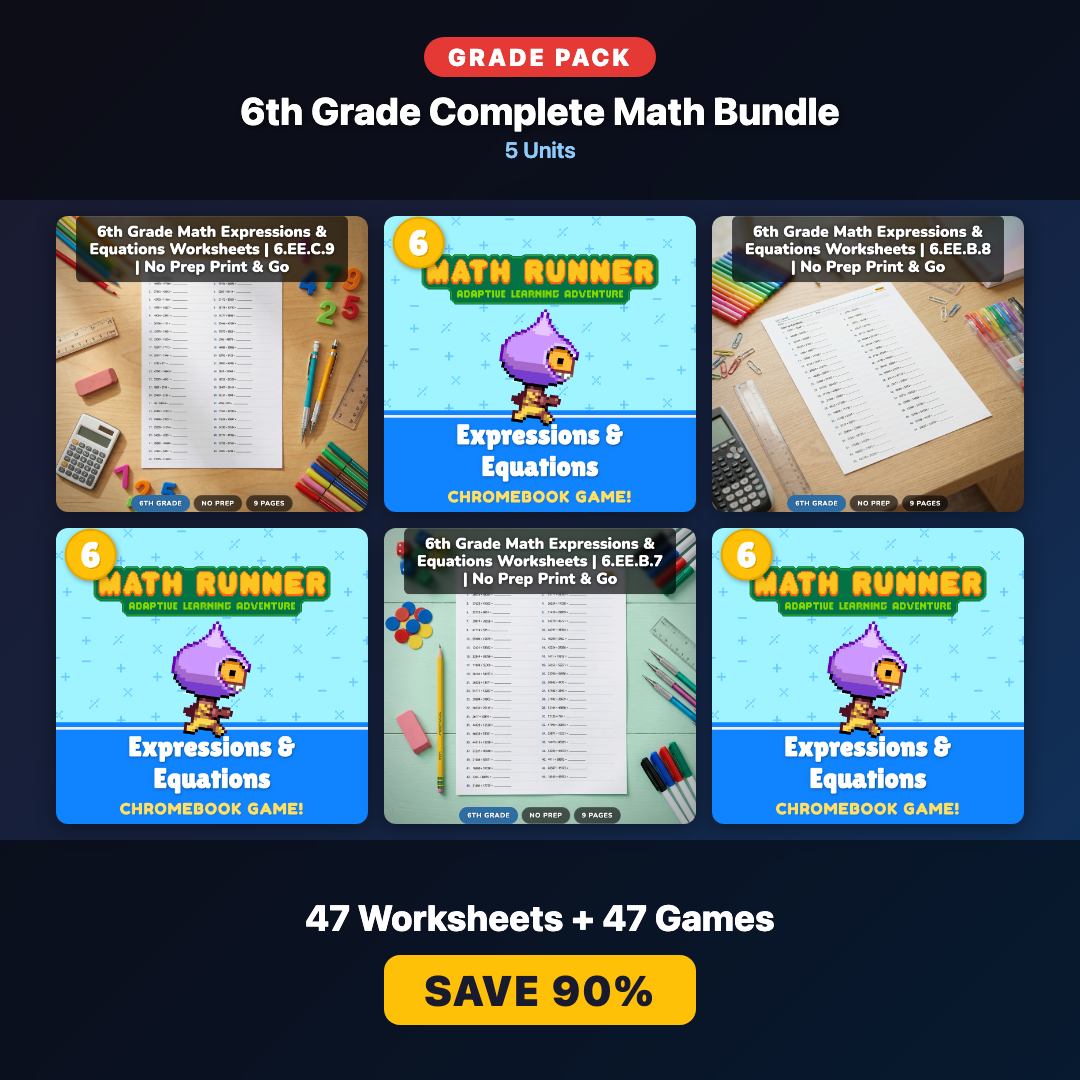
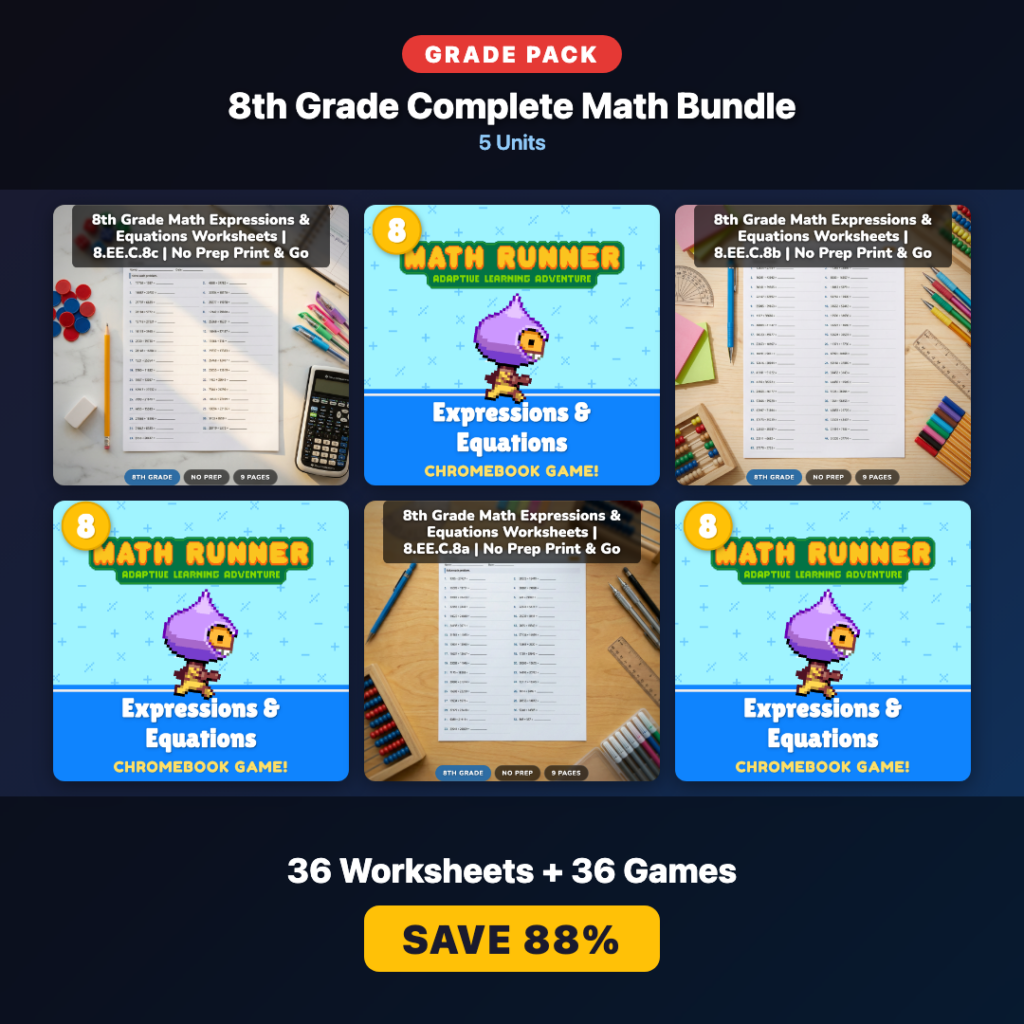
Planning an entire year of 8th grade math can feel overwhelming. You’re covering everything from systems of equations to functions to geometric transformations — and each standard needs differentiated practice, engaging review activities, and assessment prep. That’s 36 Common Core standards across five major domains, each requiring multiple approaches to reach every learner in your classroom.
What if you had ready-to-use worksheets and interactive review games for every single 8th grade math standard? This complete guide walks you through each domain with specific teaching strategies, then shows you how one comprehensive bundle can support your instruction all year long.
Key Takeaway
8th grade math covers 36 Common Core standards across five domains — this guide provides teaching strategies for each domain plus ready-to-use resources for every standard.
8th Grade Math: What Students Need to Master This Year
Eighth grade marks a crucial transition in mathematical thinking. Students move from concrete arithmetic to abstract algebraic reasoning, developing skills that form the foundation for high school mathematics. This year bridges the gap between middle school problem-solving and the formal mathematical structures they’ll encounter in Algebra I.
The Common Core framework organizes 8th grade math into five domains: The Number System (2 standards) extends rational number operations to irrational numbers and scientific notation. Expressions & Equations (13 standards) introduces linear equations, systems, and exponential functions. Functions (5 standards) formalizes function notation and linear relationships. Geometry (12 standards) explores transformations, congruence, and the Pythagorean theorem. Statistics & Probability (4 standards) analyzes bivariate data and linear associations.
Students at this age (typically 13-14 years old) are developing abstract reasoning abilities while still benefiting from concrete representations. They can handle multi-step problems but need scaffolding for complex algebraic manipulations. Visual models, real-world contexts, and technology integration support their transition to formal mathematical thinking.
Need ready-to-go resources for every standard below? I put together a complete 8th grade math bundle with worksheets and review games for each one — but first, here’s your domain-by-domain guide.
The Number System: What 8th Grade Students Learn
The Number System domain focuses on extending students’ understanding of rational numbers to include irrational numbers and working fluently with scientific notation. This domain contains just two standards but represents a significant conceptual leap for students.
Students master CCSS.Math.Content.8.NS.A.1 by understanding that irrational numbers exist and can be approximated by rational numbers. They work with CCSS.Math.Content.8.NS.A.2 to use rational approximations of irrational numbers and compare their sizes.
Number System: Building Number Sense Beyond Rationals
Students explore the gaps in the rational number system and discover numbers like √2 that can’t be expressed as fractions. They use calculators to approximate square roots and place them on number lines.
Common struggles include understanding why irrational numbers are “real” numbers and distinguishing between exact values and approximations. Students often want to convert everything to decimals, missing the precision of expressions like 3√2.
Worksheets help students practice identifying rational vs. irrational numbers and ordering mixed sets. Basketball review games reinforce approximation skills through repeated practice with square roots and scientific notation in competitive formats.
Expressions & Equations: What 8th Grade Students Learn
Expressions & Equations forms the largest domain in 8th grade math, covering 13 standards that introduce students to formal algebra. This domain builds the foundation for high school Algebra I by developing fluency with linear equations, systems, and exponential relationships.
Key standards include CCSS.Math.Content.8.EE.A.1 for working with integer exponents, CCSS.Math.Content.8.EE.B.5 for graphing proportional relationships, and CCSS.Math.Content.8.EE.C.8 for solving systems of linear equations. Students also explore CCSS.Math.Content.8.EE.A.4 for scientific notation and CCSS.Math.Content.8.EE.B.6 for finding slope and y-intercept.
Expressions & Equations: From Arithmetic to Algebra
Students transition from solving simple equations to working with systems and exponential functions. They learn to represent relationships graphically, algebraically, and in tables while connecting these representations.
Students often struggle with the abstract nature of variables and the multiple steps required for solving systems. They may understand individual concepts but have difficulty connecting graphical and algebraic representations of the same relationship.
This domain benefits tremendously from varied practice. Worksheets provide structured practice with equation-solving algorithms, while games offer quick recall of slope-intercept form and system-solving strategies in engaging formats.
For detailed strategies and free resources for each standard, see our posts on teaching linear equations in 8th grade, effective systems of equations strategies, and handling linear equations with multiple solutions.
Functions: What 8th Grade Students Learn
The Functions domain introduces students to formal function notation and linear function analysis. These 5 standards prepare students for the deeper function study they’ll encounter in Algebra I and beyond.
Students work with CCSS.Math.Content.8.F.A.1 to understand functions as rules that assign unique outputs to inputs, CCSS.Math.Content.8.F.A.2 to compare linear and non-linear functions, and CCSS.Math.Content.8.F.B.4 to construct functions modeling linear relationships.
Functions: Formalizing Relationships
Students move beyond “y equals” to function notation f(x), learning to interpret functions as mathematical machines that transform inputs into outputs. They analyze rates of change and initial values in real-world contexts.
The biggest challenge is helping students understand that functions represent relationships, not just equations to solve. Many students struggle with function notation and interpreting what f(3) = 7 means in context.
Worksheets scaffold the transition from informal relationship language to formal function notation. Games provide repeated practice with evaluating functions and identifying linear vs. non-linear patterns through immediate feedback.
Geometry: What 8th Grade Students Learn
The Geometry domain covers 12 standards focusing on transformations, congruence, similarity, and the Pythagorean theorem. This represents a shift from measurement-focused geometry to transformation-based geometric reasoning.
Essential standards include CCSS.Math.Content.8.G.A.1 for understanding rotations, reflections, and translations, CCSS.Math.Content.8.G.B.6 for applying the Pythagorean theorem, and CCSS.Math.Content.8.G.C.9 for finding volumes of cylinders, cones, and spheres.
Geometry: Transformations and Proofs
Students learn that geometric figures can be moved, flipped, and turned while preserving their essential properties. They use coordinate geometry to describe transformations precisely and apply the Pythagorean theorem in real-world contexts.
Students often struggle with the precision required for transformation descriptions and connecting algebraic expressions of the Pythagorean theorem to geometric diagrams. Spatial reasoning varies significantly among students this age.
Worksheets provide structured practice with transformation rules and Pythagorean theorem applications. Games make memorizing formulas for volume and surface area more engaging through competitive team formats.
Statistics & Probability: What 8th Grade Students Learn
Statistics & Probability focuses on bivariate data analysis and linear associations. These 4 standards prepare students for more sophisticated data analysis in high school statistics courses.
Students master CCSS.Math.Content.8.SP.A.1 by constructing and interpreting scatter plots, CCSS.Math.Content.8.SP.A.2 by understanding correlation and causation, and CCSS.Math.Content.8.SP.A.3 by fitting lines to data and interpreting slope and y-intercept in context.
Statistics & Probability: Making Sense of Data
Students learn to see patterns in bivariate data and distinguish between correlation and causation. They use technology to find lines of best fit and interpret what linear models tell us about real-world relationships.
The biggest challenge is helping students understand that correlation doesn’t imply causation and interpreting what slope means in different contexts. Students also struggle with the imprecision of real data compared to the clean numbers in algebra problems.
Worksheets provide practice with scatter plot construction and line fitting. Games reinforce vocabulary around correlation, outliers, and linear associations through repeated exposure in competitive formats.
What’s in the 8th Grade Complete Math Bundle?
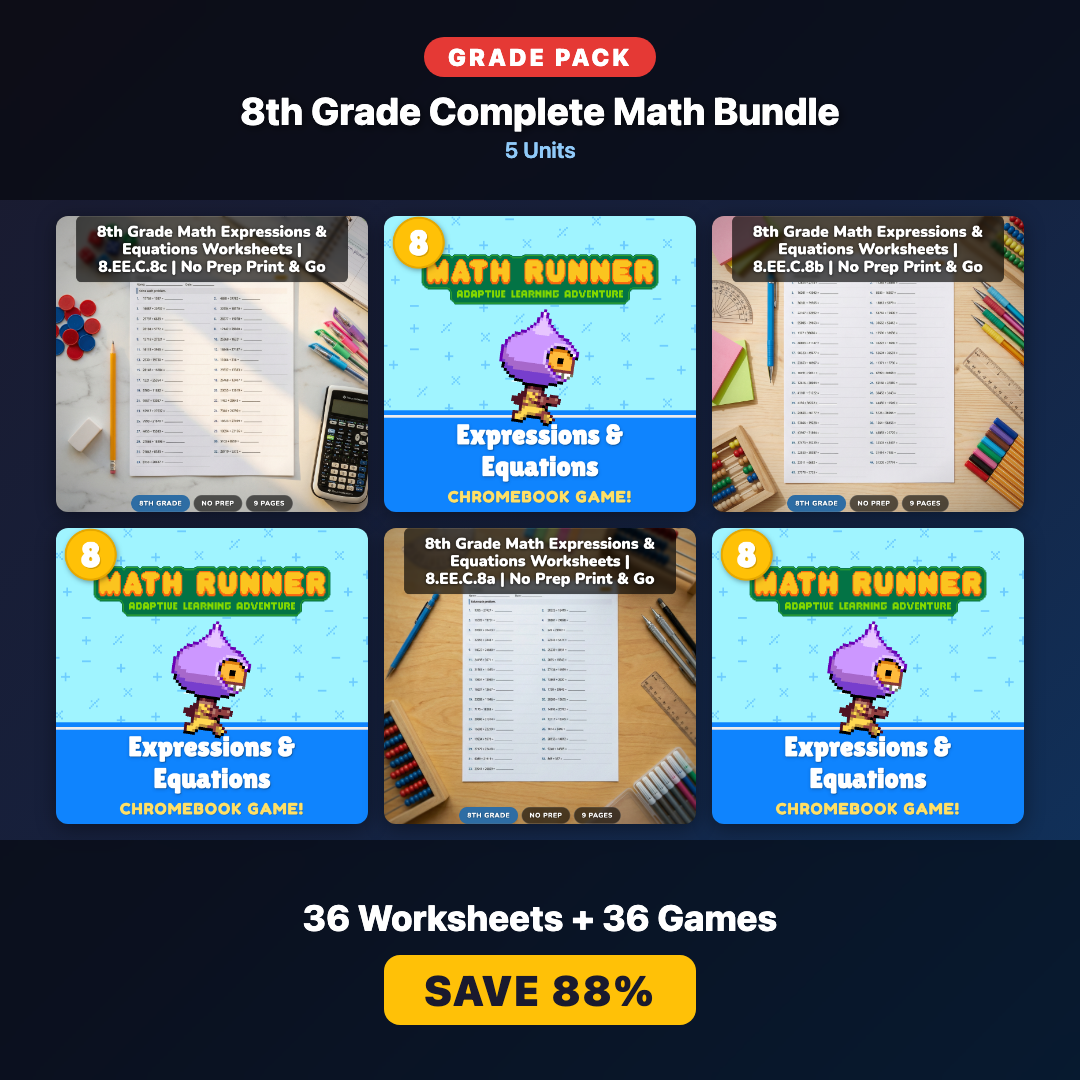
36 Differentiated Worksheet Sets
Each standard includes a complete worksheet set with color PDF, black-and-white version, detailed answer keys, and Google Slides format. Every worksheet offers three difficulty levels: foundational practice for struggling students, grade-level problems for on-track learners, and challenge extensions for advanced students. The bundle contains 999+ total pages of carefully scaffolded practice problems.
36 Interactive Basketball Review Games
Every standard gets its own HTML5 basketball game with three difficulty levels and 2-team competition format. Games work seamlessly on Smartboards, Chromebooks, and iPads without downloads or accounts. Students shoot baskets by answering math questions correctly, with instant feedback and automatic scorekeeping. The bundle includes 2,160+ total questions across all games. Try a free demo game here to see how they work.
Bundle Savings
Individual worksheet sets cost $6.00 each, making the total individual value $216.00. The complete bundle costs just $27.00 — that’s 88% savings, or $0.75 per standard. School licenses are available for $40.50, allowing unlimited teacher use within your building.
5 Ways to Use This Bundle All Year Long
1. Daily Practice & Warm-Ups
Start each class with 5-10 problems from the appropriate worksheet difficulty level. Rotate through recently taught standards to maintain skills while introducing new concepts.
2. Test Prep & Review
Use basketball games for engaging review sessions before unit tests or state assessments. Students practice problem-solving under time pressure while having fun with the competitive format.
3. Math Centers & Stations
Set up Chromebook stations with different games while other students work on worksheet problems. Rotate groups every 15-20 minutes for varied practice approaches.
4. Sub Plans
Leave a basketball game and corresponding worksheet for easy substitute coverage. Games are self-explanatory and worksheets include detailed answer keys for non-math subs.
5. Differentiated Small Groups
Use the three difficulty levels to target instruction precisely. Struggling students start with foundational problems while advanced learners tackle challenge extensions simultaneously.
Supporting Every Learner in 8th Grade Math
For Struggling Students
Start with the foundational difficulty level, which breaks complex problems into smaller steps with visual supports. Use the basketball games on easy mode to build confidence before increasing difficulty. Pair worksheets with manipulatives or graphing calculators for additional scaffolding.
For On-Level Students
Use grade-level worksheet problems for independent practice and medium difficulty games for review. These students can work through most problems with minimal teacher support while building fluency with standard algorithms.
For Advanced Students
Challenge extensions connect current standards to high school concepts and real-world applications. Hard difficulty games include multi-step problems and require deeper mathematical reasoning beyond basic skill practice.
Get the Complete 8th Grade Math Bundle
This bundle provides everything you need for a full year of 8th grade math instruction. With 36 differentiated worksheet sets and 36 interactive basketball games, you’ll have engaging practice and review activities for every Common Core standard. The 88% savings means you get comprehensive resources for less than $1 per standard.
Want to try before you buy? Play the free demo game to experience the basketball format firsthand.
Try a Free Sample First
Not ready for the full bundle? Drop your email and I’ll send you a free 8th grade linear equations worksheet pack with answer keys and teaching tips.
Frequently Asked Questions About 8th Grade Math Resources
What standards does this bundle cover?
This bundle covers all 36 Common Core 8th grade math standards across five domains: The Number System (2), Expressions & Equations (13), Functions (5), Geometry (12), and Statistics & Probability (4). Each standard gets both worksheets and review games.
How do the basketball review games work?
Students answer math questions to shoot baskets in a 2-team competition format. Correct answers score points while wrong answers miss the shot. Games include three difficulty levels and work on any device with internet access.
Can I use these on Chromebooks and iPads?
Yes! All basketball games are HTML5-based and work perfectly on Chromebooks, iPads, Smartboards, and computers. No downloads or accounts required — just click and play. Worksheets are available as PDFs and Google Slides.
Is there a school license option?
School licenses cost $40.50 and allow unlimited use by all teachers in your building. This includes sharing resources with colleagues, using in multiple classrooms, and printing unlimited copies for students.
Do the worksheets include answer keys?
Every worksheet set includes detailed answer keys with step-by-step solutions. This makes grading quick and helps substitute teachers provide accurate feedback when you’re absent.
What’s the difference between difficulty levels?
Foundational level breaks problems into smaller steps with visual supports. Grade-level provides standard practice problems. Challenge level includes extensions and real-world applications that connect to high school concepts.
Teaching 8th grade math successfully means having the right resources for every standard and every learner. This complete bundle gives you differentiated practice and engaging review activities that work all year long. Try the free demo to see how interactive review can transform your math classroom.
What’s your biggest challenge with 8th grade math instruction? The abstract nature of algebra, keeping students engaged during review, or finding time to create differentiated materials?