If your third graders freeze when they see a missing number in a multiplication equation, you’re not alone. Teaching students to find unknown numbers in multiplication and division problems can feel like solving a puzzle — except your students don’t have all the pieces yet.
The good news? With the right strategies, you can turn this challenging concept into an “aha!” moment that builds their algebraic thinking foundation for years to come.
Key Takeaway
Unknown number problems teach students to think algebraically by using the relationship between multiplication and division to solve for missing factors or products.
Why Unknown Numbers Matter in Third Grade Math
Unknown number problems in multiplication and division equations are a cornerstone of CCSS.Math.Content.3.OA.A.4, which requires students to determine the unknown whole number in equations relating three whole numbers. This isn’t just about finding missing numbers — it’s about developing algebraic reasoning skills that will serve students through advanced mathematics.
Research from the National Mathematics Advisory Panel shows that early algebraic thinking significantly predicts later success in algebra courses. When students learn to see the relationship between multiplication and division through unknown number problems, they’re building the foundation for solving equations in middle and high school.
This standard typically appears in the second quarter of third grade, after students have mastered basic multiplication facts through 10 and understand the relationship between multiplication and division. Students should be comfortable with fact families (like 3 × 4 = 12, 4 × 3 = 12, 12 ÷ 3 = 4, 12 ÷ 4 = 3) before tackling unknown number equations.
Looking for a ready-to-go resource? I put together a differentiated unknown numbers pack that covers everything below — but first, the teaching strategies that make it work.
Common Unknown Number Misconceptions in Third Grade
Understanding where students struggle helps you address these misconceptions before they become entrenched thinking patterns.
Common Misconception: Students think the unknown number is always the largest number in the problem.
Why it happens: They’re used to addition problems where the sum is typically the biggest number.
Quick fix: Show examples where the unknown is the smallest number, like 24 ÷ ? = 6.
Common Misconception: Students add all the given numbers together to find the unknown.
Why it happens: They haven’t internalized that multiplication and division show different relationships than addition.
Quick fix: Use concrete manipulatives to show groups and grouping before moving to abstract equations.
Common Misconception: Students can’t solve division problems with unknowns because they “don’t know division facts.”
Why it happens: They don’t see the connection between multiplication and division as inverse operations.
Quick fix: Always present fact families together and emphasize the relationship between operations.
Common Misconception: Students think there might be multiple correct answers.
Why it happens: They’re uncertain about the mathematical relationships and guess rather than reason.
Quick fix: Use the “check your work” strategy by substituting the answer back into the original equation.
5 Research-Backed Strategies for Teaching Unknown Numbers
Strategy 1: Think-Alouds with Fact Family Connections
This strategy helps students see the relationship between multiplication and division by explicitly connecting known facts to unknown number problems. Students learn to use what they know to figure out what they don’t know.
What you need:
- Whiteboard or chart paper
- Fact family triangles or cards
- Different colored markers
Steps:
- Present an equation like 6 × ? = 42
- Say aloud: “I know 6 times something equals 42. What times 6 gives me 42?”
- Write the related division fact: 42 ÷ 6 = ?
- Solve the division problem: 42 ÷ 6 = 7
- Check by substituting back: 6 × 7 = 42 ✓
- Show all four facts in the family: 6 × 7 = 42, 7 × 6 = 42, 42 ÷ 6 = 7, 42 ÷ 7 = 6
Strategy 2: Array Detective Work
Arrays provide a visual representation that helps students see the relationship between factors and products, making unknown numbers concrete rather than abstract.
What you need:
- Square tiles or counters
- Graph paper
- Unknown number equation cards
Steps:
- Give students an equation like ? × 4 = 20
- Have them build an array with 20 tiles arranged in 4 columns
- Count the rows to find the unknown factor (5 rows)
- Write the complete equation: 5 × 4 = 20
- Show how the array can be “flipped” to represent 4 × 5 = 20
- Connect to division: 20 ÷ 4 = 5 and 20 ÷ 5 = 4
Strategy 3: Missing Factor Hunt Game
This partner game makes practice engaging while reinforcing the relationship between multiplication and division through repeated exposure and peer discussion.
What you need:
- Equation cards with various unknown positions
- Answer key or fact family reference sheet
- Timer
- Recording sheet
Steps:
- Partner A draws a card and reads the equation (e.g., “8 times what equals 56?”)
- Partner B solves using any strategy (fact families, skip counting, division)
- Both partners check the answer by substituting back into the original equation
- Partners switch roles and continue for 10 minutes
- Record successful solutions on their tracking sheet
- Celebrate strategies that worked well during a brief share-out
Strategy 4: Story Problem Connections
Real-world contexts help students understand when and why they might need to find unknown numbers, making the math meaningful and memorable.
What you need:
- Story problem scenarios
- Manipulatives or drawings
- Equation recording sheet
Steps:
- Present a story: “Maria has 3 bags with the same number of stickers. She has 21 stickers total. How many stickers are in each bag?”
- Students identify what they know (3 bags, 21 total) and what they need to find (stickers per bag)
- Write the equation: 3 × ? = 21
- Solve using their preferred strategy (division, fact families, or skip counting)
- Check the answer in the context: “Does 3 bags with 7 stickers each equal 21 total? Yes!”
- Write the complete fact family to reinforce relationships
Strategy 5: Balance Scale Thinking
This strategy helps students visualize equations as balanced relationships, building algebraic thinking skills that will serve them in later mathematics courses.
What you need:
- Balance scale or balance scale drawing
- Equation strips
- Small objects for weighing
Steps:
- Show an equation like 4 × ? = 28 as a balance scale
- Explain that both sides must be equal for the scale to balance
- Ask: “What number makes 4 times that number equal to 28?”
- Test possibilities: “Would 6 work? 4 × 6 = 24. That’s less than 28, so the scale tips.”
- Continue testing until finding 7: “4 × 7 = 28. The scale balances!”
- Emphasize that the equals sign means “the same as” or “balanced”
How to Differentiate Unknown Numbers for All Learners
For Students Who Need Extra Support
Start with fact families students already know well, particularly 2s, 5s, and 10s. Provide multiplication charts and encourage students to use skip counting or repeated addition to verify their thinking. Use concrete manipulatives for every problem initially, and focus on one type of unknown position at a time (start with unknown products: 3 × 4 = ?, then move to unknown factors: 3 × ? = 12). Break multi-step thinking into smaller chunks and provide sentence frames like “I know ___ times ___ equals ___, so the missing number is ___.”
For On-Level Students
Students working at grade level should practice with unknown numbers in all positions within equations, using facts through 10 × 10 as outlined in CCSS.Math.Content.3.OA.A.4. They should be able to explain their reasoning and use multiple strategies flexibly. Encourage them to check their work by substituting answers back into original equations and to make connections between multiplication and division. Provide a mix of abstract equations and word problems to build both computational and application skills.
For Students Ready for a Challenge
Advanced students can work with larger factors, create their own unknown number problems for classmates, or explore patterns in unknown number equations. Challenge them to solve problems with multiple steps or to find unknown numbers in more complex contexts. They can also investigate what happens when unknown numbers appear in different positions within the same problem set, or explore how unknown number concepts connect to early algebraic thinking with simple variables.
A Ready-to-Use Unknown Numbers Resource for Your Classroom
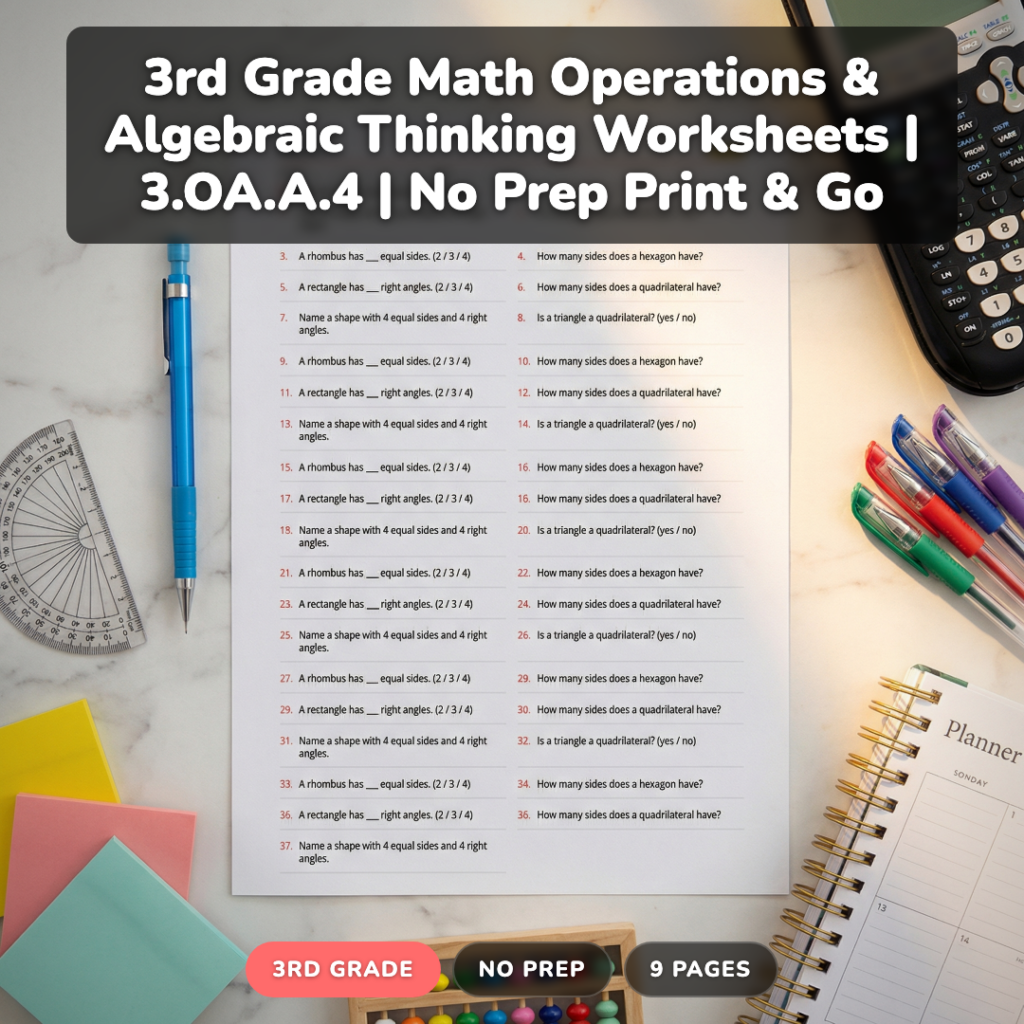
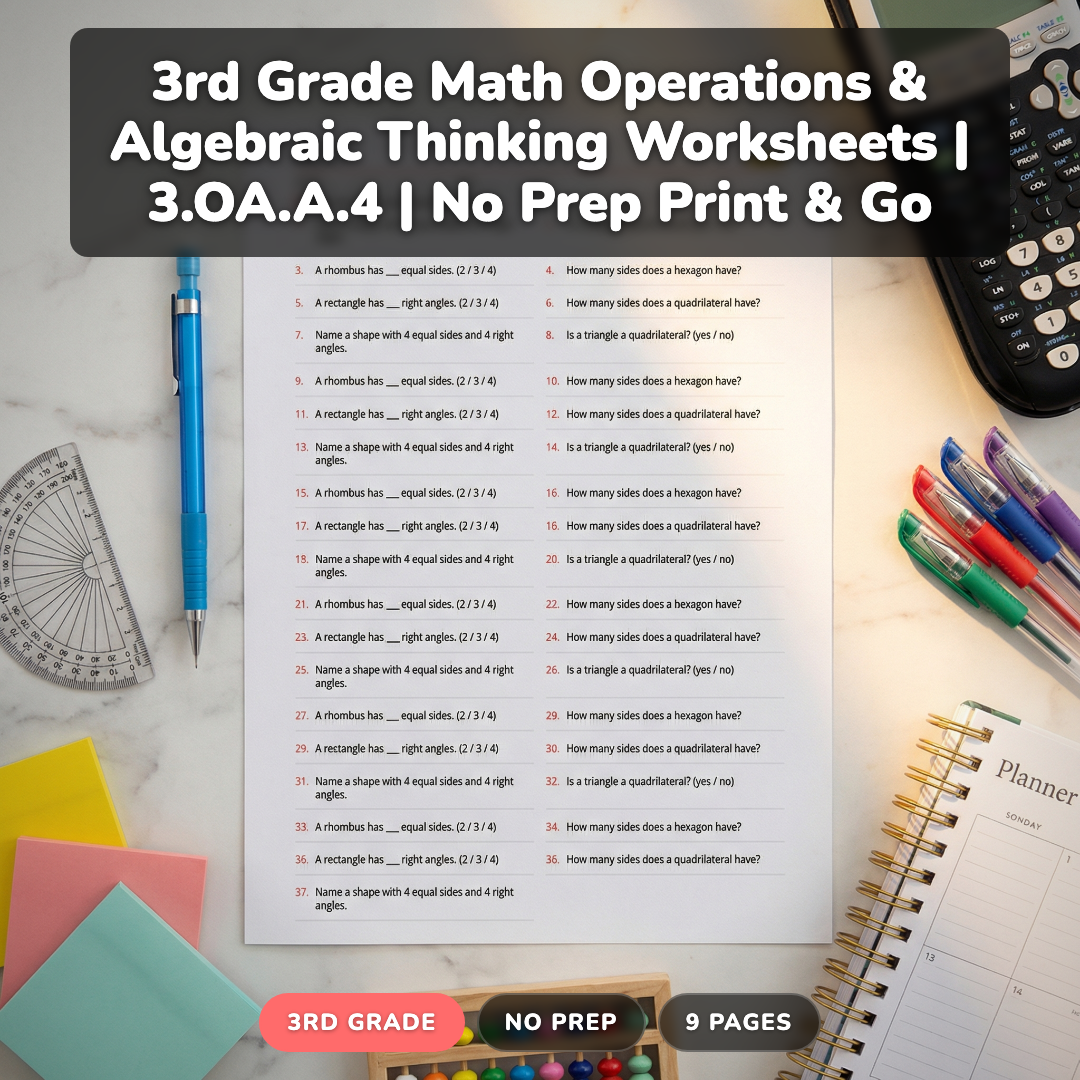
After years of creating unknown number activities from scratch, I put together a comprehensive resource that saves you hours of prep time while giving your students exactly the practice they need. This 9-page differentiated pack includes 132 problems across three levels: Practice (37 problems), On-Level (50 problems), and Challenge (45 problems).
What makes this resource different is the careful progression within each level. Practice problems focus on building confidence with smaller factors and familiar fact families. On-Level problems cover the full range of CCSS.Math.Content.3.OA.A.4 expectations with unknown numbers in various positions. Challenge problems push students to apply their understanding in more complex situations.
Each level includes answer keys and can be used for independent practice, math centers, homework, or assessment. The problems are designed to build on each other, so students develop both computational fluency and algebraic reasoning skills.
You can grab this time-saving resource and start using it tomorrow:
Grab a Free Unknown Numbers Sample to Try
Want to see how these strategies work in practice? I’ll send you a free sample pack with practice problems from each differentiation level, plus a quick reference guide for teaching unknown numbers. Drop your email below and I’ll send it right over.
Frequently Asked Questions About Teaching Unknown Numbers
When should I introduce unknown numbers in multiplication and division?
Introduce unknown numbers after students are comfortable with basic multiplication facts through 5 × 5 and understand that multiplication and division are inverse operations. This typically happens in late fall or early winter of third grade, following CCSS.Math.Content.3.OA.A.4 pacing.
What’s the difference between unknown numbers and algebra?
Unknown numbers are the foundation of algebraic thinking. Instead of using variables like x, students work with question marks or empty boxes. The reasoning process is the same: using known information to find unknown values through mathematical relationships.
Should students memorize strategies or understand the concepts?
Focus on understanding first. Students need to see why strategies work, not just how to apply them. Once they understand the relationship between multiplication and division, they can choose strategies that make sense to them for different problems.
How do I help students who guess instead of reasoning?
Require students to explain their thinking and check their answers. Use sentence frames like “I know… so the unknown number must be…” Always have students substitute their answer back into the original equation to verify it works.
What manipulatives work best for unknown number problems?
Arrays with square tiles or counters are most effective because students can physically see the relationship between factors and products. Base-ten blocks work well for larger numbers, and number lines help with skip counting strategies.
Teaching unknown numbers doesn’t have to be a struggle for you or your students. With these concrete strategies and plenty of differentiated practice, your third graders will develop the algebraic thinking skills they need for future math success.
What’s your go-to strategy for helping students understand unknown numbers? And don’t forget to grab your free sample pack above!