If your third graders freeze when they see 6 × 4 but confidently solve 4 × 6, they’re missing a crucial mathematical foundation. Understanding properties of operations isn’t just about memorizing rules—it’s about developing flexible thinking that makes multiplication and division easier and more intuitive. You’ll discover five research-backed strategies that help students truly grasp these mathematical properties and apply them confidently in problem-solving.
Key Takeaway
Teaching properties of operations through visual models and hands-on exploration helps students see patterns rather than memorize isolated facts.
Why Properties of Operations Matter in Third Grade
Properties of operations form the foundation for algebraic thinking in elementary school. According to the Common Core State Standards, CCSS.Math.Content.3.OA.B.5 requires students to apply properties of operations as strategies to multiply and divide. This standard bridges the gap between basic fact fluency and more complex mathematical reasoning.
Research from the National Council of Teachers of Mathematics shows that students who understand these properties develop stronger number sense and perform 23% better on multi-step word problems. The commutative, associative, and distributive properties aren’t abstract concepts—they’re practical tools that make mental math faster and more accurate.
Third grade is the optimal time to introduce these concepts because students have developed sufficient computational fluency with addition and subtraction while still building their multiplication foundations. The properties help students see relationships between operations rather than treating each fact as an isolated piece of information.
Looking for a ready-to-go resource? I put together a differentiated properties of operations pack that covers everything below—but first, the teaching strategies that make it work.
Common Properties of Operations Misconceptions in 3rd Grade
Common Misconception: Students think 3 × 5 and 5 × 3 are completely different problems requiring separate memorization.
Why it happens: They haven’t connected the visual representation to the numerical expression.
Quick fix: Show both arrangements with manipulatives side by side and count together.
Common Misconception: Students believe the distributive property only works with addition, not subtraction.
Why it happens: Most examples they see use addition, making subtraction seem like an exception.
Quick fix: Explicitly model 8 × (10 – 2) using area models with both operations.
Common Misconception: Students think properties only apply to small numbers they can visualize easily.
Why it happens: Initial instruction focuses on concrete examples without bridging to abstract application.
Quick fix: Gradually increase numbers while maintaining the same visual structure and language patterns.
Common Misconception: Students assume that changing the order changes the answer in division just like multiplication.
Why it happens: They overgeneralize the commutative property without understanding its limitations.
Quick fix: Use concrete division scenarios to show why 12 ÷ 3 ≠ 3 ÷ 12.
5 Research-Backed Strategies for Teaching Properties of Operations
Strategy 1: Array Rotation for Commutative Property
Students physically rotate arrays to discover that multiplication order doesn’t change the total. This hands-on approach helps them see the commutative property as a visual reality, not just a rule to memorize.
What you need:
- Square tiles or counters
- Grid paper
- Index cards for recording
Steps:
- Give students 12 tiles and ask them to arrange in a 3×4 rectangle
- Have them count the total and record “3 × 4 = 12”
- Ask them to physically rotate the array 90 degrees
- Count again and record “4 × 3 = 12”
- Repeat with different arrays, always rotating and comparing
- Students write their observations about what stays the same
Strategy 2: Break-Apart Models for Distributive Property
Students use area models to break larger multiplication problems into smaller, manageable parts. This strategy builds on their addition skills while introducing algebraic thinking patterns.
What you need:
- Grid paper or area model templates
- Colored pencils
- Base-10 blocks (optional)
Steps:
- Start with 6 × 8 drawn as a rectangle on grid paper
- Show how to break 8 into 5 + 3 with a vertical line
- Color the two sections differently (6 × 5 and 6 × 3)
- Calculate each part separately: 30 + 18 = 48
- Compare to 6 × 8 = 48 to confirm they’re equal
- Practice with problems like 7 × 9 = 7 × (10 – 1) = 70 – 7 = 63
Strategy 3: Grouping Games for Associative Property
Students explore different ways to group the same three numbers in multiplication, discovering that grouping doesn’t affect the final answer. This kinesthetic approach makes abstract concepts concrete.
What you need:
- Small objects for grouping (beans, buttons, etc.)
- Paper plates or hoops
- Parentheses cards
Steps:
- Give students 24 objects and the expression 2 × 3 × 4
- First grouping: Make 2 groups of 3, then multiply by 4
- Count: (2 × 3) × 4 = 6 × 4 = 24
- Rearrange the same objects: Make 3 groups of 4, then multiply by 2
- Count: 2 × (3 × 4) = 2 × 12 = 24
- Record both expressions and compare answers
- Try with different three-factor problems
Strategy 4: Identity Property Investigation
Students discover patterns when multiplying by 1 and adding 0 through systematic exploration. This builds understanding of identity elements and their special properties in operations.
What you need:
- Number cards 1-20
- Recording sheet with two columns
- Calculator for verification
Steps:
- Students pick any number card and multiply by 1
- Record the problem and answer in column 1
- Pick the same number and add 0
- Record in column 2
- Repeat with 10 different numbers
- Look for patterns in their recorded answers
- Write a rule about multiplying by 1 and adding 0
- Test their rule with larger numbers
Strategy 5: Property Detective Centers
Students rotate through stations where they identify which property makes each problem easier to solve. This application-focused approach helps them choose appropriate strategies independently.
What you need:
- Problem cards sorted by station
- Property reference charts
- Timer for rotations
- Recording sheets
Steps:
- Station 1: Commutative problems (4×7 vs 7×4)
- Station 2: Distributive problems (6×19 = 6×20 – 6×1)
- Station 3: Associative problems (2×5×3)
- Station 4: Identity problems mixed with others
- Students solve and identify which property helped most
- Groups share their strategies during debrief
How to Differentiate Properties of Operations for All Learners
For Students Who Need Extra Support
Start with concrete manipulatives and single-digit numbers. Use consistent language patterns (“I can switch the order”) and provide visual anchor charts showing each property with pictures. Focus on one property at a time over several days rather than introducing all properties simultaneously. Pair struggling students with stronger partners for peer explanation opportunities.
For On-Level Students
Students work with two-digit numbers and begin choosing which property to apply in different situations. They can explain their thinking using mathematical vocabulary and make connections between properties. Provide mixed practice where they identify unknown properties in given examples and justify their reasoning with visual models or number patterns.
For Students Ready for a Challenge
Extend learning by exploring how properties work with fractions or larger numbers. Challenge students to create word problems that require specific properties to solve efficiently. Have them investigate whether properties hold true for other operations like subtraction and division, developing mathematical arguments for their conclusions.
A Ready-to-Use Properties of Operations Resource for Your Classroom
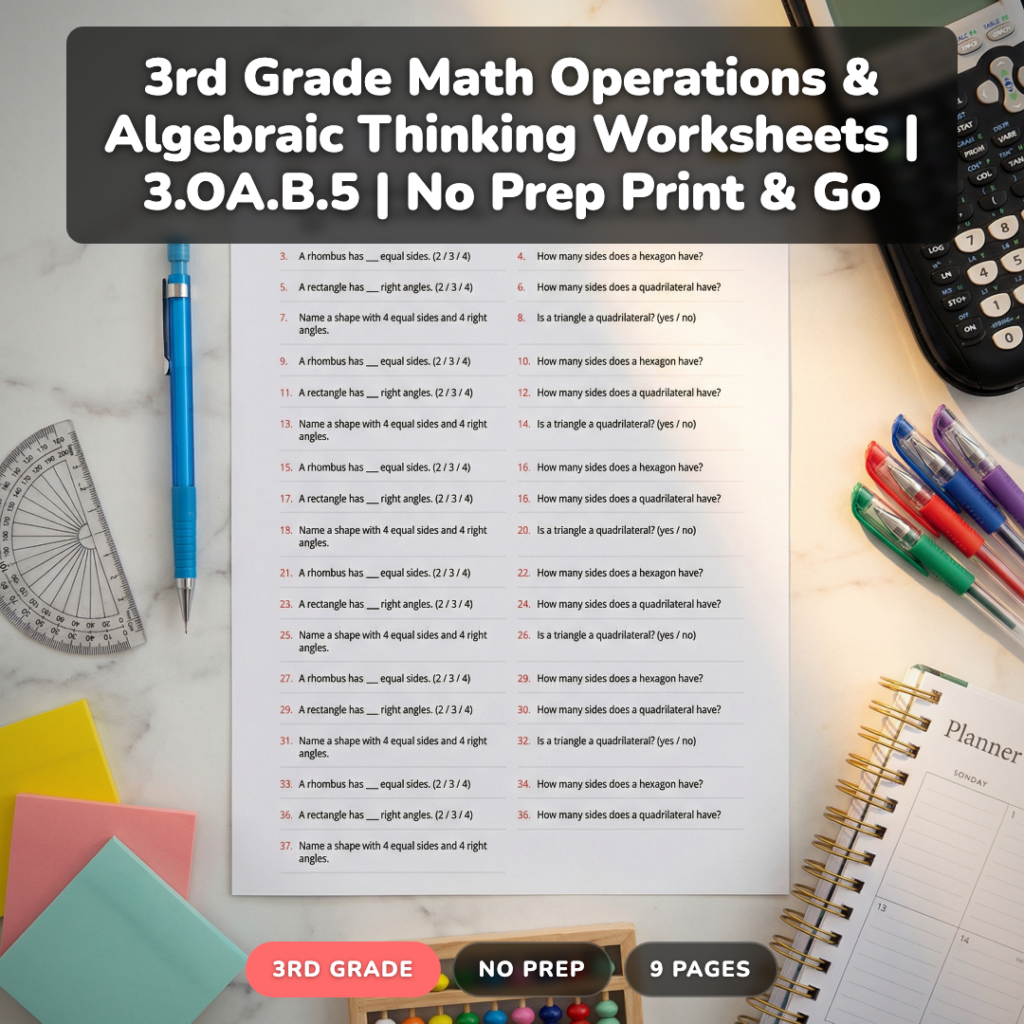
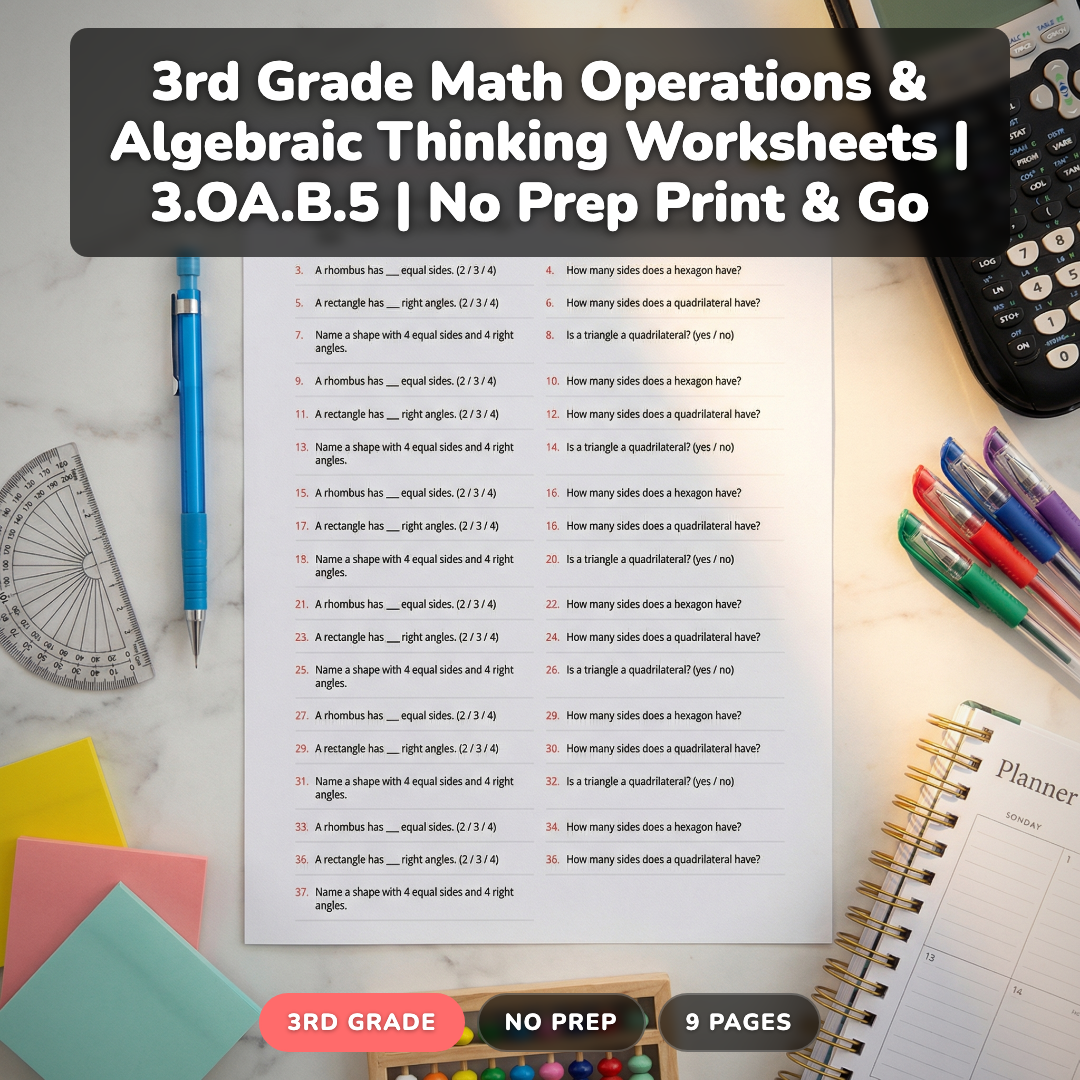
After years of creating and refining these activities, I’ve compiled everything into a comprehensive worksheet pack that saves you hours of prep time. This differentiated resource includes 132 carefully crafted problems across three difficulty levels, ensuring every student can access the learning while being appropriately challenged.
The pack includes 37 practice problems for students building foundational understanding, 50 on-level problems that align perfectly with CCSS.Math.Content.3.OA.B.5, and 45 challenge problems for students ready to apply properties in complex situations. Each level includes visual supports, clear directions, and answer keys for easy grading.
What makes this resource different is the intentional progression from concrete examples to abstract application, matching how students naturally develop mathematical understanding. The problems aren’t just computation practice—they require students to choose appropriate properties and explain their reasoning.
You can grab this complete Properties of Operations pack and start using it tomorrow—no prep required.
Grab a Free Properties of Operations Sample to Try
Want to see how these strategies work in practice? I’ll send you a free sample worksheet with problems from each difficulty level, plus a quick reference guide for teaching each property. Perfect for trying these ideas with your students before diving into the full resource.
Frequently Asked Questions About Teaching Properties of Operations
When should I introduce properties of operations in third grade?
Introduce properties after students have basic multiplication fact fluency through 5×5. Typically this happens in late fall or winter, allowing time to build on addition/subtraction properties first. Start with commutative property using arrays, then gradually add distributive and associative properties over several weeks.
How do I help students remember the property names?
Focus on understanding the concepts before introducing formal names. Use memory devices: “commutative” sounds like “commute” (switching places), “associative” relates to “associate” (grouping with friends). Create anchor charts with student-friendly definitions and visual examples rather than requiring immediate memorization of terms.
What’s the biggest mistake teachers make when teaching these properties?
The biggest mistake is teaching properties as isolated rules rather than useful strategies. Students need to see how properties make math easier, not just memorize that 3×4 equals 4×3. Always connect properties to problem-solving situations where they provide genuine advantages for mental math or computation.
How do properties of operations connect to algebraic thinking?
Properties lay groundwork for algebra by showing that mathematical relationships remain consistent regardless of specific numbers used. When students understand that (a×b)×c = a×(b×c) works for any numbers, they’re developing algebraic reasoning. This prepares them for variables and equations in later grades.
Should I teach all properties at once or separately?
Teach properties separately with focused practice before combining them. Spend 3-4 days on commutative property with multiplication, then move to distributive property for a week. Once students understand each property individually, provide mixed practice where they choose which property helps solve problems most efficiently.
Teaching properties of operations effectively transforms how students approach multiplication and division, building confidence and mathematical flexibility that serves them throughout their academic journey. The key is moving beyond rote memorization to help students see these properties as powerful problem-solving tools.
What’s your go-to strategy for helping students understand the commutative property? I’d love to hear what works in your classroom! And don’t forget to grab that free sample resource above—it’s a great way to try these strategies with your students this week.