If your third graders look confused when you mention “patterns in the addition table,” you’re not alone. Teaching arithmetic patterns feels abstract to many students—until you make the invisible visible with the right strategies.
You’ll discover five research-backed approaches that help students not just identify patterns, but actually explain why they work. Plus, you’ll get practical tips for differentiating this challenging skill for all learners in your classroom.
Key Takeaway
Students master arithmetic patterns when they can visualize relationships, use manipulatives to discover patterns themselves, and connect patterns to properties they already know.
Why Teaching Arithmetic Patterns Matters in Third Grade
Arithmetic patterns form the foundation for algebraic thinking that students will use throughout their mathematical careers. CCSS.Math.Content.3.OA.D.9 specifically asks students to identify patterns in addition and multiplication tables, then explain them using properties of operations like the commutative and associative properties.
This standard typically appears in the second half of third grade, after students have developed fluency with basic addition and multiplication facts. Research from the National Council of Teachers of Mathematics shows that students who can identify and explain arithmetic patterns score 23% higher on algebraic reasoning assessments in middle school.
The timing is crucial—students need solid fact fluency before they can focus on the underlying patterns. Most teachers introduce this concept between February and April, building on students’ growing multiplication table knowledge.
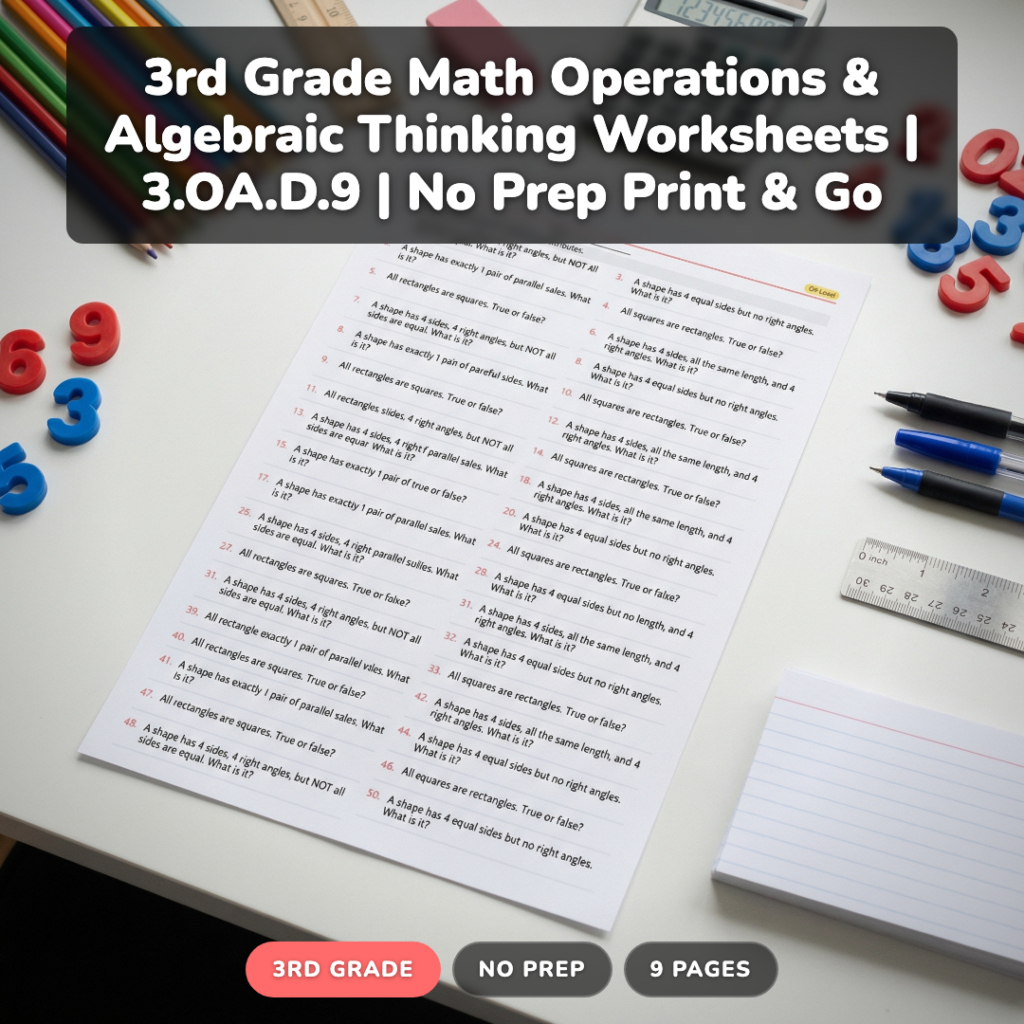
Looking for a ready-to-go resource? I put together a differentiated patterns practice pack that covers everything below—but first, the teaching strategies that make it work.
Common Pattern Misconceptions in Third Grade
Common Misconception: Students think patterns are just about counting by numbers (2, 4, 6, 8…).
Why it happens: They’ve practiced skip counting but haven’t connected it to why the pattern works.
Quick fix: Show the same pattern in multiple representations—number line, hundreds chart, and manipulatives.
Common Misconception: Students memorize patterns without understanding the underlying property.
Why it happens: They focus on the visual pattern rather than the mathematical relationship.
Quick fix: Always ask “Why does this pattern work?” and connect to properties like “adding zero doesn’t change the number.”
Common Misconception: Students think multiplication patterns are completely different from addition patterns.
Why it happens: They learn operations in isolation rather than seeing connections.
Quick fix: Explicitly show how multiplication patterns relate to repeated addition patterns.
Common Misconception: Students believe patterns only work with small numbers.
Why it happens: Most examples use single-digit numbers, so they don’t generalize.
Quick fix: Extend patterns to larger numbers and ask students to predict what happens with 100 or 1,000.
5 Research-Backed Strategies for Teaching Arithmetic Patterns
Strategy 1: Hundreds Chart Pattern Detective
Transform your hundreds chart into a pattern discovery tool where students become mathematical detectives, uncovering hidden relationships in addition and multiplication.
What you need:
- Large hundreds chart for display
- Individual hundreds charts for students
- Colored transparent chips or crayons
- Pattern recording sheet
Steps:
- Give students a specific pattern to investigate (like “add 9” or “multiply by 2”)
- Have them color or mark the results on their hundreds chart
- Ask: “What do you notice about where the numbers land?”
- Guide them to see diagonal patterns (for +9) or every-other-column patterns (for ×2)
- Connect the visual pattern to the mathematical property: “Why does adding 9 create a diagonal?”
Strategy 2: Manipulative Pattern Building
Use physical objects to make abstract patterns concrete, helping students discover why patterns work through hands-on exploration.
What you need:
- Base-ten blocks or counting cubes
- Pattern mats or recording sheets
- Timer for rotations
- “Pattern Explanation” sentence frames
Steps:
- Students build the first few terms of a pattern with manipulatives (like 3, 6, 9, 12)
- They physically group objects to show the pattern (3 groups of 1, 3 groups of 2, etc.)
- Ask them to predict the next three terms and build them
- Have partners explain their pattern using sentence frames: “I notice that… because…”
- Connect to the property: “This works because we’re adding the same amount each time”
Strategy 3: Addition Table Treasure Hunt
Turn the addition table into an interactive exploration where students discover multiple patterns and explain them using properties of addition.
What you need:
- Large addition table (12×12 works well)
- Colored highlighters or markers
- “Pattern Hunt” recording sheets
- Properties of addition anchor chart
Steps:
- Give students specific patterns to find: “Highlight all sums that equal 10”
- They discover the diagonal pattern and record their findings
- Ask: “Why do these sums make a diagonal line?” (commutative property)
- Extend to other patterns: sums of 12, doubles, near-doubles
- Students create their own pattern challenges for classmates
Strategy 4: Multiplication Array Pattern Gallery Walk
Students create visual representations of multiplication patterns using arrays, then explain the patterns they discover to their peers.
What you need:
- Grid paper or dot paper
- Colored pencils or markers
- Large poster paper
- Sticky notes for peer feedback
Steps:
- Students choose a multiplication fact family (like 4s or 6s)
- They draw arrays for the first 5-6 facts in that family
- Guide them to notice patterns: “What happens to the shape as the numbers get bigger?”
- Students write explanations connecting their visual pattern to the commutative property
- Gallery walk where students view and comment on each other’s pattern discoveries
Strategy 5: Pattern Prediction and Verification
Develop algebraic thinking by having students make predictions about patterns, then verify their thinking using multiple strategies.
What you need:
- Pattern sequence cards
- “Predict and Check” recording sheets
- Calculators for verification
- Exit ticket templates
Steps:
- Show students the first 3-4 terms of a pattern (like 6, 12, 18, 24…)
- They predict the next three terms and explain their reasoning
- Students verify predictions using a different method (skip counting, addition, etc.)
- Ask them to explain why the pattern works using properties of operations
- Challenge: “If this pattern continued, what would the 10th term be?”
How to Differentiate Math Patterns for All Learners
For Students Who Need Extra Support
Start with concrete patterns using manipulatives before moving to abstract number patterns. Focus on one type of pattern at a time (addition before multiplication). Provide hundreds charts and number lines as visual supports. Use patterns with smaller numbers (1-20) and obvious increments like +2 or +5. Give sentence frames for explanations: “I notice the pattern goes up by ___ each time because _____.”
For On-Level Students
Students should identify patterns in both addition and multiplication tables as required by CCSS.Math.Content.3.OA.D.9. They work with numbers up to 100 and can explain patterns using basic properties like commutative and identity properties. Provide opportunities to create their own patterns and challenge classmates. Include both increasing and decreasing patterns.
For Students Ready for a Challenge
Extend patterns to larger numbers (beyond 100) and explore more complex relationships. Introduce patterns with multiple steps or those that involve two operations. Challenge students to find patterns in square numbers or explore what happens when you add consecutive odd numbers. Connect patterns to real-world situations like growth patterns in nature or architectural designs.
A Ready-to-Use Math Patterns Resource for Your Classroom
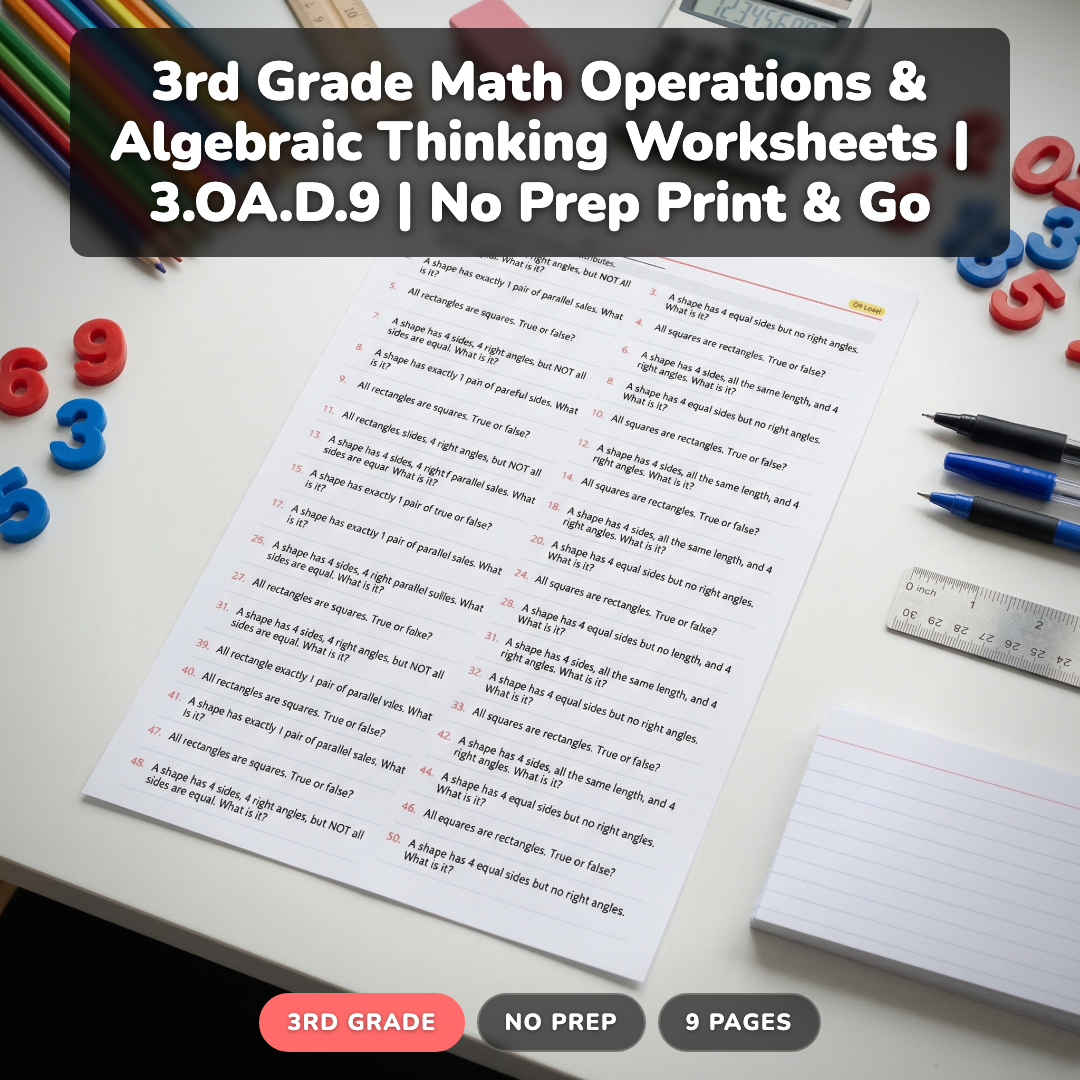
Teaching arithmetic patterns effectively requires lots of differentiated practice problems that students can work through independently. After trying dozens of different approaches, I created a comprehensive resource that gives you everything you need to teach this challenging standard.
This 9-page differentiated pack includes 132 total problems across three levels: 37 practice problems for students who need extra support, 50 on-level problems aligned to grade-level expectations, and 45 challenge problems for advanced learners. Each level focuses on the same core skills but adjusts the complexity and number size appropriately.
What makes this resource different is the variety of problem types—students work with addition table patterns, multiplication patterns, growing patterns, and pattern explanations that require them to use mathematical language and properties. Answer keys are included for easy grading, and the problems are designed to work perfectly for independent practice, homework, or math centers.
The best part? It’s completely no-prep. Just print and go, knowing your students are getting exactly the right level of challenge for their needs.
Grab a Free Pattern Practice Sheet to Try
Want to see how these strategies work in practice? I’ll send you a free sample pattern worksheet with problems at three different levels, plus an answer key and teaching tips for implementation.
Frequently Asked Questions About Teaching Math Patterns
When should I introduce arithmetic patterns in third grade?
Most teachers introduce CCSS.Math.Content.3.OA.D.9 in February through April, after students have developed fluency with basic addition and multiplication facts. Students need solid computational skills before they can focus on underlying patterns and properties.
What’s the difference between skip counting and arithmetic patterns?
Skip counting focuses on the sequence of numbers (2, 4, 6, 8), while arithmetic patterns require students to explain why the pattern works using properties of operations. Students must connect the visual pattern to mathematical reasoning and properties.
How do I help students explain patterns using properties of operations?
Start with concrete examples and provide sentence frames: “This pattern works because…” Connect to properties they know—commutative (3+4 = 4+3), identity (adding zero), and associative properties. Use manipulatives to make abstract properties visible and concrete.
What manipulatives work best for teaching arithmetic patterns?
Base-ten blocks excel for addition patterns, while arrays using tiles or grid paper work perfectly for multiplication patterns. Hundreds charts and number lines provide excellent visual supports for pattern identification and verification across all operations.
How do I assess student understanding of arithmetic patterns?
Look for three key elements: Can students identify the pattern? Can they extend it accurately? Most importantly, can they explain why it works using mathematical properties? Use both visual representations and verbal explanations in assessments.
Teaching arithmetic patterns successfully comes down to making abstract relationships visible and concrete. When students can see, touch, and explain the mathematical properties behind patterns, they develop the algebraic thinking skills that will serve them throughout their mathematical journey.
What’s your favorite strategy for helping students discover patterns in math? Try the free pattern practice sheet above and let me know how these approaches work in your classroom!