If your third graders freeze when you ask them to identify a rhombus or think every four-sided shape is a square, you’re not alone. Teaching geometry concepts like quadrilateral attributes and classification challenges even experienced teachers. You need concrete strategies that help students see the connections between shapes while building their geometric vocabulary.
Key Takeaway
Third grade geometry success comes from helping students focus on shape attributes rather than visual appearance, using hands-on sorting and systematic comparison activities.
Why 3rd Grade Geometry Matters
Third grade geometry marks a crucial shift in mathematical thinking. Students move from simply naming shapes to understanding how shapes relate to each other through shared attributes. CCSS.Math.Content.3.G.A.1 requires students to recognize that shapes can belong to multiple categories simultaneously — a square is also a rectangle and a quadrilateral.
Research from the National Council of Teachers of Mathematics shows that students who master geometric classification in elementary grades demonstrate stronger spatial reasoning skills throughout their mathematical careers. This standard typically appears in the spring semester, after students have developed foundational understanding of basic shapes and their properties.
The cognitive demand is significant: students must analyze multiple attributes simultaneously, understand hierarchical relationships between shape categories, and apply logical reasoning to classify new examples. Van Hiele’s theory of geometric thinking confirms that most third graders are transitioning from visual recognition to analytical thinking about geometric properties.
Looking for a ready-to-go resource? I put together a differentiated geometry pack that covers everything below — but first, the teaching strategies that make it work.
Common Geometry Misconceptions in 3rd Grade
Common Misconception: Students think a rotated square is a diamond, not a square.
Why it happens: They rely on visual orientation rather than geometric properties like equal sides and right angles.
Quick fix: Practice rotating shapes while counting sides and measuring angles together.
Common Misconception: Students believe rectangles and squares are completely different shapes.
Why it happens: They focus on differences rather than shared attributes like four sides and four right angles.
Quick fix: Use Venn diagrams to show how squares fit inside the rectangle category.
Common Misconception: Students think all quadrilaterals look like squares or rectangles.
Why it happens: Limited exposure to irregular quadrilaterals like trapezoids and parallelograms.
Quick fix: Show various quadrilateral examples and focus on the ‘four sides’ rule.
Common Misconception: Students confuse rhombuses with diamonds from playing cards.
Why it happens: Cultural associations override mathematical definitions.
Quick fix: Emphasize that rhombuses have four equal sides, regardless of orientation.
5 Research-Backed Strategies for Teaching Geometry
Strategy 1: Attribute Detective Sorting
Students become shape detectives, systematically examining and sorting shapes based on specific attributes. This hands-on approach helps them focus on mathematical properties rather than visual appearance.
What you need:
- Shape cards or manipulatives (squares, rectangles, rhombuses, trapezoids, parallelograms)
- Sorting mats labeled with attributes
- Magnifying glasses (optional, for engagement)
- Attribute checklist charts
Steps:
- Give each student a collection of quadrilateral shapes
- Introduce one attribute at a time (number of sides, parallel sides, equal sides, right angles)
- Students sort shapes into groups based on that attribute
- Discuss findings as a class, recording observations on anchor charts
- Combine attributes for more complex sorting challenges
- Students create their own sorting rules and challenge classmates
Strategy 2: Shape Family Trees
Students create visual hierarchies showing how shapes relate to each other, making abstract classification concepts concrete and memorable.
What you need:
- Large poster paper
- Shape cutouts in different sizes and orientations
- Markers or colored pencils
- Family tree templates
Steps:
- Start with ‘quadrilateral’ as the family name at the top
- Add ‘children’ categories: parallelograms, trapezoids, rectangles
- Show how squares are ‘children’ of rectangles
- Demonstrate that rhombuses are also parallelograms
- Students add specific shape examples to each category
- Create class discussions about why shapes belong in multiple families
Strategy 3: Quadrilateral Construction Challenge
Students build shapes using specific constraints, developing deep understanding of how attributes define geometric categories.
What you need:
- Geoboards and rubber bands
- Dot paper
- Rulers and protractors (simplified versions)
- Challenge cards with specific requirements
Steps:
- Give students specific building challenges (‘Make a quadrilateral with exactly one pair of parallel sides’)
- Students construct shapes using geoboards or draw on dot paper
- Partners check each other’s work against the requirements
- Class shares different solutions to the same challenge
- Discuss why multiple shapes can meet the same criteria
- Students create their own construction challenges
Strategy 4: Shape Attribute Bingo
A game-based approach that reinforces attribute recognition while maintaining high engagement and providing multiple practice opportunities.
What you need:
- Bingo cards with shape pictures
- Calling cards with attribute descriptions
- Markers or chips
- Answer keys for verification
Steps:
- Students receive bingo cards showing various quadrilaterals
- Teacher calls out attributes (‘Has four equal sides’)
- Students identify shapes on their cards matching that attribute
- First to complete a row explains their reasoning
- Verify answers by examining each shape’s properties
- Students take turns being the caller
Strategy 5: Real-World Shape Hunt
Students identify geometric shapes in their environment, connecting classroom learning to everyday experiences and strengthening retention.
What you need:
- Digital cameras or tablets
- Shape hunt recording sheets
- Clipboards for outdoor exploration
- Classification charts
Steps:
- Students explore school grounds or classroom looking for quadrilaterals
- Photograph or sketch examples they find
- Record the shape name and justify their classification
- Create a class gallery of real-world geometry
- Discuss how architects and designers use different quadrilaterals
- Students present their findings to younger classes
How to Differentiate Geometry for All Learners
For Students Who Need Extra Support
Begin with concrete manipulatives and focus on one attribute at a time. Use color-coding to highlight important features like parallel sides or right angles. Provide anchor charts with visual examples and simple language definitions. Start with obvious differences before moving to subtle distinctions. Pair struggling students with geometry-confident partners for peer support.
For On-Level Students
Students work with standard CCSS.Math.Content.3.G.A.1 expectations, comparing multiple attributes simultaneously and understanding basic hierarchical relationships. They should recognize that squares are special rectangles and that rectangles are special parallelograms. Practice includes both identifying and drawing examples of each quadrilateral type.
For Students Ready for a Challenge
Introduce complex quadrilaterals like kites and irregular trapezoids. Explore angle measurements and discuss why certain combinations of attributes are impossible. Students create their own classification systems and teach concepts to classmates. Connect geometry to art, architecture, and engineering applications.
A Ready-to-Use Geometry Resource for Your Classroom
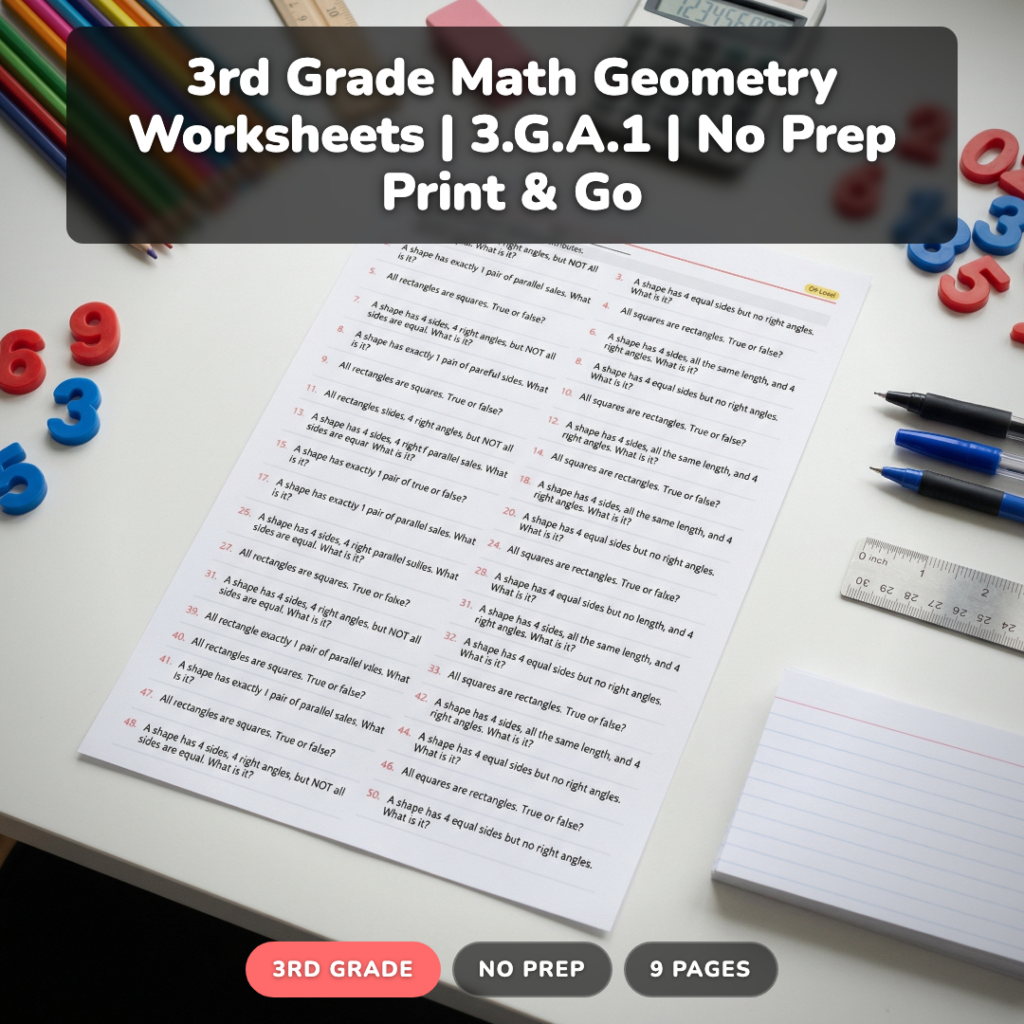
After years of creating geometry materials from scratch, I developed a comprehensive differentiated worksheet pack that saves hours of prep time while meeting every student’s needs. This resource includes 132 carefully crafted problems across three difficulty levels.
The Practice level (37 problems) focuses on basic shape identification with visual supports. On-Level worksheets (50 problems) require students to analyze attributes and classify shapes according to standard expectations. Challenge problems (45 problems) push students to create examples, explain reasoning, and work with complex geometric relationships.
Each level includes answer keys and detailed explanations, making it perfect for independent work, homework, or assessment preparation. The problems progress systematically from simple recognition to complex analysis, ensuring every student builds confidence while mastering geometric concepts.
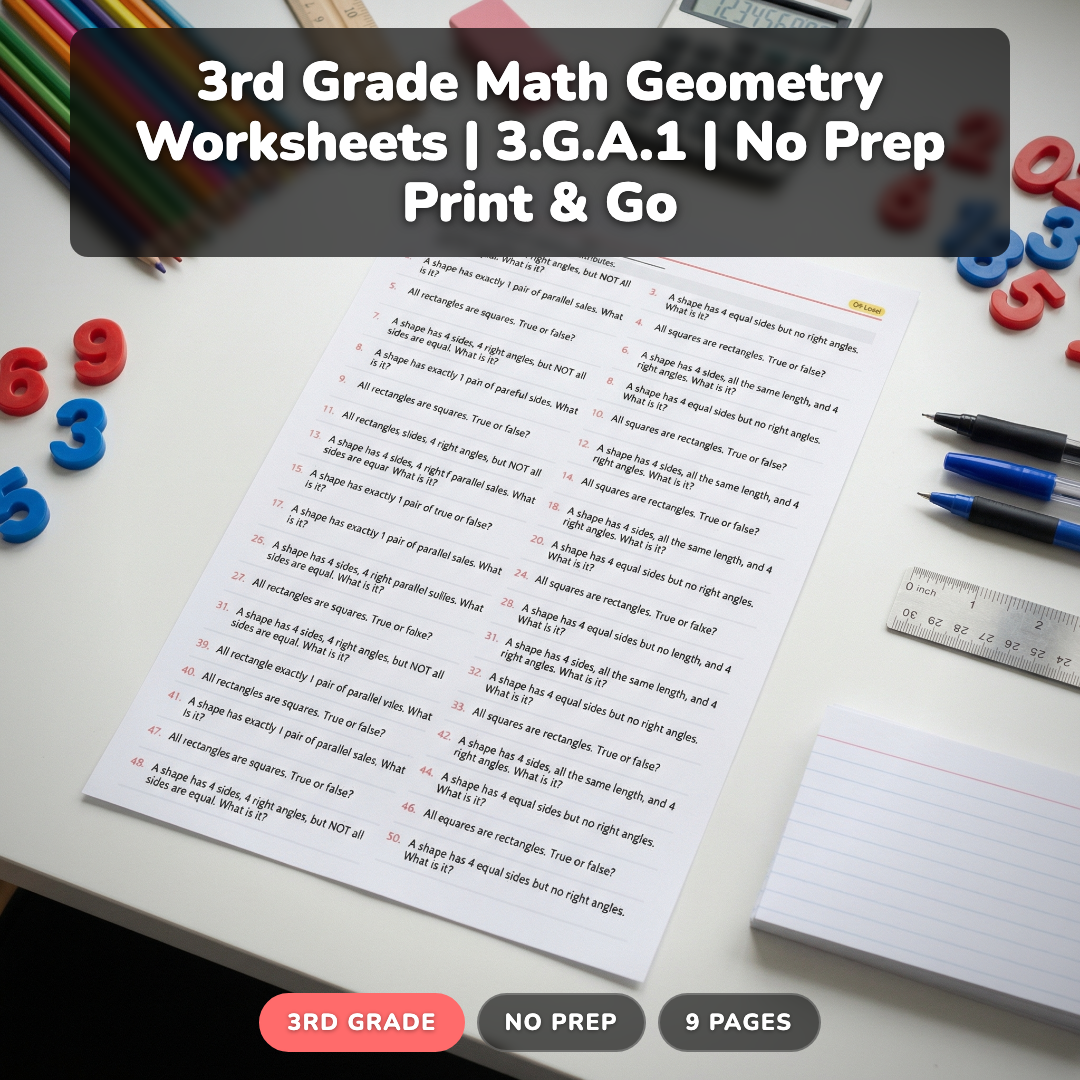
You can grab this complete geometry pack here →
Grab a Free Geometry Sample to Try
Want to see how differentiated geometry practice works in your classroom? I’ll send you a free sample worksheet with problems from each difficulty level, plus my attribute checklist that students love using during shape sorts.
Frequently Asked Questions About Teaching 3rd Grade Geometry
When should I introduce quadrilateral classification in 3rd grade?
Most teachers introduce quadrilateral classification in late winter or early spring, after students have mastered basic shape identification and understand concepts like parallel lines and right angles. CCSS.Math.Content.3.G.A.1 typically appears in the third quarter curriculum maps.
How do I help students remember the difference between rhombuses and rectangles?
Focus on the key distinguishing attributes: rhombuses have four equal sides but may not have right angles, while rectangles have four right angles but may not have equal sides. Use hand gestures and mnemonics like ‘rhombus = equal sides, rectangle = right angles.’
What’s the most effective way to teach that squares belong to multiple categories?
Use nested circles or Venn diagrams to show how squares fit inside rectangles, which fit inside parallelograms, which fit inside quadrilaterals. Emphasize that having additional properties doesn’t exclude shapes from broader categories.
Should 3rd graders learn formal geometric definitions?
Students should understand the concepts behind definitions but don’t need to memorize formal mathematical language. Focus on recognizing and describing attributes in their own words before introducing precise geometric vocabulary.
How do I assess student understanding of geometric classification?
Use performance tasks where students sort shapes, explain their reasoning, and create examples of each category. Look for evidence that they consider multiple attributes simultaneously and understand hierarchical relationships between shape families.
Teaching geometry classification transforms how students think about mathematical relationships and spatial reasoning. Start with hands-on exploration, build systematic understanding through attribute analysis, and watch your students develop confidence in geometric thinking.
What’s your favorite strategy for helping students understand quadrilateral relationships? Try the free sample activities and see which approaches work best with your class.