If your third graders look confused when you mention that 1/2 equals 2/4, you’re not alone. Teaching equivalent fractions is one of those mathematical concepts that seems straightforward to adults but can feel like magic to 8-year-olds. The good news? With the right visual models and hands-on strategies, your students will not only recognize equivalent fractions but truly understand why they work.
Key Takeaway
Students master equivalent fractions when they see, manipulate, and explain the visual relationships between equal parts, not just memorize fraction pairs.
Why Equivalent Fractions Matter in Third Grade
Equivalent fractions form the foundation for every fraction operation students will encounter in fourth grade and beyond. According to the Common Core standard CCSS.Math.Content.3.NF.A.3b, third graders must “recognize and generate simple equivalent fractions” and “explain why the fractions are equivalent” using visual models.
This standard typically appears in the spring semester, after students have mastered basic fraction concepts like identifying numerators and denominators. Research from the National Council of Teachers of Mathematics shows that students who develop strong visual fraction sense in third grade perform 40% better on fraction assessments in middle school.
The timing is crucial because equivalent fractions connect directly to addition and subtraction of fractions with unlike denominators in fourth grade. Students need this conceptual understanding before they can tackle procedures like finding common denominators.
Looking for a ready-to-go resource? I put together a differentiated equivalent fractions pack that covers everything below — but first, the teaching strategies that make it work.
Common Equivalent Fraction Misconceptions in Third Grade
Common Misconception: Students think equivalent fractions must have the same numerator or denominator.
Why it happens: They focus on individual numbers rather than the relationship between parts and wholes.
Quick fix: Always start with visual models before introducing number patterns.
Common Misconception: Students believe 2/4 is bigger than 1/2 because “2 is bigger than 1.”
Why it happens: They apply whole number reasoning to fractions without understanding fractional parts.
Quick fix: Use identical-sized circles or rectangles to show that 2/4 and 1/2 cover the same amount of space.
Common Misconception: Students think you can make any fraction equivalent by doubling both numbers.
Why it happens: They overgeneralize the pattern without understanding the underlying concept.
Quick fix: Emphasize that you’re multiplying by “one whole” (2/2, 3/3, etc.) to keep the value the same.
Common Misconception: Students confuse equivalent fractions with adding fractions.
Why it happens: They see multiple fractions and assume they need to combine them.
Quick fix: Use the language “same amount” or “equal to” consistently when discussing equivalent fractions.
5 Research-Backed Strategies for Teaching Equivalent Fractions
Strategy 1: Fraction Circles with Color Coding
This hands-on approach helps students physically see and feel why equivalent fractions represent the same amount. Students manipulate actual pieces to discover relationships rather than just memorizing patterns.
What you need:
- Paper fraction circles (halves, thirds, fourths, sixths, eighths)
- Different colored paper for each denominator family
- Recording sheet for discoveries
Steps:
- Give each student a complete set of fraction circles, with halves on red paper, fourths on blue paper, etc.
- Start with 1/2. Have students place one red half-piece on their desk.
- Challenge them to cover the exact same space using blue fourth-pieces.
- Students discover that 2/4 covers the same area as 1/2.
- Record the equivalent pair: 1/2 = 2/4 on the class chart.
- Repeat with other combinations, always starting with the visual and moving to the symbolic.
Strategy 2: Rectangle Folding Investigations
Paper folding creates equivalent fractions dynamically, showing students how subdividing parts maintains the same total amount. This kinesthetic approach works especially well for students who need to “do” math to understand it.
What you need:
- Identical paper rectangles (8.5″ x 11″ works well)
- Crayons or colored pencils
- Equivalent fractions recording sheet
Steps:
- Give each student two identical rectangles.
- On rectangle #1, fold in half and shade 1/2.
- On rectangle #2, fold in half, then fold each half in half again to create fourths.
- Shade 2 of the 4 sections to match the same area as rectangle #1.
- Hold both rectangles up to the light to confirm they show the same shaded amount.
- Record: 1/2 = 2/4 and explain using the phrase “same amount of space.”
- Extend to thirds and sixths, fourths and eighths using the same process.
Strategy 3: Number Line Fraction Matching
Number lines help students see that equivalent fractions occupy the same position, reinforcing that they represent identical values. This strategy bridges visual models with numerical understanding.
What you need:
- Large floor number line from 0 to 1
- Fraction cards (1/2, 2/4, 3/6, 1/3, 2/6, etc.)
- Masking tape for marking positions
Steps:
- Create a number line on the floor using masking tape, marked from 0 to 1.
- Give small groups different fraction cards.
- Groups take turns placing their fraction card at the correct position on the number line.
- When multiple cards land at the same spot, discuss why they’re equivalent.
- Students explain their reasoning: “1/2 and 2/4 are at the same place because they show the same amount.”
- Create a class list of equivalent fraction families discovered through the activity.
Strategy 4: Equivalent Fraction Memory Match Game
This engaging partner activity reinforces equivalent fraction recognition while building fluency. Students must justify their matches, deepening conceptual understanding through peer explanation.
What you need:
- Card sets with visual fraction models and symbolic representations
- Timer for added engagement
- Recording sheet for matches found
Steps:
- Create cards showing both visual models (circle/rectangle diagrams) and symbolic fractions.
- Partners spread 20 cards face down (10 equivalent pairs).
- Players take turns flipping two cards, looking for equivalent matches.
- When claiming a match, players must explain why the fractions are equivalent.
- If the explanation is correct, they keep the pair; if not, cards go back face down.
- Game continues until all pairs are found.
Strategy 5: Real-World Equivalent Fraction Scenarios
Connecting equivalent fractions to familiar situations helps students understand why this concept matters beyond the classroom. Pizza slices, chocolate bars, and measuring cups provide meaningful contexts.
What you need:
- Pictures of pizzas cut different ways
- Measuring cup sets
- Chocolate bar manipulatives or pictures
- Real-world scenario cards
Steps:
- Present scenario: “Maya ate 1/2 of a pizza. Jake ate 2/4 of an identical pizza. Who ate more?”
- Students use visual models to solve, discovering both ate the same amount.
- Introduce cooking scenario: “A recipe calls for 1/2 cup flour, but you only have a 1/4 cup measure.”
- Students figure out they need 2 scoops of 1/4 cup to equal 1/2 cup.
- Create student-generated scenarios using classroom objects or lunch items.
- Always connect back to the mathematical relationship: different names, same amount.
How to Differentiate Equivalent Fractions for All Learners
For Students Who Need Extra Support
Start with concrete manipulatives and unit fractions only. Use identical shapes (all circles or all rectangles) to minimize visual confusion. Focus on the language “same amount” rather than mathematical vocabulary initially. Provide pre-drawn visual models for students to color rather than asking them to create their own. Review prerequisite skills like identifying equal parts and basic fraction notation before introducing equivalence.
For On-Level Students
Students work with equivalent fractions through fourths and eighths, meeting the expectations of CCSS.Math.Content.3.NF.A.3b. They use multiple visual models (circles, rectangles, number lines) and can explain why fractions are equivalent using mathematical language. These students complete independent practice with mixed visual and symbolic problems, demonstrating both recognition and generation of equivalent fractions.
For Students Ready for a Challenge
Extend learning to more complex equivalent fractions like 3/9 = 1/3 or 4/12 = 1/3. Challenge students to find multiple equivalent forms for the same fraction (1/2 = 2/4 = 3/6 = 4/8). Introduce the concept of simplifying fractions by finding the smallest equivalent form. Connect to measurement contexts using rulers marked in different fractional units (halves, fourths, eighths).
A Ready-to-Use Equivalent Fractions Resource for Your Classroom
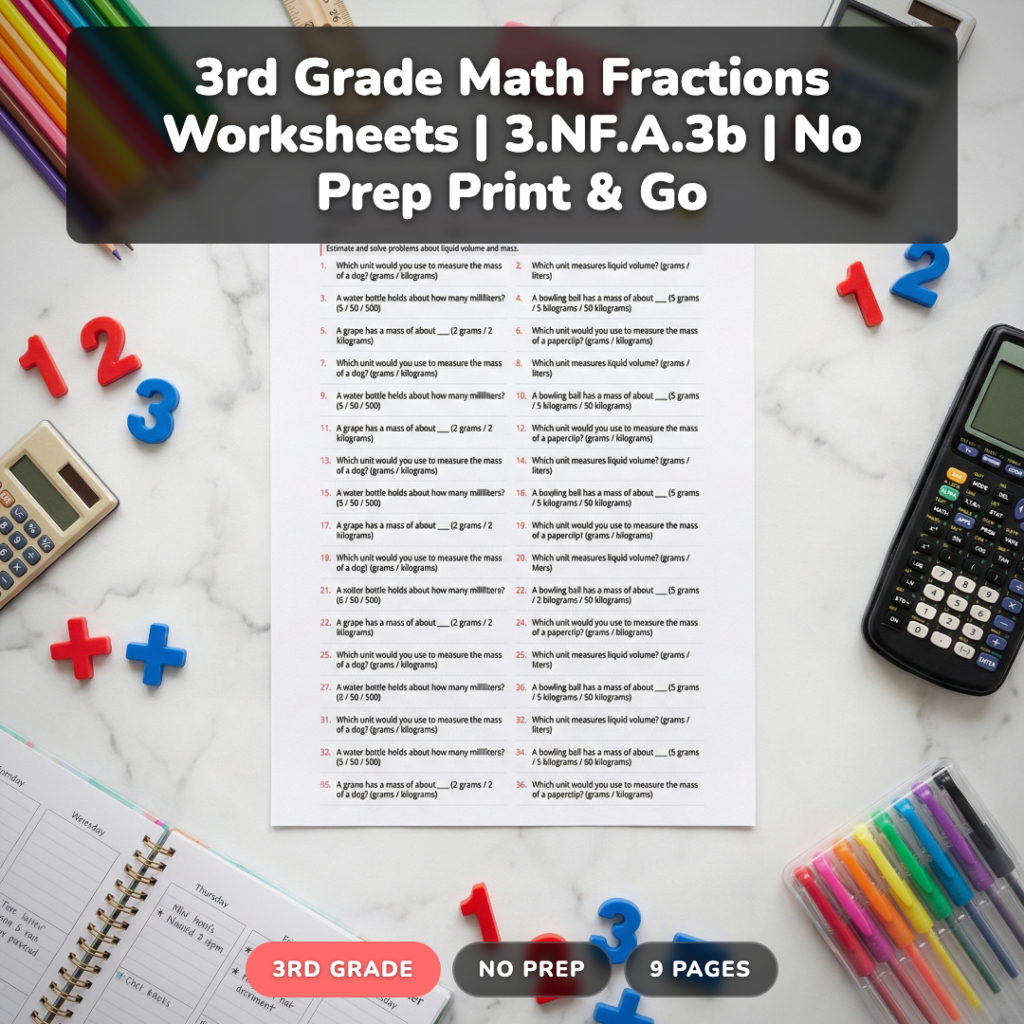
After teaching equivalent fractions for several years, I created a comprehensive worksheet pack that addresses every learning level in your classroom. This resource includes 132 carefully crafted problems across three differentiation levels, ensuring every student gets appropriate practice.
The Practice level (37 problems) focuses on visual recognition with clear fraction models. On-Level worksheets (50 problems) balance visual and symbolic representations, perfect for meeting grade-level standards. The Challenge level (45 problems) pushes students to generate equivalent fractions independently and explain their reasoning.
What makes this different from other fraction worksheets? Every problem includes visual models, answer keys show multiple solution strategies, and the progression builds conceptual understanding systematically. You get 9 ready-to-print pages that save hours of prep time while ensuring your students truly understand equivalent fractions.
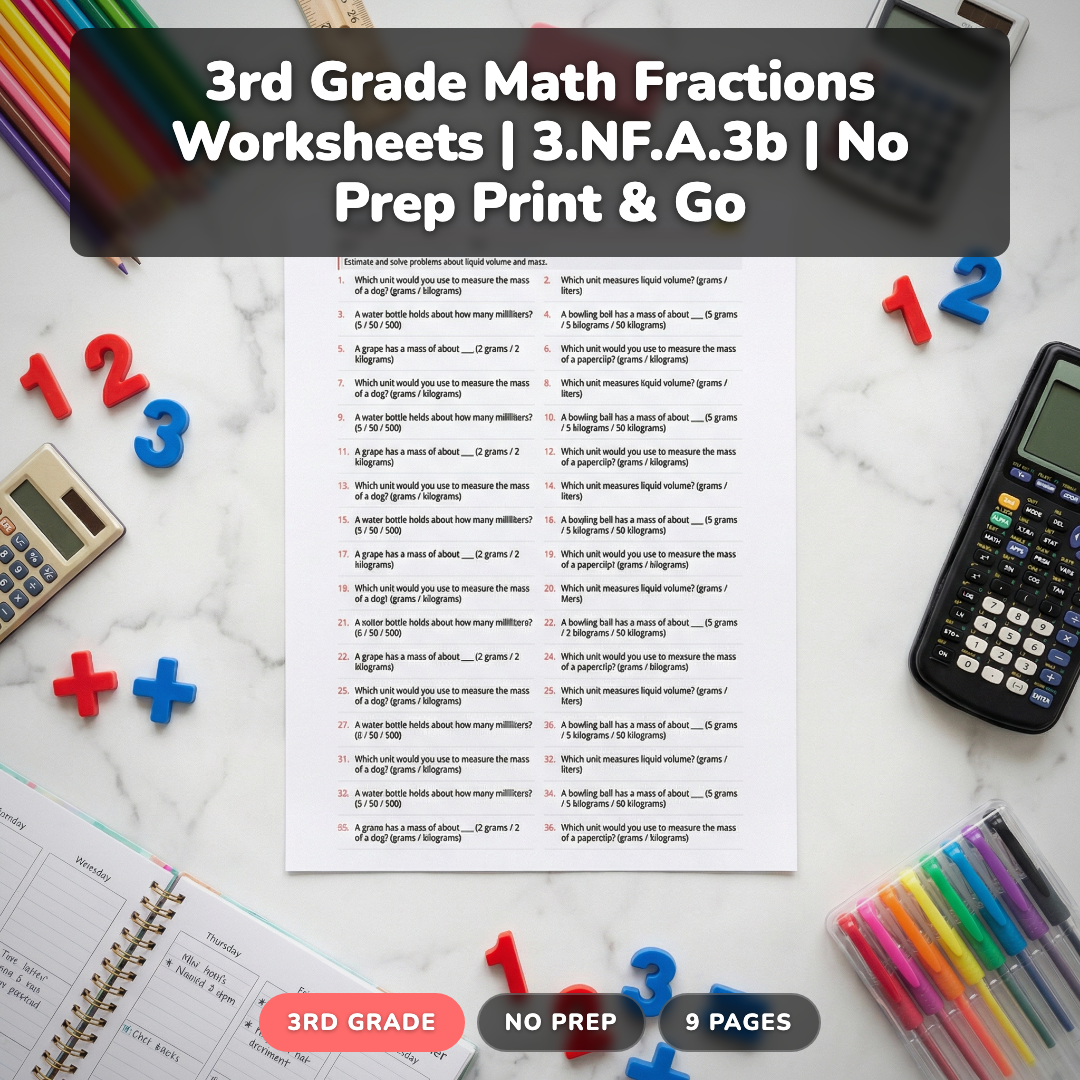
The pack includes everything you need for differentiated equivalent fraction practice, from concrete visual models to abstract problem-solving challenges.
Grab a Free Equivalent Fractions Sample to Try
Want to see how these strategies work in practice? I’ll send you a free sample worksheet with visual fraction models and teaching tips. Perfect for trying out these techniques with your class before diving into the full resource.
Frequently Asked Questions About Teaching Equivalent Fractions
When should I introduce equivalent fractions in third grade?
Introduce equivalent fractions after students master basic fraction concepts like identifying numerators, denominators, and equal parts. This typically happens in late winter or spring, following the CCSS.Math.Content.3.NF.A.3b timeline. Students need solid foundation skills before tackling equivalence relationships.
What’s the most effective visual model for teaching equivalent fractions?
Fraction circles work best initially because students can physically overlap pieces to see identical amounts. Rectangle models help students understand the subdivision process, while number lines connect to measurement concepts. Use multiple models to reinforce the same concept from different angles.
How do I help students who memorize patterns without understanding?
Always start with concrete manipulatives before showing symbolic patterns. When students say “just double both numbers,” ask them to prove it with visual models. Require explanations using phrases like “same amount” or “covers the same space” to ensure conceptual understanding drives pattern recognition.
Should third graders learn to simplify fractions to lowest terms?
The Common Core standard focuses on recognizing and generating equivalent fractions, not simplification. However, advanced students can explore finding the “smallest” equivalent fraction as an extension activity. Keep the emphasis on understanding why fractions are equivalent rather than procedural rules.
How do I assess whether students truly understand equivalent fractions?
Ask students to explain why two fractions are equivalent using visual models, not just identify correct pairs. Have them generate their own equivalent fractions and justify their thinking. Students who understand can explain the relationship between parts and wholes, not just recite memorized facts.
Building Strong Fraction Foundations
Teaching equivalent fractions successfully comes down to helping students see the relationships, not just memorize the rules. When your third graders can explain why 1/2 equals 2/4 using their own words and visual models, you’ll know they’re ready for the fraction challenges ahead.
What’s your go-to strategy for helping students visualize equivalent fractions? The hands-on approaches above work best when students can manipulate, discuss, and discover the patterns themselves.
Don’t forget to grab your free equivalent fractions sample above — it’s a great way to test these strategies with your class!