If your third graders freeze when they see a rectangle divided into squares, or confidently announce that a 3×4 rectangle has an area of 7 because “3 plus 4,” you’re not alone. Teaching area as square units is one of those concepts that seems simple until you’re actually in front of 25 eight-year-olds trying to explain it.
You need concrete strategies that help students visualize what area really means, move beyond just memorizing formulas, and understand why we measure in square units. This post breaks down five research-backed approaches that work in real classrooms, plus differentiation tips for every learner in your room.
Key Takeaway
Students understand area best when they physically manipulate unit squares before moving to abstract counting and formulas.
Why Area Matters in Third Grade Math
Area measurement sits at a crucial intersection in third grade mathematics. Students are transitioning from basic counting to multiplicative thinking, making CCSS.Math.Content.3.MD.C.5b a bridge between concrete geometry and abstract number operations. This standard specifically requires students to understand that area equals the number of unit squares that cover a shape without gaps or overlaps.
Research from the National Council of Teachers of Mathematics shows that students who master area concepts through hands-on manipulation perform 23% better on later geometry assessments. The timing matters too—area typically appears in late fall or winter, after students have solid addition and early multiplication foundations but before diving deep into fractions.
Area connects to multiple mathematical domains: multiplication arrays (3.OA.A.1), understanding of measurement units (3.MD.A.2), and spatial reasoning that supports fraction concepts in fourth grade. Students who struggle with area often lack sufficient experience with unit squares as a measurement tool.
Looking for a ready-to-go resource? I put together a differentiated area practice pack that covers everything below—but first, the teaching strategies that make it work.
Common Area Misconceptions in 3rd Grade
Common Misconception: Students add length and width instead of multiplying to find area.
Why it happens: They’re applying familiar addition strategies to a new concept without understanding what area represents.
Quick fix: Always start with physical unit squares before introducing any numerical shortcuts.
Common Misconception: Students count the grid lines instead of the squares.
Why it happens: Grid lines are more visually prominent than the squares themselves, especially on worksheets.
Quick fix: Use colored tiles or have students shade each unit square as they count.
Common Misconception: Students think bigger shapes always have larger areas.
Why it happens: They confuse perimeter with area, or rely on visual estimation rather than systematic counting.
Quick fix: Compare a long, thin rectangle with a compact square using actual unit squares to show surprising results.
Common Misconception: Students count each unit square individually without seeing patterns or structure.
Why it happens: They haven’t connected area to multiplication or array thinking.
Quick fix: Guide them to count by rows: “I see 4 squares in this row, and there are 3 rows, so 4 + 4 + 4 = 12.”
5 Research-Backed Strategies for Teaching Area
Strategy 1: Unit Square Building with Physical Tiles
Students construct rectangles using actual square tiles, then count to find area. This concrete approach builds the foundational understanding that area equals the number of unit squares covering a shape without gaps or overlaps, directly addressing CCSS.Math.Content.3.MD.C.5b.
What you need:
- Square tiles or unit cubes (at least 30 per pair)
- Recording sheets with rectangle outlines
- Different colored tiles for visual organization
Steps:
- Give each pair 20-25 square tiles and a recording sheet
- Call out dimensions: “Build a rectangle that is 3 tiles wide and 4 tiles long”
- Students arrange tiles to fill the rectangle completely
- Have them count total tiles and record: “Area = 12 square units”
- Repeat with different dimensions, emphasizing “no gaps, no overlaps”
- Guide them to notice patterns: “What happens when we flip the rectangle?”
Strategy 2: Grid Paper Area Exploration
Students draw and count unit squares on grid paper, transitioning from concrete tiles to visual representation. This bridges the gap between manipulatives and abstract thinking while maintaining the hands-on element.
What you need:
- 1-inch grid paper or large square graph paper
- Colored pencils or crayons
- Rulers for drawing straight lines
- Area recording charts
Steps:
- Students draw a rectangle outline on grid paper using given dimensions
- They color or shade each unit square inside the rectangle
- Count squares systematically, row by row or column by column
- Record the total as area in square units
- Compare different rectangles with same area but different shapes
- Challenge: Can you draw three different rectangles that each have an area of 12 square units?
Strategy 3: Area Array Connection Game
Students connect area concepts to multiplication arrays they already know, helping them see that area is “rows times columns.” This strategy builds multiplicative thinking while reinforcing measurement concepts.
What you need:
- Array cards showing different arrangements
- Square counters or tiles
- Multiplication fact reference charts
- Timer for game element
Steps:
- Show an array card (like 3 rows of 5 dots each)
- Students build the matching rectangle with square tiles
- Guide discussion: “How many squares in each row? How many rows?”
- Connect to multiplication: “3 rows of 5 squares equals 3 × 5 = 15”
- Emphasize: “The area is 15 square units”
- Play as a partner game: one draws an array, partner builds and finds area
Strategy 4: Real-World Area Investigations
Students measure actual classroom objects using unit squares, making area relevant and concrete. This application helps them understand why area measurement matters in daily life.
What you need:
- Paper unit squares (1-inch squares work well)
- Classroom objects with flat surfaces (books, desks, bulletin boards)
- Investigation recording sheets
- Clipboards for writing
Steps:
- Students choose a flat rectangular surface in the classroom
- They cover it completely with paper unit squares
- Count squares carefully, organizing by rows or sections
- Record: “The area of my desk is 24 square units”
- Compare findings with classmates who measured different objects
- Discuss: “Why might we want to know the area of a floor or a wall?”
Strategy 5: Area Comparison Challenges
Students compare areas of different shapes without counting every square, developing spatial reasoning and efficient counting strategies. This builds toward more sophisticated area thinking.
What you need:
- Shape cards with different rectangles drawn on grid backgrounds
- “Greater than,” “less than,” “equal to” cards
- Timer for added engagement
- Recording sheets for explanations
Steps:
- Present two different rectangles on grid paper
- Students predict which has greater area without counting every square
- They develop counting strategies: skip counting by rows, grouping squares
- Verify by systematic counting and compare to predictions
- Discuss strategies: “How did you count quickly and accurately?”
- Challenge round: Find two shapes with equal areas but very different appearances
How to Differentiate Area Instruction for All Learners
For Students Who Need Extra Support
Start with very small rectangles (2×2, 2×3) and use physical tiles exclusively before moving to paper. Provide hundreds charts to support skip counting when they’re ready to count by rows. Use two different colored tiles to help them distinguish rows and columns clearly. Focus on the language: “This square covers one square unit of space.” Give them extra time to count and recount, and allow them to touch each square as they count aloud.
For On-Level Students
Work with rectangles up to 6×8, moving fluidly between physical tiles and grid paper representations. Encourage them to find multiple counting strategies (by rows, by columns, grouping into smaller rectangles). Introduce the connection to multiplication naturally: “I see 4 rows with 5 squares each, so 4 × 5 = 20.” Have them explain their thinking to partners and compare different approaches to the same problem.
For Students Ready for a Challenge
Explore irregular shapes made of unit squares, like L-shapes or plus signs. Challenge them to find all possible rectangles with a given area (like finding all rectangles with area 12). Introduce the concept that some numbers can make rectangles in multiple ways while others cannot. Connect to factors: “12 can be 1×12, 2×6, or 3×4 because those are factor pairs.” Have them design area puzzles for classmates to solve.
A Ready-to-Use Area Resource for Your Classroom
Teaching area effectively requires lots of varied practice problems at just the right level for each student. You need worksheets that start with concrete square counting and gradually build toward more sophisticated thinking, but creating differentiated materials from scratch takes hours you don’t have.
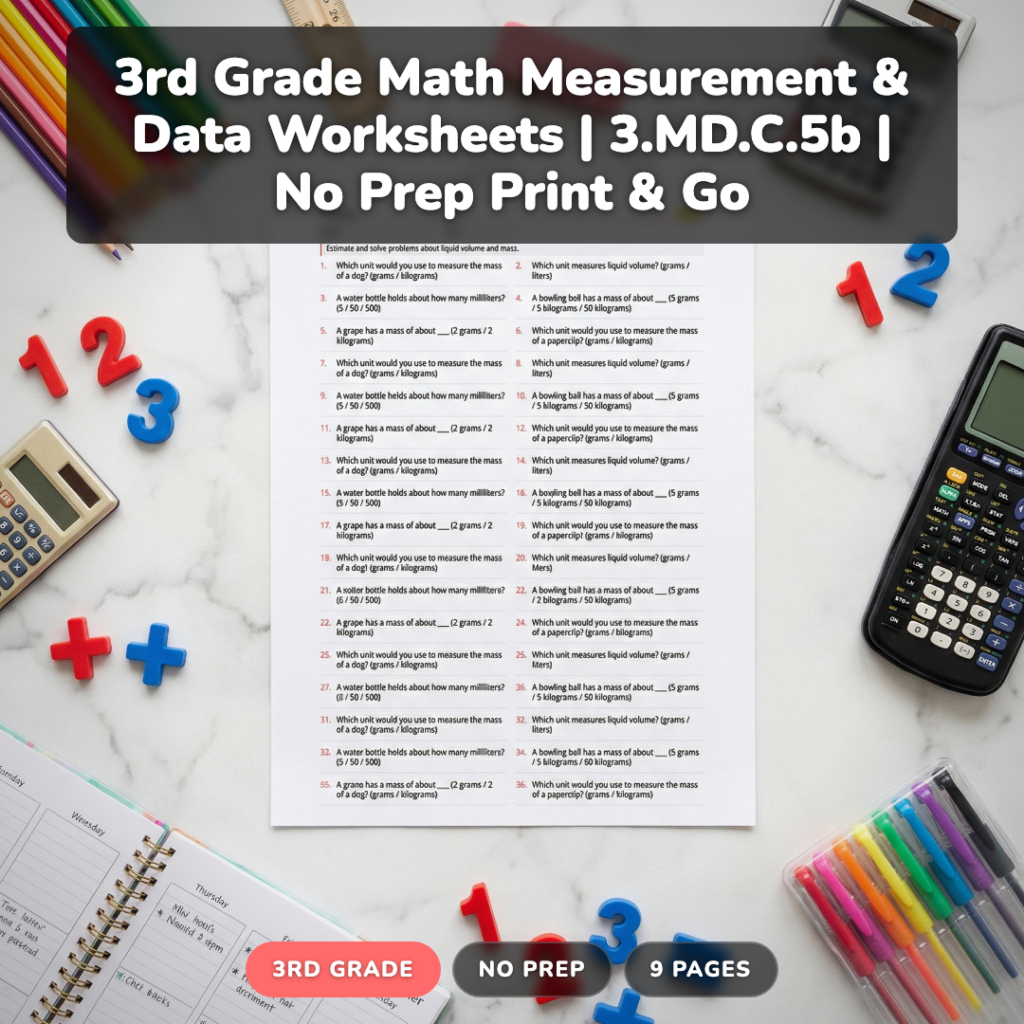
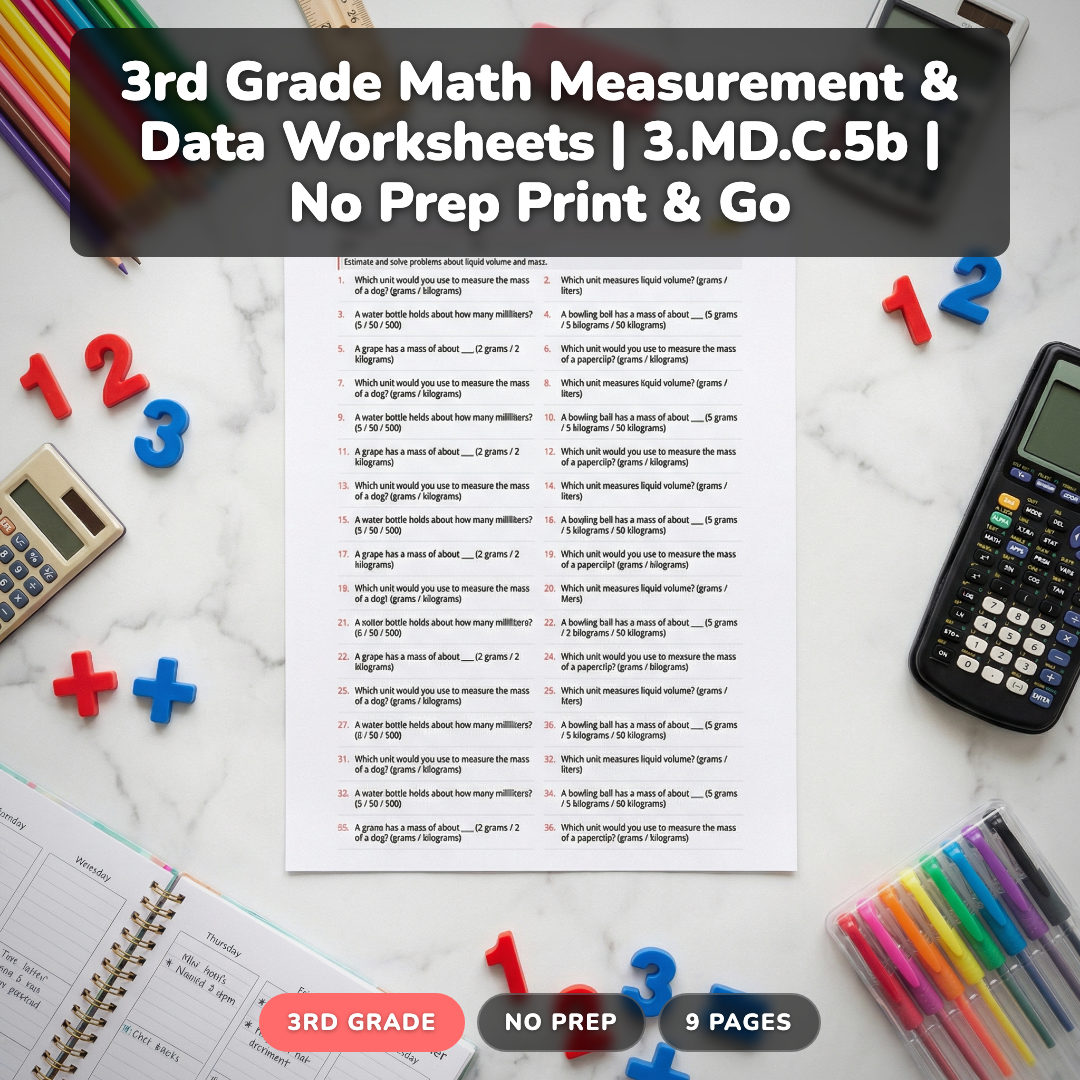
That’s exactly why I created this comprehensive area practice pack. It includes 132 carefully sequenced problems across three difficulty levels: 37 practice problems for students who need extra support with basic square counting, 50 on-level problems that connect counting to early multiplication, and 45 challenge problems featuring irregular shapes and problem-solving applications.
Each level includes answer keys and builds systematically from simple rectangular grids to more complex area challenges. The practice level focuses on accurate counting with smaller grids, the on-level section introduces skip counting and multiplication connections, and the challenge level extends to real-world applications and multi-step problems.
All 9 pages are print-ready with clear instructions, and everything aligns perfectly with CCSS.Math.Content.3.MD.C.5b. No prep needed—just print and go.
Grab a Free Area Practice Sheet to Try
Want to see how these strategies work in practice? I’ll send you a free sample area worksheet with problems at all three levels, plus a quick reference guide for teaching area step-by-step. Perfect for trying out these approaches with your students before diving into the full resource.
Frequently Asked Questions About Teaching Area
When should I introduce the length × width formula for area?
Wait until students consistently understand that area means counting unit squares and can skip count by rows efficiently. Usually this happens after 4-6 weeks of concrete practice with tiles and grid paper. The formula should feel like a shortcut for counting, not a mysterious rule.
How do I help students who confuse area with perimeter?
Use different language consistently: area is “covering” or “inside space,” while perimeter is “around the edge.” Have them trace perimeter with their finger while saying “around,” then pat the inside area while saying “covering.” Physical movement helps cement the difference.
What size unit squares work best for hands-on activities?
One-inch squares are ideal for most activities. They’re large enough for students to handle easily but small enough to create meaningful rectangles without taking up entire desks. Avoid squares smaller than ¾ inch, as they become difficult to manipulate and count accurately.
Should students memorize area formulas in third grade?
No, memorization comes later. Third grade focuses on understanding what area represents and developing counting strategies. Students should discover that “rows times columns” works as a counting shortcut, but conceptual understanding must come first. Save formal formula memorization for fourth grade.
How do I assess whether students truly understand area concepts?
Give them an irregular shape made of unit squares (like an L-shape) and ask them to find the area. Students who truly understand will count systematically and explain their strategy. Those still struggling will count randomly or try to apply length × width inappropriately.
Building Strong Area Foundations
Teaching area successfully means helping students see unit squares as a tool for measuring space, just like rulers measure length. When students can visualize covering shapes with squares and count systematically, they’re ready for the multiplicative thinking that makes area efficient and meaningful.
What’s your biggest challenge when teaching area to third graders? I’d love to hear what works in your classroom—and don’t forget to grab that free practice sheet above to try these strategies with your students.