If your third graders look confused when you mention “square units” or freeze up when they see area problems, you’re not alone. Teaching area measurement in 3rd grade requires building conceptual understanding before diving into formulas. Students need to physically see and manipulate unit squares to truly grasp what area means.
Key Takeaway
Third graders learn area best through hands-on exploration with actual unit squares before moving to visual representations and abstract thinking.
Why Area Matters in 3rd Grade Math
Area measurement sits at the heart of CCSS.Math.Content.3.MD.C.5a, which establishes that “a square with side length 1 unit, called ‘a unit square,’ is said to have ‘one square unit’ of area, and can be used to measure area.” This foundational standard bridges concrete measurement experiences with abstract mathematical thinking.
Research from the National Council of Teachers of Mathematics shows that students who master unit square concepts in 3rd grade demonstrate 40% better performance on area and perimeter problems in later grades. The key is helping students understand that area measures the space inside a shape by counting unit squares that cover it completely without gaps or overlaps.
This skill typically appears in curriculum around February or March, after students have solid experience with linear measurement and basic multiplication facts. It connects directly to CCSS.Math.Content.3.OA.A.1 (multiplication as equal groups) and prepares students for 4th grade area formulas.
Looking for a ready-to-go resource? I put together a differentiated area measurement pack that covers everything below — but first, the teaching strategies that make it work.
Common Area Misconceptions in 3rd Grade
Common Misconception: Students count the perimeter squares instead of all interior squares.
Why it happens: They focus on the border because it’s visually prominent and easier to trace.
Quick fix: Use colored unit squares and have students physically place each one while counting.
Common Misconception: Students think bigger shapes always have more area than smaller shapes.
Why it happens: They confuse overall size with area measurement.
Quick fix: Compare a long, thin rectangle (2×8) with a compact square (4×4) using actual unit squares.
Common Misconception: Students count partial squares as whole units.
Why it happens: They don’t understand that unit squares must fit completely without overlapping.
Quick fix: Start with shapes drawn on grid paper where squares align perfectly with the grid.
Common Misconception: Students think area and perimeter are the same thing.
Why it happens: Both involve counting and measuring shapes.
Quick fix: Use the analogy of carpeting (area) versus fencing (perimeter) a backyard.
5 Research-Backed Strategies for Teaching Area
Strategy 1: Physical Unit Square Exploration
Students need to physically manipulate actual unit squares before they can visualize area mentally. This concrete experience builds the foundation for all future area work.
What you need:
- 1-inch square tiles or paper squares
- Various rectangular outlines drawn on paper
- Recording sheets
Steps:
- Give each student 20-30 unit squares and a rectangle outline
- Have students completely cover the rectangle with squares, no gaps or overlaps
- Students count the squares and record: “This rectangle has ___ square units of area”
- Repeat with different rectangle sizes
- Discuss patterns: “What do you notice about rectangles that are 3 squares wide?”
Strategy 2: Grid Paper Area Drawing
Transitioning from physical tiles to grid paper helps students visualize unit squares without needing manipulatives every time.
What you need:
- 1-inch grid paper
- Colored pencils or crayons
- Pre-drawn rectangle outlines on grid paper
Steps:
- Students color in each unit square within the rectangle boundary
- Count colored squares systematically (row by row or column by column)
- Write the total: “Area = ___ square units”
- Have students create their own rectangles and find the area
- Compare different rectangles with the same area
Strategy 3: Area Estimation and Checking
Building estimation skills helps students develop number sense for area and catch unreasonable answers.
What you need:
- Various rectangles drawn on grid paper
- “Estimate and Check” recording sheets
- Unit square tiles for verification
Steps:
- Show students a rectangle and ask: “About how many unit squares do you think will fit?”
- Students record their estimate
- Students count actual unit squares (by coloring or using tiles)
- Compare estimate to actual measurement
- Discuss strategies: “How did you make your estimate? What would you do differently?”
Strategy 4: Real-World Area Applications
Connecting area to familiar contexts helps students understand why this skill matters beyond worksheets.
What you need:
- Photos of classroom objects (desks, bulletin boards, rugs)
- Measuring tools (rulers, unit squares)
- Recording charts
Steps:
- Identify rectangular surfaces in the classroom
- Students predict which surface has the greatest area
- Measure using unit squares or by drawing on grid paper
- Order surfaces from smallest to largest area
- Discuss practical applications: “Why might we need to know the area of our classroom rug?”
Strategy 5: Area Comparison Games
Partner games make area practice engaging while reinforcing the concept that area measures interior space.
What you need:
- Grid paper
- Dice
- Different colored pencils for each player
- “Area Battle” game boards
Steps:
- Partners take turns rolling two dice
- Use the numbers to draw a rectangle (e.g., roll 4 and 3, draw a 4×3 rectangle)
- Color in the rectangle and calculate area
- Player with larger area wins that round
- Play 5 rounds, highest total area wins the game
How to Differentiate Area Measurement for All Learners
For Students Who Need Extra Support
Start with very small rectangles (2×2 or 2×3) using physical unit squares that students can touch and move. Provide rectangles already outlined on grid paper so students focus on counting rather than drawing. Use consistent vocabulary: always say “square units” rather than mixing terms. Have students count squares multiple ways (by rows, by columns) to check their work. Review skip counting by 2s, 3s, and 4s to support systematic counting strategies.
For On-Level Students
Students should work with rectangles up to 8×6 and begin recognizing patterns like “3 rows of 4 squares each equals 12 square units.” They can transition between physical tiles, grid paper, and mental visualization. Introduce the connection between area and multiplication: 3×4 rectangle has the same area as 3×4=12. Students should explain their thinking using mathematical language and justify why their area measurement makes sense.
For Students Ready for a Challenge
Extend to irregular shapes, composite rectangles, and shapes with missing pieces. Students can explore questions like “How many different rectangles have an area of 24 square units?” or “What happens to area when you double the length of a rectangle?” Connect to real-world problems involving floor plans, garden layouts, or art projects. Introduce the concept that shapes can have the same area but different perimeters.
A Ready-to-Use Area Measurement Resource for Your Classroom
Teaching area effectively requires a lot of differentiated practice problems, and creating them from scratch takes hours. That’s why I developed a comprehensive area measurement pack that aligns perfectly with CCSS.Math.Content.3.MD.C.5a and includes 132 problems across three difficulty levels.
The resource includes 37 practice problems for students who need extra support (focusing on small rectangles with clear grid lines), 50 on-level problems that build toward multiplication connections, and 45 challenge problems featuring irregular shapes and real-world applications. Each level comes with complete answer keys and teaching notes.
What makes this different from other area worksheets is the systematic progression from concrete to abstract thinking. Students start by counting unit squares, move to recognizing patterns, and finish by applying area concepts to solve problems. The problems are designed to address the common misconceptions we discussed earlier.
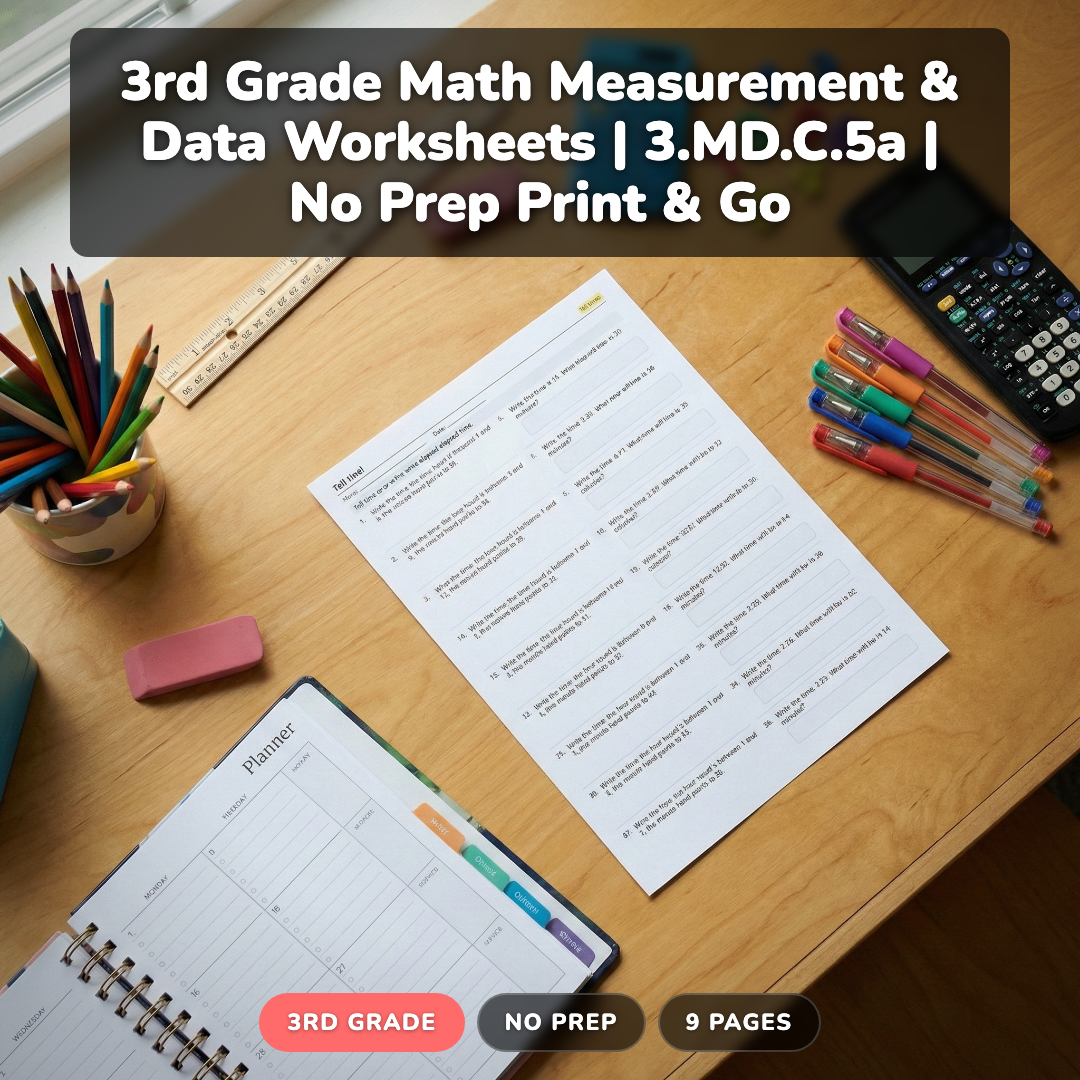
You can grab the complete differentiated area measurement pack with all 132 problems and answer keys right here:
Grab a Free Area Practice Sheet to Try
Want to see how these strategies work in practice? I’ll send you a free sample worksheet with 10 area problems at different difficulty levels, plus a quick teaching guide with the key vocabulary and common mistakes to watch for.
Frequently Asked Questions About Teaching Area in 3rd Grade
When should I introduce area measurement in 3rd grade?
Introduce area after students master linear measurement and have solid multiplication facts through 5×5. This typically occurs in February or March, allowing time for extensive practice before year-end assessments. Students need several weeks of hands-on exploration before moving to abstract problems.
Should 3rd graders learn the area formula length × width?
Not initially. CCSS.Math.Content.3.MD.C.5a focuses on understanding unit squares as the foundation for measuring area. Students should discover the multiplication connection through repeated counting experiences rather than memorizing a formula. The formal formula comes in 4th grade.
What’s the difference between area and perimeter for 3rd graders?
Use concrete analogies: area is like carpeting the inside of a room (how much space), while perimeter is like putting a fence around the outside (how far around). Have students physically trace the perimeter with their finger, then count squares inside for area to reinforce the distinction.
How do I help students who keep confusing area with perimeter?
Use different colored materials: blue unit squares for area (inside space) and red counting bears for perimeter (around the edge). Practice with the same rectangle using both measurements so students see the difference. Always use consistent language: “square units” for area, “linear units” for perimeter.
What manipulatives work best for teaching area concepts?
One-inch square tiles work perfectly because they’re easy to handle and align with standard grid paper. Color tiles, square pattern blocks, or even cut paper squares work well. Avoid using objects that don’t tessellate perfectly, like circular counters, as they create gaps and confuse the concept.
Teaching area measurement successfully in 3rd grade comes down to giving students plenty of hands-on experience with unit squares before expecting them to visualize or calculate abstractly. What’s your favorite strategy for helping students understand the difference between area and perimeter? Don’t forget to grab that free area practice sheet above — it’s a great way to see these strategies in action with your students.